
If your dog barks at other dogs on walks, change the encounters first: choose quieter routes, avoid close approaches and move away early. When another dog appears, turn or cross only when it’s safe, or use a nearby visual barrier while keeping control without jerking the lead or scolding.
For your next walk: - Choose a route with clear views and somewhere to turn back. - Move away when you spot another dog, rather than waiting for barking. - Check traffic and the space on the other side before crossing. - Use a fence, hedge or parked car to block the view if you can reach it safely and still have a way out. - If your dog remains fixed on the other dog and cannot move on with you, end the outing once you have a safe way to leave. Don’t drag them or force a close pass to get home.
If there has been a bite, your dog snaps at or bites you or another nearby animal, or you struggle to maintain control, arrange individual professional help promptly. The same applies if your dog shows serious fear, you cannot reliably keep distance, or people or animals are at risk. Reduce encounters and keep dogs safely separated while you get advice. New or worsening behaviour, possible pain or illness, and changes in movement also need veterinary assessment.
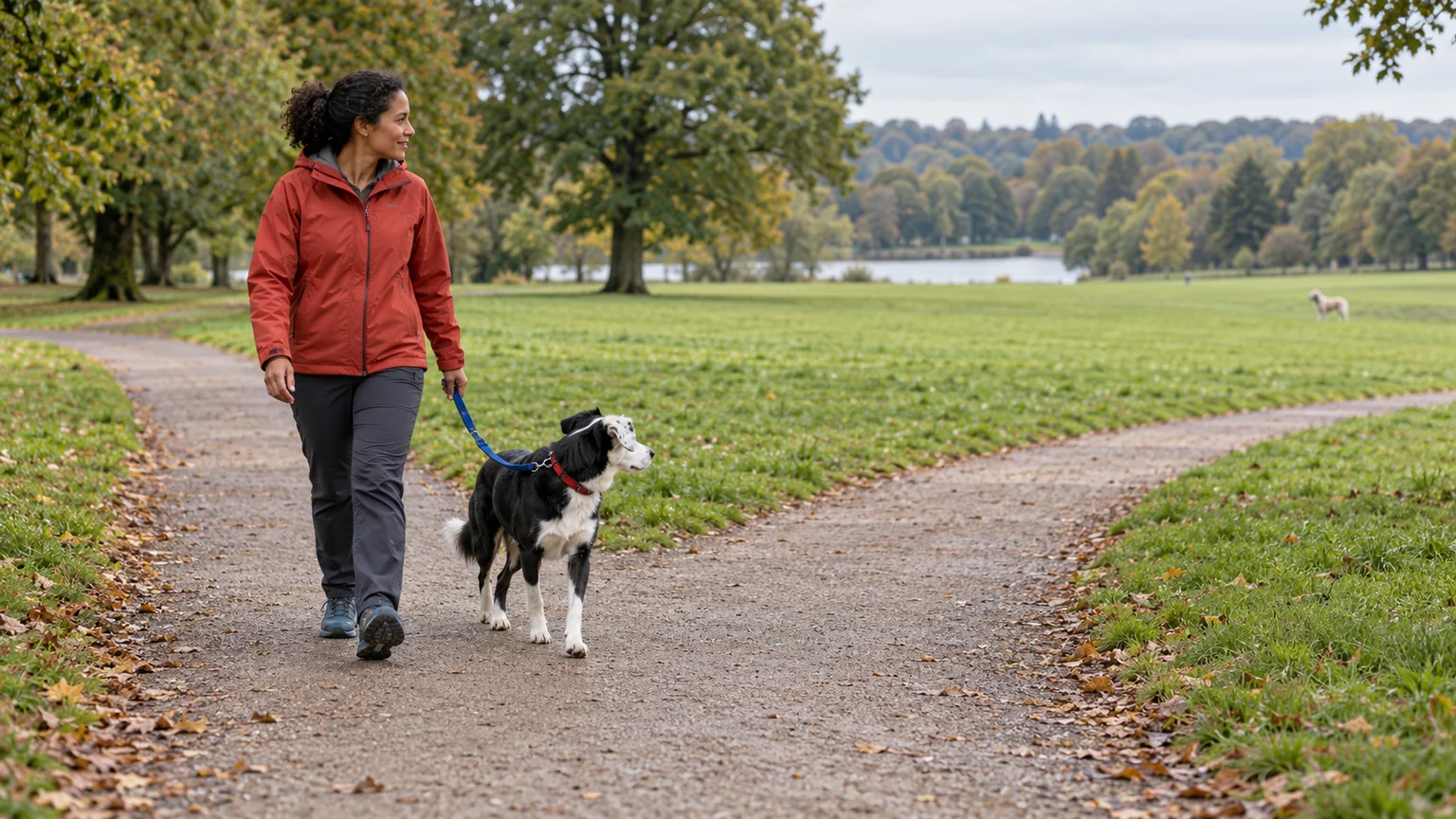
Change the walk before trying to change the barking
Your first job is to make the next outing more manageable. You don’t need to discover exactly why your dog reacts before choosing a less crowded route or turning away from an approaching dog.
That matters because an ordinary walk gives you limited control over what happens. Another owner may stop, a dog may appear around a corner, or a narrow pavement may leave you little room. Asking your dog to cope while those conditions stay unchanged can leave you dealing with the same difficult encounter again.
Dogs Trust’s guidance on reactive dogs separates managing the immediate situation from longer-term training and support. Its immediate advice includes avoiding difficult encounters, creating distance and using visual barriers.
For now, judge a route by how easily you can leave an encounter, not by how many dogs your dog might see. A shorter outing with room to turn away may be more useful than completing your usual circuit through a busy park.
If there is no barking because you avoided other dogs, record that accurately. It tells you the route reduced encounters, not that your dog is now comfortable around them.
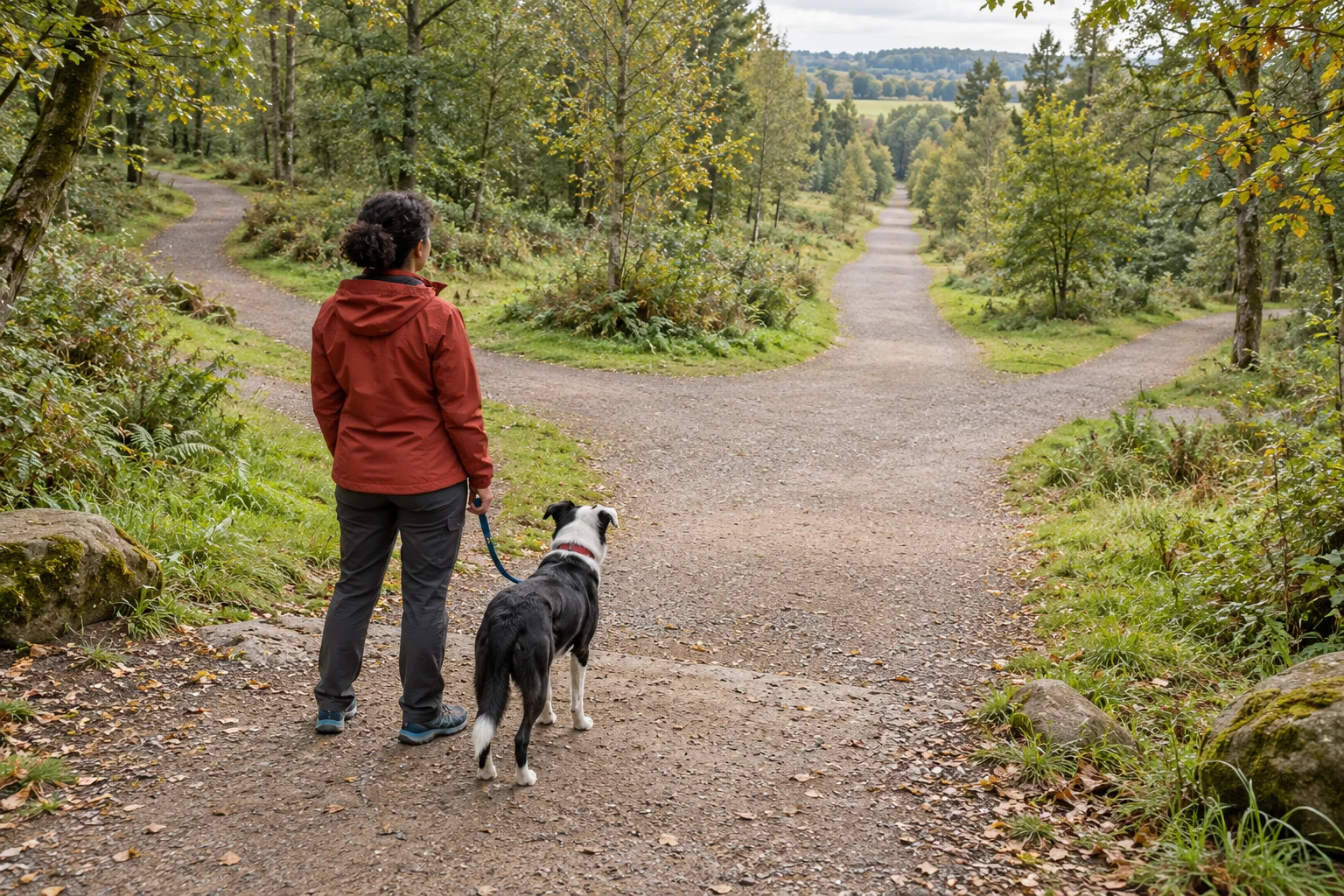
Choose a route with visibility and an exit
Look for somewhere you can see ahead and change direction without entering traffic or squeezing past another dog. A wide path with several exits may be easier to manage than a quiet but narrow path bordered by fences.
Before leaving, identify the parts of your usual route that make avoidance difficult. These might include a blind corner, a small park entrance, a narrow bridge or the pavement outside a popular dog-walking area.
You can check an unfamiliar route without your dog first. Notice where paths narrow, where dogs commonly enter and whether an apparent exit actually leads somewhere usable. There’s little value in planning to step aside into a space that turns out to be enclosed.
Quieter times can help, although they don’t guarantee an empty route. ASPCApro’s leash-reactivity guidance includes off-peak walks and quieter locations among its management options. Use those suggestions to reduce encounters, not to find a place for repeated exposure.
Choose a fallback as well as a main route. For example, if your usual wide path is busy when you arrive, you might use a quieter nearby street or return home rather than entering and hoping the crowd clears.
If every available route leaves you unable to keep distance, raise that when arranging professional support. Don’t keep attempting the same unsafe outing while waiting for help. Ask how to meet your dog’s everyday needs within the space and options you actually have.
Prepare so you can leave an encounter promptly
Use your usual walking equipment only if it fits correctly, is in good condition and lets you maintain control. Check the lead attachment before setting out. If your dog can slip out, or you cannot hold them reliably, get individual advice before attempting another walk around other dogs. A quieter route does not resolve that problem.
This article does not prescribe a particular harness, collar or specialist tool. Equipment choices need to account for the individual dog and handler. Having walking equipment on your dog does not make a close encounter appropriate.
Keep the lead held securely, without deliberately tightening it or using jerks to interrupt barking. Allow slack where you can while retaining control. If your dog lunges, keep them from reaching the other dog, but don’t add corrections or repeated pulling to make them look at you. If you cannot prevent contact reliably, you need individual help rather than more walking instructions.
Put your phone away while walking through areas where dogs may appear. Notes can wait until you are somewhere safe. You need to be able to check the route, watch your dog and notice traffic before deciding where to go.
Move away when you notice another dog
You can act before your dog reacts. When you see another dog ahead, look for the simplest safe way to increase distance: turn back, take another path or cross where traffic and the destination allow it.
Check that the new direction actually creates space. Crossing into the path of a different dog, or turning towards a dog behind you, can replace one difficult encounter with another. A brief look around helps you choose an exit rather than moving blindly.
Encourage your dog to come with you in an ordinary, calm voice. You don’t need to make them sit, hold eye contact or remain still while the other dog approaches. The useful response is that they move away with you.
For example, suppose a dog enters the path ahead while you still have an open junction behind you. Turn towards that junction and leave, rather than waiting beside the path to see whether your dog will bark. You are changing the route, not checking their tolerance.
Once you have moved away, continue towards quieter space. When your dog’s body loosens and they can move on with you, quiet praise is an option. Keep your attention on the route and lead rather than stopping to ask for more responses.
There is no universal distance to aim for. The other dog’s movement, the available space and your dog’s response all matter. Choose more room based on what you happen to see, without approaching to discover the point at which barking begins.
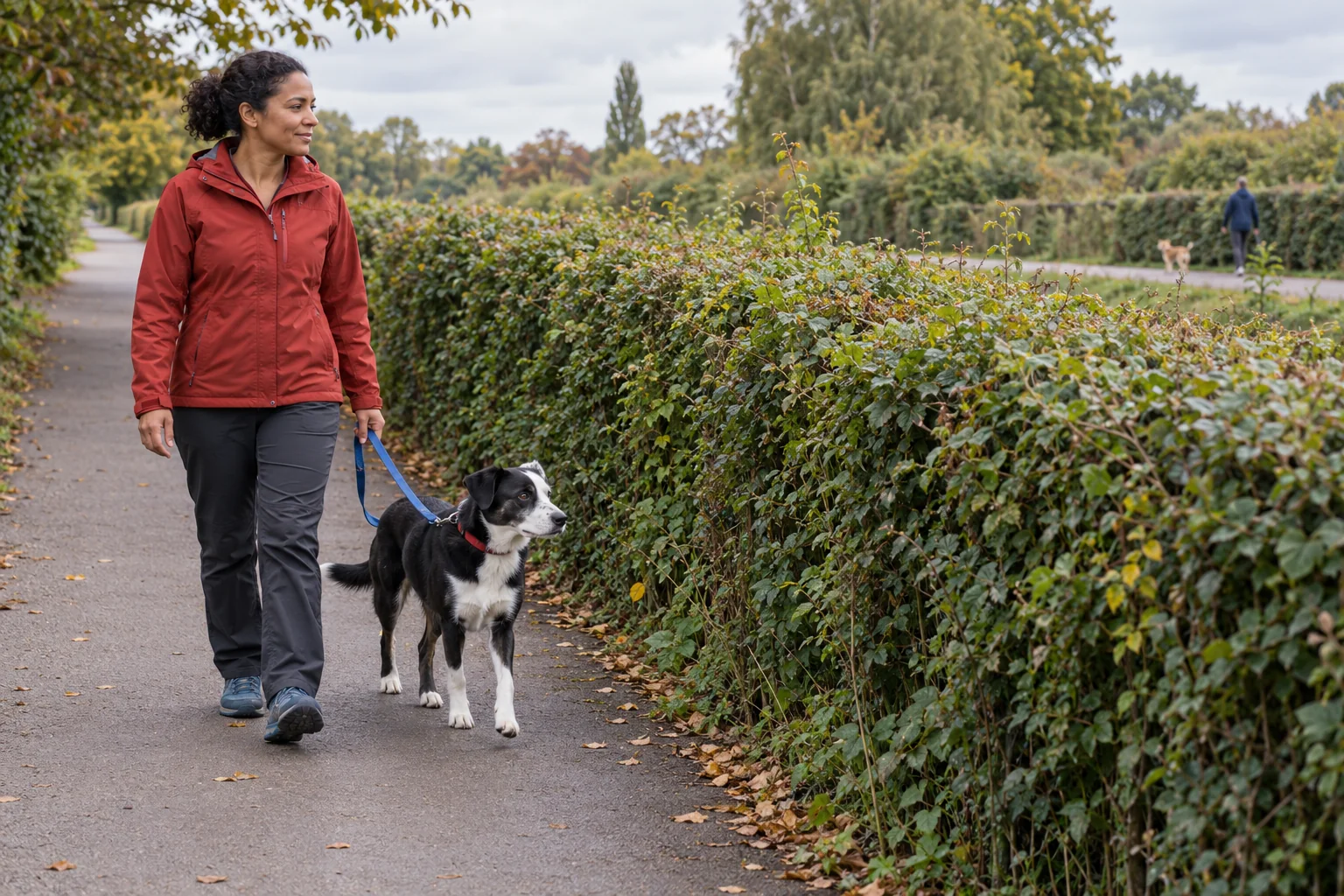
Use a visual barrier without trapping yourself
A visual barrier is something that blocks your dog’s view of the other dog. A fence, hedge or parked vehicle may help you interrupt the sightline while you move away.
Choose a barrier you can reach without passing close to the other dog. Check that there is space for you and your dog and a way to leave. Don’t enter a narrow gap between parked cars if it leaves you trapped or brings you into the road.
You do not need to hold your dog’s head or cover their face. Move together so the object is between the dogs. Keep watching the surroundings, because losing sight of the other dog does not mean they have left.
A parked car, for instance, might block the view from a broad pavement while you continue away along it. It is less useful if reaching its far side requires stepping into moving traffic.
If the barrier does not help, or the other dog continues approaching, use an available safe exit rather than waiting there for your dog to settle. Don’t stay behind it to practise sits or other responses while the encounter continues.
Have a simple plan for surprise encounters
Even a carefully chosen route can produce an unexpected meeting. If a dog appears around a corner, look for a safe direction away and move towards it without scolding or jerking the lead.
When the other owner can help, make the request short and clear: “Please give us space,” or “Please call your dog back.” You don’t need to explain your dog’s history while managing the encounter.
Keep your attention on controlling your own dog and finding an exit. Don’t attempt an introduction because the other owner says their dog is friendly. Their reassurance cannot tell you how your dog will respond.
If your dog is already barking, don’t wait for silence before leaving. Distance is still the priority. Encourage movement away rather than adding a string of commands that your dog is not responding to.
If your dog remains fixed on the other dog and will not move with you, don’t drag them or force your way past. Ask the other owner to move away or recall their dog where possible, and use a safe exit when one becomes available. End the outing by the safest available route rather than resuming the original circuit.
There may be no safe exit you can use immediately. A general article cannot supply a reliable emergency handling procedure for that situation. If you cannot maintain control or keep others safe, seek immediate assistance and arrange individual professional help promptly. Reduce further encounters while a plan is arranged. If an incident causes injury, obtain appropriate veterinary or medical attention.
What barking and lunging do, and don’t, tell you
“Reactive” describes a noticeable response, such as barking, lunging or pulling towards something. It isn’t a diagnosis, and the label alone doesn’t tell you whether a dog intends to approach, escape or cause harm.
Dogs may respond through worry, frustration, excitement, overwhelm, pain or a mixture of factors. Similar-looking behaviour can have different explanations. A dog pulling towards another dog is not automatically asking for a greeting.
The lead can also limit the dog’s options. They cannot freely increase distance or reach something they want to approach. That context may matter, but it still doesn’t allow you to identify the cause from one incident.
You don’t need to choose between calling your dog frightened or friendly before taking sensible precautions. Give them space, avoid introductions and gather straightforward observations for a professional.
Nor should you let your dog off the lead to find out whether they behave differently. That would remove your means of control and expose another dog to an uncertain encounter. Gather information from what happens naturally, without arranging a test.
Read the whole dog without assigning a cause
Dogs Trust describes changes you may notice before barking, including stiffening, staring, freezing, attempts to hide or move away, and difficulty responding to the person holding the lead. Our guide to reading your dog’s body language in context explains why one signal on its own cannot tell you how a dog feels.
These observations can help you act earlier. If your dog stops walking, becomes rigid and watches a dog ahead, you can choose an exit then. You don’t need to wait for a louder response to justify moving away.
Look at the overall pattern and context rather than treating one feature as an answer. Write “stood still and stared” instead of “wanted to attack”, or “moved behind me” instead of “was definitely frightened”.
Similarly, quiet does not necessarily mean relaxed. A dog that has stopped barking but remains stiff and fixed on the other dog may still need more space. Don’t use silence as permission to move closer.
If you happen to notice that your dog no longer takes food or responds as they normally would, increase distance rather than staying there to try something more tempting. Don’t offer food to test whether they can cope. Accepting it would not establish that a closer encounter is suitable.
You won’t see every early sign during a surprise meeting. If the first thing you notice is barking, deal with the situation in front of you. Detailed interpretation can wait until you are safely away.
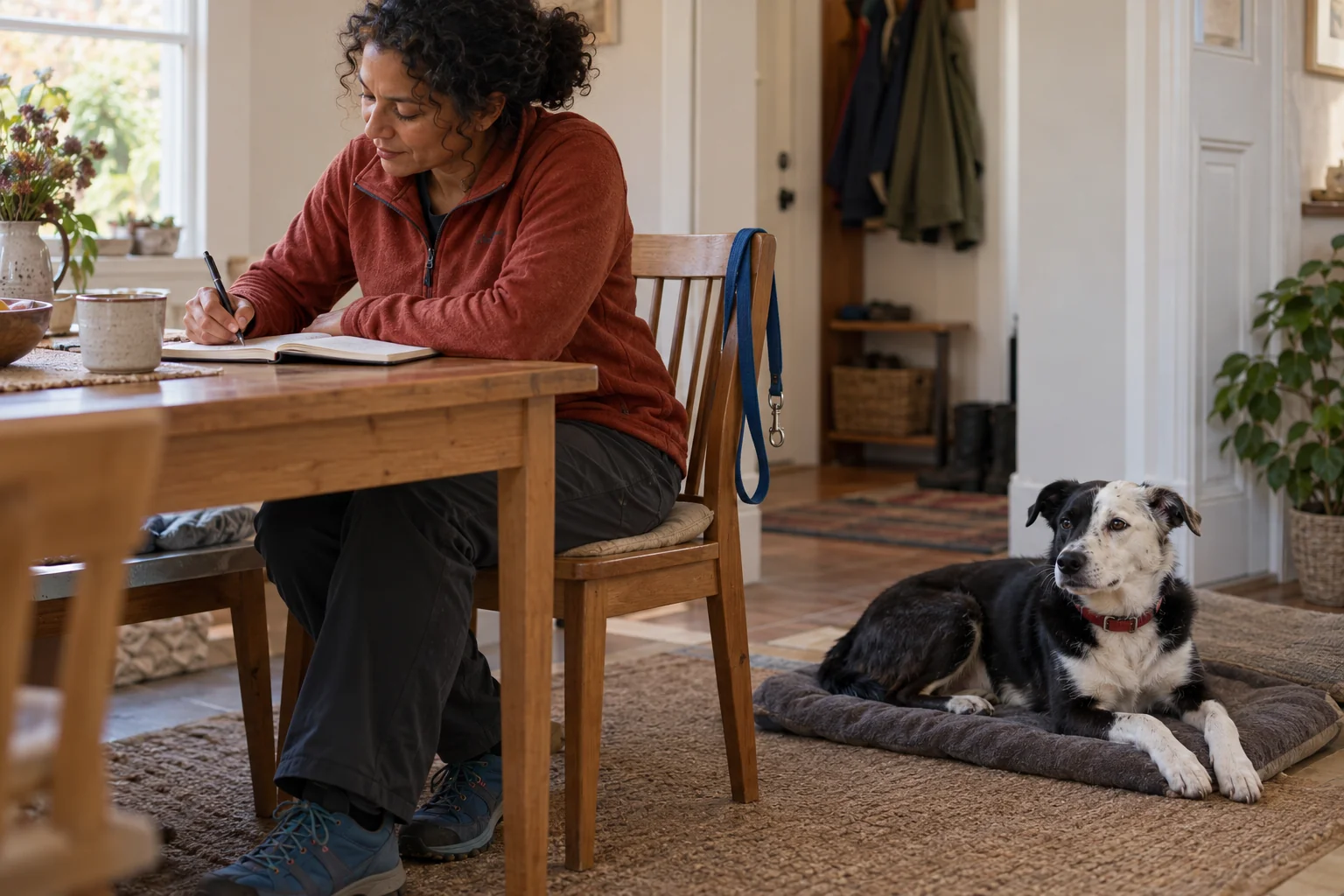
Keep a short record after naturally occurring walks
A brief record can help you identify practical route problems and give a vet or behaviour professional clearer information. Write it after the walk, or once you and your dog are safely out of the situation. Don’t film an encounter or stay near a dog to collect more detail.
Use a notebook or phone note with these five labels:
| Label | What to record |
|---|---|
| Place and context | Route, approximate time, path width and anything relevant about the surroundings. |
| Other dog | What you happened to notice, such as whether the dog approached or passed at a distance. |
| Your dog’s response | Visible actions before, during and after the encounter. |
| What you did | Turned away, crossed safely, used a barrier or ended the outing. |
| Afterwards and next action | What you observed once away, and a practical management change or question for a professional. |
Keep descriptions plain. “Barked and pulled when a dog came through the narrow gate” is more useful than “bad with dogs”. The first entry identifies both the event and a location you may be able to avoid.
Write “unknown” when you don’t know something. You might not have seen where the other dog came from, or you may be unable to estimate the distance. Don’t reconstruct missing details as facts.
If two people remember the encounter differently, record both accounts briefly rather than forcing agreement. “I noticed staring before barking; the other walker first noticed the barking” preserves the uncertainty.
Here is a hypothetical entry:
- Place and context: Evening walk, narrow path beside a hedge, junction behind us.
- Other dog: Appeared ahead and walked towards us; distance unknown.
- Your dog’s response: Stopped, stared, then barked and pulled.
- What you did: Turned back through the junction.
- Afterwards and next action: Continued watching behind, then resumed walking on the quieter street. Use that street next time; avoid the narrow path.
The next action follows from the route problem. It is not a plan to return and test a larger distance.
Recovery notes should describe what happened after leaving: continued scanning, resumed sniffing, walked more loosely or remained unsettled. Don’t assign a fixed recovery deadline. If you didn’t observe it clearly, say so.
Review the record for decisions you can actually make, such as avoiding a bottleneck or changing the walking time. If an entry leaves you without a workable alternative, put that in the final field too: “No quieter exit from home known; ask the professional about a safe toileting plan.”
Repeated loss of control, worsening responses or no workable route are reasons to request individual advice, not to devise your own treatment.
Your dog does not need to greet other dogs
You can decline greetings even when another owner expects them. Cornell’s guidance on managing reactive behaviour makes the point that a dog does not need to be friends with every dog they encounter.
A brief “We’re not greeting, thank you” is enough. You don’t need to settle the reason for your dog’s barking before keeping the dogs apart.
Don’t arrange a meeting to prove your dog is friendly, let them approach as a reward for quiet behaviour, or assume an introduction will resolve frustration. Those choices create a close encounter that this management guide does not assess.
The same applies after a quieter walk. You can keep the route and spacing that made the outing easier without adding a greeting or a narrower pass. Reduced barking is useful information, not clearance for contact.
If someone continues approaching, focus on leaving rather than persuading them to agree with your decision.
Get individual help when management is not enough
Book a veterinary assessment if the behaviour is new, suddenly different or intensifying, or if you notice possible pain, illness or changes in movement. Dogs Trust advises a vet check when behaviour changes or pain or illness may be involved. Slowing down, limping, reduced interest in walking and changes in eating or daily activity are relevant information to share.
A dog can have a health concern without an obvious injury. Explain the behaviour change when booking, and tell the practice if handling or encounters with other dogs may be difficult. Ask how they want you to manage arrival rather than improvising in a crowded waiting area.
Arrange appropriately qualified, reward-based behaviour support promptly after a bite, snapping or biting directed at you or another nearby animal, repeated loss of control, serious fear, or situations where you cannot reliably keep distance. Seek help whenever people or animals are at risk; you don’t need to exhaust general advice first.
While waiting, reduce encounters and maintain safe separation. Where necessary, discuss how to meet toileting, exercise and everyday needs without repeating unsafe walks. A professional can help address constraints that a general route suggestion cannot solve.
Changing the route can make today’s walk more manageable, but it does not assess or treat the reason for the barking. An individual behaviour plan starts with the dog’s health, behaviour and circumstances, then determines what longer-term work is appropriate.
The AVSAB humane-training position statement supports reward-based methods and management that avoids difficult situations while protecting everyone involved. Seek help consistent with that approach, without punishment, intimidation or lead corrections.
A self-study course or general video is not an individual assessment. Qualified remote consultation may be appropriate, but the professional should decide whether any part requires in-person support. Tell them about bites, near misses, health changes and control difficulties at the outset.
Bring your short walk record and explain the practical restriction you need help with, such as having only a narrow exit from home. Ask for a management plan you can use while assessment and any longer-term work are arranged. Our guide to when to seek professional behaviour help for your dog can help you prepare for that conversation.