
Make rewards worth working for
A reward only works if the dog wants it in that moment. Food is convenient, but play, access to a sniff, movement and attention can all reinforce behaviour. Match the reward to the difficulty. A quiet kitchen and a busy pavement are not the same lesson.
Deliver the reward soon after the behaviour. If several seconds pass, the dog may connect it with something else. A short marker word such as "yes" can identify the exact moment, provided it is followed by something the dog values.
If the dog repeatedly turns away from the reward, lower the difficulty or change the reward. Do not assume stubbornness.
Teach one cue at a time
Show the behaviour first, then add the cue once the dog is beginning to predict the action. Repeating a cue while nothing happens teaches the dog that the first few repetitions do not matter.
Choose words that sound different from one another. Ask once, pause, and help the dog succeed by making the situation easier. Everyone in the household should use the same cue and the same meaning.
Keep practice short and useful
Several focused minutes can be more productive than a long session. Stop while the dog is still engaged. Everyday life offers useful repetitions too: waiting before a door opens, checking in on a walk, settling while dinner is prepared and returning when called indoors.
- Work on one skill in one environment.
- Aim for a high rate of easy successes before adding difficulty.
- Change distance, duration or distraction separately.
- Finish with a response the dog can do comfortably.
Everyday skills
Loose-lead walking
Practise in lower-distraction places, reward a loose lead frequently and use equipment that allows comfortable control without pain.
Recall
Use a long line where safe, reward generously and avoid calling when success is unlikely. Build difficulty gradually.
Use management while your dog is learning
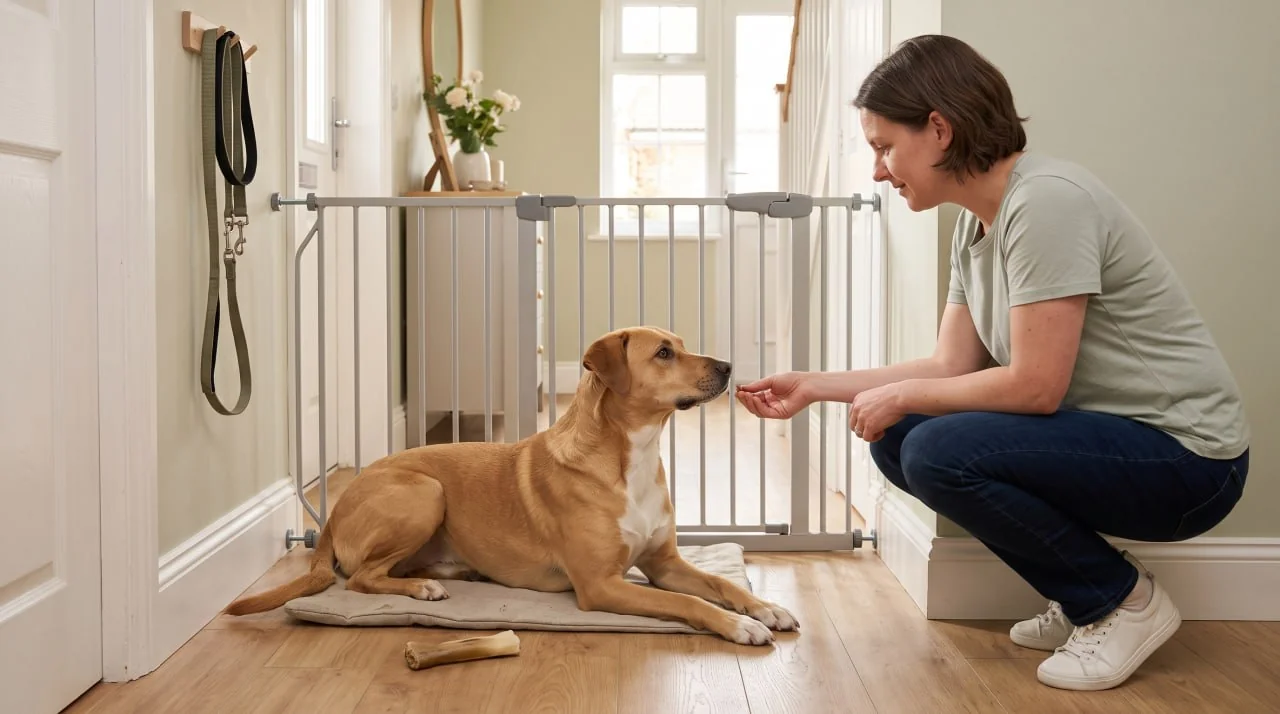
Training does not have to carry the whole load. Leads, gates, distance, covered windows, prepared chews and planned walking routes can prevent unwanted rehearsal. Management is not failure. It creates room to teach.
If a dog practises rushing the front door every day, a weekly training session has poor odds. Prevent the rush first, then practise a simpler door routine.
Track what changes
Write down the setting, the behaviour and what happened just before it. A basic record makes small improvement visible and helps expose patterns. Measure something concrete, such as successful recalls out of ten or how long the dog can settle at a chosen distance.