
A mat settle gives your adult dog a clear answer to a useful question: where can I relax while life carries on around me? The finished behaviour can help at home while you cook, at a friend's house or beside your chair in a quiet café. It should feel like a safe, rewarding option, not a place where your dog is pinned by a command.
The exercise has two parts. Your dog first learns to find and stay on a particular surface. Then they learn that softer, calmer choices there pay well. Keeping them separate helps you avoid mistaking a tense down for genuine settling.
You can teach both with food, careful observation and short practice. Start in an easy room, reward voluntary choices, introduce a release, then alter duration, distance and surroundings one at a time. Your dog is free to get up while learning. If they do, that is information about the task, not disobedience to correct.
Use the mat as a portable cue, not just a place to lie down
A down tells your dog what to do with their body. A mat adds information about where to do it and about the sort of activity that tends to happen there. With repetition, the feel, shape and sight of that familiar surface can predict quiet rewards and low-pressure time.
The mat becomes a portable environmental cue. It will not make every new place relaxing on its own. It gives your dog one recognisable part of the setup when the room, sounds or people change. RSPCA Victoria's mat-training guidance likewise describes the mat as an easily recognised area that can travel with the dog.
Choose something large enough for your dog to lie on comfortably. It should stay flat and resist sliding when they walk onto it. A washable bath mat, small rug or folded blanket can work. Avoid a surface that crackles, slips or forces a large dog to curl tightly just to remain within its edges.
The mat does not replace a comfortable everyday bed, and this guide is not about puppy sleep or first nights. It teaches a deliberate adult-dog skill that you can bring out, use for a manageable period and finish with a release. When training is over, your dog can choose another resting place.
Decide how you will mark useful choices before you begin. A short word such as “yes” can pinpoint mat contact. If markers are new to you, the guide to reward markers and timing explains how to pair one with a reward. You can also deliver food quietly without marking once you begin rewarding sustained relaxation, because calm is an ongoing state rather than a split-second action.
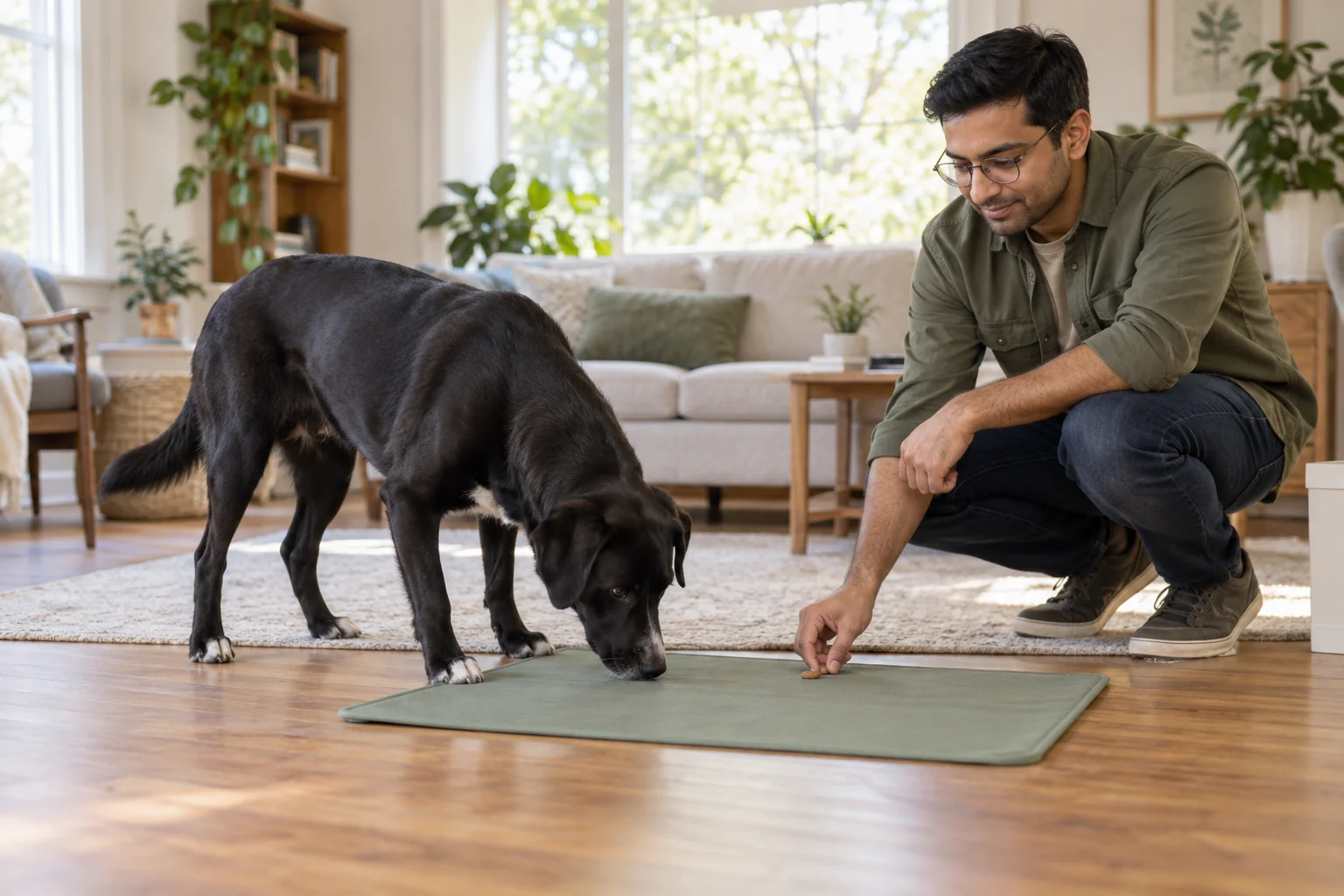
Start where your dog can investigate the mat
Begin in a familiar, quiet room when your dog's immediate needs have been met. Put the mat down with space around it, have several small food rewards ready, and stay close enough to deliver them without looming. Do not start beside the front door, during dinner or as visitors arrive. Those are eventual uses, not fair teaching conditions.
Place the mat on the floor and wait. Your first useful choice might be a glance towards it, a sniff, one paw touching it or a small movement in its direction. Mark that choice and place or toss the reward onto the mat. Delivering the food there helps make the surface relevant rather than drawing your dog back to your hand.
After they eat, allow them to move away if they wish. A tossed reset treat a short distance from the mat can create another natural approach, but it is optional. The important part is that your dog repeatedly chooses to orient towards the mat and discovers that doing so makes rewards appear there.
Battersea's settling guide describes a similar progression from investigating the surface to two paws and then four. Treat that as a flexible path. A cautious dog may need several rewards for looking and sniffing, while a confident dog may walk straight on.
Resist lifting, pushing or manoeuvring your dog onto the mat. Avoid holding a lead tight enough that the only available place is the mat. Physical placement may produce feet on fabric, but it removes the voluntary orientation you actually want to strengthen. If your dog avoids the surface, check whether it moves, smells unfamiliar or feels unpleasant, then try a more stable material.
Keep this first practice brief. Stop while your dog is still willing, pick the mat up and return later. The article on organising short dog training sessions can help if you tend to continue until either of you becomes frustrated.
Build a willing arrival before asking for a down
Once your dog approaches readily, raise the criterion in small pieces. Reward one paw, then two, then all four paws. Place each reward well inside the mat so your delivery supports the location you mean. If your dog stretches from the floor to reach food, wait for or prompt an easier approach rather than feeding at the edge repeatedly.
A food lure can help a dog understand the route, but it should not become the permanent signal. Move a treat slowly over the mat once, reward there, then try the same hand movement without visible food. Better still, return to waiting for a glance or paw movement whenever your dog is comfortable offering behaviour. The aim is a dog who notices the mat and chooses it, not one who can only follow food onto it.
Do not add the verbal cue yet. A cue is most useful when it predicts a behaviour your dog can already perform. Saying “mat” again and again while they wander teaches that the word is background noise. First build a reliable pattern: mat appears, your dog moves onto it, and good things happen on its surface.
When all four paws arrive easily, reward more than once before resetting. That makes remaining there worthwhile. Feed low and towards the middle rather than drawing your dog off the front edge. Then give them permission to leave or toss a reset reward away, ready for another voluntary arrival.
At this stage, standing calmly is a valid success. Do not rush to push the shoulders or lure the nose sharply down. Arrival is one skill and posture is another. Keeping the first criterion clear reduces guessing and gives you a clean foundation for everything that follows.
Teach the release before adding duration
A clear release tells your dog when the mat behaviour has finished. Without one, the dog has to guess whether taking a reward ended the exercise, whether your movement means they should follow, or whether they are expected to remain indefinitely. That uncertainty often creates popping up, repeated cueing and frustration on both sides.
Choose a short release such as “free” or “finished”. While your dog is on the mat, say it once, then invite movement away by tossing a reward off the mat or moving with them. The release is not a reward for breaking position. It is information that leaving is now available, followed by something pleasant.
Practise the release before asking for any meaningful wait. Your early rhythm might be: dog walks onto the mat, you reward twice on the surface, you say the release, then the dog moves off. Vary the number of on-mat rewards slightly so a particular count does not become the accidental release signal.
RSPCA Victoria emphasises letting the dog know when moving off is allowed. That clarity also protects the mat from becoming forced restraint. You are teaching a bounded behaviour with a reliable end, not demanding that your dog stay there until they finally give up trying to move.
If your dog leaves before the release, say nothing harsh and do not block them in. Reset the exercise and make the next repetition easier. Perhaps you waited too long, moved too far or stopped rewarding too abruptly. Early departures show where the current skill ends.
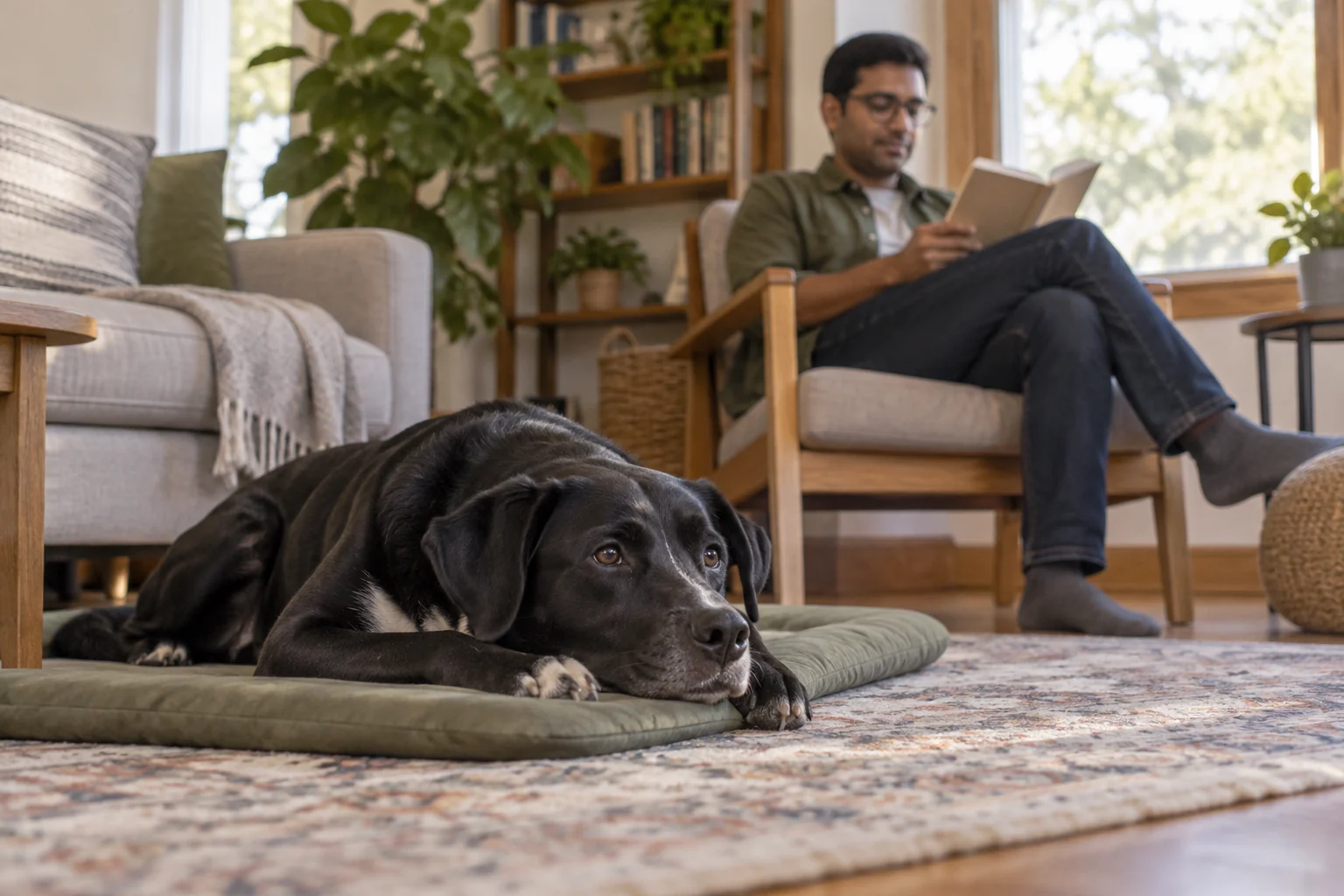
Treat arrival and relaxation as separate skills
A dog can run to a mat, drop into a down and remain highly alert. They may stare at your treat hand, hold their muscles tight and spring up after every reward. That is successful location training, but it is not yet settling. Calling it calm too early makes troubleshooting much harder.
First establish a comfortable posture. If your dog already knows a down cue and can respond happily on the mat, ask once and reward. If not, capture a sit or down that occurs naturally, or use a gentle lure without pressing on their body. Feed between the front paws so the reward arrives where a resting head will eventually be.
Then look beyond the outline of the down. Dogs Trust's settle guidance suggests progressively rewarding signs such as a weight shift, sigh or head resting. Other useful observations can include a hip rolling to one side, the neck lowering or attention disengaging from your hands. Read the whole dog and context rather than treating one signal as proof of an emotion.
Reward the first tiny softening you see. Place the food quietly between the paws, then become still again. Loud praise, rapid clicking or food delivered from above may bring your dog back into active training mode. Your delivery should support the state you want without requiring perfect stillness.
Arrival and relaxation happen on different timescales. You can mark a paw touching the mat precisely. Genuine settling may emerge gradually, so quiet reinforcement often works better than turning every breath into an event. A dog who remains standing but softens may be closer to calm than a dog who snaps into a rigid down.
Reward calmer choices without demanding stillness
Begin with what your dog can offer today. For an alert dog, that may be pausing, sniffing the mat or looking away from you. Once those choices happen easily, reserve more of the rewards for sitting, lying down and visible softening. You are reinforcing progress rather than withholding food until the dog somehow guesses the final picture.
Dogs Trust advises starting with any behaviour that is less focused on pulling, barking or staring, then becoming more selective as the dog learns. That approach matters because “relax” is too broad to impose all at once. You shape observable choices that are compatible with relaxing and allow the internal state to follow at the dog's pace.
Use food your dog values but can eat without becoming frantic. Tiny pieces are convenient because you can reinforce several good choices without turning practice into a meal. Blue Cross's reward-based training guidance notes that rewarded actions are more likely to recur and that the reward should closely follow the action. It also recommends positive methods rather than training that makes a dog stressed, worried, uncomfortable or scared.
Watch what each delivery does. If your dog becomes more upright, paws at you or scans for the next treat, slow your hands and lower the food placement. You can wait for the body to soften again before the next reward, but do not create such a long gap that your dog repeatedly fails. Calm delivery is part of the exercise.
Chews or food-filled toys can make time on the mat pleasant, provided they are safe and appropriate for your dog. They are useful support, not evidence that your dog has learned to settle without them. Alternate supported periods with very short moments in which you quietly reward calm choices, so the mat does not only mean “consume this item”.
Increase duration one difficulty at a time
Duration begins with the tiny gap between arriving and receiving a reward. Add time so gradually that your dog can continue succeeding. A few easy rewards close together may be followed by one slightly longer pause, then another easy reward. Avoid increasing every interval in a straight line, which can make the task relentlessly harder.
Treat duration, your distance from the mat and environmental distraction as three separate dials. Turn only one dial at a time. If you wait longer while walking away as someone enters the room, you will not know which change caused your dog to get up. Clear practice gives you useful feedback.
Dogs Trust recommends increasing settled time by small amounts across multiple sessions. The exact amount should be governed by your dog's response, not a universal schedule. If they repeatedly rise, stare at the food or vocalise, shorten the gap. Successful duration should look sustainable, not like your dog is holding on until payment arrives.
Build your own movement separately. Start with a small weight shift while you remain beside the mat, then a half-turn, one pace away and an immediate return to reward. Move naturally rather than creeping in a way that makes your motion unusually significant. If one pace is easy and two cause a departure, practise around the easier distance before trying again.
Do not disappear from view just because your dog can manage you walking across the room. Losing sight of you is a distinct change and is not necessary for many everyday uses. Mat settling is also not a treatment for separation distress. If being apart causes panic or persistent fear, get qualified help rather than extending absence through this exercise.
End with the release while your dog is still comfortable. Regular, predictable endings build trust in the behaviour. They also stop you from always discovering the dog's limit by waiting for failure.
Add the cue once the behaviour is clear
When placing the mat down reliably prompts your dog to go onto it, add your chosen cue. Say “mat” once just before they begin the familiar movement. Then reward arrival as usual. Over repetitions, the word gains meaning because it consistently predicts a behaviour the dog already understands.
After that association is established, occasionally say the cue while the mat is already down and you are nearby. Give your dog time to respond. If nothing happens, do not repeat the word rapidly. Move closer, reduce the angle or briefly return to rewarding voluntary orientation. A cue is information, not pressure.
Keep the cue for going to the mat distinct from the release. You do not need to chant “settle” throughout duration. Quiet rewards and the mat itself can maintain the behaviour until you release. Repeated commands may keep your dog watching you for the next instruction instead of disengaging.
Decide what the arrival cue actually requires. A practical definition might be “go fully onto this mat and remain there until released”, with relaxation built and rewarded after arrival. It need not promise an instant down or sleep. Clear criteria help everyone in the household respond consistently, a subject covered in keeping family training rules consistent.
Move the mat without assuming the skill is finished
A dog who settles in your sitting room has learned in that setting. The portable mat helps bridge locations, but it does not erase the effect of new smells, surfaces, people and sounds. Treat each move as a partial reset rather than proof that your dog has forgotten.
Start with a tiny location change inside the same room. Move the mat a metre, rotate it or place it on a different patch of floor. Reward easy orientation and arrival again. Then try another quiet room, followed by the garden or hallway if those places are comfortable. Keep duration short whenever the location becomes harder.
Next, carry the same mat to a calm familiar place outside your home. Let your dog investigate the environment first if needed. Put the mat where they have space and are not trapped between furniture, people or other dogs. Reward an easier version of the behaviour, perhaps merely standing with four paws on it, before asking for deeper relaxation.
Only later should you practise near modest activity. Increase distance from passing people, dogs or household movement until your dog can eat, orient and soften. If they cannot, the environment is currently too difficult. Moving farther away is good training, not surrender.
Keep the mat itself consistent during early generalisation. Once your dog understands the behaviour in several places, you can carefully introduce another similar surface if portability requires it. Changing the mat and the location together removes both familiar anchors at once.
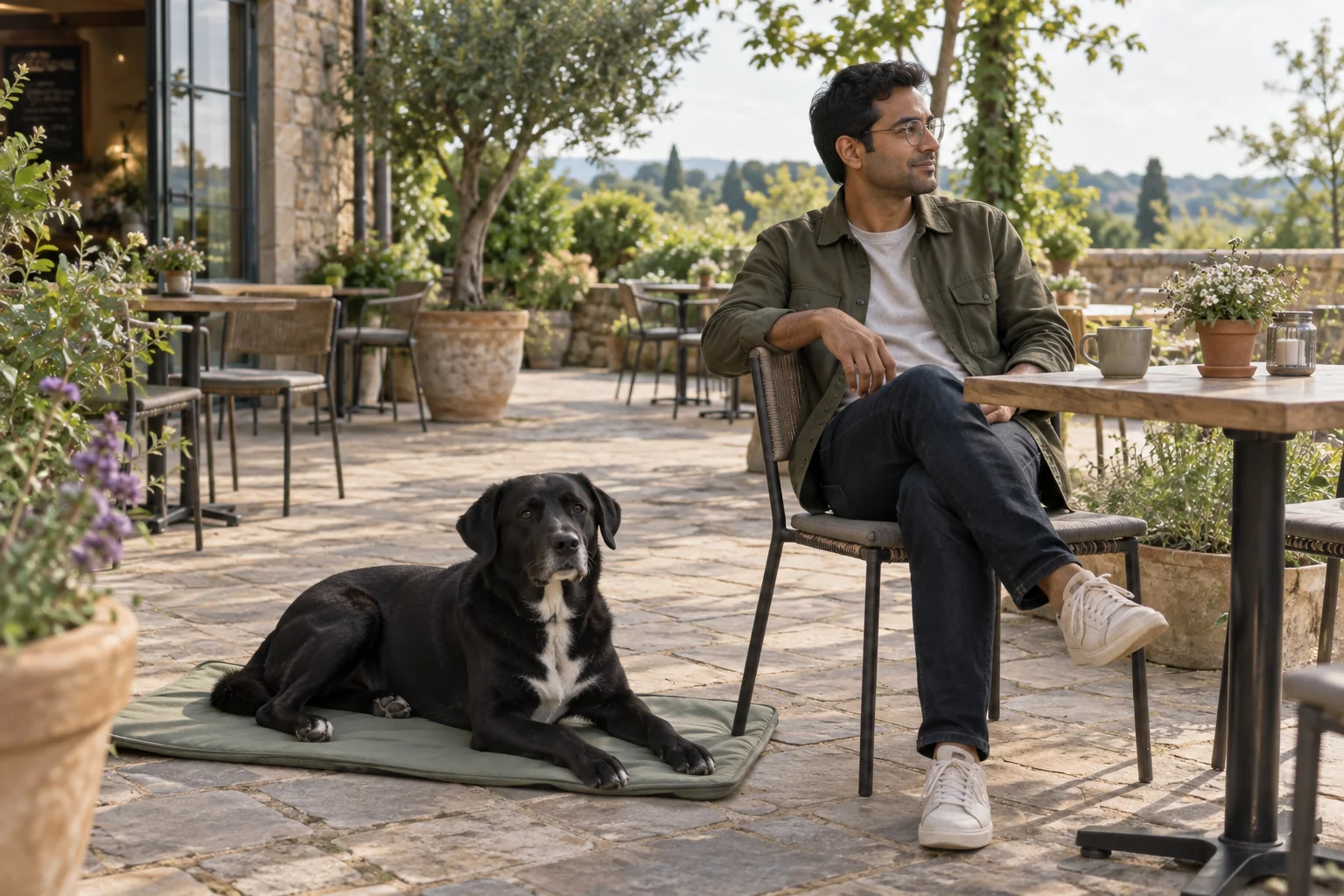
Use the mat in real life without using it as restraint
Real-life use should resemble the training your dog understands. Put the mat down before the activity becomes intense, cue or allow arrival, reward generously at first and release before your dog is exhausted by the effort. A quiet meal or one calm visitor is a better first application than a crowded gathering.
The mat must not be used to park a dog beside something they fear. Food can keep a worried dog physically present while their body remains tense, and that is not relaxation. Increase distance, provide an exit and use management instead. Forcing proximity in the name of settling risks teaching that the mat predicts being trapped.
Do not tether your dog to the mat to prevent leaving. A lead may be used safely in some controlled training setups, but it should not pull the dog into position or remove their choice to move away. Gates, another room or separation from visitors may be more appropriate management when you cannot actively train.
Respect resting dogs. Household members should not repeatedly approach, touch or call a dog away from the mat. At the same time, never present the mat as a guarantee that a dog will tolerate disturbance. Supervise interactions and give your dog genuine quiet space when that is what they need.
A mat settle is one useful alternative behaviour, not a solution to every reason for pacing, barking or following. Exercise needs, toileting, temperature, hunger, discomfort and the environment still matter. Meet the need rather than asking the mat to suppress its expression.
Find the part that became too hard
If your dog will not approach, inspect the surface first. Put it on a non-slip floor, open it fully and try a familiar blanket if the material is novel. Reward looking from a comfortable distance. Never surround the dog with the mat or place them on it bodily.
If your dog arrives but leaves immediately, pay more often on the mat and teach the release after a very short stay. Check your reward placement. Food delivered from your hand away from the surface can accidentally reinforce stepping off.
If your dog lies down but remains tense, stop extending duration. Lower environmental difficulty, reduce your own movement and reward softer choices rather than the outline of the down alone. Your dog may need an easier room or a break, not firmer instructions.
If your dog only works when they see food, hide the reward before giving the cue and pay from a pocket or nearby container after success. Return to one easy voluntary choice if needed. Do not pretend to have no food and then fail to reward. The goal is to remove the visible lure, not the consequence.
If progress collapses in a new place, restore easier criteria. Reward orientation and arrival, shorten duration and reduce distraction distance. Change only one dial on the next attempt. A simple note of location, distraction and the calmest behaviour offered can reveal progress that is hard to notice day by day.
If barking, pawing or intense staring grows during a session, the reinforcement pattern may be producing more arousal. Pause, scatter a few rewards away from the mat to finish neutrally, and review whether the gaps became unpredictable or too long. Resume later with lower energy and clearer, easier criteria.
Know when settling needs professional help
Training should produce a gradual pattern of easier orientation, more comfortable posture or longer relaxed periods. It should not require you to override fear, pain or distress. An adult dog who suddenly cannot lie comfortably, repeatedly changes position, seems stiff, cries out or loses a previously easy ability to rest needs veterinary advice. A behaviour change can be the first visible sign that something hurts.
Seek veterinary guidance too when restlessness is sudden, persistent or accompanied by other changes in appetite, movement, sleep, toileting or general behaviour. Do not assume that more exercise or stricter mat practice will solve it. Training cannot make an uncomfortable body comfortable.
Fear also changes the plan. If your dog pants, trembles, freezes, tries to escape, refuses valued food or cannot recover around a person, dog, place or sound, stop using the mat near that trigger. Give them distance and choice. A qualified reward-based professional can help you assess the context without provoking the behaviour; the guide to when professional behaviour help is needed explains that decision.
Aggression, a bite history, panic when left or persistent distress is outside a general mat-training exercise. Begin with your vet where health may contribute, then use an appropriately qualified behaviourist or trainer working without aversives. The safe goal is not to make the dog stay on a rectangle despite how they feel.
Keep the next session small. Put a stable mat in a quiet room, reward your dog for choosing to orient towards it, and finish with a release after an easy success. Build arrival first, notice relaxation separately, and let the familiar surface become portable only as your dog's comfort travels with it.