
The doorbell rings and your dog explodes into barking, racing to the door before you've even stood up. Deliveries, friends and neighbors all get the same noisy welcome. You can't hear yourself think, let alone talk to whoever's on the doorstep.
Barking at the doorbell is a very understandable habit. The bell predicts that someone is about to arrive, and from your dog's point of view, barking often seems to work: the visitor goes away, or the door opens and something exciting happens. The most effective approach is usually to teach your dog what to do instead when the bell rings, practice it with pretend rings first, and manage real visits while they learn.
Start here before the next delivery
For the next delivery, secure your dog away from the front door before you open it. Use a suitable closed room or secure gate, and keep children away from the doorway. Where possible, ask visitors to text instead of ringing. Set that up before you expect someone, so you can answer the door without trying to teach a new skill at the same time.
For practice, start in a quiet room with a mat and small food rewards. Teach your dog to go onto the mat and stay briefly. Once that is familiar, play a very quiet recording of your doorbell, cue the mat and reward your dog there. Keep real arrivals separate from these easy practice sessions until your dog is ready.
If your dog is frightened of visitors, growls, snaps or lunges, use separation and get qualified, reward-based help. Keep them away from visitors rather than testing the routine at the door.
Why dogs bark at the doorbell
Dogs learn quickly that a sound predicts something important. A doorbell or a knock almost always means a person is about to appear, so it soon sets off a strong reaction.
PDSA vets point out that dogs often see the front door as part of their territory, and that barking can seem to work from the dog's point of view. If a delivery driver leaves after your dog barks, your dog may believe they chased the visitor away (PDSA: Barking mad at the post?).
Other things can add to it:
- Excitement. Some dogs love visitors and bark because they can't wait to say hello.
- Worry. Some dogs feel unsure about strangers, and barking is a way to keep them at a distance.
- Habit. The more often your dog has barked at the door, the more automatic it becomes.
- Your reaction. If you rush to the door, shout over the barking or get flustered, your dog may join in all the more.
- Sounds from TV and phones. Many dogs react to doorbell sounds on television, in commercials or in phone notifications, which gives them extra practice.
Is your dog excited, worried or on alert?
The right plan depends on how your dog feels when the bell rings. It helps to watch closely for a few days.
An excited dog may bounce, spin, wag with a loose body and whine or yip between barks. They often want to jump up at the visitor.
A worried dog may bark with a stiff or low body, hackles raised, ears back or a tucked tail. They may back away from the door between barks or hide behind you.
A dog on alert may give a few deep barks, stand still and stare at the door, then settle once they see who it is.
Many dogs show a mix. Our guide on how to stop your dog barking at the window explains how to look at what starts barking and what keeps it going, and the same ideas apply at the door.
If your dog seems worried, growls, snaps or lunges at visitors, it's safer to focus on management and get help from a qualified professional, rather than trying to train it alone. There's more on this later.
Teach your dog to go to a mat
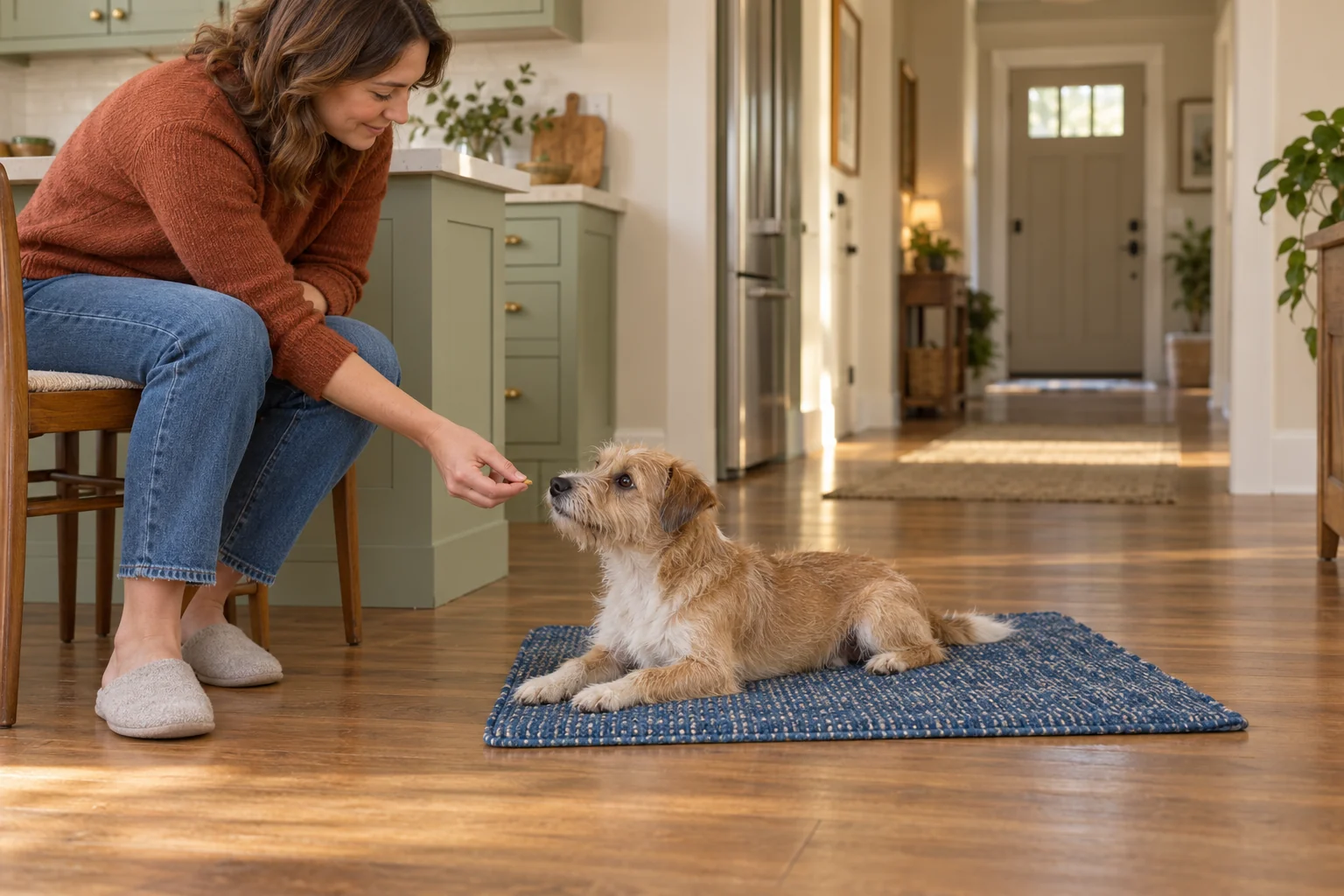
PDSA suggests teaching your dog to go to their bed or mat when the doorbell rings. Choose a comfortable spot away from the entrance so you can reward your dog there while someone answers the door.
Keep the mat routine as your main training plan. Everyone in the household should use the same mat cue and reward your dog in the same place.
Our guide on how to teach your dog to settle on a mat explains how to build a mat behavior. In brief:
- Choose a spot away from the front door, ideally where your dog can't see it, such as a corner of the living room or kitchen.
- Teach your dog to go to the mat in quiet moments, by tossing a treat onto it and rewarding them for stepping on.
- Add a cue, such as "mat" or "bed", once they're going there reliably.
- Build duration, rewarding your dog for staying on the mat for a few seconds, then longer.
Practice this until your dog will go to the mat happily, from different parts of the room, before adding the doorbell.
Practice with a quiet doorbell recording
Once your dog loves their mat, you can link the doorbell sound to it.
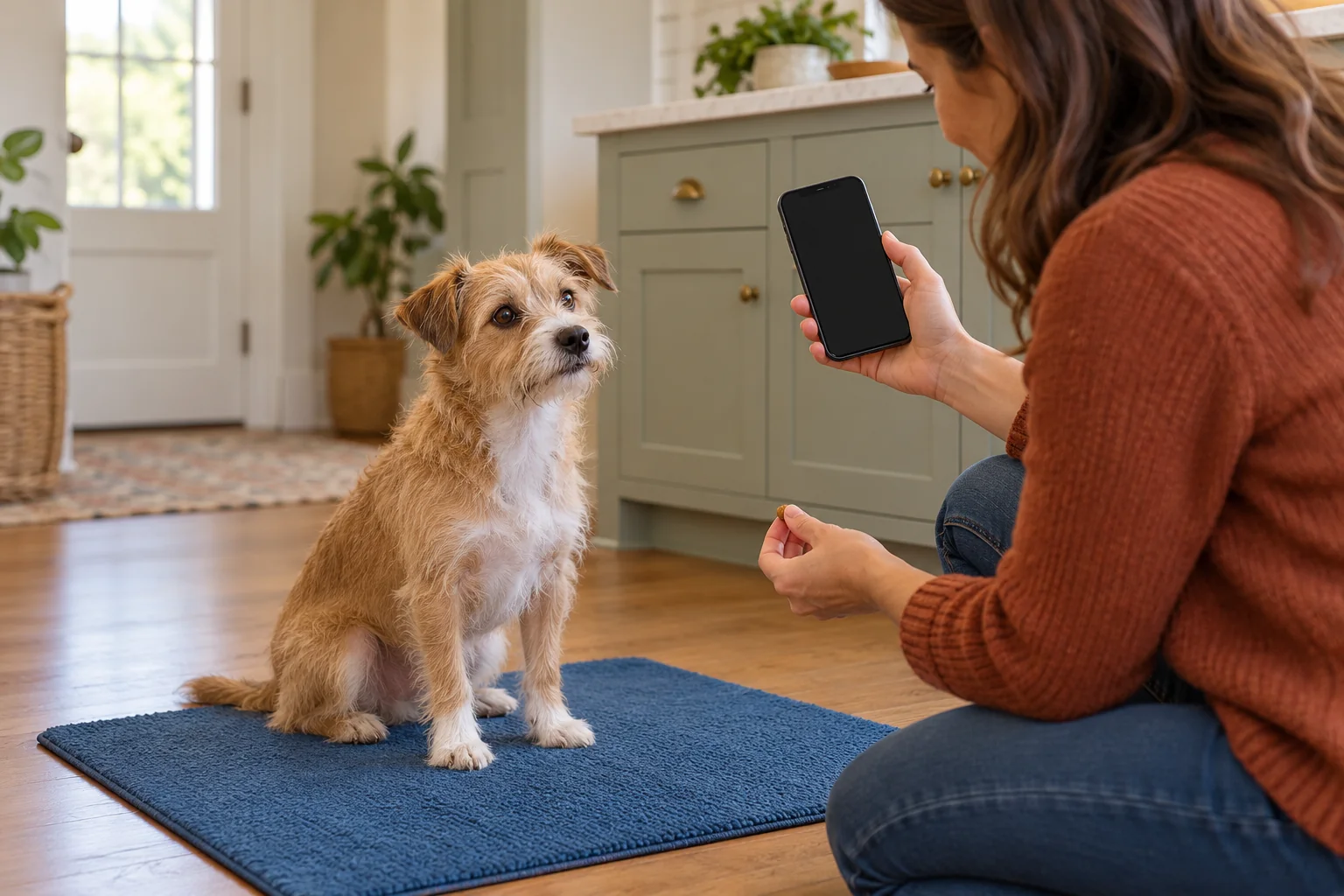
Start with a recorded doorbell. PDSA recommends practicing with recorded doorbell sounds or knocks before moving on to real visitors. You can record your own bell on your phone, or find a doorbell sound online. Play it very quietly at first.
- Play the sound at a low volume.
- Immediately say your mat cue and toss a treat onto the mat.
- When your dog is on the mat, reward them several times.
- Repeat a few times per session, with breaks in between.
Over several sessions, your dog may start to head to the mat as soon as they hear the bell. When that happens, you can stop saying the cue and let the bell itself become the signal.
Raise the volume slowly. Increase the volume gradually over days or weeks. If your dog starts barking, the sound is too loud for now. Turn it down and make it easier.
Then try the real bell. Ask a family member to ring the real doorbell while you stay with your dog. Keep the mat and treats ready. At first, nobody comes in. The bell simply means "go to your mat for treats".
Then add someone at the door. Once your dog goes to their mat reliably for the real bell, have a family member ring and then come in calmly, while you reward your dog on the mat.
What to do when a delivery arrives
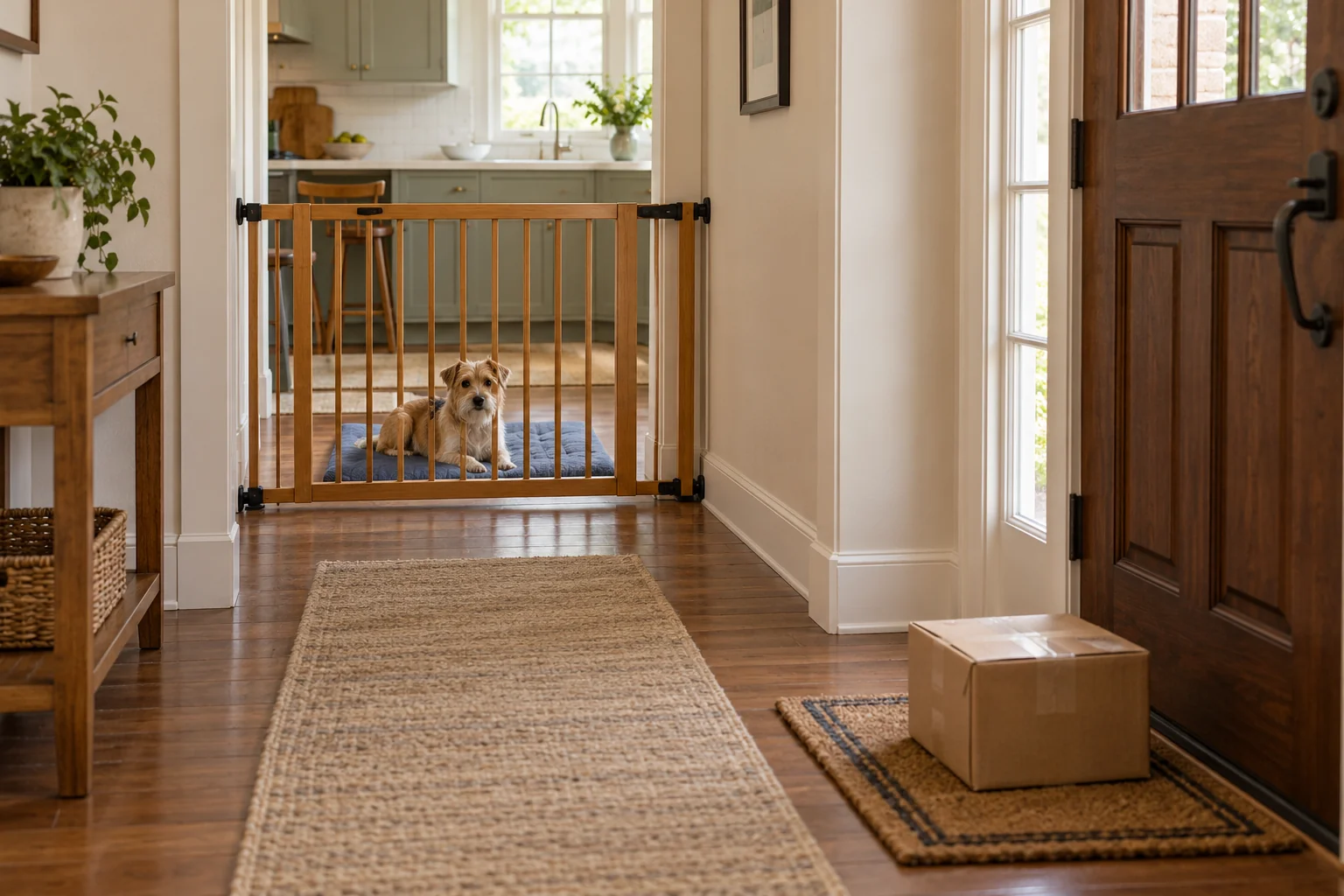
Use the same delivery setup while your dog learns. Put the barrier in place before opening the door, and save practice with the bell for times when you can stay with your dog.
- Put your dog in another room or behind a baby gate before you answer the door, with a chew or food toy.
- Use a sign or a message. Best Friends Animal Society suggests leaving a note asking visitors to text or call rather than knock or ring the doorbell (Best Friends: How to stop dog barking that's problematic).
- Plan deliveries. Where possible, choose a delivery option that doesn't need the bell, or ask for parcels to be left in a specific place.
- Mute other doorbell sounds. Turn off doorbell sounds on phones, smart speakers and video doorbells inside the house, so your dog doesn't hear them through the day.
- Use background noise. A radio or white noise can soften sounds from outside.
Our guide on how to teach your dog to wait calmly at the door also helps with the moment when the door actually opens.
Knocking, video doorbells and other door sounds
A doorbell isn't the only sound that sets dogs off. Knocking, the click of the gate, footsteps on the porch, the mail slot and the chime of a video doorbell can all become signals that someone is arriving.
It helps to make a short list of the sounds that trigger your dog. You may notice that some are much harder than others. A gentle knock might be easy, while the sound of the gate latch sends your dog straight to the door.
Work on each sound separately, in the same way as the doorbell. Start with the easiest sound, at a low level, and pair it with the mat and treats. Then move on to the next. Your dog may pick up later sounds more quickly, because they already understand the routine.
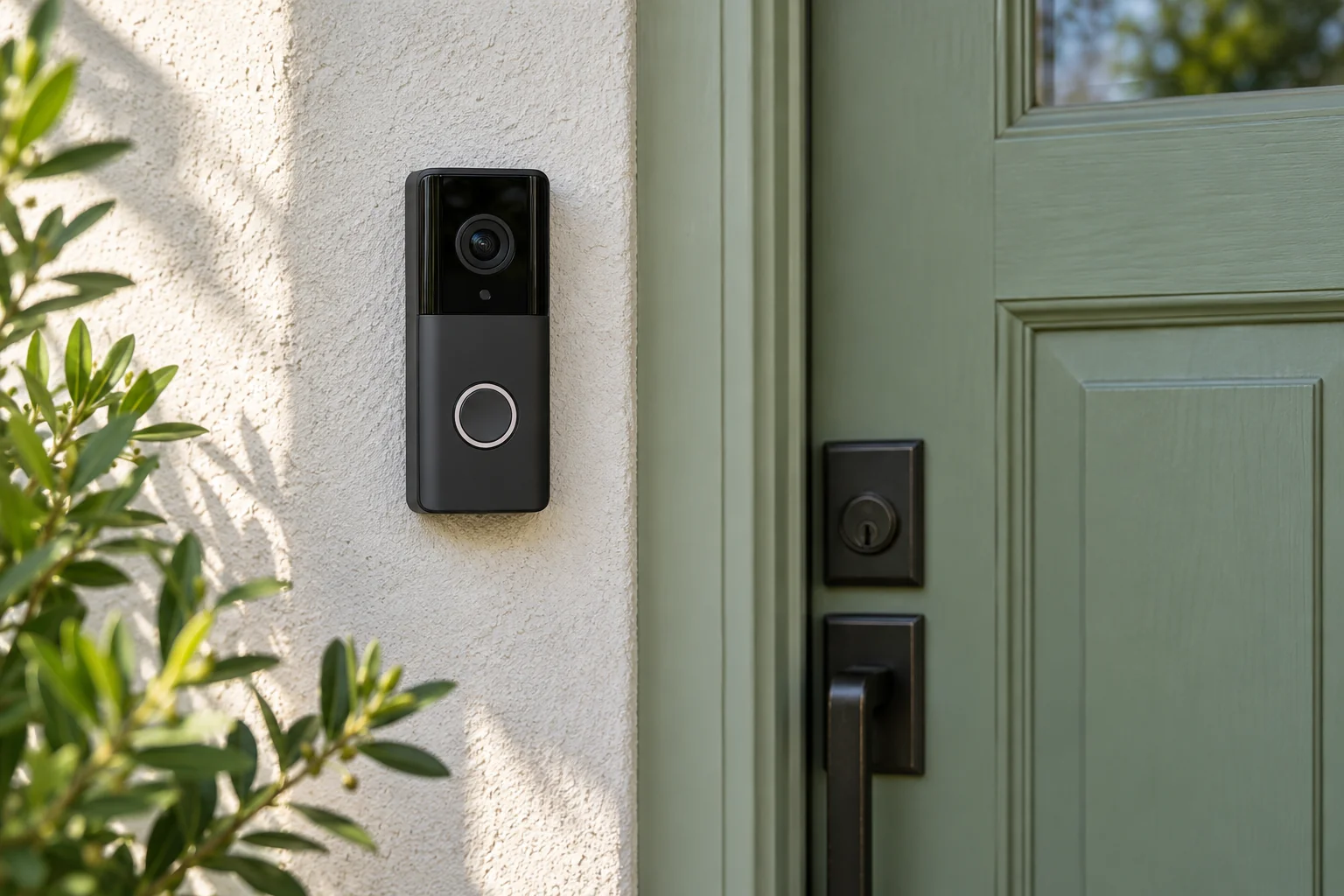
If you have a video doorbell, check its settings. Many let you turn off the indoor chime or change the sound. A new, unfamiliar chime can buy you a little time while you train, although your dog may learn to react to it too if real visits keep happening without a plan.
Also think about what your dog can see. If your dog watches the path or porch through a window or a glass panel in the door, they may start barking before the bell even rings. Blocking that view with frosted film or a closed door can make training much easier.
Help your dog greet visitors calmly
Once your dog can cope with the bell, the next challenge is the person who walks in. Excited dogs often go from barking to jumping up.
- Keep your dog on their mat or behind a gate while the visitor comes in and sits down.
- Ask visitors to ignore your dog at first, with no eye contact, talking or reaching, until your dog is calm.
- Reward calm behavior. Toss treats onto the mat while the visitor settles in.
- Let your dog say hello when they're ready, and keep greetings short.
Our guide on how to stop your dog jumping up at visitors goes into greetings in more detail.
For a worried dog, it's usually kinder to let them stay in a quiet room with a chew while visitors are there, rather than asking them to meet everyone.
Keep everyone safe at the door
Barking at the door is usually harmless, but it can sometimes lead to problems. PDSA notes that in some extreme cases, barking at visitors can lead to a dog biting.
To keep everyone safe:
- Don't let your dog rush the door, especially when it's opened to delivery drivers, children or strangers.
- Keep children away from the door while your dog is excited, and never ask a child to answer the door with an excited or worried dog nearby.
- Use gates or closed doors so your dog can't slip out onto the street.
- Make sure your dog wears ID, in case they ever get out.
If your dog has ever growled, snapped or bitten at the door, keep them well away from visitors and get professional help.
Don't shout or punish
When the barking is loud and constant, it's tempting to shout "quiet!" or reach for a gadget. PDSA advises never to shout at or punish barking, as this can increase a dog's fear and excitement.
Shouting can sound like you're joining in. Punishment, including spray or shock collars, can make a worried dog more frightened of visitors and damage your dog's trust in you.
Reward-based training is safer and more effective. The American Veterinary Society of Animal Behavior states that evidence supports reward-based methods for all canine training (AVSAB: Why you need to reward your dog in training).
A worked example: a terrier who barks at deliveries
Here's an illustrative example of how the practice can build up. Move on when the terrier can manage the current part comfortably, and return to an easier version if barking increases. Each part may take a different amount of time.
The pattern: A small terrier barks loudly every time a delivery arrives, races to the door and keeps barking long after the driver has gone. The doorbell on the owner's phone also sets them off.
Begin with manageable deliveries and a familiar mat.
- Turn off phone and smart speaker doorbell sounds.
- Leave a note on the door asking delivery drivers to leave parcels without ringing.
- Start teaching a mat behavior in the kitchen, away from the front door.
The terrier is ready for a quiet recording once they can go to the kitchen mat on cue and remain there for a few rewards.
- Play a quiet recording of the doorbell, then toss a treat onto the mat.
- Practice a few times a day, keeping the volume low.
Increase the sound only while the terrier can hear it, go to the mat and take food without becoming distressed. Change the volume separately from introducing a person.
- Gradually raise the recording volume.
- Introduce the real doorbell, rung by a family member, with no visitor.
Add a familiar person coming in once a practice ring sends the terrier to the mat and they can remain there while being rewarded.
- Practice with a family member ringing and coming in.
- Keep managing real deliveries with the note and a closed kitchen door.
Try a calm friend when the family-member practice is comfortable. If the terrier leaves the mat to rush the door, go back to a quieter practice setup and keep real visits separate.
- Invite a calm friend who knows the plan. Ask them to ring once, wait a few seconds, then come in and sit down without greeting the dog.
- Reward the terrier on the mat throughout, and let them say hello once they're settled.
- Gradually let real deliveries ring again, but only when someone is home and ready with treats by the mat.
The owner might notice the terrier glancing toward the kitchen when the bell rings or recovering more quickly after an arrival. Those observations help decide whether to repeat the current practice or make one part slightly harder.
What progress usually looks like
Barking at the door rarely disappears overnight. It's more useful to look for small changes than to wait for complete silence.
Signs of progress include:
- Your dog barks fewer times when the bell rings
- They stop barking more quickly
- They glance toward the mat or toward you when they hear the bell
- They take treats when the bell rings, when before they couldn't
- They settle faster after a visitor arrives or leaves
It can help to keep a simple note for a week or two, recording roughly how many barks and how long it took your dog to settle. That makes it easier to see improvement that might otherwise feel invisible.
Expect setbacks, too. A busy week with lots of deliveries, a new visitor or a day when your dog is already tired or unsettled can make things harder. When that happens, go back to an easier version for a few days rather than pushing on.
What to do if your dog still barks
My dog won't take treats when the bell rings. The sound is too strong for now. Go back to a quieter recording and practice at a lower level.
My dog goes to the mat but keeps barking. Reward the moments of quiet, even if brief, and keep the volume lower for a while.
My dog is fine with recordings but loses it with real visitors. Real visits are much harder. Keep managing them, and practice with familiar people first.
The barking goes on long after the visitor has left. Your dog may be very aroused. Give them something calming to do, such as a chew or a sniffing game, in a quiet room.
My dog barks at every noise outside, not just the bell. This may be more general alert barking. Consider window film, background noise and other management, and get help if it's constant.
Other people in the house rush to the door. Agree on a household plan, so everyone sends your dog to the mat and stays calm.
My dog runs to the door before I can say anything. Put a gate across the hallway for now, so your dog can't reach the door, and keep treats by the mat so you can reward them the moment they arrive there.
Optional: use a "thank you" cue for a brief alert
If your dog gives a brief alert and can readily turn away, you may find a "thank you" cue useful alongside the mat routine. It is optional; keep your main practice focused on the bell becoming a signal to go to the mat.
After a brief bark, say "thank you" calmly and toss a treat away from the door or onto the mat. Praise the pause when your dog stops barking to eat. Over time, the cue can become a familiar invitation to turn away and come for a reward. If your dog is too worked up to respond, use your delivery-management setup and return to easier mat practice later.
When to get help
Many dogs improve with consistent practice and good management. Some need more support.
Look for a qualified, reward-based trainer or behavior professional if:
- Your dog growls, snaps, lunges or has bitten at the door
- Your dog seems frightened of visitors
- The barking is getting worse despite consistent practice
- Your dog can't settle for long after a visit
Talk to your vet if barking at the door has started suddenly, is part of a wider change in your dog's behavior, or comes with signs your dog is unwell.
You can find more help with everyday problems in our dog behavior guides.