
Your dog spots a person, dog or delivery van through the window. The barking starts, the movement outside disappears and the room eventually goes quiet. From your side of the glass, the noise can seem pointless. From your dog's side, the pattern may look as though it worked.
That does not mean your dog believes they chased anyone away. It does explain how an ordinary alert can become a well-practised routine. Something outside starts the barking, but what happens during and after the incident can keep the routine going. The lookout position, rising arousal, attention from people and the regular disappearance of passers-by may all become part of it.
You do not need to decide exactly why your dog barks before making a useful change. Window barking can involve alerting, fear, frustration, excitement or a mixture that has been practised many times. Start by observing what happens, preventing the practice you can prevent and teaching an easy alternative away from the glass.
Separate what starts the barking from what keeps it going
The trigger is the event immediately before the response. It could be a dog appearing between parked cars, someone approaching the house, a van door closing, headlights moving across the wall or footsteps your dog hears before you do. One window can have several different triggers.
What keeps the behaviour going is a separate question. A passer-by will carry on walking whether your dog barks or not, but their departure follows the barking often enough to make a convincing pattern. The window also provides a clear view, a familiar patrol spot and repeated chances to practise. If you hurry over, talk, touch your dog or join the commotion, your attention may become another consequence, even if you sound annoyed.
Imagine a delivery driver appearing at the window. The driver is the trigger. If your dog then returns to the window through the day, repeats the routine and watches the driver leave, that sequence may be helping the habit persist. Removing one surprise will not change a routine that the room makes available all day.
Do not turn this explanation into a diagnosis. Barking alone cannot tell you whether your dog is frightened, frustrated, excited or trying to alert you. Look at the whole dog and the surrounding situation. Dogs Trust advises looking from head to tail because one body part cannot fully explain how a dog feels. Its guide to understanding canine body language also explains why context matters.
A loose dog who gives two barks and readily turns back to you presents a different picture from a tense dog who cannot look away, will not take food and redirects onto another dog in the room. If you need help describing what you see without guessing at a label, read our fuller guide to dog body language in context.
Observe the window pattern without setting it up
Use incidents that happen naturally. Do not ask someone to pace outside, knock repeatedly or bring a dog closer so you can test your theory. Deliberate provocation creates more rehearsal and can increase distress or risk.
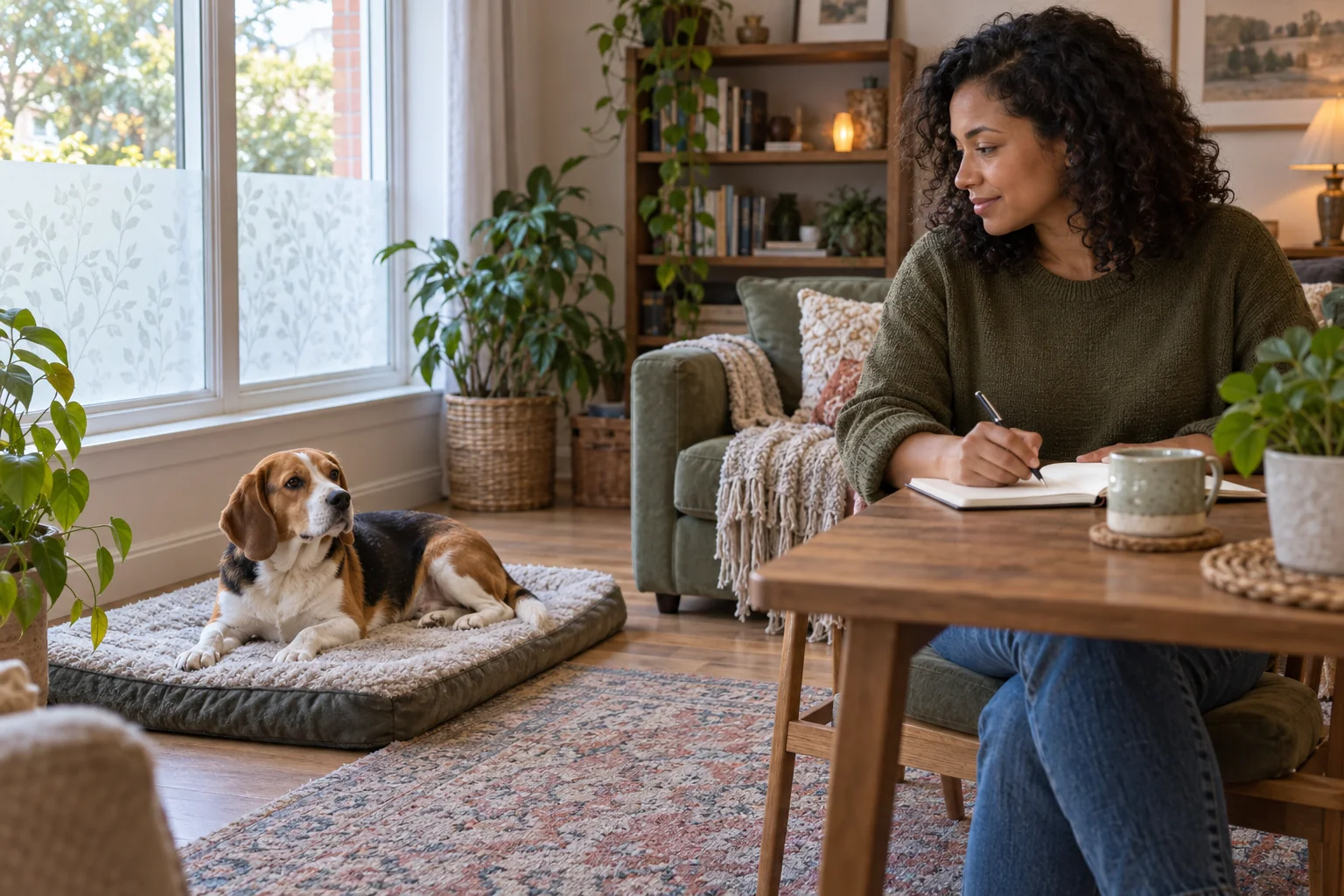
For several ordinary days, record the time, the exact sight or sound, where your dog was beforehand, what their body did, what you did and how the incident ended. Note whether your dog could turn away, respond to their name, eat a familiar reward and settle afterwards. Recovery often tells you more than a bark count because it shows whether your dog can leave the event behind.
Keep the notes factual. Write “body stiff, weight forward, three barks, ran to side window, took food after the cyclist had gone” rather than “protective”. Write “whined, bounced, tail moving broadly, returned to the window twice” rather than “aggressive”. A short dog behaviour observation log can help you compare incidents without relying on memory.
Look for differences instead of forcing every incident into one category. Does the reaction happen only when a dog passes, or with every moving shape? Does sound start it before the trigger is visible? Is the afternoon harder because the pavement is busy, because sunlight makes movement clearer or because your dog has already had a demanding day? Does a lower window cause more trouble than an upstairs one?
Your notes are not a home diagnosis. They are a map of conditions you can change. They also give a vet or behaviour professional more useful information if the problem is new, intense or unsafe.
Change the view before asking for self-control
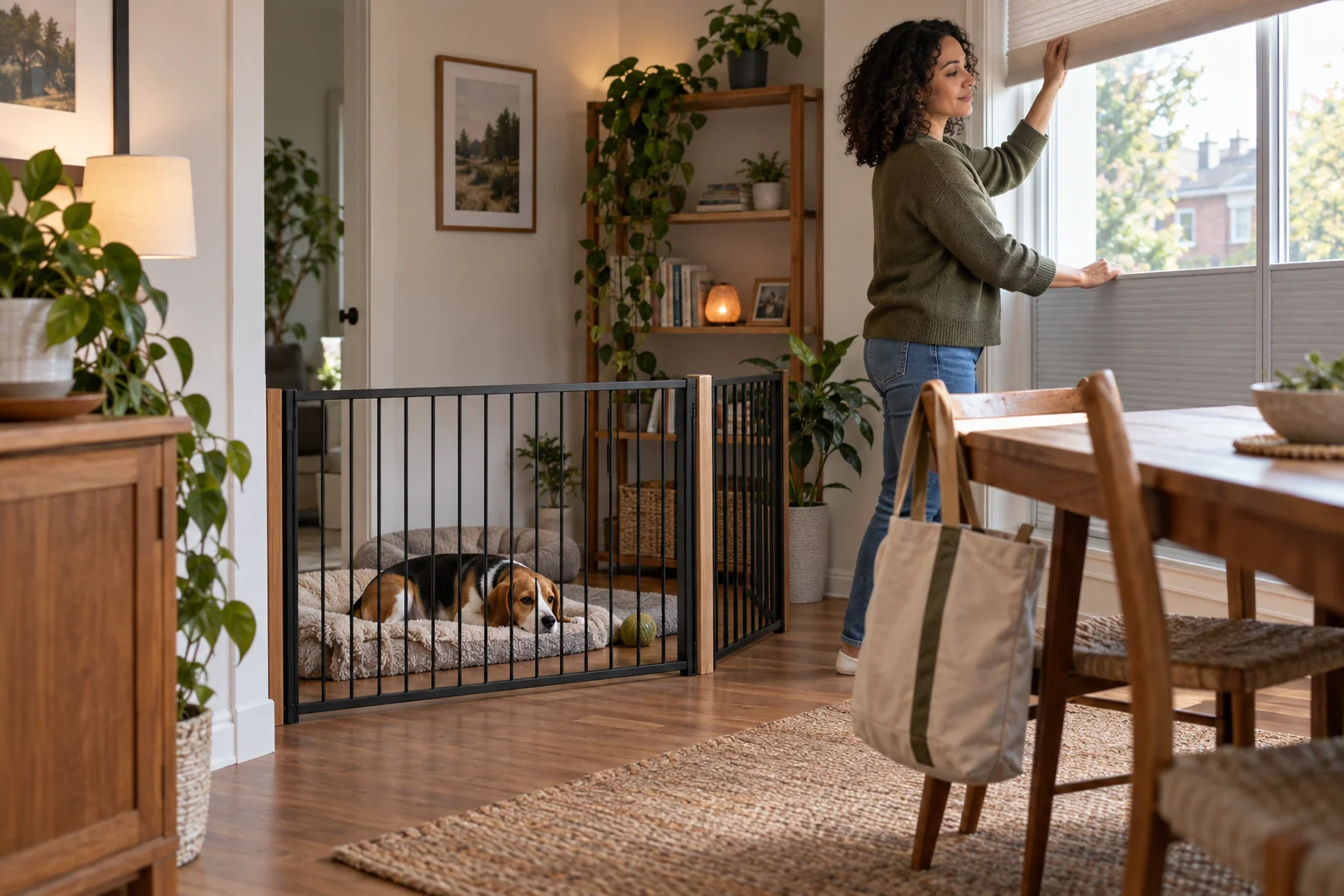
The quickest low-risk change is often to reduce access to the visual trigger. You could cover the relevant part of the glass with removable privacy film, close a blind before a busy period, move the sofa or chair that acts as a lookout, shut the room door or use a secure gate to keep your dog farther from the window. Choose an arrangement that is safe in your home and does not introduce hazards around cords, furniture or barriers.
You may not need to cover the whole window. Watch where your dog's sightline falls when they stand or lie on the usual perch. Frosting the lower section may block pavement movement while keeping daylight. A dog watching from the back of a sofa may need the furniture moved too. If sound is the main trigger, visual film will not solve it, although moving the resting area away from the frontage may reduce both sound and view.
Management does not cure fear or frustration. It changes the opportunity to practise. The broader principle is covered in why preventing rehearsal is not cheating, so it does not need repeating here. For this problem, ask whether your dog can spend ordinary unsupervised time in the room without the layout putting them on lookout duty.
Make this the default before work calls, school runs, deliveries or any period when you cannot respond promptly. Waiting for barking and then closing the blind means the full routine has already happened. Setting the room first prevents the practice you were not available to train through.
Build a window zone that works when you are busy
Create two clearly different areas. Screen or block the window zone when you are not actively supervising. The calm zone might be a bed, mat or comfortable resting place far enough from the glass that your dog is not pressed against the trigger. Give your dog a route into it that does not require squeezing past people, children or another pet.
The calm zone is not a punishment corner. Introduce it while the street is quiet. Place or deliver rewards there for choosing to approach, stand calmly, sit or lie down. If your dog already enjoys a safe chew or food toy, you can offer it there when supervision and dietary needs allow. The value comes from good things happening away from the window, not from physically putting your dog there after an outburst.
The plan also needs to work when you cannot train at every trigger. Before a predictable busy period, screen the view and make the calm zone worthwhile. When you leave the room, use the door or gate instead of hoping your dog will ignore a stream of movement. If a visitor, cleaner or family member is responsible, give them one simple rule about which barrier stays closed.
Check the human side of the setup. Can everyone close the blind easily? Does the film cover your dog's actual viewing height? Can the gate be used without carrying shopping over it? Does the resting place remain comfortable and away from household traffic? A routine nobody follows is less useful than a plain one that works every day.
Management can stay in place if it improves life for everyone. You do not have to uncover a busy street-facing pane to prove training has worked. If you later test less coverage, do it gradually and while you are present, rather than removing every support for a whole day.
Teach the route away from the glass in quiet conditions
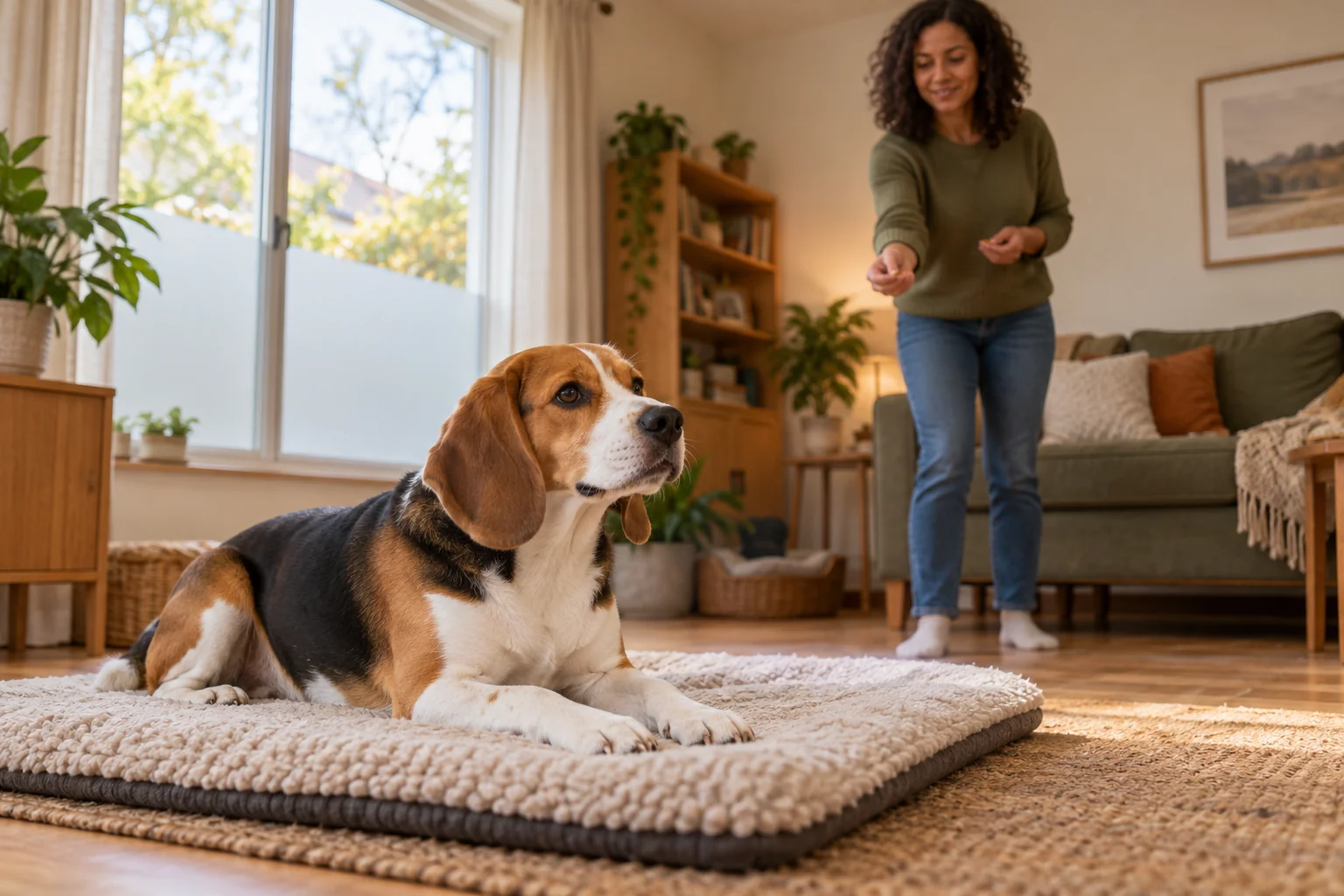
Choose one alternative that moves your dog away from the window. They could go to the calm-zone mat, follow you to the kitchen doorway or turn to touch your hand. Use a cue you can say calmly. The behaviour should be easy and familiar, and it should be generously rewarded before you need it around a passer-by.
Start with the view screened and nothing happening outside. Say the cue once, move towards the calm zone if that helps your dog understand, then mark the arrival and reward there. A marker could be a consistent word such as “yes”. Dogs Trust explains that a marker identifies the moment your dog got it right and should always be followed by the reward in its guidance on positive reinforcement training.
Place the reward away from the window. Delivering it at the glass can keep your dog in the lookout position. A small scatter on the mat may encourage sniffing and keep your dog's orientation away from the street, provided scattering food is safe in your household and no other animal may compete for it.
Practise the route at ordinary moments throughout the day. Cue it when you cross the room, before putting the kettle on or when your dog is already looking at you. Release them naturally after the reward. You are building an easy movement with a pleasant destination, not demanding a long formal stay.
If your dog does not follow in a quiet room, make the task easier. Reduce the distance, improve the reward or choose a simpler action. Repeating the cue more loudly will not make it clearer. The response needs to be easy enough to use before arousal rises.
Reward the earliest workable choice
When the route is easy in calm conditions, use it during naturally mild events. A workable moment is when your dog notices a distant person or soft sound but can still turn, eat and move with you. Mark the glance back, the turn away or the first movement towards the calm zone, then reward away from the window.
Dogs Trust notes that worried dogs can generally cope better when a trigger is farther away, and that the useful distance varies with the individual dog and the intensity of the event. At a fixed window you cannot move the pavement, but you can create more functional distance by moving your dog deeper into the room, screening more of the view or working from another window with a less direct sightline.
If barking has become rapid and your dog cannot disengage, skip training in that moment. Calmly block the view or guide your dog away without grabbing, scolding or crowding. Wait for recovery in a quieter area. Trying to secure a perfect response during the hardest incident turns practice into a test your dog cannot pass.
Do not repeatedly expose your dog to passers-by in the name of getting them used to it. AVSAB distinguishes gradual work that keeps a dog feeling safe from flooding or forced exposure, and recommends reward-based methods for behaviour concerns in its humane dog training position statement. Real life will provide enough uncontrollable events. Training should make chosen moments easier, not manufacture harder ones.
A brief alert bark followed by a turn away can be meaningful progress. So can noticing a person without rushing forward, taking the route after one cue or settling sooner. The aim is not a dog who never communicates. It is a dog who can leave the window and recover safely.
Adjust the plan when your dog cannot disengage
Failure to turn away is information about the setup, not disobedience. The trigger may be too close or fast. Too much of the window may be open, the reward may be weak in that context or the cue may only be familiar in easy rooms. Change one condition instead of repeating the same unsuccessful attempt.
Increase the visual block first. Work farther from the pane. Practise the route without a trigger again. Use a reward your dog genuinely values and can eat safely. If your dog will not take food they normally enjoy, do not assume stubbornness. In context, refusal can be one sign that the situation is too difficult, although appetite can change for many reasons.
Check whether you are arriving late. After months of practice, a dog may move from noticing to barking very quickly. Watch for the head turn, ear movement, closed mouth, weight shift or sudden stillness that comes before the first bark. Marking and moving at that point is easier than interrupting a full charge at the glass.
Do not hold your dog at the window, force a sit facing the trigger or use the lead to keep them close while people pass. Do not bang on the glass, spray water, throw objects, shout or use an anti-bark device. These actions may add surprise or discomfort without making the outside event feel safer. AVSAB's position is that aversive methods should not be used for training or behaviour modification. Environmental arrangement and reinforcement of desirable responses belong in humane plans.
If your dog repeatedly cannot disengage even with substantial screening and distance, stop making the exercise harder. Maintain the barrier and seek individual guidance instead of improvising exposure.
Track recovery and rehearsal instead of demanding silence
Use your original log to see whether the plan changes the pattern. Count incidents only if you can do so accurately. Also record access to the window, the type of trigger, whether your dog could turn away and roughly how recovery looked. A day with fewer passers-by is not proof of learning. A day with the view covered is successful management, but it is not a test of the trained response.
Keep those two kinds of success separate. “No incidents while film and gate were in use” tells you the environment worked. “Saw a dog at partial view, turned on cue, ate on mat and stayed away” tells you the alternative was available at that level of difficulty. Both matter, but they answer different questions.
Review several ordinary days instead of judging one dramatic event. Delivery workers approaching the house may remain much harder than people across the road. A dog who recovers faster from distant walkers may still need full screening during delivery times. Let the evidence guide where management stays firm and where supervised practice is reasonable.
Do not turn progress into a race to uncover the glass. If the household is quieter, your dog rests more and the alternative is becoming reliable, the plan is doing useful work. Reduce screening only after calm performance at an easier level, and restore it whenever the environment becomes busier.
Know when the window is not the whole problem
Window barking needs professional assessment when it carries distress or risk beyond ordinary alerting. Seek help if your dog redirects onto a person or another animal, snaps when moved, bites, throws their body at the glass, cannot recover or remains intensely vigilant around the home. Use barriers and separation while you arrange help. Do not recreate the behaviour for a video.
A sudden change also belongs with your vet. New barking, agitation or an inability to settle can occur alongside pain, sensory changes or other health problems, and only a veterinary assessment can investigate medical causes. Tell the vet what changed, when it began, what triggers you have observed and whether sleep, movement, appetite or social behaviour changed too.
Fearful body language, rising intensity and an inability to take food or respond at a workable distance are reasons to stop treating the issue as a simple noise nuisance. A qualified reward-based professional can assess the dog, the view, household movement and safety in a way a general article cannot. Our guide to when your dog needs professional behaviour help explains the distinction between training support, behaviour support and veterinary input.
Get urgent individual help where there is bite risk, redirected aggression or any difficulty keeping people and animals safely apart. While you wait, use secure physical separation, prevent window access and avoid trigger practice. Do not test whether the dog is improving.
Make the first change the one that survives tomorrow
Start with the window your dog uses most. Observe its real triggers without provoking them, cover the useful sightline, remove the perch if necessary and prepare a comfortable place away from the glass. Teach one route to that place while the street is quiet. Then reward the earliest turn away during naturally easy events.
This order matters because it stops training competing with an all-day habit. The blocked view handles the hours when you are cooking, working or out of the room. The alternative gives your dog something clear to do when you are available. The log tells you whether recovery is changing or whether you have simply had a quiet week.
You may still hear barking. An alert is communication, and no humane plan can promise silence. You can change the repeated rush to the glass, the length of the incident and your dog's ability to come away. If those things do not improve at a genuinely manageable level, keep the view blocked and ask for qualified help instead of increasing exposure.
The window is not a character test for you or your dog. It is an environment that currently makes one routine easy. Change that environment first, teach a safer routine elsewhere in the room and let ordinary records, rather than frustration, decide what needs to happen next.