
Your friend has barely taken off their coat before your dog is on their chest. Telling the dog to get down takes your attention away from the guest; the guest laughs, reaches out, and the whole thing happens again. You need a plan that works while somebody is actually coming into your home, not only when the hallway is empty.
For an enthusiastic dog, the useful lesson is that four paws on the floor make a greeting possible. First prevent the rush at real arrivals, then reward the ordinary moments when your dog approaches a familiar adult without launching. The visitor can offer brief attention only if both they and your dog want that contact. A barrier and a quiet room remain perfectly good options on days when a greeting is too much.
A jump does not always mean your dog wants a cuddle
An excited dog might spring up to get closer to a face, a hand or a voice. If people talk, laugh, push the dog away or stroke them, the dog may find that jumping reliably starts an interaction. That does not mean you or your guests did anything terrible. It does explain why saying “down” while touching the dog's chest may not produce a quieter hello.
But the same movement can happen for different reasons. Dogs Trust's guidance on jumping up distinguishes excited greetings from jumping associated with worry, frustration or pain. A dog may leap towards a visitor because the person feels too close and the dog wants space, not because the dog wants to be stroked.
Before practising greetings, notice what happens before and after a visitor comes in. Is your dog's body loose and able to turn away, or stiff and unable to disengage? Do they approach and then retreat, bark with their weight shifted back, or hide behind you? A tail wag on its own cannot answer that question. Our guide to reading dog body language in context can help you look at the whole picture without diagnosing your dog from a single signal.
This article is for ordinary, willing greetings where jumping is the problem. If the person makes your dog fearful, or there has been growling, snapping, lunging or a bite, do not recruit somebody to rehearse an arrival. Give your dog secure separation and seek individual advice. Polite visitor manners cannot be taught by making a frightened dog endure company.
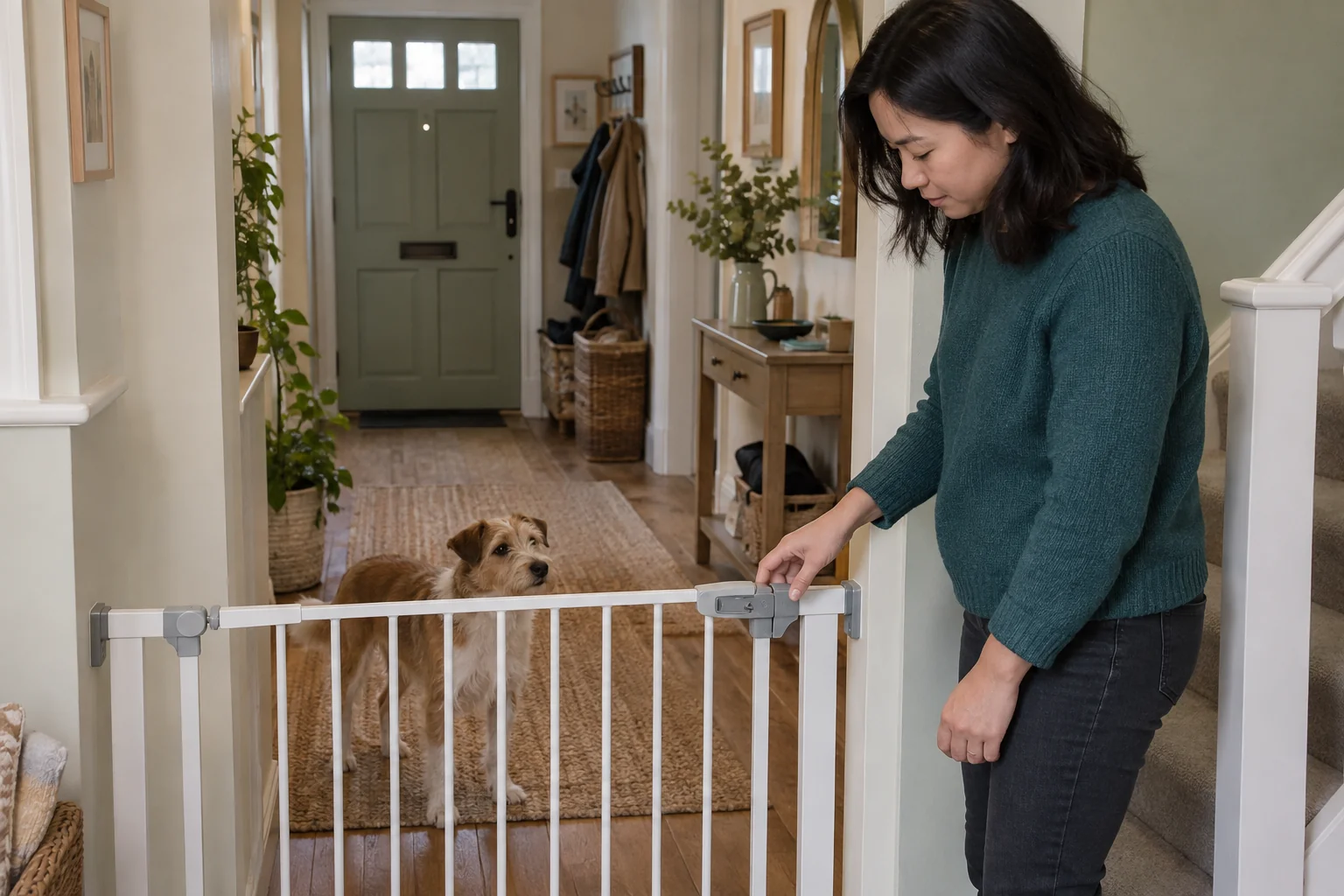
Make the next arrival manageable before you open the door
Choose where your dog will be while you admit a guest. A latched internal gate, with enough distance that nobody can reach across it, can keep an eager dog out of the entrance. A comfortable separate room with water and a familiar resting place may be better if seeing the visitor through a gate makes your dog bark or pace. Check that a gate cannot be pushed aside, climbed or opened accidentally.
If you use a lead for a dog who is comfortable with one, an adult should hold it on a well-fitted harness with enough room for the dog to stand and turn without pressure. Do not tether the dog at the entrance or use a tight lead to stop a leap. A lead does not make it safe to invite a person within jumping distance, and your guest should never have to hold the dog while you find the treats.
Put rewards where you can reach them before the bell rings. A few small food rewards or a favourite toy might help an excited dog turn away from the hall, but make sure the dog has space to enjoy them undisturbed. If food causes conflict with another pet or around visitors, use separate rooms and ask for tailored advice rather than scattering it into a shared hallway.
Let your guest know ahead of time that you will admit them first and decide later whether the dog will come in. Ask them not to call the dog, lean over a barrier or start stroking before you have settled coats and bags. A short message before they travel is easier than negotiating over a dog at the front door. Dogs Trust's visitor guidance likewise prepares a separate comfortable area before guests enter.
The door opening is an arrival task, not a greeting exercise. Keep an exterior exit secure as you move the dog away, then greet your visitor yourself. Our doorway-wait guide deals with the separate skill of pausing behind a threshold; do not rely on that cue alone to manage a live visitor and an open front door.
Decide what a successful hello looks like
You do not need a sit with eyes fixed on you. For a dog who bounces on a familiar adult, a sensible goal is a relaxed approach with paws on the floor, followed by a short greeting if the dog and person are both comfortable. Standing, sniffing the person's shoes and then returning to you can all fit that goal. So can choosing not to approach at all.
Pick a job for each adult. You notice and reward the dog's feet staying down. A willing visitor stands comfortably and waits for your invitation before offering quiet attention. If your dog jumps, the person stops offering attention and moves out of reach if they can do so safely. They do not catch paws, turn their back into a narrow space or try to outlast repeated impacts. You manage distance and end the attempt if it is not working.
Tell the visitor they can decline the greeting without explanation. Some people are unsteady on their feet, worried by dogs or simply wearing clothes they would rather keep clean. Their comfort is part of the plan. A dog who can be in the same house without touching every visitor already has a useful social option.
Veterinary behaviour guidance from VCA Animal Hospitals suggests deciding in advance whether a dog should stand, sit or ignore a person, and rewarding that chosen behaviour. This is helpful when a household has been giving mixed messages. If one visitor invites a full-body leap and the next expects stillness, the dog cannot easily tell what greeting will earn attention today.
Keep the rule simple enough for everyone to follow. If sitting is a familiar, comfortable behaviour for your dog, you can reward it. If asking for a sit near a person makes your dog wriggle harder or freeze, start with feet on the ground. The greeting is optional; staying safely apart is also a success.
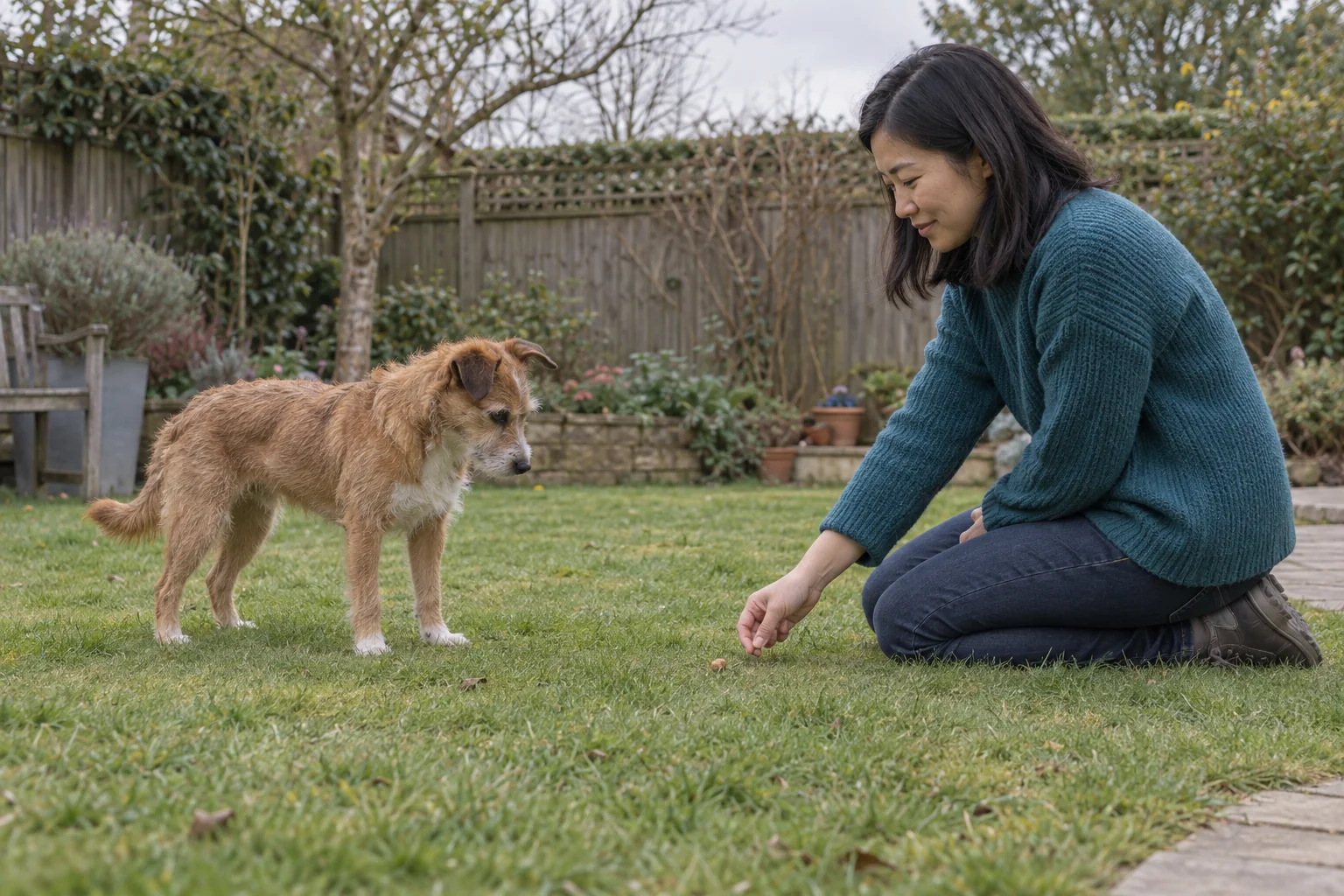
Practise four paws on the floor when nobody is visiting
Begin in a quiet room with someone your dog already knows and likes, or practise your own returns after briefly leaving the room. Do not bring a new visitor into the house just to discover what happens. Have rewards ready, and give your dog room to approach or walk away.
As your dog comes towards you with paws down, say a soft marker such as “yes” if you use one, then place the reward low enough that taking it does not require a jump. A small treat near your dog's mouth or on the floor beside you makes staying low convenient. If their body is loose and they want touch, offer a brief stroke while their feet are still down, then pause. Food is not the only reward; for a social dog, a gentle hello may be valuable too.
Practise on uneventful passes through the room. If your dog walks over and all four feet remain grounded, notice it. If they choose to carry a toy while approaching, that can also be a workable alternative, provided it does not turn into grabbing at hands. You are building a history of ordinary, successful approaches before adding the excitement of somebody at the door.
Should your dog spring up, do not push them down or lift a knee. If it is safe, fold your hands close, turn slightly sideways and let the moment pass without an animated conversation. Then give your dog space and reward the next calm approach before a jump occurs. If they bounce straight back up every time you pay for landing, the exercise is too exciting: increase distance, make your own movements quieter and reward an earlier grounded moment. Do not build a jump-land-treat game by accident.
Dogs Trust recommends rewarding paws on the floor and avoiding attention that keeps jumping worthwhile. VCA's veterinary authors also describe delivering rewards before a dog launches in a calm setting. Neither approach requires frightening the dog or withholding all friendly contact. You are making the useful behaviour pay at a point where your dog can still choose it.
Add a familiar adult without making them a target
When the quiet-room version is easy, ask an adult your dog already knows to help in a space well away from the front door. Explain that they are free to stop at any time. The dog should look comfortable with this person before the practice begins. If you are uncertain about that, keep the person out of the exercise and seek qualified guidance rather than finding out at close range.
Begin with the helper still and at a distance where your dog can notice them and also take a familiar reward from you. The helper can take a small, ordinary movement closer while you reward the dog's feet staying down. If your dog strains or repeatedly jumps before they get near, the person is too close or moving too quickly. Ask them to move farther away; make the next attempt easier. The lead, if used, is a safety backup, not a way to tow the dog towards a greeting.
When your dog can approach with a loose body and grounded feet, the helper may offer a very brief hello only if the dog approaches willingly. Avoid holding food at the visitor's face or asking the person to bend over the dog. Keep your own rewards available low to the ground. After the hello, cheerfully invite the dog back to you and reward that return. Ending while things are going well is more useful than waiting for a jump to end the meeting.
Some dogs prefer a sniff without touch. Let them move away; VCA advises against reaching for a dog who shows avoidance or fear.
A familiar helper is not a test of readiness for every visitor. Dogs Trust recommends moving a helper farther away if the dog cannot respond or take a reward.
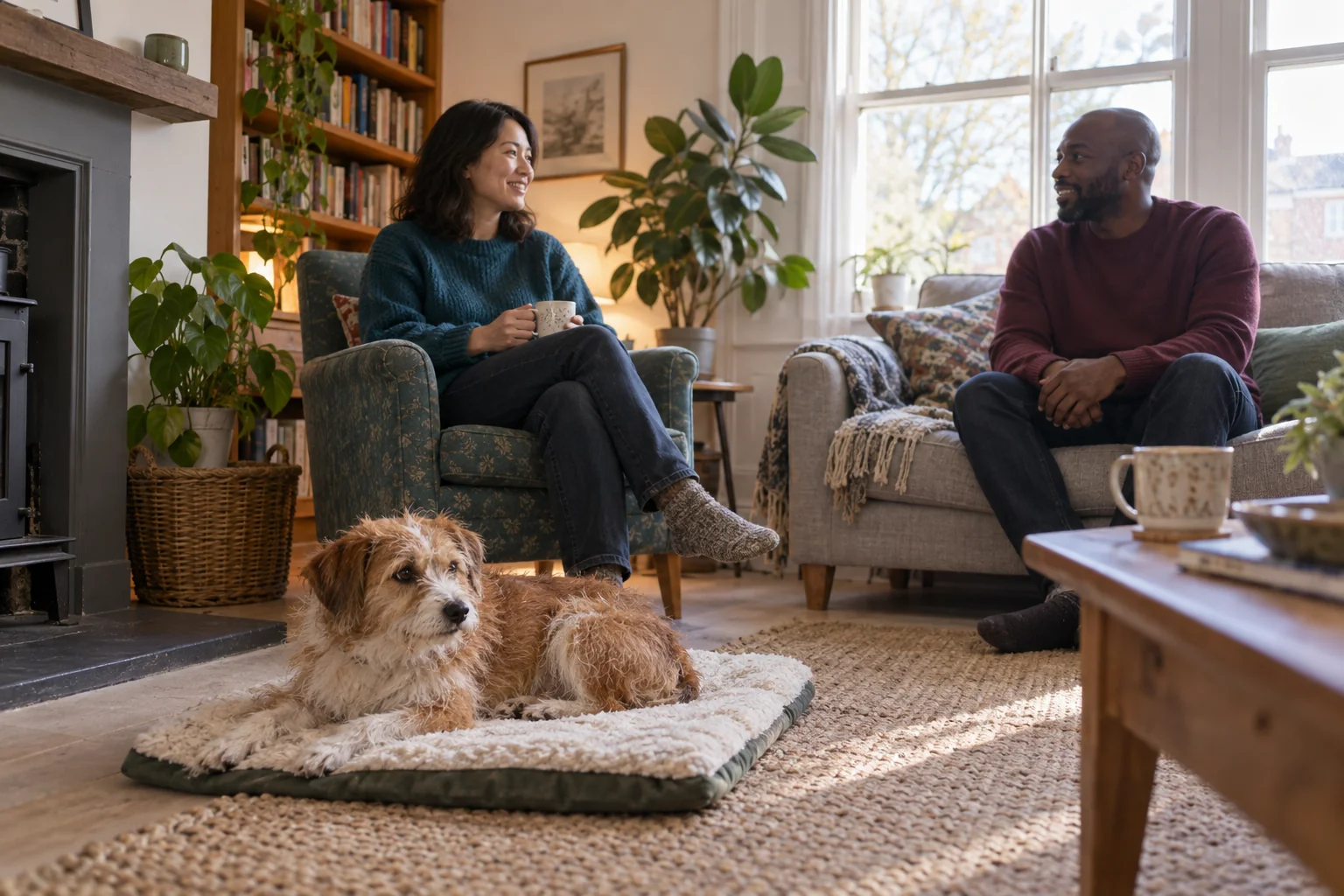
Bring the greeting to the room where visitors sit
The hall is often the worst place to start: the bell has sounded, the door may still be open, and people are moving in a small space. Instead, rehearse in the sitting room once an invited adult is already seated and your dog has had time apart. Keep your barrier or separate room available so the dog can return to it. Tell the guest that you will do the handling and that they can remain seated.
Bring your dog in only if they are comfortable and you can prevent contact if they surge. Start far enough from the seated adult that your dog can look, sniff the room and take a reward from you. Reward any loose, feet-down check-in with you, even when the dog does not go over to the visitor. After a moment, leave the room together or return the dog to their quiet area. They have practised being near company without needing to greet.
On a later easy occasion, offer the dog the option to move closer. Reward the approach before they jump. If both parties seem willing, allow a short interaction, then call the dog back for a reward and give them a break. You can use a toy or a safe activity in their separate area afterwards. Keep a guest's food, bags and coat out of reach so the greeting is not complicated by tempting objects or conflict.
A mat can be useful if your dog already enjoys settling on one, but it is not a requirement and this is not the place to teach the mat from scratch. The mat-settle guide covers that separate skill. Similarly, you do not need to train a doorbell response before you can arrange one calm sitting-room visit. The distinct job here is a chosen, grounded greeting after the arrival bustle has passed.
Notice the whole session rather than counting only jumps. A dog who approaches once, returns to you and then relaxes separately has made a different choice from one who repeatedly runs towards a person while tense. If the dog's behaviour changes after a guest stands up or speaks, return to more space and simpler practice. Movement by a seated person is a new challenge, not proof that earlier practice failed.
Handle the real arrival without turning it into a test
On the day someone visits, follow the boring arrangement you can manage with one pair of hands. Before the guest arrives, check the gate or room, put rewards within reach and decide where the dog will wait. When the bell rings, settle the dog behind the barrier first, then answer the front door. Your visitor comes in, shuts the door and puts down their things. Your dog does not have to perform at the exact moment everybody is busiest.
If your dog enjoys a suitable chew or food-filled toy in a separate room, you may offer it before opening the door. Check that it is safe for that dog and do not ask the visitor to enter their space while they have it. If your dog ignores food because they are watching the door, do not insist or move the item closer to the guest. Keep the distance and let the first part of the visit be quiet.
Once the guest is settled, decide whether you actually want to offer a greeting. An adult staying for a relaxed cup of tea may be willing to follow your plan; a tradesperson carrying tools need not meet the dog at all. If you bring the dog into the room, use the easy version they have practised, allow them to opt out and return them to their separate space at the first sign that the situation is too much.
If a surprise guest arrives and you have no time for practice, choose management without guilt. Ask the person to wait while you secure the dog, or keep the dog behind a closed door for the whole visit. Why management matters alongside training is a wider explanation; here it gives you the time to welcome somebody without asking the dog to improvise a new skill.
A calm arrival and a successful greeting are separate outcomes. It is enough to get your guest indoors safely today. You can work on a friendly hello another time, rather than trying to salvage an exercise from a hectic entrance.
Let your dog and visitor decline contact
Permission to meet should not become a demand to be stroked. Some dogs enjoy a familiar person in the room but are happier keeping their distance. Others may approach for a sniff and walk away, which is useful information, not unfinished training. Ask the guest to avoid following the dog, calling them back or reaching over their head.
If your dog willingly approaches and remains loose, the visitor can offer a brief stroke where the dog is comfortable with touch, then pause. If the dog moves closer for more, you can continue; if they turn away, stop. Do not hold the collar, block a retreat or keep offering food at the visitor's feet to prolong contact. VCA's greeting guidance stresses watching for avoidance and never allowing a person to touch a fearful dog.
A swallowed treat does not prove comfort with a stranger. If your dog is stiff, trying to leave or unable to settle afterwards, stop the greeting and give them space. Seek help if this recurs.
There is no deadline for sharing a room. Keeping certain guests and the dog separate may be the kinder permanent arrangement, especially when a visitor is frightened or frail.
Change the setup when jumping returns
If the dog jumps as soon as the helper moves, return to an easier distance and reward sooner. If they can stand with feet down until a hand reaches over their head, the hand movement is the difficulty. Ask the helper to stop touching, reward a grounded approach with no hand coming down, and keep any later contact brief and low-pressure.
If the dog jumps when you stop delivering treats, look at whether the greeting itself is too long. Pay for several easy feet-down moments before the leap, invite the dog back to you, and end the interaction. You are not trying to keep a highly excited dog beside a visitor indefinitely. A short successful hello followed by a break is more informative than a long one that falls apart.
If their feet remain down in the sitting room but they jump in the hallway, keep the hallway out of greeting practice. Let the guest enter and sit first. If the dog leaps only at one particularly animated relative, ask that adult to remain neutral and give them another job, such as sitting down, rather than trying to coach their movements while the dog is already airborne.
If you cue “sit” repeatedly and the dog cannot do it, the environment is probably asking more than that cue currently means to your dog. A standing dog with paws on the floor is acceptable. Move farther away, keep the visitor still, or finish the session. If the dog is not taking a familiar reward, do not raise your voice or wave the treat under their nose; stop and make the next occasion easier.
Keep a simple note after a visit: who came in, whether the dog was behind a gate or in another room, what happened before the first jump, and whether the dog could return to you. Those details help you identify the part of an arrival that needs adjusting. Do not count a managed visit as evidence that your dog has mastered an unprotected greeting. The arrangement itself did valuable work.
Keep children and busy visits out of greeting practice
Children must not be asked to walk towards a jumping dog, hold the lead, scatter rewards beside the dog or stand still while a dog lands on them. Even an exuberant greeting can knock someone over. Securely separate the dog before children come in and supervise any later interaction actively; if your attention is divided, keep them apart. Dogs Trust advises separation or an adult-held lead around children when a dog is likely to jump.
A crowd is different from one quiet helper. Coats, voices and several reaching hands may overwhelm your dog. Prepare a quiet space before guests arrive; nobody needs to take turns greeting them.
Deliveries and trades visits are not casual training opportunities. Keep the dog secure while you open the front door and finish the exchange. Do not invite a courier to reinforce a greeting, especially near an open route outside. If a visitor brings another dog, manage them separately rather than improvising a joint introduction at the threshold.
Some dogs dislike being behind a gate where they can see but cannot reach guests. If your dog repeatedly barks, bites the barrier or cannot recover there, move them to a more private, comfortable space if that is safe. Do not force them to watch people enter while you wait for silence. The point of management is to make the visit easier for your dog too.
Seek help when the greeting does not look willing
Stop home greeting practice if your dog growls, snaps, lunges, freezes, redirects onto someone nearby, or seems frightened by people entering. Do not stage another visitor arrival to confirm what you saw. Keep guests and dog securely apart and talk to your vet and an appropriately qualified reward-based behaviour professional about a plan for your particular household. Dogs Trust recommends qualified help when a dog struggles with visitors at home.
If jumping is new, suddenly much more intense, or accompanied by a change in movement, touch tolerance or general behaviour, arrange a veterinary check. Pain or another health concern cannot be ruled out by practising a better greeting. Our guide to when to seek professional behaviour help covers the referral decision in more detail.
Avoid kneeing, shoving, shouting, lead jerks or frightening devices. Besides doing nothing to teach the desired greeting, physical confrontation can make a visitor's arrival feel unsafe. The American Veterinary Society of Animal Behavior's current humane-training position recommends reward-based methods and rejects aversive training. If keeping the dog and guest apart feels difficult, get help adapting the environment rather than relying on stronger corrections.
This week, arrange one easy practice with a familiar adult your dog already likes, away from the front door. Reward a grounded approach, allow only a very brief greeting if both are comfortable, and invite the dog back before jumping starts. At the next real arrival, keep the barrier ready and let the guest settle first. You can then decide whether a hello is welcome at all.