
You have a parcel in one hand and the front-door key in the other. Your dog hears the latch, squeezes beside your legs and is looking down the path before you have put the parcel down. You might call them back on a quiet day. With a delivery driver at the door, you need the dog safely behind a barrier before you open it.
A doorway wait is a brief pause on the safe side of a threshold until you tell your dog what happens next. Sometimes you will invite them through. Sometimes you will close the door and carry on inside. You can teach that choice in a quiet room; the front door comes later, with a lead or barrier still in place. A trained pause is useful, but it must never be your only protection against an escape into traffic.
Decide which doorway problem you are solving
Watch one ordinary doorway before you plan the practice. Does your dog crowd your feet when you go to the garden, surge through the front door before their lead is attached, or slip into the hall whenever a visitor arrives? Those situations have different levels of risk. A dog who squeezes through the kitchen door on the way to dinner can learn the same basic pause in a much safer setting than a dog who has bolted towards a road.
Choose a visible boundary. The threshold itself may be enough for a calm dog at an internal door. At the front entrance you might ask for feet to remain behind a particular floor seam or a mat set back from the door. The boundary should leave room to open the door without pushing into your dog. If you have to squeeze past a dog who is wedged between the frame and your shoes, the position is too close.
The behaviour you want is modest: your dog stays on the safe side while you touch the handle, open the door and decide whether to invite them through. Standing is fine. Sitting is fine. A dog may even move farther back and still be waiting. A formal stay asks for a more exact position and often a longer period; a doorway pause is about crossing a boundary. Best Friends Animal Society describes a wait in which the dog may change position but does not move through until released in its doorway training guide.
Do not treat every door as interchangeable. A kitchen door can lead to a dull hallway; a front door opens onto footsteps, birds, neighbours and perhaps a road. Expect to teach the skill afresh in easier versions of each place.
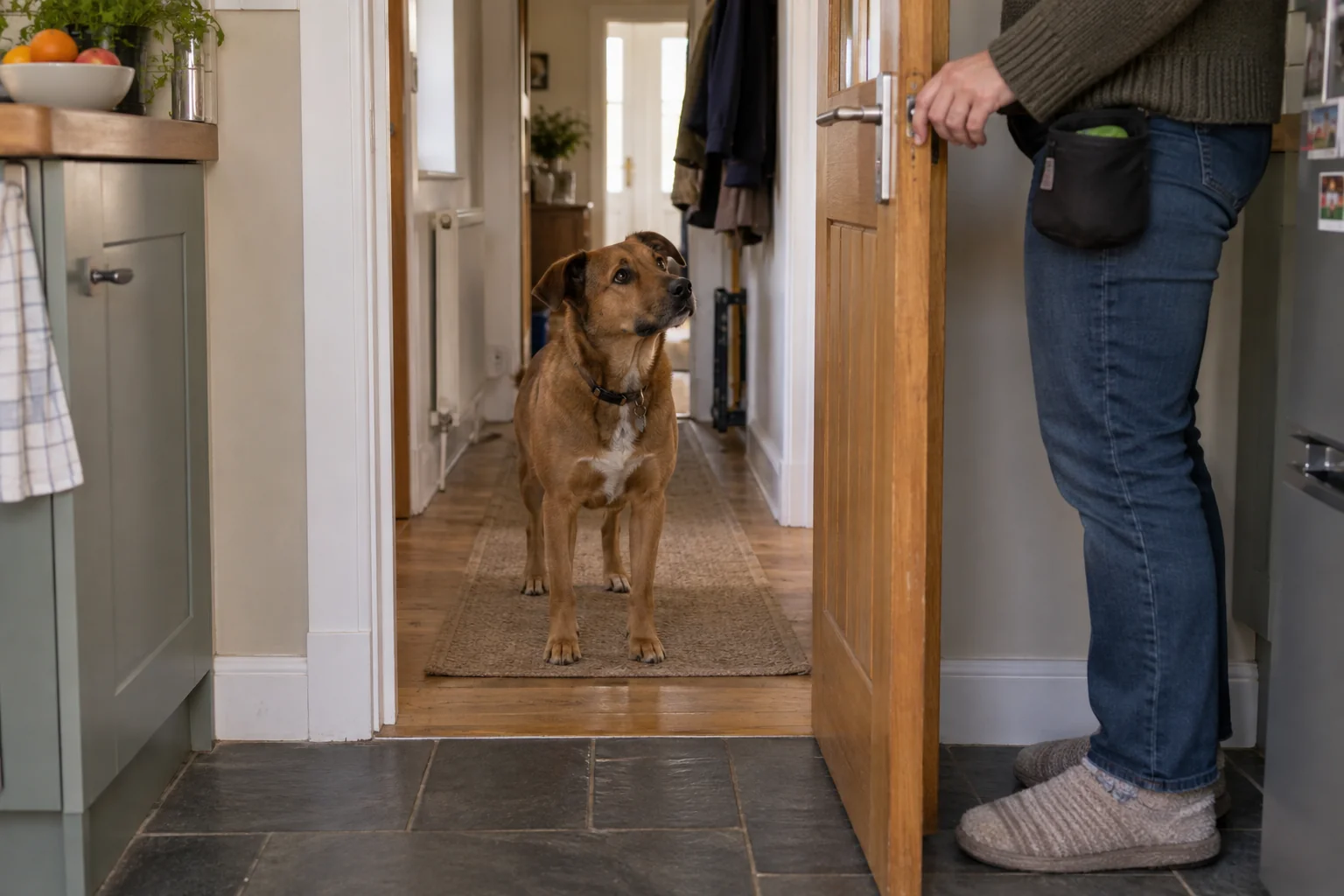
Set up so a mistake cannot become an escape
Begin at an internal doorway leading to a quiet, enclosed room. Close exterior exits elsewhere in the house. Take a few small rewards your dog can comfortably eat, and make sure you can operate the door without trapping paws or a nose. If the door opens towards the dog and creates a narrow gap, choose another door for the early practice.
For an exterior door, keep an independent safety measure until you have a long record of calm behaviour in that setting. That might be a secure internal gate across the hall or a properly fitted lead attached to a comfortable harness and held by an adult. Check the gate latches, the lead is not wound around anyone, and the dog cannot push between the open door and the barrier. Never tether a dog unattended near an entrance. A lead is a backup to prevent escape, not something to jerk or tighten to force a pause.
Think about how the household actually uses this space. The gate needs to be easy to close when you are carrying shopping and difficult for a child to open accidentally. If the safe arrangement depends on somebody remembering a complicated sequence while the delivery driver waits, simplify it. Our guide to dog management and training explains why a working barrier remains useful even after a new behaviour has been taught.
During a real delivery, use the gate or a closed room rather than trying to run a training exercise with an open exit. Your dog can learn at a calm internal door while a practical arrangement handles the times you cannot supervise every movement.
Reward a pause before you ask for a word
Stand with your dog on the same side of the closed internal door. Wait for a moment when their feet are on the floor and their body is reasonably loose. Touch the handle briefly, then reward them on their side of the threshold. If your dog dives at the handle, move farther from the door or start by turning your body towards it. Make the first successful version almost boring.
Place the reward a little behind the boundary, where you want your dog to remain. Food delivered at the gap draws them towards it. You can use a short marker such as “yes” to pinpoint the moment they pause, then deliver the reward. Dogs Trust says a marker should be followed by the reward in its positive reinforcement guidance. If you do not use a marker, calm, well-timed delivery works too.
Try lifting the latch without opening the door. Reward a comfortable pause. Then open the door a crack and close it gently before your dog has a chance to rush through. Reward while they are still on the safe side. Keep your hand where you can close the door slowly without catching them; do not use the moving door to block or startle them. If their nose is already in the gap, you have opened it too far for this attempt.
Dogs Trust's doorway-training guidance also begins in a quiet place, rewards calm behaviour at the closed door and opens it gradually. You can follow that progression without demanding a sit. A standing dog who waits comfortably has done the job.
Let the practice end with an ordinary break. Walk away from the door together. A few clear, easy repetitions are more useful than keeping your dog at the door until they start to worry about what the next movement means.
Open the door without turning it into a race
Once your dog can see the latch move and remain comfortable, widen the opening slightly. The decision is still made on your side of the threshold. Reward there before closing the door again. If your dog moves forward, close it gently only while there is room to do so safely, then move away and make the next attempt easier. Do not keep clicking the door shut in front of a dog who is increasingly excited or frustrated.
Change one thing at a time. An opening that is wider, held open longer and accompanied by you walking forward is a different exercise altogether. With a new width, keep the pause brief. When that feels easy, you can linger a little before rewarding. Save your own movement towards the doorway for a later practice.
A door that stays open may be more tempting than a door that immediately closes. If your dog walks through on the first attempt, do not haul them backwards to prove a point. In a secure internal room, calmly bring them back with you and return to a much smaller opening. At an exterior exit, the lead or barrier should prevent an unsafe crossing; stop the exercise and reset indoors rather than pulling a dog against a tight lead.
Watch how your dog moves, not just whether their paws stayed behind a line. A dog who crouches, freezes or cannot take a familiar reward is telling you that something about the scene is difficult. End the practice and consider what changed. For help reading the whole dog, see our guide to dog body language in context.
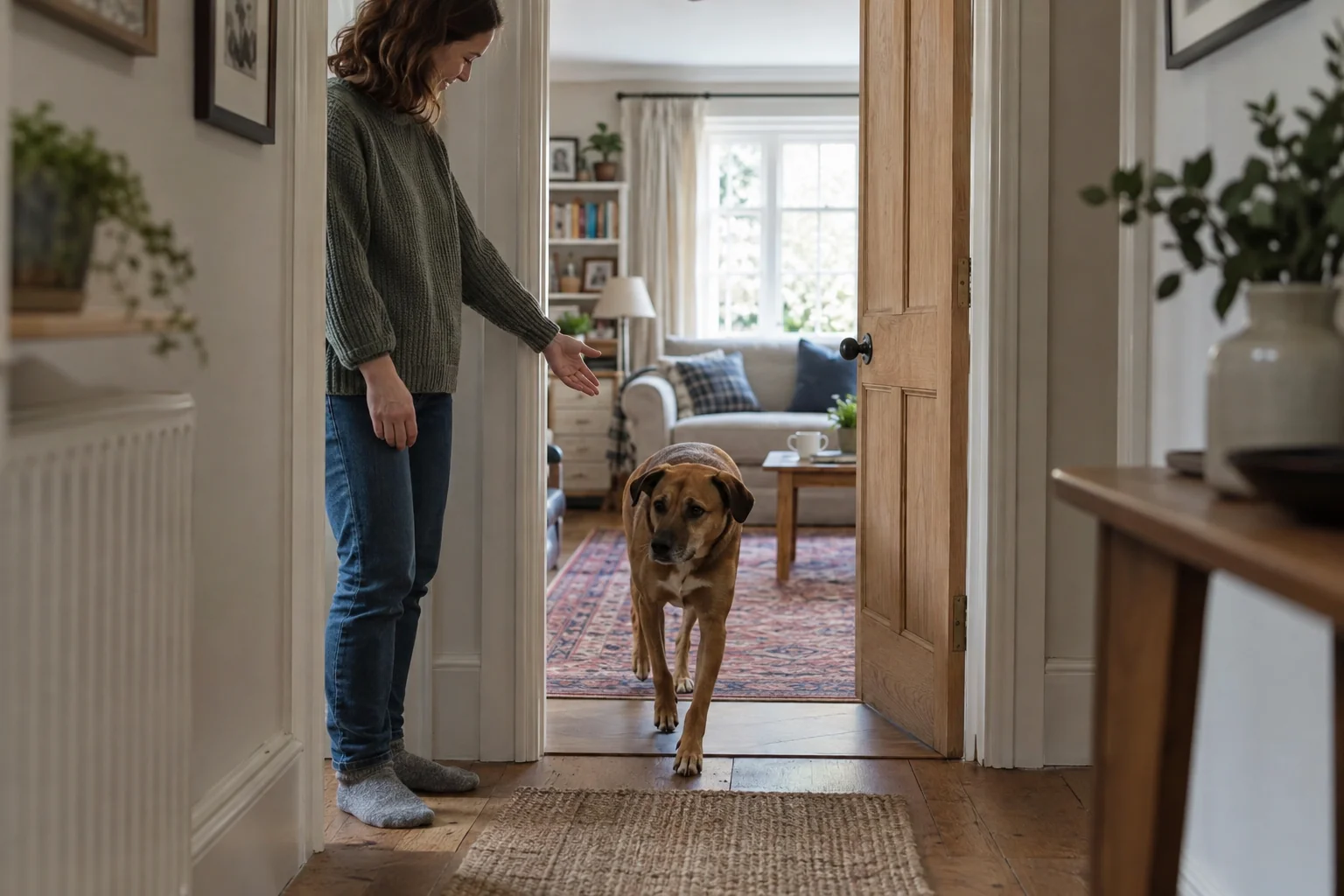
Make the release cue mean something definite
Pick a short word you do not say casually in every conversation, such as “through”. After an easy pause with an internal door fully open, say it once. Invite your dog across into the secure room and reward after they cross. Your dog should learn that the cue gives permission to cross, rather than trying to guess from the width of the opening or a shift in your feet.
The destination can itself be rewarding. Going into the garden for a sniff or leaving for a walk may matter more to your dog than another piece of food. Dogs Trust notes that access to something a dog wants can be used as a reward. At first, still give food for a good pause and for coming through when invited, so your message is clear. Never use access to an unsafe outside area as the reward during early practice.
Also practise rewarding your dog behind the boundary, closing the door and walking away together. Try that version at the internal door too. If every open door always means “go now”, your dog has little reason to wait while you answer the post or bring a bin inside.
Keep the word for crossing distinct from a cue that asks your dog to leave the doorway with you. For example, “through” may mean pass the threshold with you; “this way” may mean turn back into the hall. Give each one an easy, rewarded history in quiet conditions before using it when your hands are full. A dog who hesitates after the release may simply need more practice recognising it. Move with them and reward; do not repeat the word louder.
Add your movement after the dog understands the pause
A person reaching through a door changes the picture. Practise it only after your dog can watch the opening without edging over the line. Open the internal door a familiar amount, move one foot towards it and return to your dog to reward. Later put a foot over the threshold and come back. Make the movements small enough that your dog is still able to wait.
You may find your dog follows you before crossing the marked boundary themselves. That is a normal response to a person they usually accompany. Rather than telling them off, shorten your movement and reward sooner. Try staying beside them for another session while you make the door movement familiar. If the boundary is a mat, reward on that mat; our mat-settle guide covers teaching the mat behaviour itself, which is a separate skill from waiting to pass a door.
Walk through only when you can easily return to your dog in the secure room. Return and reward a pause from their side before trying the release cue on a different repetition. You need both endings: you go through and come back, and you invite them to join you. This becomes important later when you step out to take a parcel while the dog stays safely inside.
A dog who rushes as soon as you bend for the handle may be reacting to a whole familiar departure routine, including picking up keys or shoes. Practise your movement without the door for a while, reward a quiet pause, and put the keys away again. Do not force a dog to wait through every signal of an exciting walk at once.
Bring the skill to the front door with a backup in place
Choose a quiet time, attach the lead or secure the internal gate, and start with less door movement than your dog managed inside. Exterior sights and sounds are new conditions, even if the door looks similar. Dogs Trust explicitly advises moving to a less stimulating internal door when the front door is too exciting in its doorway guide.
If you use a lead, position yourself so your dog cannot reach the open exit even if they move suddenly. Leave the lead slack while they pause. Hold it securely; do not loop it around your wrist or a child's hand. A second adult can manage the door while you handle the dog, but practise only if both know the plan. If you cannot maintain that safety margin while operating the door, work behind a secure gate or at an internal door instead.
Reward when your dog remains behind the boundary as your hand reaches the lock. Perhaps that is all you do today. On another quiet occasion, open the door a fraction, reward inside, close it and leave the area together. Check the pavement before any real passage through. Invite your dog outside only when their harness and lead are secure and you have a safe route. A pause at the door does not replace safe equipment, a closed garden boundary or your attention to traffic.
Garden doors need thought too. A fenced garden may still have an open side gate, tools, visiting people or another animal nearby. Check the space before practising. If your dog charges out after a ball, work without the ball first. Do not turn a quiet doorway exercise into a test against an irresistible chase.
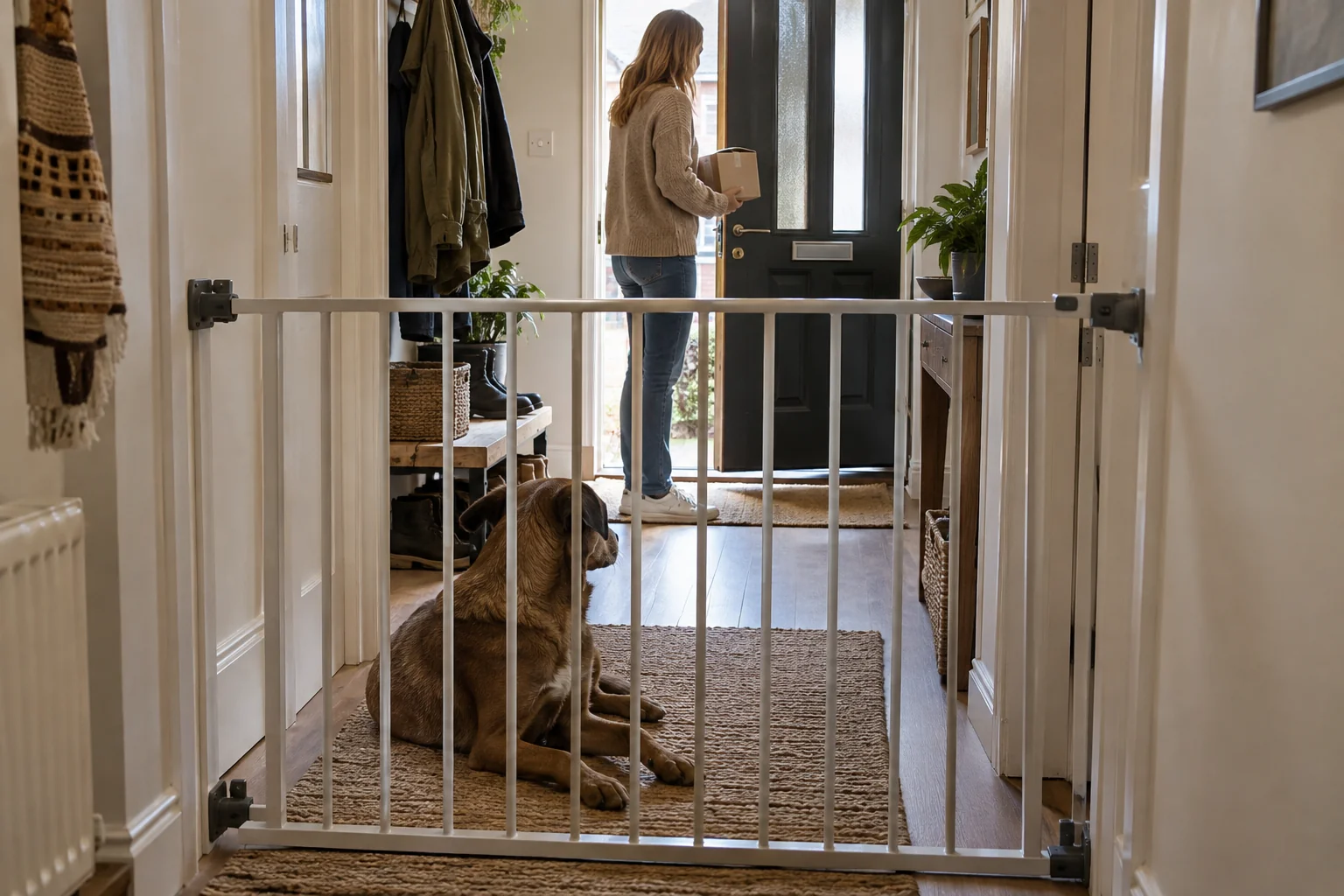
Keep visitors and deliveries out of the training exercise
A doorbell can change everything. For many dogs it predicts people, conversation and movement in the hall. A successful wait while you open an empty door does not mean the same dog is ready to remain beside it when a courier leans over a parcel. Answering the door also demands your attention. You cannot reliably watch your dog, hold the parcel, speak to a visitor and manage an open exit at the same time.
Before a delivery you expect, arrange a secure barrier or a comfortable closed room. Offer your dog something they can enjoy there if safe for that dog and your household. When the bell rings unexpectedly, close the internal barrier before you open the outer door. Tell visitors not to reach over a gate or call the dog towards it. If the dog is barking or tense, do not ask them to hold a doorway wait for the visitor's benefit. That is a different problem from crossing a threshold.
If the goal is a calmer greeting, teach an alternative away from the doorway in separate quiet sessions. For deliveries, keep using the barrier while your dog learns the threshold pause. There is no need to remove a safe barrier simply to demonstrate that training is working.
When children are visiting, separate the dog whenever you cannot actively supervise. Blue Cross guidance on dogs and visiting children recommends supervision and separation when attention is elsewhere. Children should not practise the door exercise as props, be given charge of the lead, or be expected to make a split-second safety decision at an open front door.
Work out why a particular practice falls apart
If your dog repeatedly stands up before you open the door, first decide whether standing is actually a problem. Waiting means remaining on the safe side; a relaxed stand may be fine. If they cross the boundary, shorten the opening and reward earlier. If they remain still only while your hand holds food at their nose, move the food out of sight between rewards so that the door movement, rather than a lure, becomes the signal to pause.
A dog who paws the door may have learned that paws make you open it. Step away, wait for a moment with paws on the floor and reward that moment before touching the handle. For a dog who grabs a sleeve or jumps, your movement may already be too exciting. Start with the door closed and reward from farther away, where they can keep their feet down. Stop before either of you becomes frustrated.
If barking starts, look at what is happening outside and at the dog's body. The sound may be alerting, frustration, fear or something else. Barking alone does not diagnose it. Read the whole dog's body in context, rather than drawing a conclusion from the noise alone. Cover a glass panel, move farther back or return to the internal door if you need to lower the difficulty. Do not stage knocks or ask someone to walk past repeatedly to see whether the barking improves.
A dog who normally takes food but refuses it here may be too worked up to train at this door, although appetite can change for other reasons. Close the exit safely and move to a quieter space. If you are carrying shopping and your dog has already reached the front door, do not try to rescue the lesson with a cue you have only taught beside the kitchen door. Use the barrier and carry the bags inside. You can practise later.
If waiting has improved at home but not at another house, that does not erase the learning. Door shapes, floor surfaces, people and smells have changed. Rebuild the simple version in a secure room. Do not use a stranger's unsecured front entrance to find out where the skill fails.
Know when a doorway wait needs more than training
A dog who has slipped out before needs reliable physical containment while you work. If your dog has bolted towards a road, practise at an internal door unless a secure second barrier reliably prevents access to the outside route. Ask a qualified reward-based trainer for help adapting the setup if you cannot create that safety margin.
Stop a home exercise and seek individual help if your dog snaps when moved, redirects onto a person or another animal, lunges at a visitor, panics behind a barrier, or cannot recover after a door event. Use secure separation while arranging support. A sudden change in how your dog behaves around doors may warrant a veterinary check, particularly if movement, sleep, appetite or comfort has also changed. Our guide to professional behaviour help can help you decide whom to contact.
Avoid physical pushing, lead corrections, shouting or trying to make the dog wait by repeatedly opening the door into them. The AVSAB humane training statement recommends reward-based methods and environmental management, and advises against aversives. If your current setup requires a struggle, change the setup. You can keep your dog safe without turning a busy doorway into a confrontation.
A wait is one skill among several. If the dog's main difficulty is distress at being separated from you, fear of visitors or conflict with another pet, a threshold cue will not resolve the underlying concern. Keep the entrances safe and get advice that takes the whole household into account.
Try a first session at home
Pick an internal door you can operate safely and choose a visible place for your dog to pause. With the room quiet, reward them on the safe side when you touch the handle. Open the door only as far as they can watch comfortably, reward there and close it again. After that is easy, practise a clear release into the secure room and an ending where you close the door without inviting them through.
Write down which door, opening and ending your dog could manage. The note does not need a score. “Waited while I lifted the kitchen latch; stepped forward when the door opened wider” gives you enough information for the next practice. Keep the front-door gate in its usual position in the meantime. When you eventually bring the skill to that exit, the gate or lead still has a job.
On the next real delivery, use the gate or closed room rather than testing the new cue. Practise again at the internal door when the house is quiet, adjusting the opening to what your dog managed last time.