
To teach your dog to get into the car, practise with the vehicle parked and the engine off, with no journey planned. Reward a voluntary look or approach before asking for a climb in, and let your dog move away. Check that the entry is physically comfortable, then build up to getting inside at the pace your dog can manage. Never pull them in on the lead or hold food beyond a point where they hesitate.
Getting into the car is also not the same as enjoying a journey. A dog may hop in happily and then feel sick or frightened once the car moves. This guide focuses on voluntary entry and a safe, calm transition into the car. It does not ask you to push through travel distress. The aim is willing participation, not getting the dog into the vehicle at any cost.
Choose where your dog will enter the car
Before practising, decide what “get in” should mean for your dog and your vehicle. It may mean stepping into a secured boot area, walking onto a back-seat platform, or entering a crate already safely positioned in the car. It does not have to mean jumping. A low vehicle might be easy for one dog and an awkward, painful height for another. The best version lets your dog move comfortably and gives you a practical way to secure them before the car travels.
A car combines unfamiliar surfaces, smells, sounds, movement and a high step. Your dog may have learned that opening the car door predicts a vet visit, an unpleasant journey, or being lifted when they would rather stay on the ground. Refusing to get in can be a sensible response to the whole picture, not a stubborn refusal of a simple cue. Start by finding out which part seems difficult instead of assuming the dog needs more encouragement.
Think of this as building a small chain of comfortable choices. Your dog notices the car, approaches, investigates the open doorway, puts some weight onto the entry surface, climbs in and then settles in the chosen travel area. Reward one comfortable movement at a time. An approach can be enough for today; you do not have to follow it with a climb inside or a journey.
The Dogs Trust travel guidance recommends rewarding calm behaviour near the vehicle, beginning with simply walking around it, and gradually introducing car travel. It also warns against forcing a frightened dog to travel. That is a more useful starting point than trying to install a single “in” cue and hoping it overcomes worry. The American Veterinary Society of Animal Behavior's humane-training position recommends reward-based methods for all dog training; this guide follows that boundary.
Check comfort, access and the travel setup first
Choose a time when you are not late, the driveway or parking area is secure, and the vehicle can stay parked with its engine off. Use a flat, non-slip surface around the car. Keep your dog on a comfortable, slack lead if there is any route towards traffic, but do not use the lead to tow them towards the door. If you cannot set up a safe practice area, begin indoors with a stable, low platform or arrange a more secure location. Check that the car interior is cool enough before inviting your dog inside, and never leave them unattended in the vehicle.
Look at the physical route into the car. Is the sill high? Does the boot lip move underfoot? Is there a steep drop once the dog climbs in? Can the dog turn around without slipping? Some dogs benefit from a sturdy, correctly positioned ramp or low platform, while others may prefer a different door or entry area. Any equipment must be stable, wide enough for the dog and introduced separately before you rely on it. Do not balance a loose board against the car or improvise a surface that could shift.
Consider your dog's size, age, body shape, mobility and health. A dog with stiffness, a recent injury, weakness or difficulty jumping should not be asked to leap into the car. If getting in or out has become newly difficult, or your dog hesitates in a way that suggests pain, pause and ask your vet for advice. Training can change how a dog feels about a manageable situation; it cannot make an uncomfortable movement physically safe.
Prepare the travel arrangement before the dog enters. Dogs Trust's guidance says dogs should be suitably restrained in a vehicle, for example in an appropriately secured crate, behind a boot guard, or using a correctly fitted car harness secured as intended. Choose an arrangement suitable for your car and dog, and get the dog comfortable with its parts on the ground before attaching anything. Do not let a dog ride loose or in the driver's area. A safe entry routine ends with the dog secured, not with a dog wandering around a parked or moving vehicle.
Let the parked car become ordinary
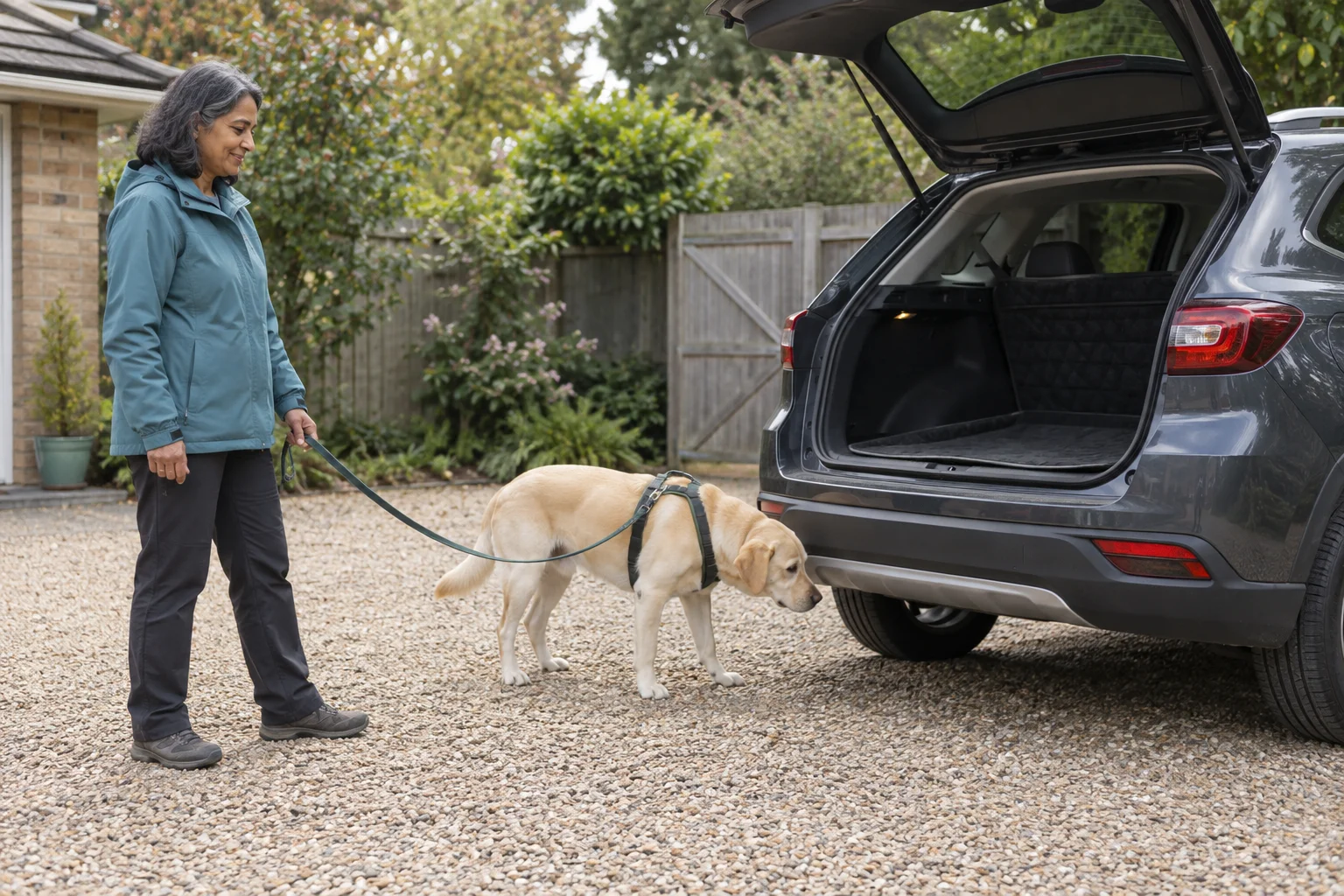
Start far enough away that your dog can notice the car and still behave comfortably. That might be the other side of a quiet driveway, or a few metres from a parked vehicle. Have a small supply of rewards ready. When your dog glances at the car, mark that moment with a quiet “yes” if you already use a reward marker, then offer a reward. You can also place a treat on the ground near your dog, so they do not have to approach the car to collect it.
Wait and watch what happens next. If your dog looks again, sniffs the air or takes a step towards the vehicle, reward that choice. Let them move away after eating. The point is not to lure the dog into a position where they feel stuck. It is to let the car predict good things while the dog retains a clear route back to a comfortable distance.
Dogs Trust specifically suggests rewarding calm behaviour near the car, even when the dog is only walking around it. Use that principle flexibly rather than requiring a sit. A dog who prefers to stand, sniff briefly and step away may be more at ease than one who sits stiffly while staring at the food in your hand. Reward the relaxed interest you can see, not a posture that happens to look tidy.
Reward your dog for approaching the open car
When your dog is comfortable near the vehicle, reward a voluntary approach to a parked door. Stand sideways rather than leaning over them. Let your dog choose whether to sniff the tyre, inspect the sill or look inside. You can drop or place a reward on the ground beside the car, then later on the sill if your dog is already happy to reach that far. Do not hold food inside the car to make the dog stretch until their front feet are committed.
The location of the reward matters. If you repeatedly toss food deep into the boot, your dog may scramble in to retrieve it and immediately jump back out. That is not necessarily a problem, but it does not tell you that the doorway, footing or time inside feels comfortable. For now, pay the small behaviour you are building: looking, approaching, sniffing, placing one paw on a stable edge or calmly investigating the opening.
Notice whether the dog returns to the car after taking the reward. If they immediately retreat, increase distance and reward there instead. If they remain nearby, sniff or offer another approach, you can reward again. Watch whether your dog chooses to approach again. A dog following a treat may be moving for the food while still feeling uneasy about the car. A dog who approaches, investigates and can comfortably pause is showing you that the current version may be ready to grow.
Build up to climbing into the car
Only work on getting inside once your dog is readily approaching the open doorway. Make the car stationary, the engine off, and the chosen travel area ready. If a crate is part of the setup, it should be secured in place and the dog should already be familiar with entering it on the ground. If a car harness is part of the setup, first ensure it fits comfortably and that its buckles, straps and attachment are familiar from a calm setting. Do not make the first encounter with restraint happen while the dog is already worried inside the car.
Choose a first movement your dog can manage. It could be leaning forward to sniff the floor, touching the sill with one paw, or placing both front paws onto a low, stable surface. Mark the movement and place the reward where your dog can eat without having to stretch or twist. Then allow them to step back out. If your dog offers a larger movement easily, reward it, but do not assume that means you need to ask for the whole climb on the next attempt.
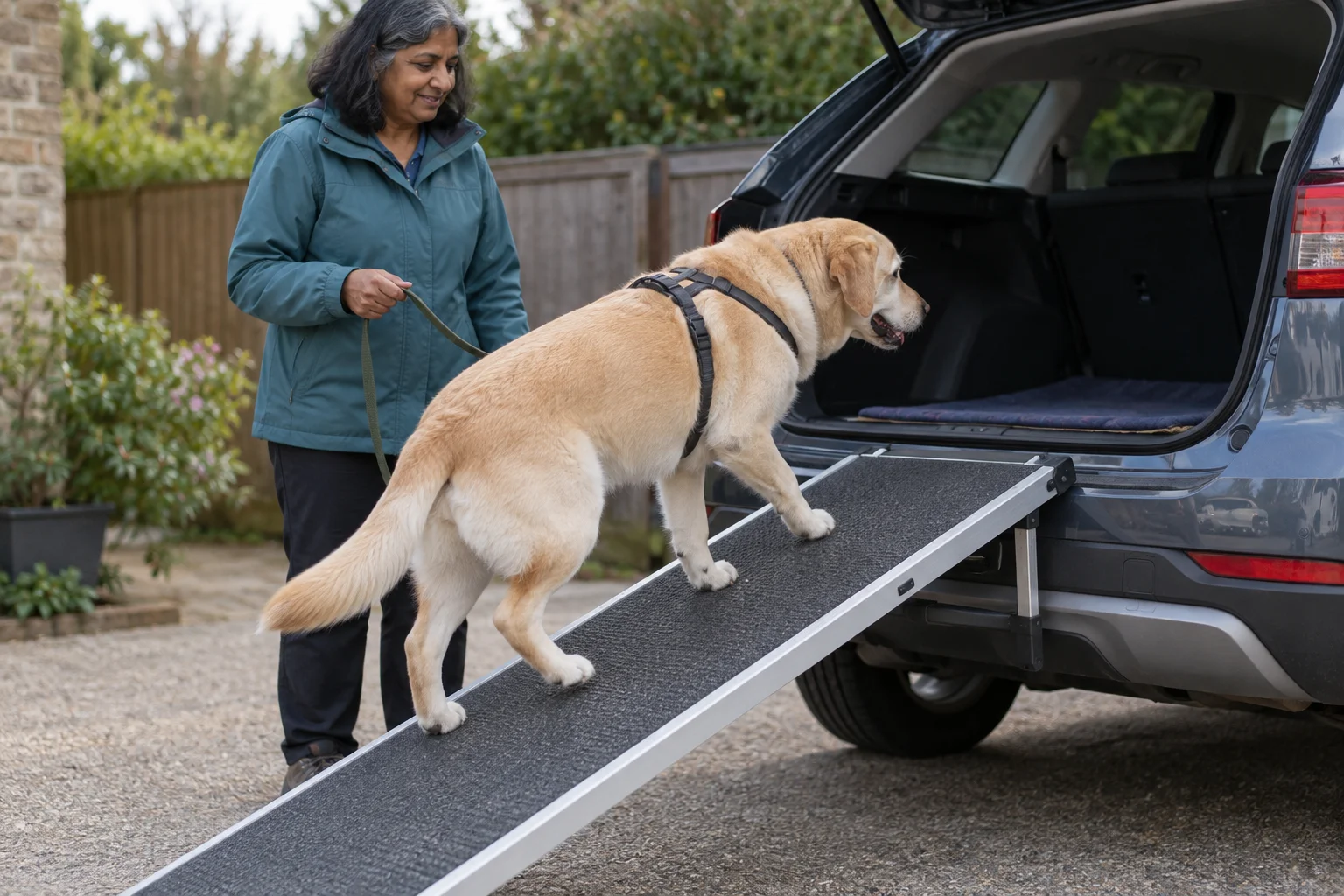
Some dogs need a ramp, a lower access point or help from a trained professional to make the movement safe. Introduce a ramp on level ground first, reward investigation and walking across it, and only then place it in a stable position at the vehicle. If the dog is wary of the ramp, work with the ramp away from the car. If the dog is uncertain about the car, keep the ramp stationary elsewhere until it is familiar. Changing one thing at a time makes it easier to see what is helping.
Avoid lifting a dog into the car as a shortcut during training. Being picked up can be uncomfortable or frightening, and it removes the choice this exercise is meant to build. There may be situations where a dog must be transported for urgent veterinary care; that is a practical emergency decision, not a training repetition. If your dog needs regular lifting because they cannot enter independently, ask your vet about mobility and a qualified reward-based professional about a safe cooperative routine.
Practise a brief pause inside with the door open
Once your dog can enter willingly, let them investigate the prepared space for a brief moment with the car still parked. Keep the door open and the route out clear. Deliver a reward inside the vehicle at a position that helps the dog remain balanced, rather than reaching over them or making them turn sharply. Then give them time to come back out. Early success might be one comfortable breath, a sniff around or simply standing with all four paws inside before choosing to leave.
Do not close the door, clip on unfamiliar equipment or start the engine as soon as the dog enters for the first time. Those are separate changes, each of which can make a previously easy entry feel trapping. Introduce any securing equipment gradually and safely, following its maker's fit and use instructions. You can practise the sound or motion of a buckle away from the car, reward calm investigation and stop if your dog moves away.
When your dog is comfortable entering and staying briefly, you can close the door partway and reopen it, provided there is no risk of catching the dog or making them feel trapped. Keep your body out of the dog's exit path. Reward calm behaviour and open the door again while the dog is still comfortable. You are not testing how long they can tolerate being shut in. You are teaching that a small door movement is predictable and ends safely.
If your dog tries to leave, let them do so if it is safe. Do not hold the door shut or tighten a lead to keep them inside. Return to a version where they can remain comfortable, perhaps with the door open or with just a paw on the sill. The ability to leave is part of what makes the invitation trustworthy. Over time, that can make it easier for the dog to choose to come back in.
Add the travel equipment as its own lesson
Safe travel requires more than a willing hop into the car. A dog must be secured appropriately before the vehicle moves. The equipment can feel unfamiliar, so teach its parts away from the vehicle first. Let your dog see and sniff the item, reward an approach, and gradually build comfortable contact. If it involves a harness, practise wearing it during calm everyday moments rather than first fastening the car attachment while the dog is in the boot.
For a crate, make sure it is suitable for the dog and can be secured in the vehicle according to its instructions. Your dog can practise entering and leaving the crate while it is stable on the ground, then relax briefly with the door open. Closing the crate door, placing it in the car and travelling are later changes, not a single combined test. Our crate-training guide covers that familiarisation at home. A dog who already has a separate crate routine may still need time to learn that the car environment feels different.
For a harness or other restraint, use the exact attachment arrangement intended for that product and vehicle. Do not improvise a clip, connect a lead to a part that is not designed for it, or leave excess line that could entangle the dog. If you are uncertain about fit or compatibility, check the manufacturer's guidance or ask your vet or a suitably qualified professional. This article cannot assess a particular product or crash performance.
Keep rewards safe for your dog and count food treats as part of their usual daily food. If food is unsuitable, use another reward your dog enjoys and can safely access in the setup. Do not leave a chew or toy in a moving vehicle unless it is appropriate for the dog, the restraint arrangement and the journey. A reward should make practice pleasant without creating a choking, distraction or entanglement hazard.
Teach a safe exit from the car
Getting into the car willingly and getting out safely are related but separate skills. An open car door may lead directly to a road, a car park or other moving vehicles. Keep your dog on a properly attached lead before you open the exit fully, and have the lead ready before releasing a crate or undoing the travel restraint. If you cannot control the exit safely by yourself, ask another adult to help or choose a safer parked location for practice.
You can teach a pause and release at a quiet internal door before using the same idea at the vehicle. The public guide to teaching a dog to wait calmly at the door covers how to practise a threshold pause with a safety backup. At the car, keep expectations modest: the dog waits while the door opens enough for you to attach the lead, then leaves when invited and safe. The cue is not a substitute for physical control or a secure location.
The Dogs Trust travel guidance recommends a controlled, calm exit and advises against allowing a dog to leap out excitedly. That is especially important when you do not know what is on the other side of the door. Before every real exit, check the surroundings, attach the lead and confirm that you have enough room to guide the dog away from traffic. Keep the lead attached when you open the exit.
If your dog won’t get into the car
If your dog will not approach the vehicle, start farther away and reward calm attention there. Check whether the car's engine, a door alarm, a neighbour's movement or the location itself has changed the picture. Try again at another quiet time without calling the dog repeatedly. If the dog is more relaxed when the car is parked somewhere else, location may be part of the difficulty.
If your dog approaches but will not put a paw on the sill, do not repeat “in” louder or wave food farther into the car. Reward an easier choice, such as standing near the doorway or sniffing the opening. Check the surface for heat, cold, movement or an unfamiliar smell. Make the entry physically easier if possible, or accept that this dog may need a ramp, different vehicle access or help from a professional.
If your dog climbs in and immediately scrambles out, allow the exit and make the next repetition easier. Perhaps the car feels too enclosed, the footing is slippery, the door is closing too soon or the dog has not learned that they can leave. Keep the door open, reward calmly and finish after a comfortable moment. Do not trap the dog in the vehicle to prove that they can stay.
If the dog takes treats but looks tense, stops eating, freezes, pants heavily, trembles, repeatedly tries to escape or cannot settle after leaving, end the practice and create distance. Food does not prove that the dog is comfortable. Our guide to reading your dog's body language in context explains why you need to consider the whole dog and the situation rather than a single sign. Return another day at an easier level only if the dog recovers readily and the issue appears mild.
When car reluctance needs veterinary or behaviour help
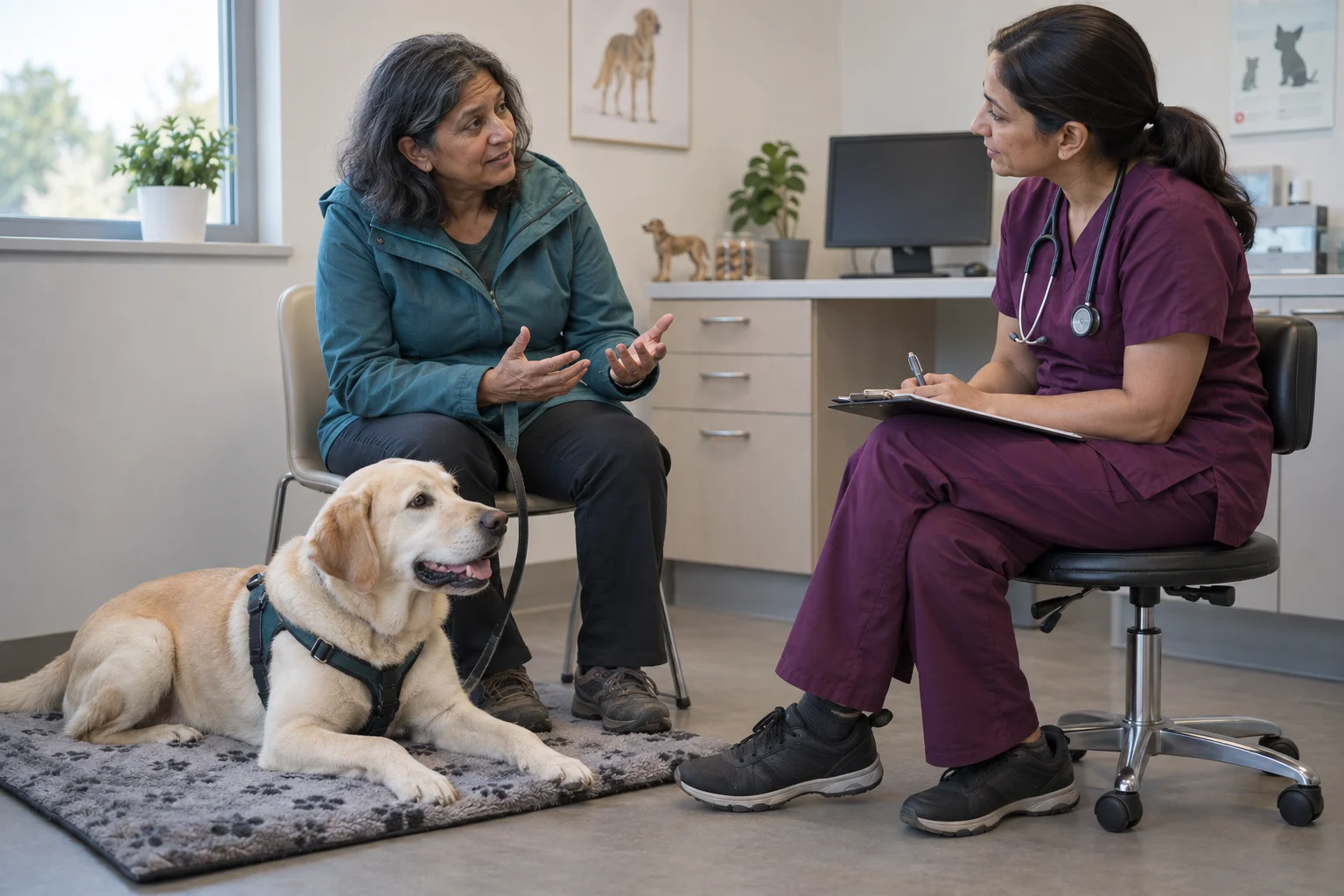
Some dogs enter the car because the movement into it is manageable, then become distressed when doors close, the engine starts or the vehicle moves. Others may hesitate at the car because past journeys made them feel ill. Do not assume that the right treat or a stronger entry cue will resolve either problem. Vomiting, heavy drooling and repeated lip-licking can be signs of travel sickness, as VCA’s veterinary guidance on motion sickness explains. They do not establish a diagnosis on their own. Ask your vet about these signs, refusal of usual food or persistent distress instead of continuing entry practice.
Dogs Trust says not to force a frightened dog to travel and recommends seeking experienced behaviour support. Where a journey is unavoidable, speak with your vet about the safest plan rather than using a home exercise to override fear. Your vet can consider physical health, motion sickness and appropriate treatment. If fear is persistent, a qualified reward-based behaviour professional can help you plan a gradual approach without staging a stressful ride.
If a dog who previously entered easily suddenly refuses, seems stiff, struggles to jump or reacts when handled, stop and ask a vet to check for a physical cause. If the dog growls, snaps, panics or risks injury while being moved, do not attempt to lift, restrain or coax them alone. Use safe distance and qualified help. This guide is for ordinary, low-pressure learning, not for resolving entrenched fear or handling risk.
Plan your first parked-car practice
Choose a quiet time when you do not need to go anywhere. Prepare the travel area and a reward your dog can safely enjoy. Start at the distance where your dog can look at the parked car, move comfortably and take the reward if they normally would. Mark and reward a glance or a calm approach, then let the dog walk away. If that is the only thing you do, the practice has still served a purpose.
At another calm opportunity, reward a voluntary sniff near the open doorway. If your dog approaches happily, reward a paw on a stable edge, then allow them to step back down. Keep the car door open and the engine off. Do not aim for a full entry unless your dog is already offering the earlier choices with ease. A handful of relaxed moments is enough; there is no schedule to catch up with. For help keeping practice manageable, see our guide to short dog training sessions.
Make a brief note afterwards: where you practised, how close your dog chose to come, what they explored, and when they moved away. That is not a scorecard. It helps you repeat the comfortable version rather than accidentally raising the difficulty next time. If your dog was hesitant, make the next session easier, not longer.
When voluntary entry becomes easy, practise brief time inside with a clear way back out, then introduce the travel restraint and any door movement separately. Only after the dog is comfortable with the full stationary setup should you consider short travel practice, and that is a different goal from entry. Stop if your dog becomes worried or seems uncomfortable. Leave the next journey out of your practice plans until you have a safe arrangement your dog can manage, with individual advice where needed.
For more everyday training guidance, browse DogTrainingScout's training guides.