
To crate train a dog, start with the door secured open and reward your dog for choosing to investigate, enter and rest inside. Introduce door movement only when that is comfortable, then try a brief closure while you stay nearby. Let your dog’s response set the pace. If they become worried, return to an easier version or stop.
Crate training is not essential for every dog. A bed, gated room or suitable pen may work better, and some dogs are more relaxed without confinement. If you choose a crate, teach comfort with it as a separate skill from being left alone. A dog who will nap with the door open has not automatically learnt to cope with a closed door or an empty house.
This guide is for ordinary, low-pressure familiarisation. It is not a treatment plan for panic when alone, confinement distress, aggression, or a dog who may hurt themselves trying to escape. Those situations need individual help. Watch whether your dog approaches, enters and leaves voluntarily, and whether they remain comfortable as you introduce a small change.
Decide whether a crate suits this dog
Start with the reason you want a crate. It might provide a quiet retreat with the door open, help you supervise a puppy briefly, or make a familiar place available during travel. A crate is not a cure for chewing, barking, toileting indoors or distress when alone. It cannot teach a dog to feel safe by keeping them inside while they are frightened.
Some dogs choose enclosed resting places; others prefer an open bed or more room to move. Consider what you have seen your dog choose at home. If they avoid small spaces, become worried behind barriers, or have already struggled in a crate, a pen or dog-proofed room may be a kinder starting point. You do not have to prove that a crate will work.
The RSPCA's guidance on crates and playpens frames the crate as a possible safe haven, not a punishment or a way to suppress unwanted behaviour. Before using a crate for a planned period, give your dog time to learn that it is a comfortable place to be. If they show distress when the door closes, reconsider the arrangement.
For broader practice planning, our guide to management and dog training explains how arranging the environment can prevent difficult situations without treating confinement as the only solution.
Choose a safe, comfortable setup
Your dog should be able to stand without crouching, turn around, lie down naturally and stretch out. Check the dimensions with your dog in the position they actually rest in, rather than relying only on a weight chart. A growing puppy needs room to develop, but the available space still needs to work for resting and safe movement. If you travel, follow the vehicle restraint and crate guidance relevant to that journey; a home setup is not automatically safe in a car.
Place the crate where your dog can rest without being isolated from ordinary household life or placed in the middle of constant traffic. Avoid direct sun, draughts, radiators and noisy appliances. Provide a comfortable surface if your dog does not chew or swallow bedding. Anything left with your dog must be suitable for them without supervision. Remove anything they shred, ingest or become possessive about.
A water bowl should be available when the dog is confined, secured so it is less likely to tip. Keep the door fixed open during early exploration so it cannot swing shut unexpectedly. Check the latch, floor and edges for sharp points, damaged wire or gaps that could catch a collar or paw. Follow manufacturer guidance for the particular crate.
The PDSA's veterinary crate-training guide emphasises comfort, water, a suitable location and gradual reward-based introduction. Its practical details are useful, but no generic setup overrides your dog's response. If your dog pants in a cool room, chews bars, or cannot lie comfortably, adjust the arrangement and seek advice rather than adding more time.
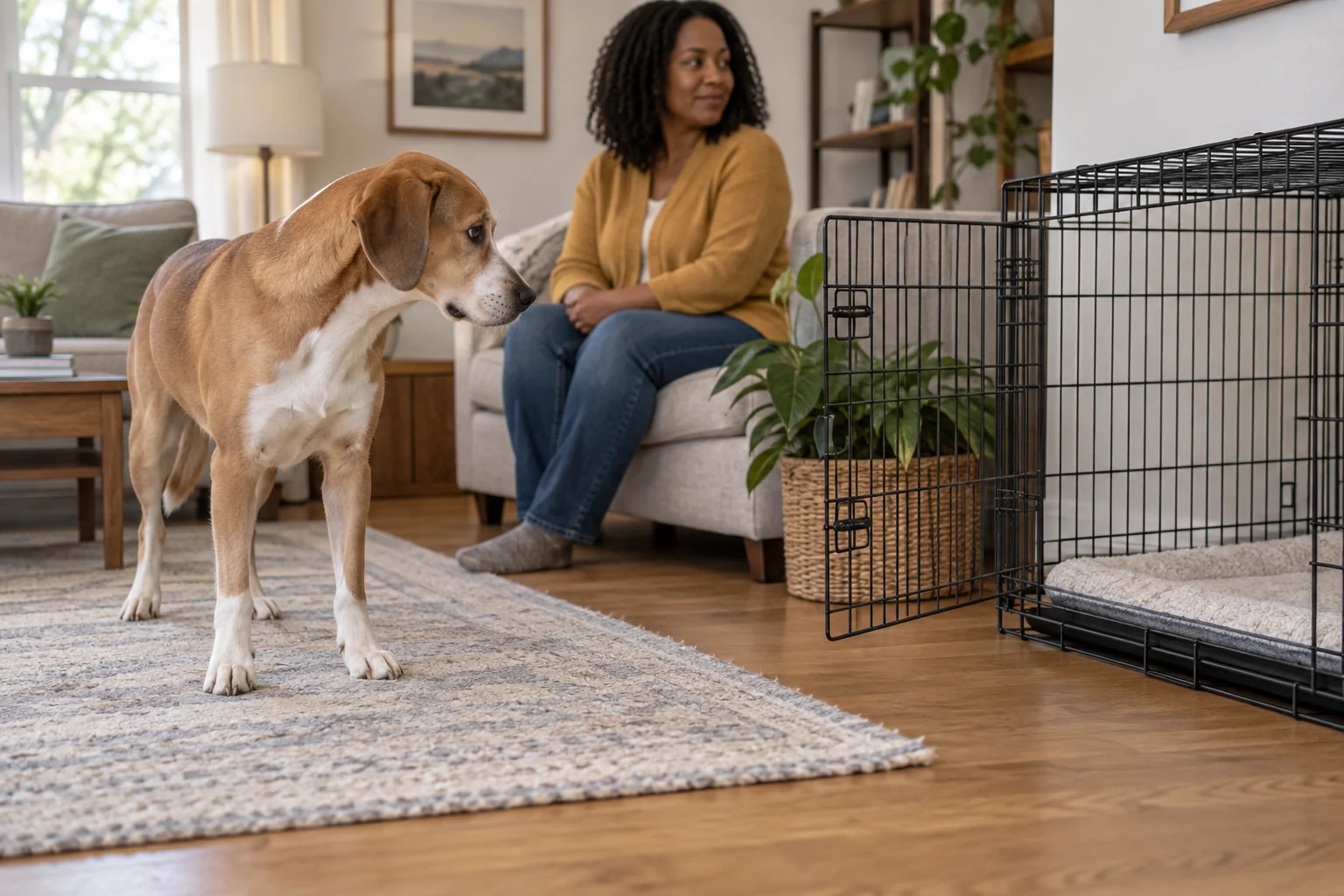
Let your dog investigate without a closed door
Set the crate up before inviting your dog over. Secure the door wide open, sit nearby without leaning over the entrance, and let your dog notice it at their own pace. If they look towards it, sniff it or walk near it, you can quietly place a treat on the floor at a comfortable distance. Keep the reward where your dog can reach it without stretching past a point where they hesitate. The guide to choosing training rewards can help you find something suitable for quiet practice.
If your dog readily approaches, place a few pieces of their usual food near the entrance and later just inside. Let them choose whether to reach in, put their head through, or take a step inside. Dogs Trust also advises fixing the door open during early introductions so a dog can come out quickly and easily (crate and playpen guidance).
Avoid pushing, lifting or pulling your dog into the crate. Do not wave food deeper and deeper while they stretch uncomfortably to reach it. If they take the food and retreat, that is a useful choice. Keep the next reward closer to the entrance, or simply leave the crate available with the door secured open.
You are looking for easy, voluntary investigation, not a full entry on the first try. Some dogs walk in immediately; others may need the crate to be part of the room for a while before approaching. Do not interpret hesitation as stubbornness. If your dog freezes, repeatedly scans the room, refuses food they normally enjoy or moves away, give them space and make the environment easier.
Make entering and leaving predictable
When your dog is comfortable approaching, reward small choices that bring them nearer: looking inside, putting their nose over the threshold, or stepping in and stepping back out. Place the reward on the floor so your hand does not need to reach over your dog. Keep your body angled sideways and let the dog choose how much of their body enters.
The open doorway matters. Let your dog leave whenever they want, then allow time before offering another opportunity. If they keep returning, you can reward a little more generously while they are inside. If they leave and do not come back, end the practice. Repeating an invitation after the dog has opted out can turn choice into pressure.
Once entering is relaxed, you can introduce a simple cue such as “crate” immediately before your dog chooses to go in. Say it once, then allow time. If they do not move, do not repeat it or guide them physically. Use it only when entering already looks easy and comfortable. You can also skip a verbal cue entirely if it is not useful in your household.
A consistent release word can help make the end of a brief practice clear. Say it while the door is open, then let your dog walk out. Do not use the release to call them out when they are worried, and do not make them wait for permission before every ordinary movement during early learning. Keep ordinary movement through the open doorway easy while your dog is learning.
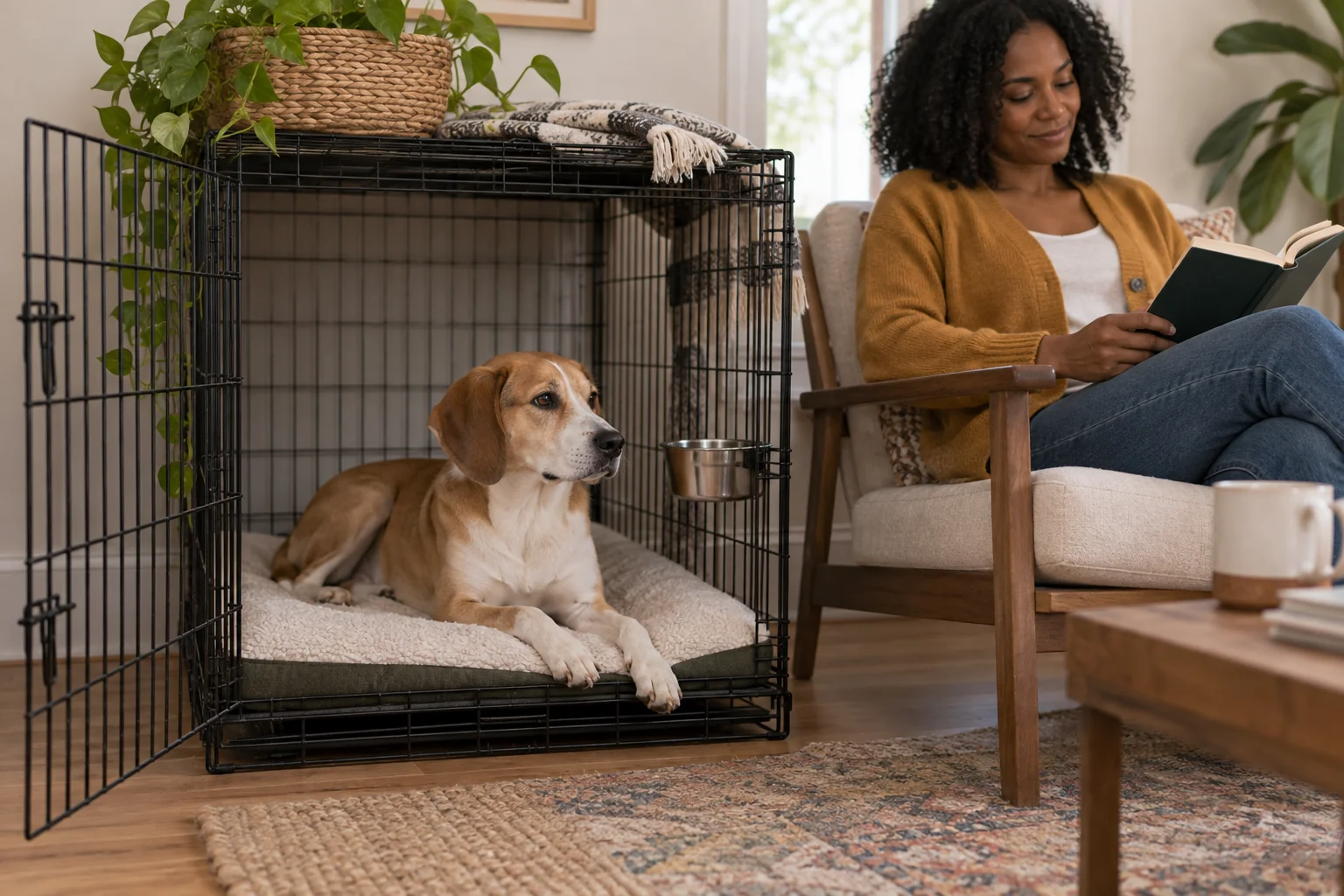
Reward comfort, not just being inside
A dog can enter a crate and still feel uneasy. Watch the whole picture: loose movement, ordinary sniffing, taking food normally, choosing to lie down, and being able to leave and return are more useful than simply counting all four paws inside. Read these observations together, using our guide to dog body language and context if you need help looking beyond one isolated signal.
When your dog is comfortable inside with the door open, calmly place a treat between their paws or give a safe activity they already enjoy. Keep your voice and movements low-key. If you make the crate exciting with constant calling, reaching and praise, your dog may stay alert to you rather than relax. Quiet rewards can make resting easier to choose.
Do not make food the price of enduring fear. If a dog grabs food and then scrambles to leave, the food has not shown that they are comfortable. Give them an easier option, increase the distance from the crate, or stop for now. If they will not eat when they normally would, that can be a sign the situation is too difficult, though appetite also has other causes.
It can help to notice calm choices outside the crate too. If your dog already has a familiar bed where they rest comfortably, continue to make that available. Keep other resting places available too. For a separate skill involving relaxed time on a portable surface, see how to teach your dog to settle on a mat.
Introduce door movement before closing it
Before you close the door, make sure your dog can enter and remain inside voluntarily while it stays open. Then practise tiny movements that do not trap them: touch the door, move it a few centimetres and return it to its open position. Reward relaxed responses if your dog remains comfortable. If the door movement startles them, stop and return to simply having the door still.
Later, move the door partway towards the frame and immediately reopen it, while you remain beside the crate. Do not latch it yet. Give your dog a choice to leave after each easy repetition. Watch your dog while the door moves, and repeat only the amount of movement they handle comfortably.
Only when those movements are unremarkable should you briefly close the door, then open it before your dog becomes concerned. At first this may be a moment, not a prolonged interval. Stay close and keep the session quiet. If your dog stiffens, paws at the door, stops taking food or tries to leave, open it calmly and make the next attempt easier or end the session.
Do not wait for escalating crying or panic to stop on its own. Vocalising can signal a need to toilet, discomfort, fear or frustration. You cannot reliably decide that it is merely protest by ignoring it. Check what your dog is communicating, and prevent practice from reaching distress. This is especially important for puppies, dogs with medical needs and any dog whose history is unknown.
Build time only while your dog stays at ease
Once a closed door for a brief moment is easy, vary the length gently. Open it while your dog is still comfortable, not only after they have begun to complain. Keep the ending predictable, so your dog does not need to struggle to get out.
Change one feature at a time. First build a little more time with you sitting nearby. On another occasion, you might shift your chair or stand briefly while remaining visible. Do not combine a longer duration, a person leaving the room and a new location into one test. When several things change together, you cannot tell what made the task difficult.
Use a camera only if it helps you observe a short, already comfortable practice and does not replace supervision or professional advice. A recording may show pacing, panting, repeated door checking or other behaviour you could not see while out of sight. Do not use a camera to justify leaving a worried dog confined for longer than they can cope. Our guide to keeping a useful dog behaviour diary can help you note what happened and what changed without treating one clip as a diagnosis.
There is no universal duration that every dog should reach. Age, toileting needs, health, temperament and previous experience matter. The PDSA advises never leaving a dog in a crate for more than three hours and warns that some cannot manage even that long. That upper limit in its general guide is not a training target or a suitable duration for every dog. Follow current veterinary guidance for your dog, and arrange care that permits regular movement, water, toileting and social contact. A crate is not a workday solution simply because a dog has been introduced to it.
Treat being alone as a separate skill
A dog may be relaxed in a crate while you sit beside it but distressed when you leave. Being behind a barrier and being alone are different challenges. Practise them separately. First establish that the dog can comfortably remain in the open or briefly closed crate with you present; do not assume that means you can leave the house.
If your dog is calm with the door briefly closed, you might shift your position a small amount while staying in sight, then return. Keep the change short and ordinary. Do not make departures a test of endurance. If your dog begins to vocalise, pant, drool, scratch, bite the crate or repeatedly throw themselves against it, stop using the crate as a way to manage absence and seek help.
A crate can worsen distress for some dogs who panic when separated or confined. PDSA advises veterinary or qualified behaviour support where separation-related difficulty is suspected. Speak with your vet if your dog cannot settle when alone, has injured themselves, or shows a sudden change. A reward-based clinical behaviour professional can help assess what is happening and plan appropriate support. Our guide to when your dog needs professional behaviour help explains how to find the right kind of help. This article does not provide a separation-anxiety programme.
For puppies, build independence in a safe, age-appropriate way and plan frequent care rather than relying on long confinement. For adult dogs, previous experience still matters. A rehomed dog may have learned to fear a crate, and a dog who was comfortable months ago may be struggling now because of pain, illness or a change at home. Start from what this dog can manage today.
Use the crate for real life without turning it into a test
Once your dog is comfortable in familiar practice, consider the specific everyday use you have in mind. A crate that works in the sitting room may feel different in a busy kitchen or unfamiliar home. Move it only if it is safe to do so, and repeat easy open-door exploration in the new place. A new location can make a known skill harder.
If you need a crate for travel, follow the vehicle and airline rules that apply and choose equipment designed for that use. Secure it as directed and check that your dog can maintain a safe, comfortable position. A household wire crate should not be presumed suitable for every vehicle. Ask your vet about travel if your dog has a health or mobility concern.
When the crate is not being used for a short, planned period, secure the door open so the dog can enter and leave safely. Keep household members from disturbing a resting dog. Children must not climb into, reach into or use the crate as a play area. The dog should always have another safe place to rest and should not be shut away as punishment for normal behaviour.
If you need a barrier because your dog is not yet ready to be unsupervised around a particular item or room, compare options rather than assuming a crate is best. A dog-proofed room or sturdy pen may give more room and choice. Management can keep everyone safe while you address the actual training need. Choose the arrangement your dog handles comfortably.
Troubleshoot by making the next try easier
If your dog will not approach the crate, stop luring them towards it. Check whether it wobbles, smells unfamiliar, is too hot, sits in a busy walkway or has a door that moves. Move it, secure the door or offer food farther away. You can reward calm looking from a distance before asking for any closer choice.
If your dog enters but darts straight out, let them. Reward the approach and exit, then make the next invitation easier. Do not close the door to prevent them leaving. If they will enter for food but refuse to stay, the food may be drawing them further than their comfort allows. Place it nearer the entrance or stop using a lure and wait for voluntary exploration.
If your dog becomes worried only when the door moves, return to door-still practice. If worry appears after the door closes, shorten the closed-door moment and remain closer. If concern starts when you move away, do not continue increasing distance. These are different points in the process, so reduce the specific change that caused difficulty rather than repeating the whole exercise unchanged.
Record a few plain observations: where the crate was, what happened just before discomfort, how your dog moved, whether they ate normally and how quickly they recovered. Avoid labels such as “stubborn” or “manipulative”. Concrete notes are more useful if you speak with a vet or behaviour professional. If the response is intense, worsening or includes attempts to escape, stop DIY confinement practice and get help.
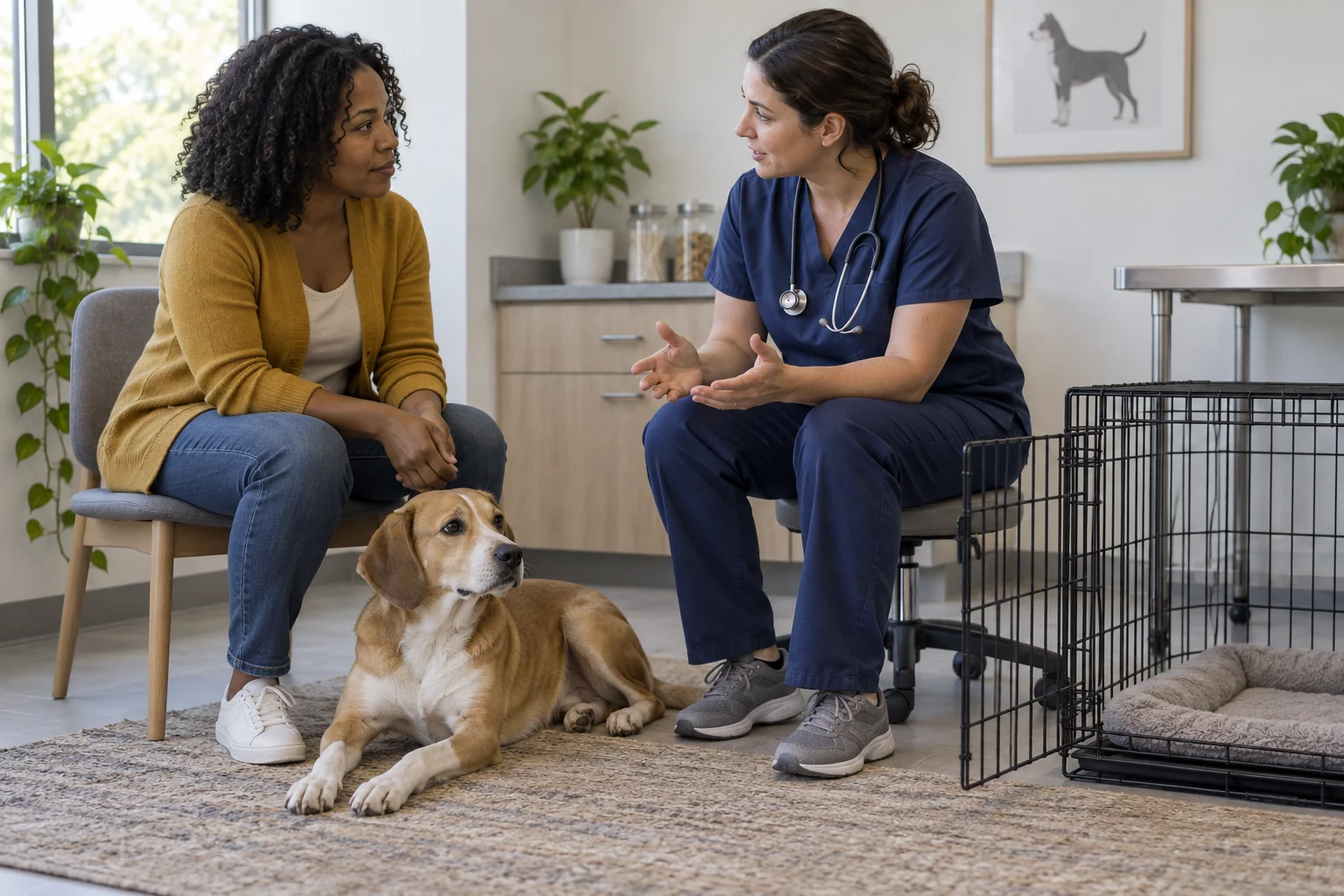
Know when a crate is not the answer
Never use a crate as punishment or to contain a dog who is panicking. Do not use it to force rest or stop your dog communicating. Do not leave a dog confined without water or beyond their physical and emotional capacity. Toileting accidents, destruction or barking may reflect unmet needs, stress, illness, age or insufficient support; they are not proof that a dog needs longer in a crate.
Contact your vet if your dog has a sudden change in tolerance, pain, difficulty breathing, repeated soiling, injury or another health concern. Seek a qualified reward-based behaviour professional for persistent fear, escape attempts, aggression, severe distress or a history that makes confinement risky. If people or other animals could be harmed, use safe separation and get individual advice rather than experimenting with the crate.
You may decide to keep the crate open as a place your dog chooses to nap. A pen, room or bed may suit them better. Choose a safe arrangement that meets the practical need while allowing your dog to rest comfortably.
This week, you can set up the crate with the door secured open, make sure it is comfortable, and let your dog investigate without pressure. If they choose to approach, reward that choice and let them leave. Finish while your dog is comfortable, and note how they responded before deciding what to try next.