
To stop your dog begging at the table, make one rule for everyone: nobody gives the dog food from their plate or from the table. Then give your dog something better to do. Before the meal, set up a comfortable bed several feet from the table, where your dog can still see you. Feed your dog their own meal first. During the meal, one adult rewards your dog at that bed with treats from a separate pot, never with food from anyone's plate.
When nobody can do that, keep your dog away from the table with a gate or a closed door, but only if your dog settles calmly there. If your dog growls, stiffens or snaps around food, or becomes distressed when shut away, that is not ordinary begging. Read the safety guidance below before you start.
This guide covers begging during human mealtimes. Grabbing food from the kitchen counter while you cook is covered in the guide to stopping counter surfing.
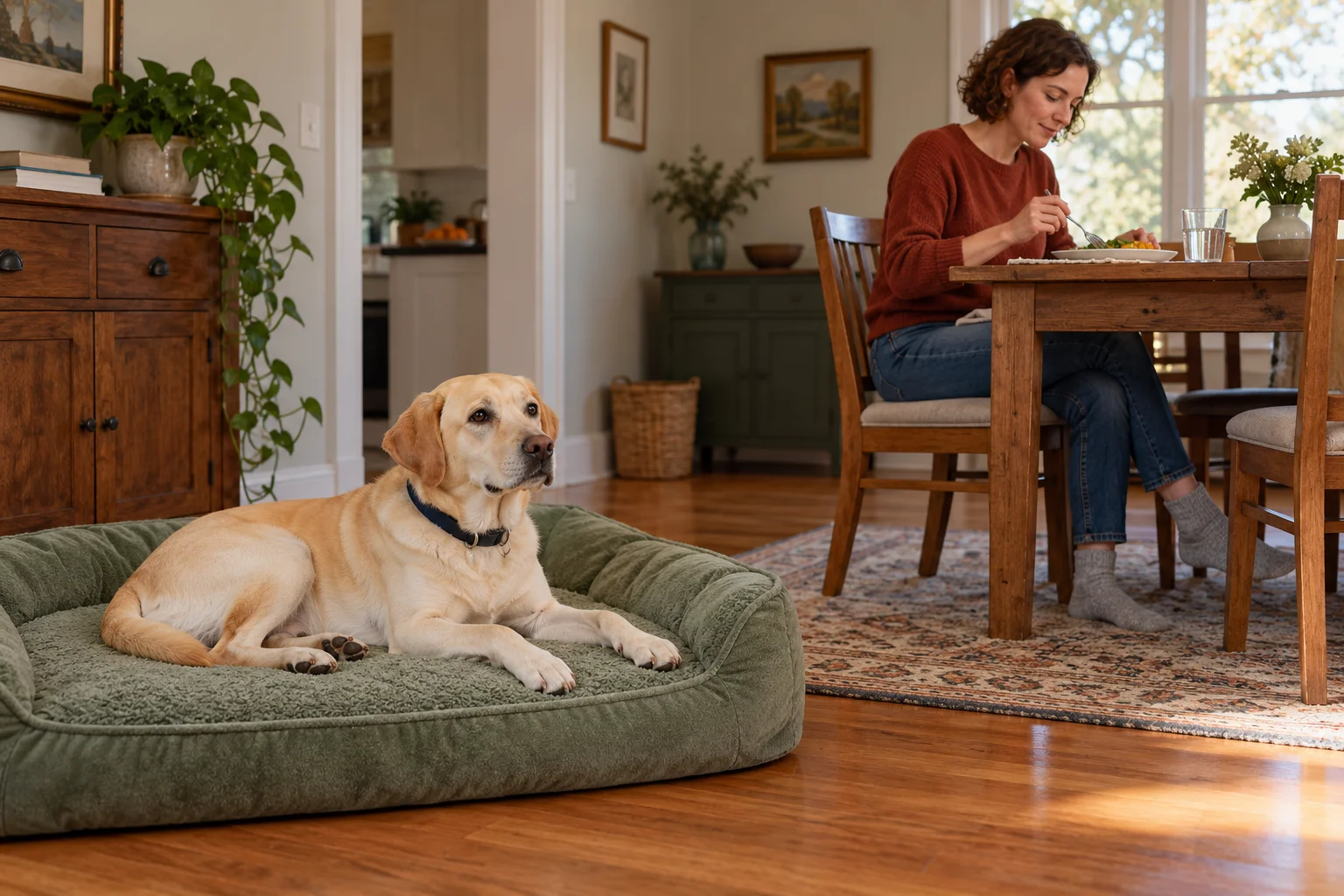
Stop feeding your dog from the table
Begging usually keeps going because it has paid off in the past. Whole Dog Journal's article on preventing begging, by behavior consultant Nancy Tucker, CDBC, CPDT-KA, explains that a dog who gets food after nudging, staring or pawing at the table learns that those behaviors work. The kind of food matters much less than where and when your dog gets it.
That gives you one rule to keep: diners never hand food to the dog. That means no scraps passed under the table, no crusts offered from a plate and no dropped food left on the floor for the dog. The Ontario SPCA's advice on dogs and the dinner table says everyone in the household needs to agree on no food from the table, because even occasional exceptions teach your dog that waiting pays off.
This rule does not mean your dog gets nothing during the meal. Food can still be part of training, as long as it is planned and goes to the right place:
- Diners: no food to the dog, ever, while sitting at the table.
- The person training: gets up from the table and delivers treats from a separate treat pot to your dog's resting spot.
Keeping those two jobs separate is what stops the table itself from becoming a place where food appears.
Check for guarding, distress or appetite changes
Ordinary begging looks hopeful. Your dog sits or stands near the table, stares, drools, nudges a knee, paws at you, whines or barks. They are interested in your food, not worried or threatening.
Some behavior around meals needs a different plan. Keep the cases below out of this begging exercise and get help.
Guarding, threats or a bite history
Stop and get help if your dog:
- Stiffens, freezes, growls, lifts a lip or snaps when someone moves near their food, a chew, or food that has fallen on the floor.
- Has bitten anyone, around food or at any other time.
For these dogs, set up meals so nobody comes near your dog while they have food. Give your dog's own meal and any chews where people won't pass by, keep people (especially children) away from them while they eat, and pick up dropped food before your dog can reach it. Do not reach for food your dog has, and do not try the bed-and-treats exercise in this guide.
Distress when separated from the family
Also keep this exercise on hold if your dog becomes frantic when shut away from you: howling or barking that keeps building, scratching at doors, trying to escape, or not settling at all.
Do not shut a dog like this in another room or behind a gate to stop begging. Keep them in the same room as the family during meals, in sight of you, and use the no-food-from-the-table rule. If you need a little more distance from the table, place your dog's bed farther away within the same room, or have one adult sit near the bed with your dog while others eat.
If your dog guards food and also becomes distressed when separated, do not choose between these setups on your own. Keep meals as simple and calm as you can, and get help before you change anything.
Getting help
For any of these dogs, talk to your vet, who can check for health problems and refer you to a qualified, reward-based behavior professional. The guide to when to seek professional behavior help explains how to find the right person.
A sudden change also deserves a vet check. If your dog suddenly seems much hungrier than usual, or starts begging far more intensely than before, mention it to your vet rather than assuming it is only a training problem.
Choose a resting spot away from the table
Pick one spot where your dog will stay during meals. A dog bed, mat or folded blanket works well.
Place it:
- Several feet from the table, so your dog cannot reach plates, laps or the table edge.
- Where your dog can still see you. Being close to the family may be part of what draws your dog to the table.
- Out of the path people walk to bring food in and out.
- On a surface that does not slip, with enough room for your dog to lie down comfortably.
Keep the resting spot within sight of the table, but beyond reach of food. Try a little more distance if your dog keeps leaving to approach diners, or a little less if being farther from you makes it harder to stay. Never move the bed within reach of plates or laps.
Your dog does not need to lie down. Sitting, standing or lying on or beside the bed all count. The goal is a dog who stays near their spot during the meal instead of at the table, not a dog held in one position.
Teach your dog to use the bed before mealtimes
Do not wait until dinner to introduce the bed. Your dog needs to know the spot is a good place to be first.
A few times a day, outside mealtimes, take a small handful of your dog's kibble or small treats. Stand near the bed. When your dog looks at it, sniffs it or puts a paw on it, place a treat on the bed. Let them eat it, then walk away. Repeat this a few times per session. You can also toss a treat onto the bed when your dog wanders past.
Once your dog approaches the bed freely, try a brief rehearsal before expecting them to stay during a meal. Put a snack at the table, invite your dog to the bed and place a treat there. Sit down, then get up to reward again while your dog is still comfortably at the bed. Start with a pause short enough that they can stay there easily. If that goes well, try taking a bite of your snack before returning with the next reward.
If your dog leaves as soon as you sit down, shorten the pause or return to practice without food on the table. Use a comfortable management arrangement while you eat rather than asking for a whole meal's worth of waiting. If they avoid the bed itself, try a different one or move it somewhere quieter.
You can begin this brief practice without teaching a formal mat cue. For a cue and longer relaxed periods, the guide to teaching your dog to settle on a mat explains how to build the skill. Keep early mealtime practice within what your dog can comfortably manage now.
Get your dog ready before you sit down
A hungry, bored dog with a full bladder is more likely to hover at the table. Before the meal:
- Feed your dog their own meal before you eat, or at the same time in another spot. Whole Dog Journal and the Ontario SPCA both suggest feeding your dog before the family sits down.
- Give them a chance to go to the toilet.
- Make sure fresh water is available.
- If you can, fit in a walk or a short game earlier in the day.
Then get your own setup ready. Put a small pot of treats on a shelf near the dog's spot, or on a side table, not on the dining table. Use small pieces of your dog's own kibble or low-value treats, taken from their daily food allowance, so mealtime practice does not add up to overfeeding.
Choose who is training. One adult takes the job for the meal. Everyone else simply eats and follows the no-food rule.
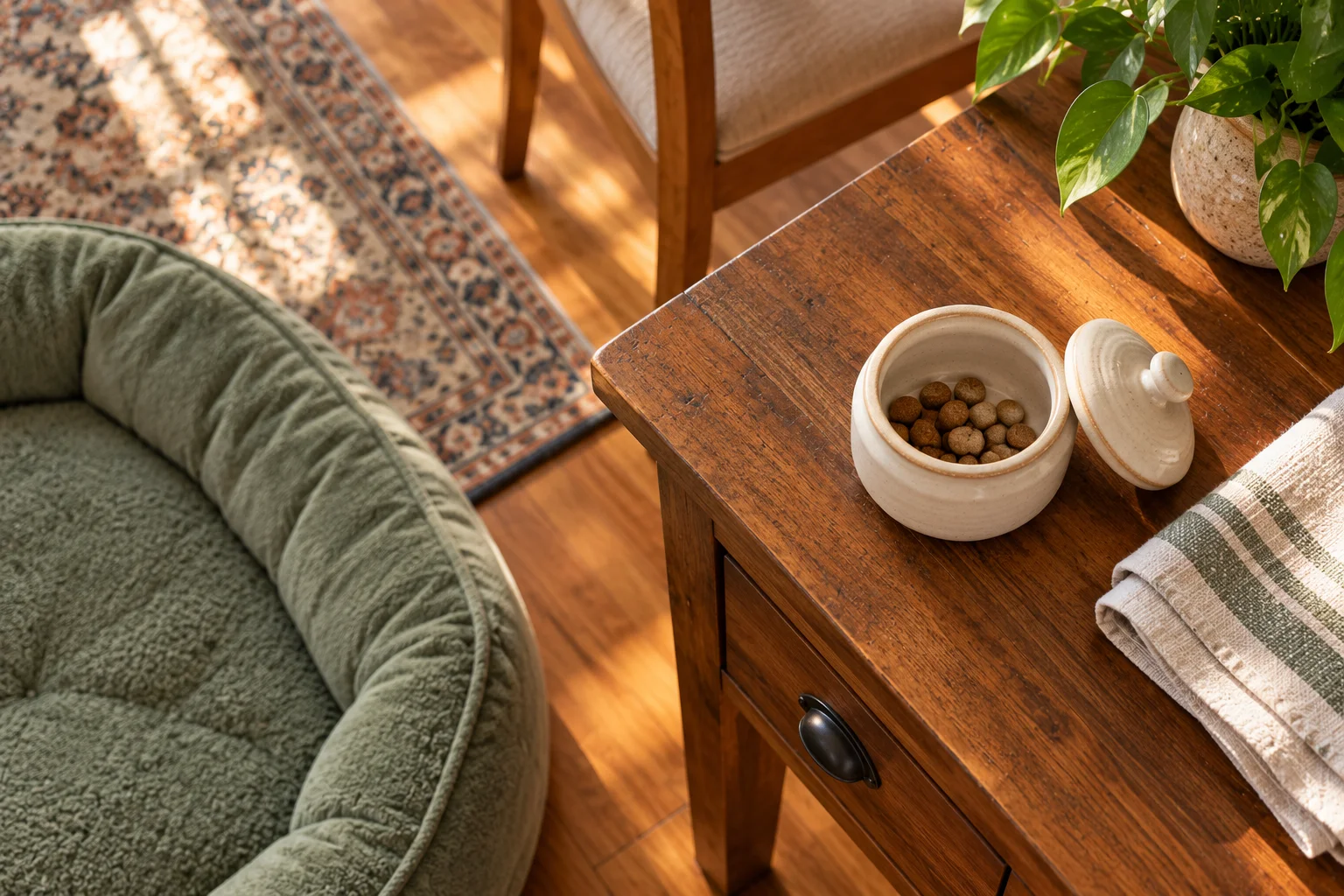
Pick a chew or a barrier that suits your dog
A chew or food toy can keep your dog busy at their spot, and a barrier can keep them away from the table when nobody can train. Neither suits every dog, so check each one.
Chews and food toys
Whole Dog Journal, Vetstreet and the Ontario SPCA all suggest a long-lasting chew or a food-stuffed toy on the dog's bed during meals. Before you use one:
- Choose something your dog has already had safely. Vetstreet's guide to choking hazards notes that rawhide and dental chews both require supervision. Check with your vet if you are unsure what suits your dog.
- Keep it within sight while your dog chews, and take away any small pieces that could be swallowed.
- Count edible chews as part of your dog's daily food.
- Skip chews if your dog guards them, or if another pet will be nearby. Give each dog their chew apart from the others, using a separate room only for a dog who is comfortable there.
Some dogs leave a chew to come and beg anyway. If that happens, use rewards at the spot or a barrier instead.
Gates, doors and crates
A baby gate across the dining room door, or a closed door with your dog in another room, stops them from reaching the table. This suits dogs who settle comfortably on their own. Do not use it for a dog who barks, scratches or panics when separated from the family. Keep them in the same room instead, as described in the section on distress, and get help.
A crate is only an option if your dog already rests in one happily. The guide to crate training explains how to introduce one without rushing.
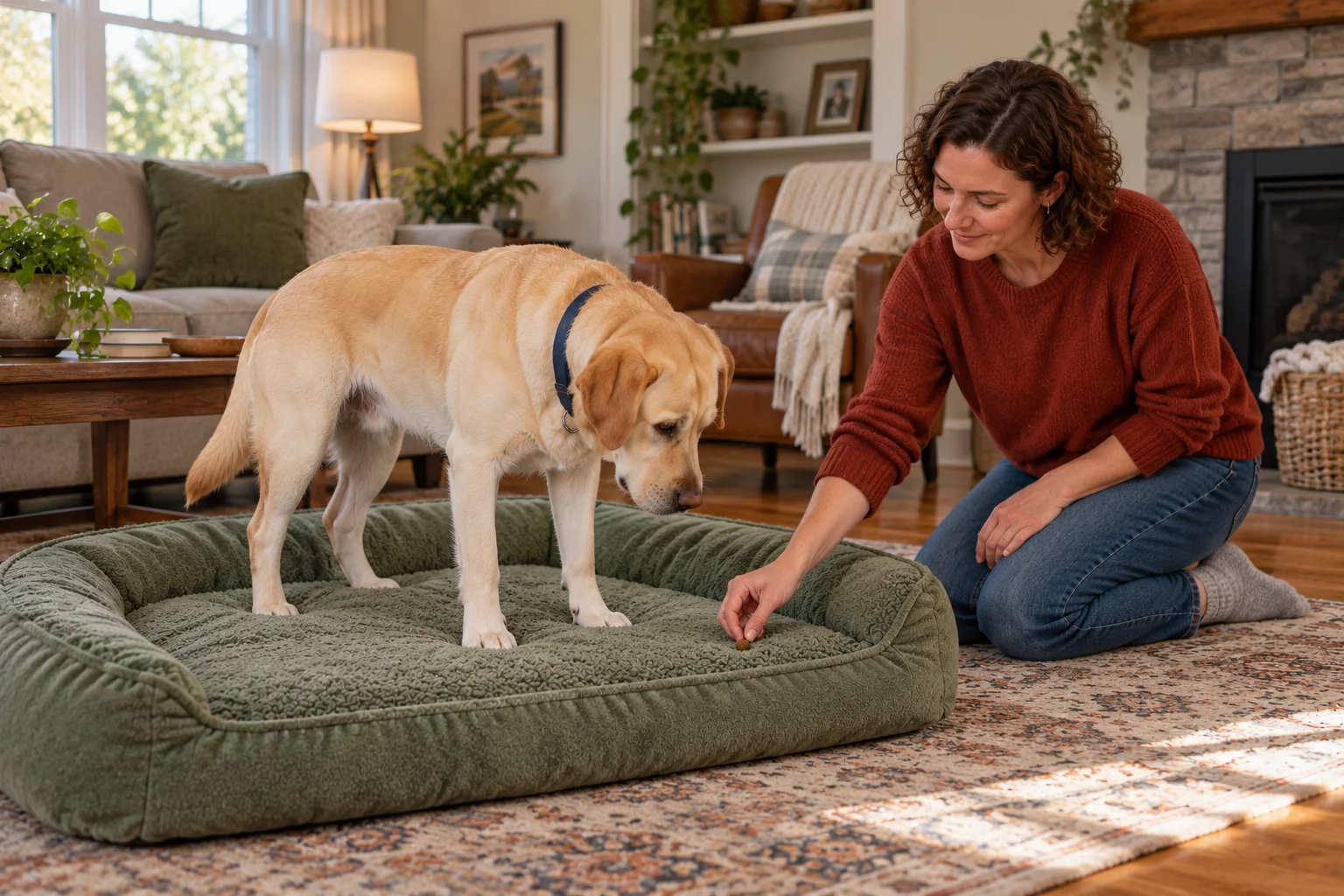
Reward your dog at their spot during the meal
Start with an easy, short meal, such as breakfast or a snack, when you are not rushing.
When everyone sits down, the training adult invites the dog to the bed by standing near it, as you practiced. When the dog is on or beside the bed, the trainer places a treat on the bed and goes back to the table.
During the meal, the trainer gets up every so often and places another treat on the bed while the dog is there. Vetstreet recommends placing kibble or treats on the mat at unpredictable intervals, so your dog never knows exactly when the next one is coming. At first, that might mean a treat every few seconds. As your dog stays more easily, the gaps can get longer.
At the end of the meal, give your dog one last treat or their chew on the bed. Then they are free to leave.
Keep the two kinds of food separate throughout. Treats come from the treat pot, and the trainer delivers them to the bed. Nobody hands food from the table, and the trainer never feeds the dog while sitting at the table.
If you use a marker word such as "yes," follow it with a treat every time. You do not need a marker for this exercise; placing the treat on the bed is enough.
What to do when your dog whines, barks or comes back to the table
When your dog leaves the bed and comes to the table, do not give them food, and do not toss a treat to move them away. Whole Dog Journal warns that tossing food to a begging dog rewards the begging. Vetstreet advises stopping rewards until your dog goes back to the mat.
Instead, the adult doing the rewarding can stand up and walk calmly toward the bed. Your dog may follow. Once they are back, reward them for remaining there while you briefly move away or sit down again. If you are repeatedly escorting them back, stop the practice rather than spending dinner repeating a table-to-bed reward loop. Make the next attempt shorter and reward at the bed before your dog starts to leave. For the rest of this meal, use an arrangement your dog is comfortable with. Avoid scolding; the Ontario SPCA advises against punishment, which it says can create anxiety and confusion.
Whining or barking needs a little more thought. Do not try to ignore every sound no matter what. First check that your dog's needs are met. Have they been out to the toilet, eaten, had water, and are they comfortable? If something is wrong, deal with that. If your dog is simply asking for your food, make the next part of the meal easier: put a treat on the bed sooner and more often, while your dog is quiet. If the noise keeps building, end the session and make the next practice meal shorter. For the rest of the meal, use a gate or another room only if your dog settles there; otherwise keep them with you and move their bed farther from the table. The guide to barking for attention explains how to respond to demand barking without overlooking genuine needs.
Get the household and guests on board
Begging only fades if everyone sticks to the rule. If one person passes scraps under the table, the habit keeps going.
Agree on:
- The rule: no food from the table, from anyone.
- Who trains at each meal.
- Where the treat pot lives and where the dog's spot is.
Write the rule down if it helps. The guide to getting everyone using the same training rules has ideas for agreeing on household rules without arguments.
Children need extra help, because they drop food and slip scraps. Do not make children responsible for training the dog. During children's meals, have one adult do all the rewarding, or use the gate or a separate room if your dog settles there calmly.
Tell guests before they sit down. A short explanation is usually enough: "Please don't give the dog anything. She gets her treats on her bed." For a busy gathering, it is usually simpler to put your dog in a quiet room with water, a suitable chew and their bed, rather than trying to train through the meal. Only do this if your dog settles there calmly; otherwise ask one adult to stay with your dog and their bed, away from the table.
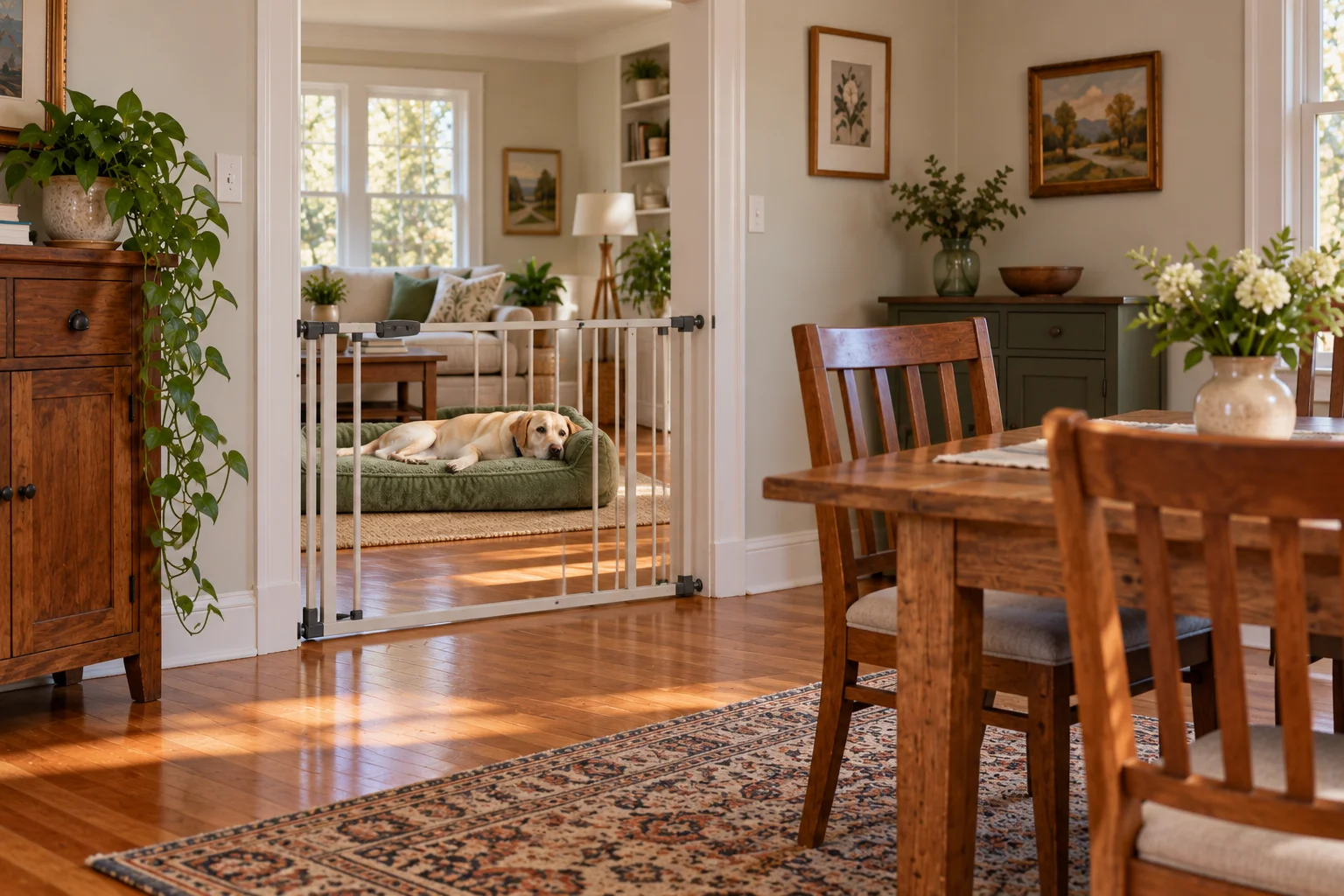
Manage meals when nobody can train
Training only helps when someone can reward your dog at their spot. When nobody can, prevent begging instead, so it doesn't get rewarded by accident.
Options include:
- Your dog in another room or behind a gate with a suitable chew, if they settle there comfortably.
- Your dog's own meal at the same time, in another room if they are comfortable there, or at their spot in the same room.
- Picking up dropped food straight away. The Ontario SPCA advises cleaning up spills promptly so your dog doesn't learn that scraps pay off.
Management is part of the plan, not a sign that training has failed. The guide to dog management and training explains why stopping a habit from being practiced helps the new behavior grow.
The American Veterinary Society of Animal Behavior recommends reward-based methods for all dog training, and notes that common problems can often be resolved with positive reinforcement and management. Avoid spray bottles, shouting or anything else meant to scare your dog away from the table.
Fix common begging problems
Your dog stays on the bed until the food arrives, then comes over
The moment plates appear is the hardest part. Place several treats on the bed as the food is brought in, and keep the first few minutes of the meal short and well rewarded. If your dog still comes over, use the gate for the start of the meal if your dog settles behind it, and practice the spot later on, once everyone is eating.
For example, a young adult dog stays on her bed while her family lays the table, then trots over as soon as plates arrive. Her owner puts a treat on her bed as each plate is set down. The dog stays put through the first minutes and then lies down. Over the next few meals, the owner spaces the treats out more as the dog stays on her bed more easily.
Your dog begs from one person in particular
That person may be the one who used to share food, or who sits nearest. Seat them farther from the dog's spot, check that they are sticking to the no-food rule, and let someone else do the training.
Your dog only stays on the bed when a chew is there
That is fine for now. Some dogs need the chew for longer. Practice the spot with treats at quieter meals as well, so the bed itself becomes a good place to be.
Your dog skips their own meal, then begs for yours
Some dogs leave their bowl and wait for something better from the table. Keep to the rule, so table food never becomes the better option. Offer your dog's meal at the usual time, and pick up anything left after the meal you give them. If your dog regularly refuses their own food, or their appetite changes, talk to your vet before you change their diet.
Your dog is too excited to stay near the bed
If your dog bounces back to the table as soon as you sit down, the setup is too hard for now. Move the bed a little farther from the table, use the gate for the first part of the meal if your dog settles behind it, and practice the bed during calmer snacks. A walk or a game earlier in the day can also help.
Your dog begs at the coffee table or couch
Snacks in other rooms count too. Use the same rule and set up a second spot, or keep snacks to times when your dog is elsewhere.
Plan your next meal
For your next meal, set up the spot and the rule before anyone sits down.
Feed your dog first and let them out to the toilet. Put the bed several feet from the table, in sight of everyone, and put a small pot of treats on a side table. Decide which adult is training and tell everyone else: no food from the table. If your dog already chooses the bed during your short practice sessions, use rewards at the bed through the meal. If not, keep practicing the bed outside meals. While you eat, use a gate or another room with a suitable chew if your dog settles there calmly, or keep your dog in the room with one adult beside their bed if they don't.