
Your dog waits until you turn to the oven, then the sandwich is gone. Or you come back to the kitchen to find a paw on the worktop and a very pleased face. It is frustrating, but it is not a moral failing or a contest of wills. Food on a counter is an unusually clear reward: reach, grab, eat. If that sequence has worked before, it makes sense for your dog to try it again.
The practical answer has two parts that work together. First, make it hard for your dog to find food on the counter, including when you are not watching. Then teach a different, rewarded way to spend kitchen time, such as relaxing on a mat or waiting behind a barrier. Training gives your dog something useful to do; management keeps them safe while that habit develops. How the two work together is explained in our guide to dog management and training. This pairing reflects the American Veterinary Society of Animal Behavior's guidance to arrange the environment and reinforce desirable responses, using reward-based methods for unwanted behaviours too (AVSAB's humane dog training position statement).
This guide is about food taken from kitchen counters and nearby worktops. It is not a plan for taking food from a dog, recovering stolen objects, table begging, or resource guarding. If your dog stiffens, growls, snaps or guards food when approached, do not try to test or take it. Give space and seek help from your vet and a suitably qualified reward-based behaviour professional. A sudden change in food-seeking or behaviour, particularly alongside signs of pain or illness, also deserves veterinary advice.
Why counter surfing can become a stubborn habit
A counter can pay out even when your dog is alone. They do not need you to offer the food or praise the behaviour. One successful reach may be enough to make checking the worktop worthwhile, and the occasional forgotten crust can keep the search going after many empty visits. That is why a dog who seems to understand “off” while you are in the room may still jump up when nobody is there.
From the dog's point of view, the counter is not a forbidden place with a rule attached. It is a surface that sometimes produces food. A shout or a scolding after you find an empty plate does not change what happened earlier. Even a correction delivered in the moment can make your presence the important difference, rather than teach what to do when you leave.
You do not need to prove that your dog can resist a tempting plate. Each practice opportunity carries the chance of another success, and there is no training prize for setting the dog up to fail. Arrange the kitchen so the unwanted behaviour is less available, then reinforce a safe alternative in situations your dog can manage.
That is the useful shift: think of counter surfing as a learned route to food, not disobedience that needs a stronger reprimand. Your plan changes both the route and the reward. The food stops appearing on the counter, while calm behaviour elsewhere becomes worthwhile. The veterinary-behaviour guide to counter surfing from Preventive Vet similarly centres prevention and teaching an incompatible behaviour.
Start with the kitchen you have, not an ideal one
For a few ordinary days, notice when the problem is most likely: preparing dinner, unloading shopping, clearing plates, food cooling after cooking, or a quiet moment when everyone has left the room. You do not need to leave tempting food out to find out. Use what you already know, and write down the times when your dog has tried it or the arrangements that make you worry they might.
Look at the whole reachable area, not just the central worktop. A low island, breakfast bar, dining table, open bin, chair beside the counter, or bag of shopping can all provide access to food. Dogs vary in height and jumping ability, so assess what your own dog can reach rather than relying on a general idea of what counts as “high enough”.
Then decide where your dog can be during each high-risk activity. A closed door or securely fitted gate may keep the kitchen clear while you cook. In a smaller home, a comfortable bed or mat behind a barrier may work better. Choose an arrangement that the household can use without wrestling with it or leaving the dog distressed.
Keep a brief note if patterns are unclear: what was happening, where the dog was, what food or smells were present, and which barrier or alternative was available. Describe what you saw, not what you think the dog intended. A simple record can show whether the risk is linked to cooking, visitors, unattended food or access to a particular counter. The dog behaviour observation log offers a fuller way to notice patterns if you need one.
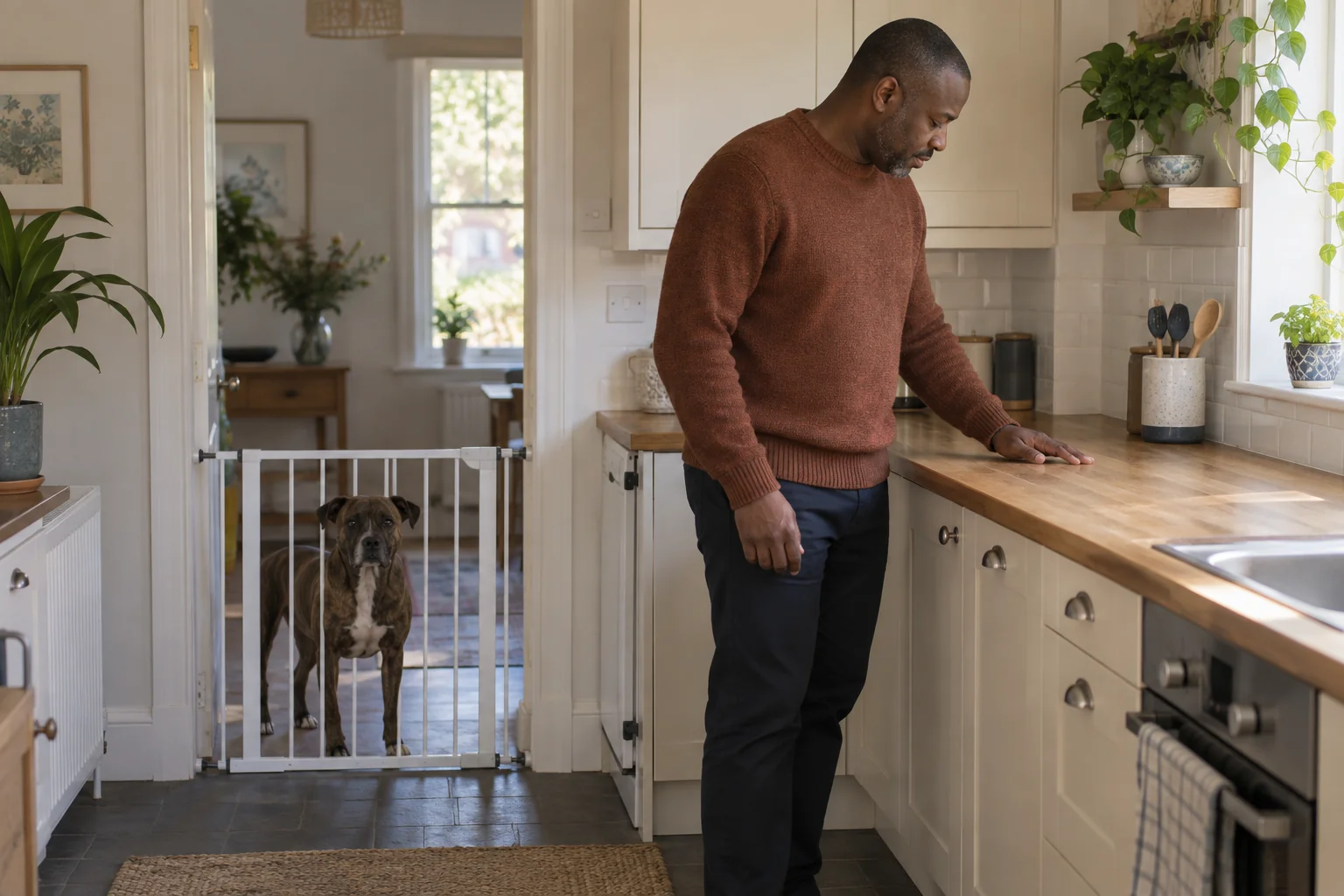
Make finding food on the counter less likely
Put food away as soon as it is no longer actively being prepared or served. Use a cupboard, fridge or a properly closed container, and move plates away from the edge while you work. Wipe up crumbs and drips when it is practical. Do not leave a tray cooling unattended if your dog can reach it; use an area or barrier that makes access impossible instead.
Secure the rubbish and recycling too. Food wrappers, bones, packaging and leftovers can be tempting, and a dog that cannot reach the worktop may still find a rich reward in an open bin. Keep shopping bags, lunchboxes and food deliveries somewhere inaccessible until you can unpack them. VCA's pet-proofing guidance for the kitchen recommends keeping counter-surfing dogs out of the kitchen when they are unsupervised and securing rubbish.
Choose management according to the moment. If you are cooking with hot pans or knives, your dog may be safest behind a barrier in another comfortable area. When you are preparing a simple snack and can supervise, a mat at a distance may be realistic. When you cannot watch, close a door or use another secure arrangement rather than relying on a cue the dog has not learned well enough.
A barrier is not a punishment. It is a practical way to stop the dog practising a behaviour that can be rewarding and sometimes dangerous. Make the space on the other side comfortable, and provide an appropriate resting place or activity if that suits your dog. If confinement causes distress or your dog cannot settle, do not force the arrangement; speak with your vet or a reward-based professional about a safer fit.
Choose a safe place for your dog during food preparation
Pick a spot where your dog can rest comfortably and where they are not underfoot. That might be a mat in a quiet room, a bed on the far side of a gate, or a suitable resting area within sight of the kitchen. Consider noise, heat, floor grip, household traffic and whether the dog can move away. A bed beside a hot oven or a narrow route through busy feet is not a useful alternative.
If you use a gate, check that it is stable, appropriate for your dog and fitted according to its instructions. A barrier that can be pushed over or climbed is not reliable management. Avoid tying your dog where they could become tangled, and do not leave them in a situation where they could reach a hot appliance, pan handle or food-preparation surface.
You can offer a safe enrichment activity away from the counter if your dog enjoys it and can use it safely. Their usual meal portion in an appropriate food toy may be enough; it does not have to be a special human-food treat. Check that the item suits your dog's chewing and swallowing habits, and supervise when needed. If the activity becomes a source of tension with another pet, separate them so each can eat undisturbed.
For help choosing rewards that suit the moment, see how to choose dog training rewards. Whatever you choose, make it part of a calm setup before cooking gets busy rather than trying to improvise once your dog is already reaching for food.
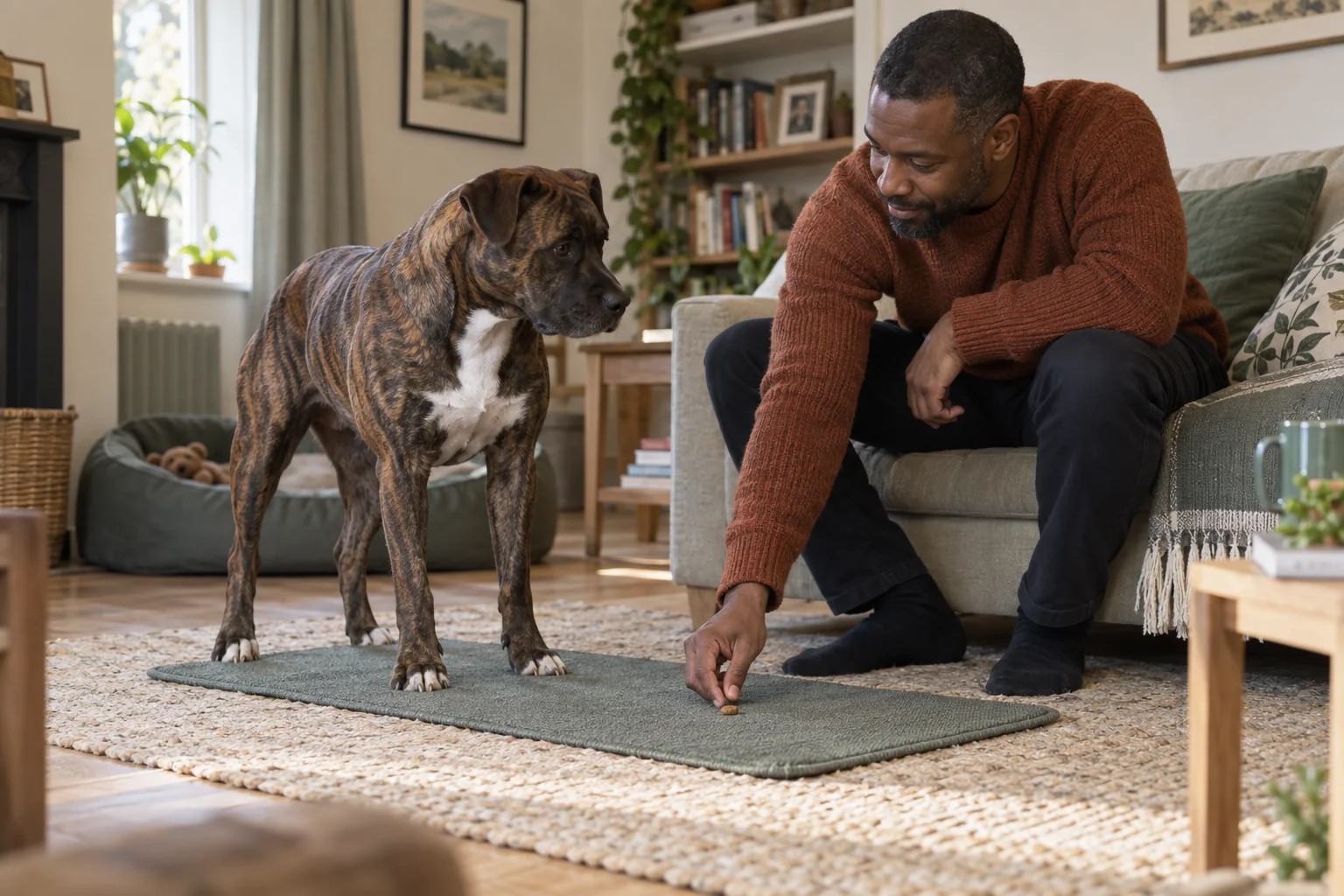
Teach a mat behaviour away from the counter
A mat can give your dog a clear place to go while you prepare food. Start when the kitchen is quiet and the counter is empty. Put a non-slip mat down in a comfortable spot. When your dog looks at it, approaches, sniffs or puts a paw on it, mark that choice with a consistent word such as “yes” and place a small reward on the mat. Let your dog decide whether to investigate; do not push or lure them onto a surface they dislike.
At first, reward the small choices that bring your dog towards the mat. When they are readily stepping on, wait for a moment of stillness, then reward there. Gradually build towards lying down if that is comfortable for them. Keep the reward close to the mat so the dog does not need to leave it to collect their payment.
Add a release word, such as “all done”, so your dog can learn when the resting period has finished. Early practice may be brief: reward the arrival, reward a comfortable pause, release, and let the dog move away. The point is not to keep them in place for a long time; it is to make the mat a predictable, rewarding option.
The guide to teaching a dog to settle on a mat walks through the skill in more detail. If your dog already knows a mat cue, return to an easy version first. A familiar behaviour in a quiet room does not automatically transfer to the smell of dinner or your movement around the kitchen.
Make kitchen practice easy enough to succeed
When the mat is comfortable in a quiet room, practise with the dog settled there while you do something uninteresting nearby, such as moving an empty bowl or putting away a tea towel. Return and reward calm staying before your dog becomes restless. Finish with the release while the practice is still going well.
Change only one part of the picture at a time. You might move the mat a little closer to the kitchen, briefly walk in and out of view, or handle a closed food container. Do not add a plate of tempting food, longer duration and a busy household all at once. If your dog gets up, calmly guide the arrangement back to an easier level: increase distance, shorten the pause, or use the barrier while you practise separately.
Use food rewards that are appropriate for your dog and deliver them where you want the dog to remain. Small pieces of their usual food may work in an easy setting; a more valuable dog-safe reward may help when the distraction is stronger. Keep rewards modest and account for them in the dog's normal food allowance. Avoid using ingredients just because they are human food, and check with your vet if diet restrictions or health needs affect treat choices.
If your dog can stay on the mat while you lift a clean utensil, try a slightly more realistic kitchen activity next time. Put a covered container on the worktop, walk a short distance, then return to reward calm behaviour. Keep real, accessible food out of the picture initially. As your dog learns the pattern, add ordinary food-preparation movements while still storing food securely and paying the alternative behaviour.
A calm dog is not necessarily motionless. They may shift position, look around or get up when released. Reward the behaviour you want to see, such as choosing the mat, settling comfortably or turning away from the worktop. If their body looks tense, they are panting when it is not warm, repeatedly scanning the counter or unable to take a familiar reward, reduce the difficulty and provide more distance.
Reward the choice you want before your dog jumps
Notice the moments when your dog is already making a good choice: standing with all four paws on the floor, turning towards you, moving away from the counter, or settling in their designated area. Mark and reward those choices while they are happening. This is clearer than waiting for a jump and then trying to interrupt it.
Keep your response quiet and predictable. If you see your dog begin to investigate a counter, avoid shouting, chasing or grabbing at them. If they can respond comfortably, invite them to their familiar mat or another well-practised behaviour and reward when they get there. If they are too close or already reaching, block access safely and reset the room rather than turning the moment into a contest.
You can also practise a simple “leave it” cue away from kitchen counters, using low-value food that your dog cannot take and rewarding them for looking away or turning back to you. Build the skill in controlled, easy settings, and do not use it as your only protection around reachable food. A cue may fail when a dog is excited or when the food is exceptionally tempting. Secure storage and barriers remain important even after practice goes well.
If your dog gets something from the counter, stay calm. Do not pry open their mouth or corner them. If it is ordinary food and there is no guarding, calmly move other food out of reach and restore the barrier. If the item could be harmful, or you are uncertain what was eaten, contact your vet promptly and follow their advice.
Keep dangerous and unsuitable foods out of reach
Counter surfing is more than a nuisance because ordinary kitchens contain ingredients that can make dogs ill. Chocolate, grapes and dried vine fruits, onions and garlic, alcohol, and products containing xylitol are among the foods PDSA advises keeping out of pets' reach in its guide to common poisons and hazards. Some foods that are not poisonous can still cause problems, especially in large amounts or when they are fatty, heavily seasoned, contain bones, or are unfamiliar to the dog. No general list can assess every food, amount or individual dog.
Store ingredients and finished dishes where your dog cannot reach them. Take particular care with wrapped sweets, baking ingredients, chewing gum and sugar-free products, which may contain xylitol; foods with raisins or other dried fruit; and scraps with onion or garlic in sauces, stuffing or seasoning. Keep hot pans, sharp utensils and breakable dishes away from edges as well. A dog reaching up can pull down more than the food they were aiming for.
If your dog has eaten something harmful or you are unsure, do not wait for symptoms or try to make them vomit unless your vet specifically tells you to. PDSA advises contacting your vet immediately in this situation; its guidance on what to do if your dog has eaten something harmful explains why. Tell your vet what may have been eaten and when, and keep the packaging or ingredient information to hand if you can do so without delaying contact. This article is not an emergency assessment; your vet is the right person to advise on an individual exposure.
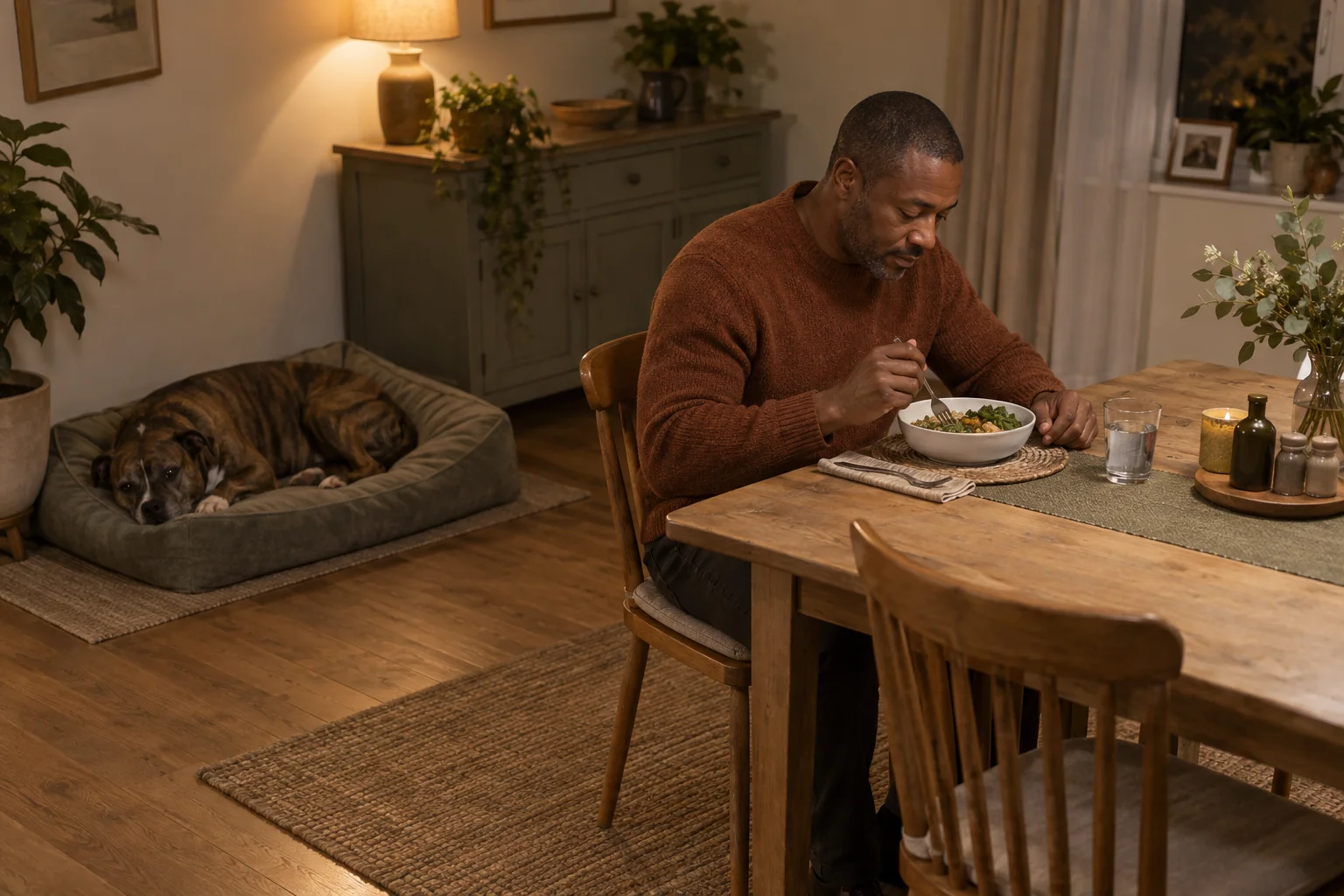
Set household rules that are realistic to follow
A plan only works if it survives ordinary life. Agree where the dog will be during cooking, who is responsible for putting food away, and what happens when a delivery arrives or guests are eating. Leave a gate in its usual place, keep a mat ready, and store food containers where they are easy to reach. The best routine is not the most elaborate one; it is the one people can follow on a busy evening.
Ask visitors not to feed the dog from the counter or leave plates within reach. If someone is helping with a meal, show them the barrier or resting place rather than asking them to correct the dog. Children should not be responsible for managing the dog around food. An adult should set up the environment, supervise, and protect both the child and the dog from awkward encounters.
Make the rule about food consistent without expecting everyone to train in exactly the same way. One person can reward the dog on a mat while another stores the meal; both are supporting the same outcome. The separate guide on getting a household using the same dog training rules can help with wider consistency.
Troubleshoot the moments that keep going wrong
If your dog only jumps up when you leave the room, assume that supervision alone is not enough. Use a closed door, gate or secure food storage whenever they are not directly supervised. Practise the mat behaviour separately, then make brief, easy absences part of the training only while the dog remains comfortable. Do not leave a tempting plate out to see whether the lesson has transferred.
If they jump while you cook, the setup may be too difficult or the alternative may not yet be rewarding enough. Move the mat farther from the counter, use the barrier, shorten the activity, or offer a suitable resting activity. Reward the dog before they have been waiting long enough to get frustrated. You can prepare the dog's safe area before starting dinner instead of trying to teach during a rushed moment.
If your dog leaves the mat repeatedly, look for practical causes before assuming they are being stubborn. Is the floor slippery? Is the bed too close to heat or noise? Are rewards being placed where the dog has to step off to reach them? Is the dog being asked to wait longer than they can comfortably manage? Make the space more comfortable, reduce the duration and reward more often for returning to the mat by choice.
If food keeps being left out by different people, do not build a more complex cue system around an unreliable kitchen. Change the storage routine or restrict access when the kitchen is unattended. A sticky note, covered dish or gate can help prompt the human routine, but the dog should not be left responsible for a temptation that can be removed.
If your dog is stealing food from a person's hand, guarding a stolen item, or threatening someone who approaches, that is a different concern from reaching an unattended counter. Do not rehearse trades or test how close someone can get. Create distance from the dog and food, keep people safe, and contact your vet for a referral to a qualified reward-based behaviour professional. Pain, sudden appetite change or a sudden new pattern of scavenging should also be discussed with a vet.
Notice progress without testing your dog
Progress may look like fewer attempts during a short cooking task, choosing the mat after you move around, or being comfortable behind a gate while food is prepared. Record what your dog could do and under what conditions. “Stayed on the mat while I made tea, with the kitchen gate closed” tells you more than “was good”. You can then decide whether to repeat the same setup or make one small part harder.
Expect to keep some management habits even when things improve. Food still belongs in cupboards, fridges or covered containers, and barriers still have a role when you cannot supervise. Success is not proving that a dog will never notice an open sandwich. It is building a kitchen routine in which they rarely get the chance to practise stealing, and have a comfortable alternative that is worth choosing.
If your dog has a lapse, return to the setup that was working. There is no need to scold, punish or start from scratch. One incident is information: perhaps the counter was left accessible, the mat was too close, or the household was unusually busy. Adjust the environment, reinforce the behaviour you want, and keep the next practice easy.
The lasting change comes from making the counter a poor place to search and making the dog's own spot a good place to be. Clear surfaces and secure barriers protect them today. Rewarded choices teach the routine you want for tomorrow.