
A long line gives your dog room to sniff, move and practise returning to you while you keep a physical connection. It can also create hazards in a cramped place, across a path or around a hand, especially if your dog is already running when the line runs out.
Think of a long line as an adjustable safety margin. You decide how much room to offer, where the line can travel and when to shorten it or move. Never use it to haul your dog back to you.
This guide is about choosing and handling the equipment. To teach the recall cue itself, start with how to practise recall without taking unnecessary risks. If the difficulty is an everyday tight lead on pavements, loose-lead walking foundations is the more relevant guide.
A long line gives room without removing your responsibility
Long lines are often described as a bridge between a short lead and off-lead freedom. That can be a helpful picture if you remember what the bridge is for. It lets a dog explore at more distance while you retain a physical connection. It does not show that a dog is ready to be unrestrained in an open area.
Dogs Trust recommends a long line attached to a harness for recall practice, and advises allowing the dog to move away before you call. It also says not to pull the dog towards you, but to guide them in gently or collect them if necessary (Dogs Trust recall guidance). That distinction keeps the line in its proper role: management while the dog learns.
Your job is still to watch the surface, people, dogs, traffic, wildlife, routes out of the area and the amount of line left between you. A long line cannot assess any of those things for you. It cannot prevent a dog reaching a road if you have allowed too much line out in the wrong place. It cannot safely remove the force from a sudden sprint if the line is nearly at full extension.
This is why the best session can look uneventful. Your dog gets freedom to investigate, you keep the line moving cleanly, and you shorten or relocate before there is a dramatic moment to manage. Calm handling is not wasted handling. It is the reason the session stays useful.
Choose a line for the dog, the place and your own handling
There is no one correct long-line length, width or material for every dog. A very long line offers more space, but asks more of you and needs a larger, clearer area. A shorter one is easier to manage but can become tight sooner. A light line may suit a small dog, while a heavier or bulkier one may be difficult for that dog to carry. A line that is easy for one person to gather may feel slippery or awkward to another.
Ask practical questions before choosing one. Can you comfortably hold and gather this line while your dog is calm? Could your dog pull you off balance if they accelerated? Does the clip look substantial enough for your dog and the connection point? Does the line drag smoothly over the ground available to you? Will it pick up thorns, mud, water or burrs where you plan to use it? Can you see it clearly enough to keep it out of another person's path? If your dog could pull you off balance, use a shorter lead or secure enclosed space and seek individual help. Never test this at speed.
Avoid treating a retractable lead as a substitute. It manages tension and distance differently, with a mechanism that can encourage a permanently taut line. For open-area recall practice, a fixed line gives you a clearer view of the line's route and lets you decide how much slack is available.
Before the first outdoor use, practise paying the line out and gathering it in a safe enclosed space without your dog at speed. You are learning the equipment too. If it immediately forms knots, catches on your footwear, or feels too much to control, change the setup before adding a busy environment.
Attach the line where sudden force is less concentrated
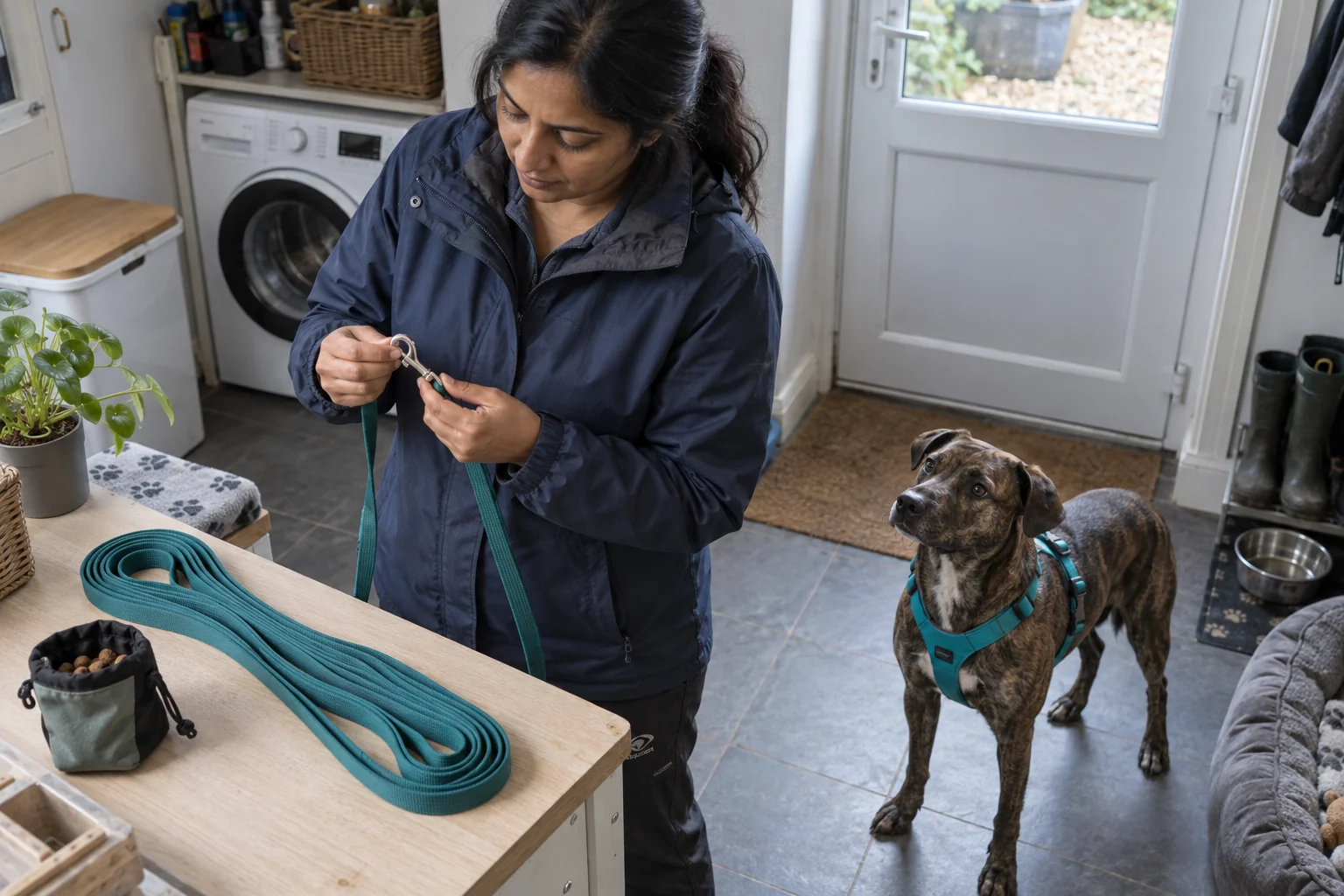
A long line needs a secure connection, but secure does not mean any attachment point will do. For this work, use a well-fitting harness that your dog can move comfortably in and whose attachment point is sound. Dogs Trust's recall guidance specifically advises attaching the long line to a harness (Dogs Trust recall guidance).
Check the harness before you set off. Look at the webbing, stitching, buckles, adjustment points and ring. Make sure it is fitted so your dog cannot simply reverse out of it or slip through it when they turn. Check the line's clip and the harness ring for wear, damage, distortion, grit or a gate that does not close cleanly. A line is only as dependable as its weakest connection.
Do not attach a long line to a slip lead, choke chain, prong collar or head collar. These can concentrate an abrupt force on the neck or face if a dog moves suddenly, even during a calm session.
In Great Britain, most dogs on a highway or in a public place must wear a collar bearing their owner's name and address, with some exceptions (Control of Dogs Order 1992). Keep that identification collar on as required, but clip the long line to the harness, not the collar. If your dog cannot wear a harness comfortably, or has a condition that changes what equipment is suitable, pause and ask your vet or a qualified reward-based professional for individual advice.
Check the connection again after your dog has had a shake, roll or energetic sniff. That is not fussy. A clip can pick up mud, a harness can shift, and a line can wind around a leg before you notice. Frequent quick checks are easier than managing an equipment failure at distance.
Inspect the line and the area before you clip on
The safest long-line decision is sometimes not to use it that day. A quick pre-session check gives you permission to make that decision early, before your dog has left the car or the house expecting a big outing.
Run the line through your hands while it is still clean enough to inspect. Look for frayed sections, cuts, flattened areas, knots, damaged stitching and a clip that sticks or fails to shut fully. Test the clip on the harness ring, then check it has seated properly. If anything looks questionable, use a different lead or choose a secure enclosed activity instead.
Then scan the area as if you were tracing the line across it. Roads and vehicle access are an automatic reason to choose another location or keep your dog on a conventional short lead. Crowded paths, playground edges, picnic areas, cycle routes, narrow gates and places where people may suddenly appear are poor long-line practice spaces. The issue is not whether your dog is friendly. A person can still trip, a cyclist can still be caught by the line, and your dog can still be startled.
A suitable location has open ground, enough visibility to notice approaching people and dogs, and room to move away before anyone enters the line's path. It also has no obvious traps such as brambles, broken fencing, deep water, loose wire, steep drops, parked vehicles or dense obstacles that could catch a line. The clearer the space, the easier it is to keep the line from becoming a hazard.
Look at the weather and surface too. Wet grass, mud, frost and leaves can change your footing and make a line harder to see. A line that runs freely on short grass may snag repeatedly in scrub or around tree roots. If you would need to stare at the ground to avoid falling, you have less attention available for your dog and the space around you.
Keep the line travelling on the ground, not around you
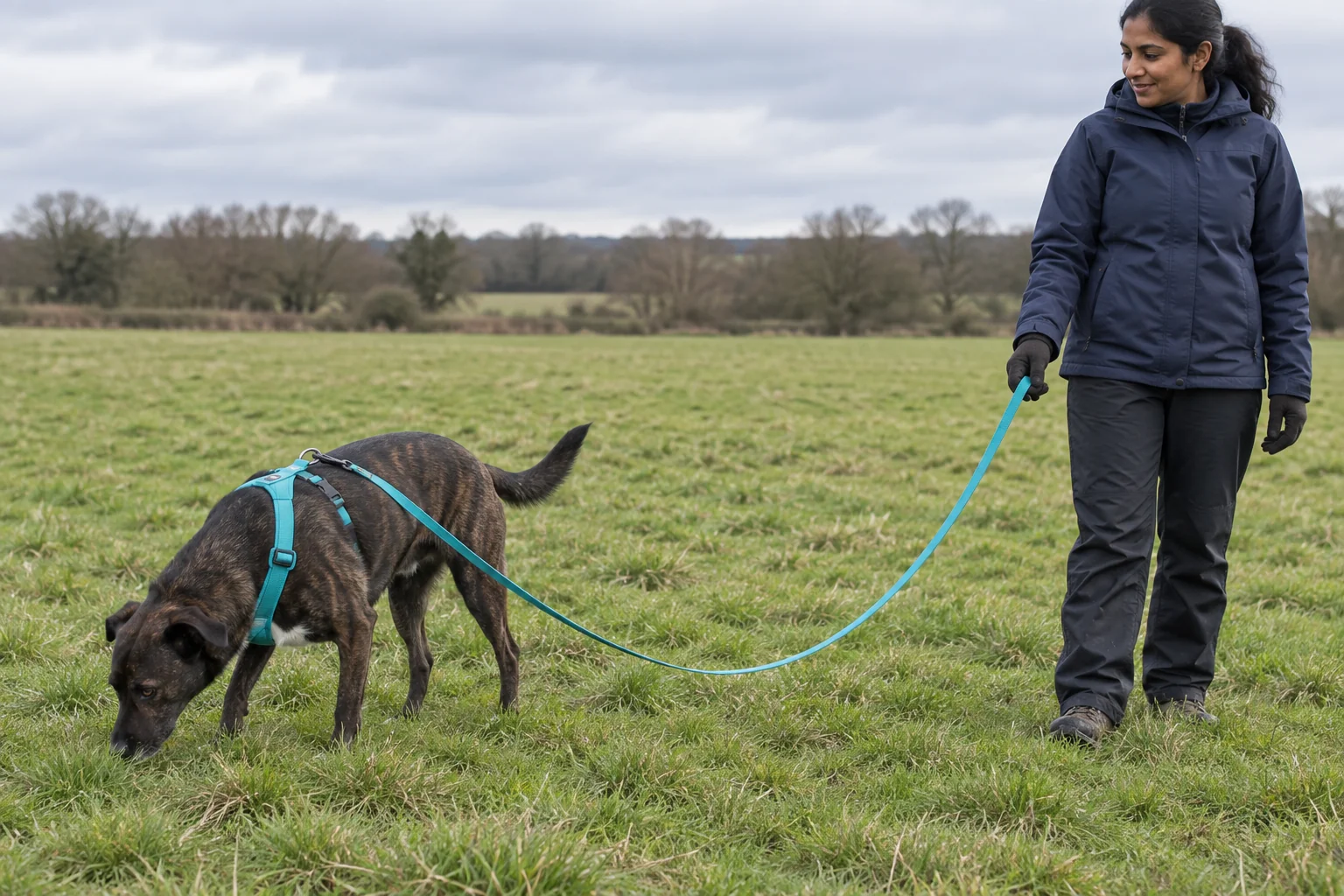
Pay out and gather the line. Feed out controlled amounts from loose folds, then gather loose sections when your dog comes closer or when you need less range. Never wrap it around your hand, wrist, waist, body or a fixed object, and do not let a fast-moving line slide through your grip.
Wrapping can feel secure because it stops the line moving. It also means a sudden movement transfers the force to a small part of you and makes it harder to release or reposition. The same applies to making loops around fingers or gripping a tangled bundle. A long line is not a tow rope, and your body is not an anchor point.
Keep the line organised in broad, loose folds rather than a tight coil. Let the folds fall clear of your feet. When your dog moves away, feed out only what they can use safely in that direction, rather than releasing the entire length automatically. When they turn back or the space narrows, gather the spare line before it piles up around you.
Gloves can offer a little protection from friction for some handlers, but they do not make it safe to hold a runaway dog, wrap line around a hand, or permit a sudden stop at full speed. If you use them, make sure you can still feel the line and operate the clip. Better line management and an earlier reposition are the main safeguards.
Keep your hands in front of you and your stance balanced. If you need both hands briefly to gather, stop walking first. When you move while looking down at a complicated bundle, the bundle often gets worse and you stop noticing what is approaching.
Manage slack so the line does not become a trip hazard
A long line works best when it has useful, manageable slack. Too little slack turns the line into constant tension and reduces your chance to respond before it reaches the end. Too much unmanaged slack can sweep around feet, catch on objects, or cross a route someone else may take.
Think of the line as having a lane. Your dog has a lane where they are moving, and the line has a lane between you. Keep that lane as clear as you can. If your dog starts circling a tree, bench, person or you, move early to uncross the line rather than waiting for a knot. If the dog changes direction, turn with them where it is safe, or gather before they create a large loop. Battersea's long-line guide also warns that excess line can trip people or snag in the environment.
Do not let the line drift across a public path while your dog sniffs at the edge. A runner, child, bicycle or another dog can appear quickly. Keep the line within open ground and move with your dog as the edge of the space approaches.
The same awareness matters when your dog is close to you. A heap of line at your feet is not harmless just because the dog is nearby. Gather it before you ask the dog to move again. A clean reset is faster than untangling a foot, a harness strap and several metres of muddy line after the dog has changed direction.
Dogs Trust advises starting lead work in calm places and rewarding the dog for the behaviour you want rather than relying on punishment (Dogs Trust loose-lead guidance). The same approach helps here. Pay attention to calm check-ins and movement with you, while using the environment and your line handling to prevent messy, over-stretched repetitions.
Prevent the sudden stop instead of bracing for it
Notice when your dog is likely to reach the end of the available line, then change direction or shorten the range before they accelerate.
Watch your dog, not just the loose line. A dog who has suddenly locked onto something, gathered speed, lowered their body to chase, or moved towards another dog may be about to use up the remaining distance very quickly. Do not wait to discover whether you can stop them. Turn, move away, shorten the line smoothly, or leave the area while you still have time.
If your dog is already running and there is little line left, there may be no safe handling trick that removes the force. Do not grab a line sliding through your hands, wrap it around yourself, step on it or deliberately brace for impact. Sudden tension can hurt your dog and pull you over. Move with them only if you have clear ground and can avoid other hazards. Limit the available range and leave before your dog accelerates whenever you can.
This is also why the setting matters more than the exact line measurement. In a wide, empty field you may have room to alter direction and gather gradually. Beside a road, a hedge gap or a crowded path, you may not. A shorter lead or a different route is sensible management, not a failure of recall practice.
Never use a long line as permission to let a dog chase wildlife, rush towards people, or barrel up to other dogs. The line may stop the dog eventually, but it does not remove the risk created before it goes tight. Keep enough distance that your dog can remain under control and reposition before the line becomes the only thing preventing contact.
Practise the handling in easy sessions first
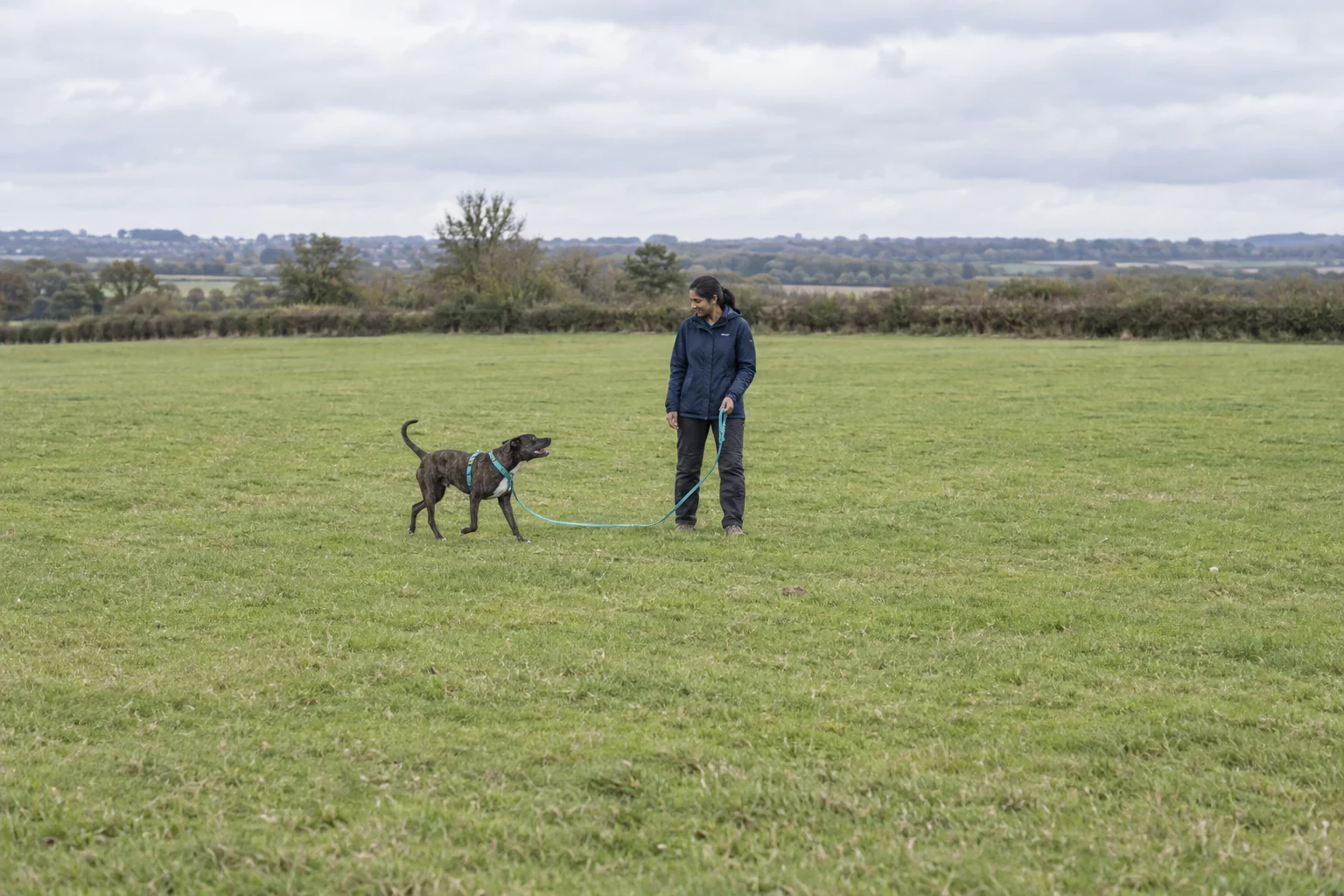
Long-line practice is more useful when the first sessions are deliberately boring. Choose a quiet, open space, have rewards ready, attach the line to the checked harness, and allow your dog to explore at a distance you can manage without rushing.
Let the dog sniff while you practise paying out a little and gathering a little. Your aim is not a spectacular recall or a fully extended line. It is to develop a rhythm where you notice direction changes, collect slack before it becomes a pile, and keep yourself in a place where the line stays clear.
When you use the recall cue, use it according to the plan in our recall practice guide. Here, the handling point is what follows. Reward the return, gather the line calmly as the dog approaches, and decide whether to release them to explore again or move together to a clearer spot. Do not reel them in with the line because the line has become the answer instead of the cue.
Keep the session short enough that you can stay observant. Fatigue, cold hands, a wet line and an increasingly distracted dog all make handling less tidy. Ending while you are both still succeeding is better than staying until the line is tangled and everyone is tense. For that kind of deliberate, manageable session design, see how to organise short dog training sessions without rushing.
Use rewards that your dog can take quickly and that you can deliver without dropping the line. A pouch and a simple plan prevent you from trying to search through pockets while the dog is reaching the end of their range. Choosing training rewards for the moment can help you decide what to bring.
A helper is optional, not a safety shortcut
A helper can add value when they make the situation easier to manage, not when they add excitement. A trusted adult can stand at a sensible distance in a quiet area while you handle the line and practise an easy return. They should not call, grab, crowd or suddenly move towards the dog.
Do not use children as recall targets or long-line props. They may move unpredictably, become excited, or be unable to respond safely if the dog reaches them at speed. Do not ask a helper to act like a jogger, cyclist, dog walker or stranger in order to test your dog. Creating a risky scene is not necessary practice.
A helper is also not someone to take the line from you at the last moment. One person should be responsible for handling it, with the other person staying clear of the line's lane. Clear roles reduce crossed lines, mixed cues and accidental trips.
Move before people, dogs and obstacles enter the line’s path
Long-line work asks you to be earlier than you think you need to be. When someone is still far away, you have options. You can gather some line, call your dog into a closer area, change direction, create distance, or leave. When they are beside you, the line can already be across their route.
Scan regularly in every direction, especially behind you. Notice approaching dogs, people, bicycles, horses, runners and vehicles before your dog does where possible. If the path is becoming shared or narrow, gather the line, transfer to a conventional short lead if you can do so securely, and move your dog well clear before anyone passes. Do not allow greetings or interactions while a long line is loose around dogs or people. If there is not enough space to manage the pass calmly, turn away early or choose another place.
Obstacles deserve the same respect. A line that runs around a tree, picnic table, bench or fence post can stop a dog abruptly if they keep moving. If the dog heads towards an obstacle, walk with them to keep the line clear or turn away while you have room. Do not stand still and hope the line will slide free.
Treat each new arrival as a reason to review the setup, not as an interruption you must endure. A busy space may have been suitable five minutes ago and unsuitable now. Leaving or moving to a clearer area protects both your dog and everyone else using the space.
A long line does not make off-lead exercise safe. It is a managed lead activity. If the area, your dog's behaviour or the number of people around you no longer allows safe management, the responsible choice is to shorten the lead, relocate or finish.
Solve grabbing and end-of-line problems by changing the setup
Some dogs grab, chew or play with the line. Do not turn that into a tug game or a chase. Keep your movements quiet, reduce the amount of loose line near the dog, and make the next repetition easier. If the dog grabs when they are close to you, gather more cleanly so there is less trailing material available, then reward an alternative calm action such as moving with you or orienting back to you.
If line grabbing happens repeatedly, look for the reason before you add a verbal correction. The line may be dragging in a tempting way, the session may be too long, the dog may be frustrated by the environment, or you may be offering too much loose line in a small space. A pause, a quieter area or a shorter managed range is more useful than scolding.
Repeatedly hitting the end of the line is also information. It can mean the line is too long for the site, you are releasing more line than you can manage, the dog is becoming too aroused, or you are waiting too long to respond to movement in the environment. Do not solve it by letting the dog hit the end harder until they learn not to. Reset the distance and location instead.
If your dog is pulling hard, lunging, barking or trying to reach people or dogs, this is no longer just a long-line handling problem. Increase distance and leave the situation. Then use guidance on when to seek professional behaviour help to decide what support is appropriate. A long line should not be used to keep a dog near a trigger while they practise distress.
Know when to stop and ask for individual help
Do not use a generic long-line plan to work around pain, mobility limitations or a sudden change in movement. A dog who is stiff, reluctant to walk, suddenly pulling differently, limping, avoiding the harness, or unable to turn comfortably needs a veterinary check before more training practice. Equipment and handling that suit a healthy, comfortable dog may not suit that dog today.
Aggression, a bite history, serious fear, predatory chasing, repeated escape attempts or a dog who can slip ordinary equipment are also clear limits. Do not rely on a long line as the whole safety plan. Get help from a qualified reward-based behaviour professional and, where relevant, your vet. Choose management that prevents rehearsal and protects other people and animals while you wait for that advice.
The American Veterinary Society of Animal Behavior states that reward-based methods should be used for all canine training and that aversive methods should not be used (AVSAB humane dog training position statement). That matters when long-line handling feels frustrating. Tightening your grip, jerking the line or using painful equipment may suppress a moment, but it does not make the location safer or teach your dog how to cope.
In a quiet open area, start with a range you can manage, keep the line clear and reward your dog when they return. If the space becomes busy or the line repeatedly reaches its end, shorten it or finish the session.