
Begin by letting your dog choose whether to approach a stationary basket muzzle and withdraw whenever they want. If they stay relaxed, you can gradually add brief nose entry, small voluntary movement and the feel of the straps while good things happen. Start with a well-fitted basket muzzle that lets them pant, drink and take treats. If your dog already fears face handling, guards food, has a bite history or reacts around people, ask your vet and a qualified reward-based behaviour professional for an individual plan rather than trying this alone.
Muzzle training is useful preparation, not a verdict on your dog and not a behaviour treatment. A muzzle can reduce some immediate risks, but it does not make a worried dog feel safe, replace distance or prevent every possible injury. Think of the aim as teaching a calm, voluntary equipment skill for ordinary practice, while leaving medical, legal and higher-risk decisions to the people qualified to assess them.
Why a calm introduction matters before you need one
A muzzle may be needed for a vet visit, transport, a legal requirement or a safety plan. Those situations can arrive with little warning. If the first time your dog sees a muzzle is when someone is holding them still during a frightening or painful event, the equipment may become part of what worries them. Gentle practice in a quiet context gives you a chance to build a different association before there is pressure to use it.
That does not mean every dog can be prepared for every future emergency at home. Pain, panic and urgency change what a dog can cope with, and even a dog who practises happily may need veterinary help or a professional handling plan. The Cornell University College of Veterinary Medicine explains that comfortable muzzle conditioning can support safer, gentler handling, while also recommending qualified support when a dog has a biting history or handling sensitivities.
The useful distinction is between learning the equipment and resolving the reason it might be needed. Muzzle practice teaches your dog about the basket, the nose opening, the straps and wearing it briefly. It does not treat fear, aggression, scavenging, pain or anxiety. The Dogs Trust is explicit that a muzzle will not change how a dog feels about a trigger. If a behaviour concern is part of the reason, manage distance and seek suitable help as well as preparing the equipment.

Choose a basket that fits your dog, not just the shelf
For training and most planned uses, a properly fitted basket muzzle is usually the practical choice. It should let your dog open their mouth to pant, drink and accept small rewards. Close-fitting fabric or sleeve styles can limit panting and drinking; Cornell notes that constricting nylon muzzles are not suitable for most situations. Do not use one for exercise or extended wear. Do not use any muzzle to stop barking, prevent a dog opening their mouth, or leave it on while the dog is unattended.
Fit is individual. Look for enough room for a full pant and no contact that presses on the eyes, blocks the nostrils or rubs the soft nose. The basket should not press against the face when your dog lowers or turns their head, and its fastening should stay in place without digging in or restricting movement. As a practical check, Cornell advises leaving room for one or two fingers under the strap. Follow the maker’s fitting instructions and ask your vet or a qualified professional to check it if you are unsure. Breed shape, coat, age and facial proportions affect what fits. A product that looks close to the right size in a photograph can still be uncomfortable on your dog.
Ask your vet, a qualified reward-based trainer or a veterinary behaviour professional to help you check fit if you are unsure. This matters especially for dogs with short faces or unusual head shapes, whose breathing and comfort can need extra care. Do not alter a muzzle by cutting or stretching it unless the manufacturer or a knowledgeable professional confirms that the change will not weaken its safety or affect fit. A training article cannot confirm the fit of an item it cannot see on your dog.
Before you practise, put the muzzle down and check it yourself. Are there sharp edges, damaged fasteners or rough spots? Can your dog take a treat through the openings without scraping their nose? If the basket is dirty, clean it according to its material and maker's instructions. Keep the treat size small enough to pass safely through the opening and suitable for your dog’s diet.
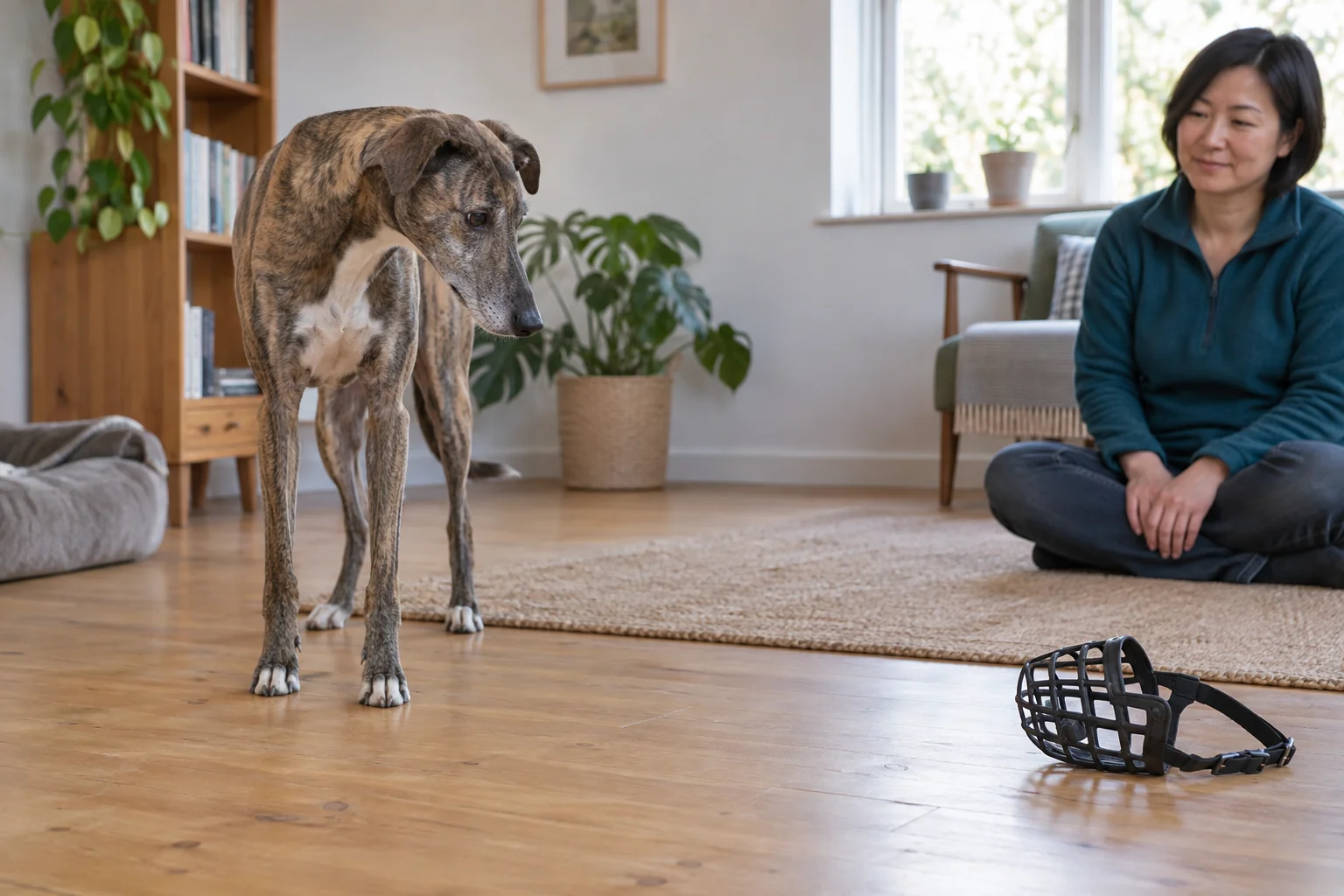
Set up a session where your dog can leave
Choose a familiar, quiet room with enough space for your dog to turn away and move off. Have the muzzle, a handful of tiny treats your dog enjoys, and a marker word or clicker if you already use one. A marker is a brief signal such as “yes” that tells the dog which moment earned the reward. If you do not use one, calmly offer the reward after the behaviour you want.
Keep children and other pets out of the practice area. Do not practise when your dog is hungry to the point of distress, overexcited, tired, in pain or already worried. Put the muzzle away between sessions so it does not become an object your dog chews or carries off. At the beginning, a session can last only a minute or two. Stop while your dog is still relaxed and interested rather than trying to meet a target number of repetitions.
You can use food without taking choice away. Some dogs are comfortable investigating a treat placed at the edge of the basket; others do better when you first reward a glance and toss the reward away so they can reset. Keep the basket still, never guide your dog’s nose into it, and make sure they can withdraw or leave. A treat should make the basket more worthwhile, not draw your dog into contact they would otherwise avoid.
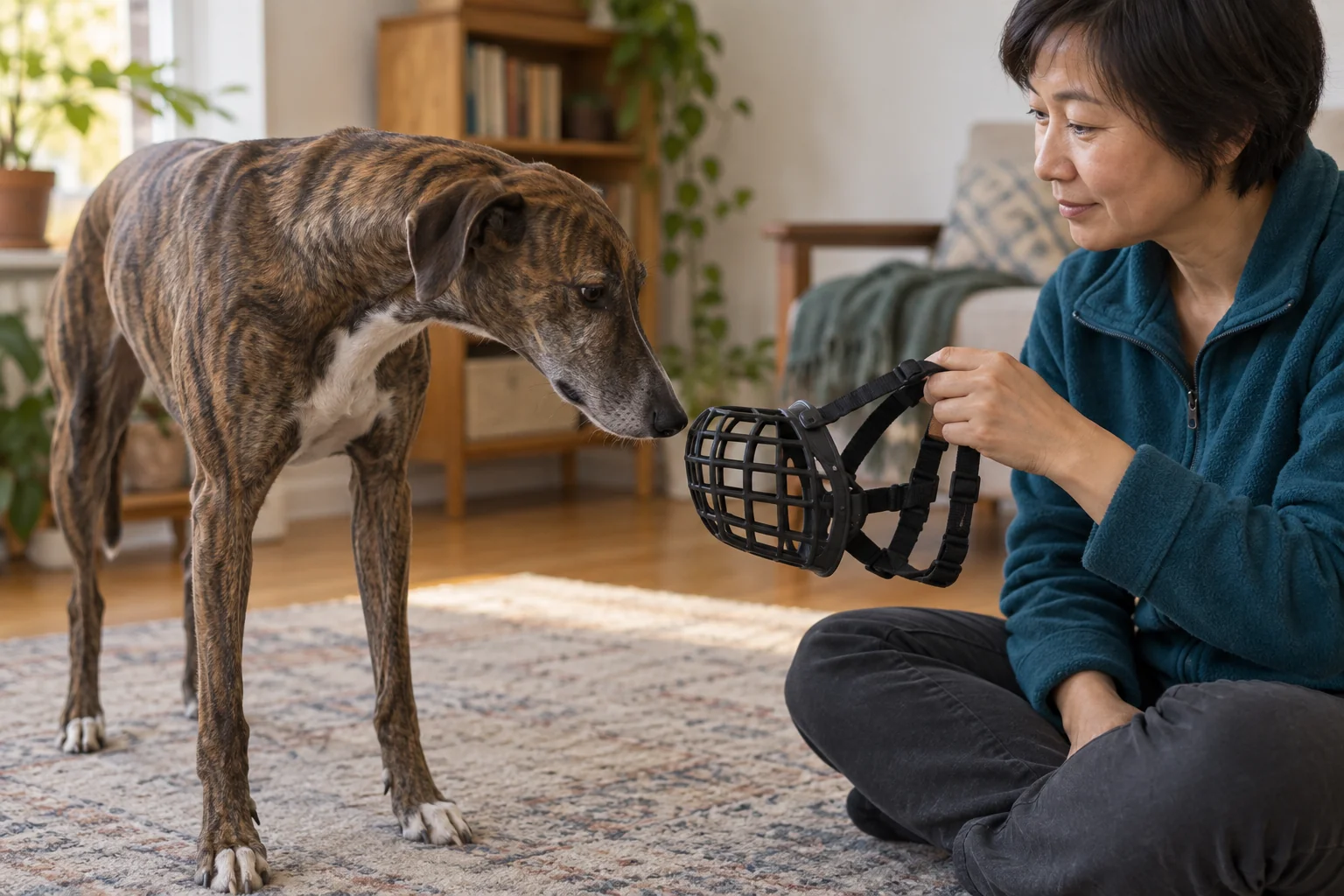
Let the muzzle predict a good reward
Start with the muzzle out of sight. Bring it into view at a distance where your dog notices it without tensing, then mark that glance and toss a treat away from the muzzle. The treat landing away gives your dog space to eat and a natural chance to turn back if they want to investigate again. Put the muzzle out of view and repeat only while your dog remains loose and willing.
If your dog looks away, freezes, backs up or stops taking food, do not wave the muzzle closer or repeat more urgently. Put it away and make the next attempt easier by increasing distance or ending sooner. If even seeing the muzzle causes a clear worry response, the ordinary home routine described here may be too much. Ask a qualified professional to help you plan a lower-pressure approach.
When your dog is comfortable seeing the muzzle, place it on the floor with a few treats around it, not only inside it. Let your dog sniff the object, eat a treat beside it or walk away. Reward a relaxed glance or sniff, then pause. Your dog does not have to touch it for the session to count. This stage is about the object becoming ordinary, not about coaxing a nose into the basket.
Move only one variable at a time. You might first reward a look, then a voluntary step towards the muzzle, then a brief sniff. If the dog moves away, the next opportunity can be easier. Keep the muzzle still and let the dog decide when to close the distance. The Cornell veterinary muzzle-training guidance recommends qualified positive-reinforcement support when a dog has handling sensitivities or a bite history.
Let your dog choose how far to reach for food
Once your dog approaches the stationary muzzle readily, you can place a treat at the opening or just inside it. Cornell’s veterinary guide also uses food in the basket while allowing the dog to approach at their own pace. Starting at the edge is fine if that feels easier for your dog. Reward a comfortable reach, then let them withdraw freely. If they choose not to take the treat, wait until they move away before retrieving it and resetting. Never push the muzzle towards them or use food to keep them in contact when they are trying to leave.
Some basket designs make food delivery easier than others. You can hold a treat just inside the opening or use a small amount of dog-appropriate soft food on the inner front surface, provided it is safe for your dog and easy to clean. Avoid sticky foods if your dog has dietary restrictions or if the product's cleaning instructions make them unsuitable. If food can only be reached by forcing the dog's nose into a cramped or uncomfortable position, stop and ask a professional whether a different basket would be safer.
The next change is to present the empty muzzle and reward any voluntary nose movement towards it. At first, a tiny lean or brief nose touch may be the right response. Mark it and feed a treat away from the muzzle so the dog can reset. Gradually reward the nose entering the opening for a moment, then allow your dog to withdraw. The treat follows the choice; it does not pull the dog in.
Dogs Trust advises returning to a version where the dog is relaxed and progressing more slowly when they seem unsure. A rush-and-retreat pattern is therefore a reason not to count treat-taking alone as proof of comfort. Make the next session easier or get qualified guidance.
Make staying in the basket feel easy
When your dog voluntarily places their nose into the empty muzzle, mark that moment and deliver a treat through the basket. Let them take their nose out whenever they like. Repeat only while the dog is choosing to return. You are building a predictable pattern: nose in, reward arrives, nose out is allowed. Your dog does not have to remain in place while you hold the basket against them.
Build duration in tiny increments, with food delivered while your dog is still comfortable. You might begin with a brief nose dip, then a moment longer, then a few calm seconds. There is no universal timetable. If your dog withdraws sooner than before, that is useful feedback, not a reason to hold on. Return to the last easy version and finish there.
You can make the experience more flexible by changing the angle of the muzzle slightly while keeping it still and allowing your dog to re-enter. Change only one thing at a time: position, duration, room or handler movement. If your dog can comfortably put their nose in when the basket is held in one position, that does not automatically mean they are ready for a hand moving towards their head or for a strap behind their ears.
Use treats that the dog can safely eat through the basket. Keep them small and give your dog time to chew and swallow. Do not ask for tricks, repeated head turns or walking while your dog is still learning the basic feel of the muzzle. The core skill is relaxed voluntary nose entry, not performing a sequence of behaviours in equipment.
Introduce movement before you bring the straps near
When nose entry is easy and your dog can remain there briefly, you can hold the basket slightly away from your body so your dog chooses to follow it for a short movement. Keep the basket steady and move away from your dog rather than advancing towards them. Start with a subtle change in your own position, reward, then let your dog leave. Later, a small step backwards can invite the dog to move with you while keeping their nose in the basket for a moment.
Movement is its own challenge. Your dog might happily put their nose in when you are sitting still but withdraw when your arm shifts. If that happens, return to a stationary basket. A dog can be comfortable with one part of the routine and worried by another. Keep the successful parts intact instead of repeating the harder version until the dog gives in.
Do not hold the basket against your dog’s face, push it forward, or use it to lead your dog by the muzzle. A brief movement that your dog chooses to follow is different: keep it easy, then let them withdraw and reward. Save ordinary walking and new environments until your dog can wear a properly fitted, secured basket comfortably. A professional can help you decide how to build on that without adding too much difficulty at once.
Treat each strap part as a separate lesson
The sound and sensation of a buckle can be as unfamiliar as the muzzle itself. Begin away from your dog: click the buckle once, then give a treat. If your dog notices the sound and stays relaxed, repeat at a comfortable distance. Over later sessions, the sound can happen a little closer. If the click makes your dog startle or leave, increase distance or pause rather than bringing the buckle towards them.
Next, while your dog is relaxed with the muzzle present, move a loose strap in your hand without touching the dog. Reward calm observation. Later, you can let a strap pass briefly near the side of the neck while the dog is not wearing the muzzle, if they already accept gentle handling there. Do not reach over the dog's head or hold them still. If face or head touch is difficult, stop and seek individual guidance instead of trying to desensitise it by repetition.
When the dog is relaxed with the muzzle and strap movements separately, present the basket for voluntary nose entry. Briefly lift a strap towards its normal position, reward, then lower it again. Practise draping the strap loosely without fastening it, and let it fall away. Only when that is comfortable should you try the buckle closing and opening. Keep the basket in place only as long as your dog remains relaxed and can eat and breathe normally.
The first fastening can be extremely brief. Reward promptly, open the buckle and remove the muzzle calmly. The Dogs Trust guide recommends taking time with buckle sounds and strap movement before fastening, then building wearing time in small increments. Do not tighten a strap to hold a struggling dog in place. If your dog paws at the muzzle, freezes, turns away or tries to escape, remove it when you can do so safely and return to an easier stage.
Check comfort before asking for more time
A dog who wears a muzzle is not automatically comfortable in it. Look at the whole dog before, during and after a brief practice. Does the dog approach freely, move normally and take food at their usual pace? Is their breathing easy? Do they recover quickly when the muzzle comes away? These observations are more useful than counting seconds alone.
Check the fit after every change in equipment and whenever your dog grows, gains or loses weight, or the straps shift. A basket that rubs can make the dog avoid the equipment even if training was previously going well. Watch for rubbing marks, pressure on the nose, a basket touching the eyes, restricted panting, repeated pawing, rubbing the face on the floor or an inability to drink. Stop using a poorly fitting muzzle and seek advice about alternatives.
Do not leave a muzzled dog alone, tied up, in a hot place or unattended with other animals. A muzzle can catch on objects, shift, or become damaged. It is not a substitute for supervision, a secure lead, barriers or a safe environment. Follow veterinary advice and the manufacturer's directions for the specific equipment and context.
Never use a tight fabric muzzle for exercise, warmth or extended wear. The dog must be able to pant effectively to regulate body temperature. If a vet or emergency professional recommends a short-term muzzle in a clinical situation, follow their direct advice rather than trying to convert that emergency use into a home training routine.
Add ordinary activities only after the fit and wearing skill are sound
Once your dog is comfortable wearing the basket for a short period, pair it with something quiet and familiar, such as standing in the room or moving at an easy pace. Continue to reward at first. End the activity while your dog is still coping, remove the muzzle in a calm way and give them a break. Progress might include another room or a calm enclosed area, but there is no need to rush towards a busy walk or a difficult appointment.
Prepare the activity before putting the muzzle on, so your dog is not left waiting while you find a lead, open a door or search for treats. For outdoor practice, choose a quiet, safe place and have another suitable lead or management arrangement ready. Do not use an early session to confront a trigger or see whether a muzzle has changed your dog's behaviour. The aim is comfortable equipment, not exposure to something frightening.
If the muzzle is needed for a real veterinary appointment, call the clinic ahead of time. Tell them whether the dog has practised wearing it, what fit concerns you have and whether the dog has any bite or handling history. The veterinary team can tell you whether to bring the basket, how to approach arrival and whether another safety plan is needed. Do not assume a training success means an unfamiliar clinic procedure will be easy.
If a muzzle is legally required where you live, check current official local guidance and ask a knowledgeable professional about equipment that meets those rules while still allowing safe panting and drinking. Requirements differ by jurisdiction and can change. This article does not provide legal advice or determine whether a particular muzzle satisfies local rules.
Respond to hesitation by making the next try easier
Hesitation is not disobedience. A dog who avoids the basket, turns away, lowers their body, stops taking food, repeatedly licks their lips, freezes, paws at the muzzle or backs away may be uncomfortable. One signal alone does not tell you everything, but a change from your dog's relaxed baseline is a reason to pause. Let the dog move away, put the equipment aside and consider what you can make simpler.
Try a greater distance, a shorter session, a different room, less movement or an earlier point in the routine. Change one feature at a time so you can tell what helped. Do not withhold food to make the dog comply, block their retreat, chase them with the basket or hold their head still. Those tactics might produce contact, but they do not show that the dog is comfortable wearing the equipment.
If your dog is reluctant in every setting, has already had a frightening muzzle experience, guards food, or reacts when a person reaches towards their face, get help rather than repeating the exercise. A qualified reward-based behaviour professional can observe the dog and environment, and your vet can check for pain or health factors. If a bite has happened or there is a credible risk of one, the plan needs individual professional oversight and careful management. Do not try to fit the muzzle during a confrontation.
For a sudden change in tolerance, pain, breathing difficulty, injury or illness, contact your vet. A muzzle is not a way to examine or treat a dog at home. If there is immediate danger, move away, use barriers if safe, and contact an appropriate veterinary or emergency service for instructions.
Keep practice separate from the problem the muzzle is meant to manage
A muzzle does not make it safe to put a dog close to a person, another dog or a trigger they find frightening. It can reduce some bite risk but cannot prevent every injury, and the dog's distress can remain or worsen. Avoidance, distance, secure barriers and qualified guidance may still be needed. This is especially important for aggression, fear, guarding or a history of bites.
If the reason is scavenging, a muzzle does not remove the need to supervise and manage access to hazards. If the reason is veterinary handling, work with the clinic on an appointment plan. If the reason is a legal obligation, follow current official requirements and keep the dog's welfare central. Each use context needs its own risk assessment; a successful living-room practice is not proof that every setting is safe.
You can still do something useful this week: leave a suitable basket visible at a comfortable distance, reward your dog's voluntary interest, and stop before they feel pressure. If your dog is already relaxed with the object, you may gently build towards a voluntary nose dip and then end the session. If the dog seems worried or has a risk history, your useful action is to contact your vet or a qualified professional and ask for help choosing equipment and a safe plan.
For broader preparation around everyday touch and grooming, see gentle handling preparation for puppies. To make sense of a dog's changes in posture and willingness to approach, read dog body language in context. If the reason for considering a muzzle involves fear, aggression, biting or another serious concern, start with when to seek professional behaviour help and use management alongside training as a safety principle, not a DIY treatment plan.