
To teach your dog their name, say it once in a quiet room and reward them as soon as they turn towards you. Keep practice short, then try slightly different settings as the response becomes familiar. Their name can become a useful attention cue, so you can ask for the next behaviour without repeating yourself.
You can teach a puppy, an adult dog who has just joined your home, or a dog whose current name has become background noise. Begin somewhere easy, reward the turn towards you, then make the game a little harder only while your dog is comfortable and responding. The goal is not to demand eye contact or to test your dog in danger. It is to build a familiar, positive attention cue that helps you communicate.
A name means look and listen, not come
For this exercise, decide what you want the name to mean: “notice me and see what I ask next”. Your dog might turn an ear, turn their head, look towards your body or orient their whole body in your direction. You can accept a small, clear response at first. You do not need to insist on a fixed stare or a perfect posture.
Coming to you is a different behaviour. A dog can hear their name, look towards you, then wait where they are. You can follow the name with a separate cue such as a trained recall, or simply give another familiar instruction. Keeping those messages separate matters in ordinary life. Sometimes you want your dog’s attention while they remain on their bed; sometimes you want them to come closer; sometimes the safest choice is for them to stay exactly where they are.
Name recognition can support future training, but it does not make another cue reliable by association. Your dog still needs to learn what “come”, “wait” or “leave” means in the situation where you use it. Dogs Trust describes name response as attention you can build patiently, and the American Veterinary Society of Animal Behavior’s name-recognition guidance similarly distinguishes looking at you on hearing the name from responding to a later cue. Treat the name as the start of a conversation, not the whole conversation.
This is also why a name response is not an emergency recall. A dog who turns to look at you has not necessarily moved away from a road, stopped chasing wildlife or become safe off lead. Keep using a lead, a secure barrier or other suitable management in places where a missed response could cause harm. For recall itself, use a gradually practised recall plan rather than assuming the name will do that job.
Choose one sound and make it worth hearing
Pick the name or short form you want to use when asking for attention. If your household has settled on “Milo”, use that sound consistently during this exercise rather than alternating between Milo, Mi, Mils and a string of nicknames. Dogs can learn multiple words, but changing the cue while it is new makes it harder to tell what you are teaching. You can still chat affectionately to your dog; just keep the attention cue distinct enough to recognise.
If you have adopted an adult dog and prefer a new name, you can teach it in the same positive way. There is no need to preserve a name that does not suit your household. For a while, say the new sound when your dog is already relaxed and nearby, then reward their orientation. Avoid announcing a new name only when you need your dog to stop something or leave a place they enjoy. Give the sound a history of good, ordinary moments first.
Use a voice your dog can hear without shouting. A clear, friendly tone is useful, but you do not need to become squeaky or wildly animated. Some dogs find sudden high-pitched excitement distracting; others happily orient to it. Watch your own dog and choose a volume and tone that invite attention rather than startle them.
Before practice, prepare a reward your dog enjoys and can take comfortably. Small food pieces can be convenient, but a toy, a brief game or another safe activity may suit some dogs better. If food is part of the session, use suitable pieces and account for them within your dog’s usual daily feeding. For help matching rewards to the situation, see how to choose training rewards. You do not need a clicker or specialist kit; a brief word such as “yes” can mark the moment if you already use one consistently.
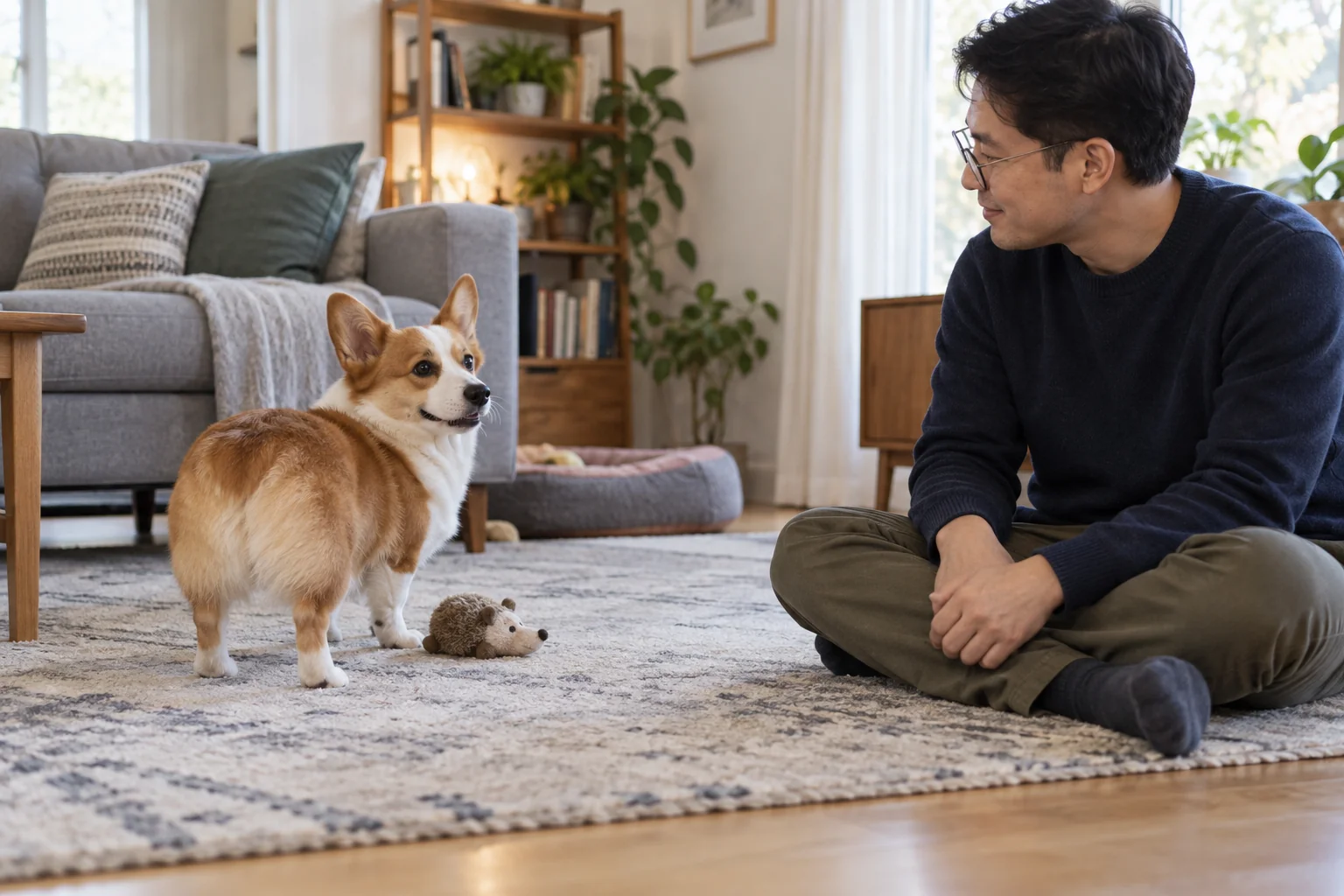
Begin in a quiet place while your dog is relaxed
Choose a familiar room with enough space for your dog to move freely and few competing sights or sounds. Practise when they are awake and calm, not while they are asleep, eating, unsettled, playing intensely or trying to get away from you. Put the reward within easy reach before you begin so you can deliver it without rummaging or reaching over the dog.
Stand or sit comfortably, with your shoulders and hands relaxed. Do not hold food beside your face to force your dog to stare at you. Instead, wait for a moment when your dog is looking elsewhere but is still at ease. Say their name once in your chosen voice. As soon as they turn their head, flick an ear towards you, or otherwise orient, mark that response with your marker word if you use one, then give the reward promptly.
The reward can be delivered near you, or you can place or gently toss a piece a short distance away if that suits your dog and the space is safe. Allow them to eat it and turn away again before trying another repetition. That small reset gives you a fresh chance to ask for a response rather than repeating the cue while your dog is still engaged with the first reward.
At first, reward the smallest clear acknowledgement. Your dog does not have to move closer, maintain eye contact or hold their head in a particular position. You are teaching the sound to predict that noticing you pays. Your first sessions should be quiet enough for your dog to notice you without competing distractions. Dogs Trust’s guide to teaching your dog their name recommends calm preparation and rewarding spontaneous check-ins as a foundation for the name cue.
Keep the first practice brief enough that your dog remains interested. A handful of well-timed repetitions is more useful than a long session in which attention fades and the name becomes constant noise. End by putting the rewards away and doing something ordinary together. A short, positive game can be fitted into a quiet moment at home without turning every interaction into a formal lesson.
Reward the turn, not a guessed perfect pose
A common beginner mistake is to wait for a full face-to-face stare when the dog has only just learnt that the sound matters. That can make the exercise feel harder than it needs to be. Reward the first clear turn towards you, then let the skill become more fluent before deciding whether you want a longer look as a separate goal.
Notice the exact moment your dog responds. If you use a marker, say it as the head begins to turn, then deliver the reward. If you do not use a marker, simply give the reward promptly after the turn. Avoid calling the name, waving food around, repeating the name and then rewarding whichever behaviour happens last. A clean sequence helps your dog connect the sound with orienting towards you.
Your timing does not need to be laboratory-perfect. If the dog looks at you and you take a moment to hand over the food, the response can still be reinforced. A marker can help bridge that delay if your dog already understands the marker, but it is optional. If marker timing is a separate challenge, our guide to reward markers and timing covers that skill in more detail.
Be thoughtful about where the food appears. If you always keep a treat visible in your hand before saying the name, your dog may be responding to the food rather than the sound. Keep rewards ready but out of sight when practical. Say the name, wait for the turn, and then reach for the reward. If your dog is not responding yet, make the environment easier rather than using food to lure their face around repeatedly.
You can reward with something other than food if you know your dog enjoys it and can deliver it without creating a struggle. A short toy game might work in a spacious room; a chance to sniff a safe patch of ground could be rewarding on a quiet walk. Food is often convenient for repeated practice, but there is no need to use an item that your dog does not want or cannot safely have. If appetite, diet, allergies or weight management are a concern, ask your vet how treats can fit your dog’s needs.
If your dog does not turn, make the question easier
A missed response is information, not defiance. Your dog may not yet know the sound, may be tired, may be absorbed in something, may not hear you clearly, or may be finding the environment too difficult. Do not repeat the name more loudly and faster. Pause, move closer if that is safe and comfortable, reduce the distraction, or try again later in a quieter place.
Check that you are not saying the name while your dog is already focused on something intense. A new learner cannot be expected to turn away from every exciting smell, moving animal or unfamiliar person. If they can hear you but do not respond in that moment, the sensible training choice is to create an easier opportunity next time, not to keep increasing pressure.
You can also use a natural pause. If your dog glances up while pottering around the room, reward that spontaneous check-in. After they have taken the reward and looked away again, try the name once. If they still do not turn, end the attempt and make the next practice simpler. Dogs Trust recommends rewarding check-ins and avoiding repeated name calls when a dog is not responding; its advice is to adjust your approach and keep rewarding the attention you want.
Do not clap near your dog’s ears, startle them, pull their lead, touch them unexpectedly or wave food in their face to force a response. Those tactics may produce a head movement, but they do not teach a comfortable, willing response to the name. If your dog looks worried, freezes, moves away or refuses a reward they normally enjoy, stop the session and give them space. You can try later in an easier context if they are otherwise relaxed.
Practise from different positions before adding distractions
Once your dog is responding readily in one quiet spot, vary your position while keeping the rest easy. Sit down instead of standing. Turn slightly sideways. Move a little farther away or practise from another familiar room. Each variation helps you learn whether your dog is responding to the name or to a familiar picture, such as you standing in one particular place with a treat in your hand.
Change one feature at a time. If you move farther away, keep the room quiet. If you change rooms, stay close. If you add another person moving around, do not also add a toy, a new cue and a long distance. The new version may feel like the same exercise to you, but your dog is meeting a different combination of sounds, movement and context.
Watch the response you actually get. A quick ear turn is a success if that is what your dog can offer at that level. If the response slows, disappears or looks uncertain, go back to a condition where your dog was comfortable and successful. The point is not to prove that they can cope; it is to build a history in which hearing their name predicts something worthwhile and manageable.
Try a few repetitions in ordinary routines rather than saving all practice for one long session. For example, you might practise in the hallway on one occasion and in the living room later, when your dog is relaxed. Do not call the name every time you want something. Frequent, unnecessary use can make it fade into the household soundtrack. Give it a clear purpose and make sure you are ready to reward the response.
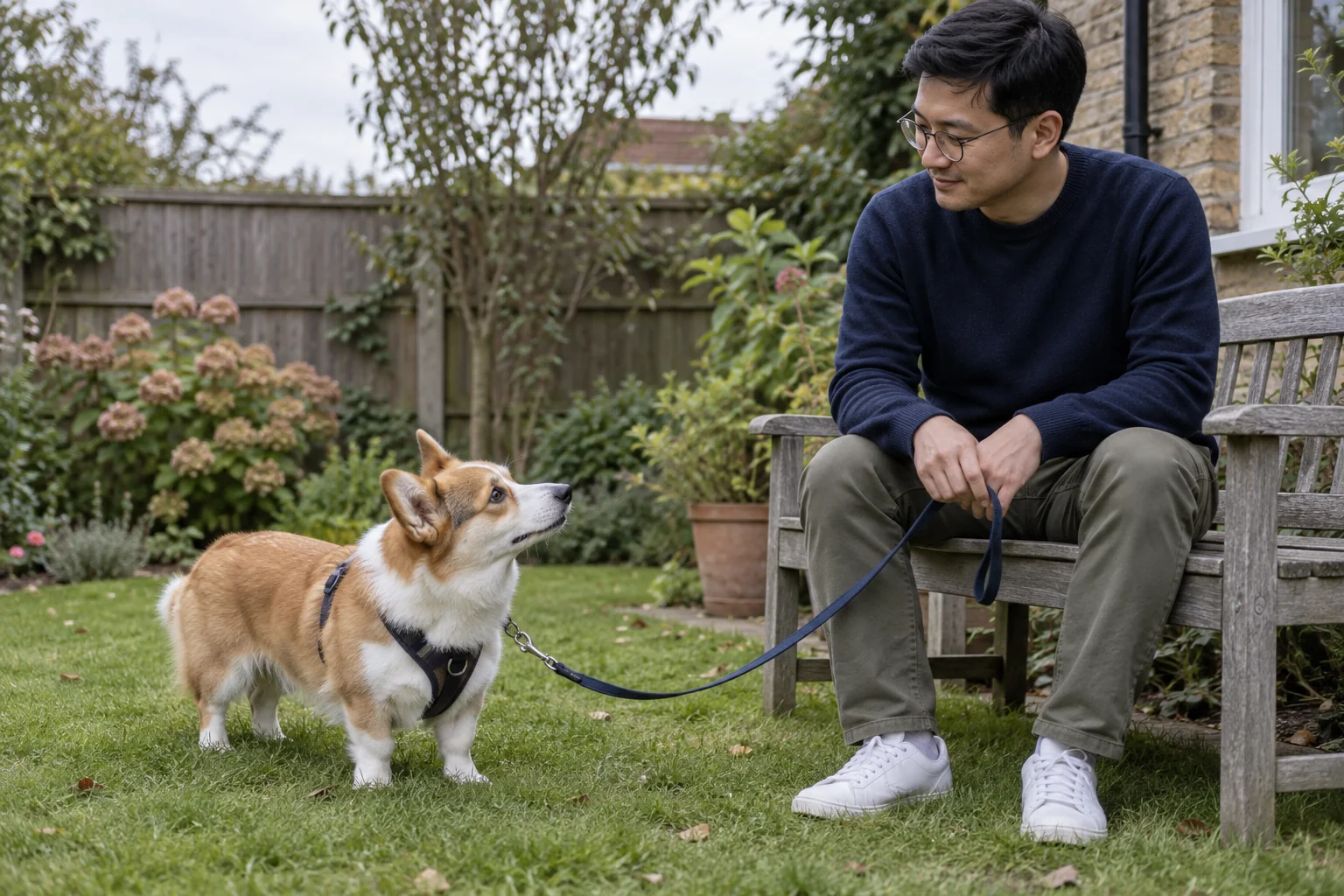
Take the game outdoors without turning it into a test
A response in the kitchen does not automatically transfer to the garden or pavement. Outdoors brings new smells, movement and sounds, so begin again at an easier level. Start in a familiar, enclosed garden or another quiet, safe place. Keep your dog on a lead where appropriate, and choose a location with enough distance from hazards and distractions for them to notice you comfortably.
Wait for your dog to look away from you while remaining relaxed. Say the name once. Reward the turn immediately, then let the dog resume sniffing or looking around if it is safe to do so. The reward need not be a cue to leave the environment. This makes the exercise useful without teaching that every response ends a walk, play or exploration.
If your dog does not respond, do not use the name to demand attention from a distance where they cannot succeed. Move closer, choose a quieter moment, or practise in a less stimulating setting. You can also reward spontaneous check-ins during a walk without saying the name. Those moments keep attention pleasant and voluntary, rather than making every glance a command.
Do not remove the lead or allow your dog to approach people or animals because they responded to their name. A name response does not establish recall, social comfort or safety around a trigger. If you are working on recall, keep the dog physically safe while you teach that separate behaviour. If your dog becomes worried outdoors, increase distance and leave the situation rather than asking for more repetitions.
Keep the name positive in everyday conversation
Your dog hears their name in many contexts, not just training. If the sound is often followed by a scolding, an unpleasant interruption or an activity they dislike, it may become less useful as an attention cue. Try to avoid using the name as the opening word for reprimands. If you need to interrupt an unsafe action, use a suitable trained cue or manage the situation safely, then review how to prevent a repeat.
This does not mean you must never say your dog’s name casually. You can say it warmly during ordinary conversation, greet them, or use it when you are about to offer a pleasant activity. The useful distinction is whether the name is predicting a positive chance to attend to you, rather than repeatedly announcing that trouble is coming. A name is not a moral label, and your dog is not being “bad” when they fail to turn.
Avoid using the name as a substitute for every instruction. If your dog already knows a cue such as “down”, you can say that cue without adding the name each time. When you do want attention first, say the name once, reward the turn, then give the separate cue if it is appropriate. This keeps the messages clearer for both of you.
Household members can help by agreeing on the sound and the general meaning. Our guide to using the same training cues at home can help you agree on a simple approach. One person using a nickname as a recall, another using it to scold, and a third using it as a general greeting may create a muddled pattern. You do not need a strict family rulebook. Just decide which sound means “look towards me”, use it consistently during practice, and help everyone keep the interaction kind.
Troubleshoot common snags without repeating the cue
If your dog only responds when you have food visible, hide the food in a pocket or place it nearby before practice. Say the name once, reward the turn, then prepare for the next repetition. If the response becomes less reliable, make the exercise easier and continue paying the behaviour. Do not suddenly withhold every reward to see whether the cue works.
If your dog turns but immediately returns to what they were doing, that can be a perfectly good response. The name does not require a long stare. If you need your dog to remain engaged, teach a separate duration or attention behaviour and reinforce that specific skill. Do not keep saying the name to hold them in place.
If your dog responds at home but not outside, treat the outdoor setting as new practice rather than assuming they have forgotten. Start where distractions are mild and the dog can still relax. Our guide to why your dog listens at home but not outside explains why familiar cues can become difficult when the surroundings change. Short, well-planned practice is also easier to fit into daily life; see how to organise short dog training sessions.
If several people use different pronunciations, select one sound for now and practise that consistently. Later you can teach another nickname deliberately, using the same reward-based association. If you have a dog who is hard of hearing or deaf, spoken name training may not be the right communication channel. Ask your vet about hearing concerns and consider help from a qualified reward-based trainer to choose an appropriate visual attention cue.

Know when the problem needs more than training
A dog who does not turn to their name may simply be learning, distracted or tired. But a sudden change in responsiveness, especially if it occurs alongside changes in movement, appetite, sleep, mood or reactions to touch, deserves a veterinary conversation. Pain, illness or hearing changes can affect how a dog responds, and a training article cannot identify the cause.
If your dog seems frightened of you, becomes distressed when approached, growls, snaps or has a bite history, do not use name practice to lure them closer or test whether they will comply. Keep everyone at a safe distance, avoid confrontation, and seek advice from your vet and an appropriately qualified, reward-based behaviour professional. Read when your dog needs professional behaviour help if you are unsure which support to seek. Do not ask children to run the exercise or use them as distractions.
Likewise, this guide is not a plan for interrupting aggression, guarding, chasing, panic or separation distress. Name recognition can be useful communication, but it is not treatment and does not make a risky situation safe. A professional can help you decide what kind of support and management fits the individual dog.
For ordinary learning, the simplest practice is enough: choose one name sound, say it once when your dog is relaxed and able to notice you, reward a small turn, and make the next repetition easier if the response fades. Try that calmly at home this week, then consider one slightly different quiet place only when your dog is comfortable.