
You've signed up for puppy class, and now the questions start. What will actually happen? What should you bring? Will your puppy be the only one barking, or the one hiding under your chair? And what if they pee on the floor in front of everyone?
A good first puppy class gives you a chance to learn a few simple skills while your puppy gets used to a new place. There is no expectation of perfect behaviour. Puppies may bark, get distracted or have an accident, so a good instructor makes room for that. Bring what you need, watch your puppy's comfort and take one useful idea home to practise.
Before your first class: quick checklist
- Check the instructor's entry rules and ask your vet about your puppy's health and vaccine timing.
- Pack small treats, a well-fitted collar or harness and leash, a mat, water and cleanup supplies.
- Plan a calm arrival. Give your puppy time to watch, and take a break if they need one.
- If your puppy is shy, excitable or gets carsick, tell the instructor in advance so they can suggest a calm arrival plan.
This guide covers how to get ready, including vaccinations, what to pack, what usually happens during the class, how puppy play should look and how to help a shy or overexcited puppy. It also explains signs of a well-run class, what to do afterward and when a class may not be the right fit.
Why puppy classes are worth it
A good puppy class does more than teach sit and down. It gives your puppy positive experiences in a new environment, with new people and other puppies, while you're there to support them. It also gives you expert guidance on everyday puppy issues, such as biting, potty training and chewing.
The American Veterinary Society of Animal Behavior (AVSAB) supports early socialisation. Its position statement says that, in general, puppies can start puppy classes as early as 7 to 8 weeks of age (AVSAB: Position statement on puppy socialization).
Class won't do everything, though. Most of your puppy's learning happens at home, in the days between sessions. Think of class as a weekly lesson for you, with a supervised field trip for your puppy.
Class is also a chance to meet other owners going through the same things. It can be a relief to discover that other puppies are biting ankles, waking at night and stealing socks too. Questions from other owners can be just as useful as your own.
Check vaccines and health first
Before your first class, talk to your vet about vaccinations and parasite treatment. Requirements vary between classes and areas, so check what your class asks for.
The AVSAB position statement recommends at least one set of vaccines at least 7 days before the first class, a first deworming before class and keeping vaccinations current throughout the course. The 7-day interval applies to the vaccine set, not the deworming. It also recommends that, where possible, classes use surfaces that can be cleaned and disinfected. Check the timing with your vet and the instructor's entry rules.
Before class:
- Ask your vet whether your puppy is ready, based on their vaccinations and health.
- Bring proof of vaccination if the class asks for it.
- Keep your puppy home if they seem unwell, for example with diarrhea, vomiting, coughing or low energy.
- Ask your class how they clean the training area between sessions.
If your puppy is too young for class or has a health problem, your vet and the instructor can help you decide when to start.
Ask your vet where it's safe to go before your puppy has finished their vaccinations, too. AVSAB advises avoiding dog parks and other busy, unsanitised places where dogs' vaccination or disease status is unknown. Ask your vet which safe experiences are suitable in your area.
Choosing a class that fits
If you haven't booked yet, it's worth looking closely at how a class is run. A few things to look for:
- Reward-based methods, with no prong, choke or shock collars
- Small class sizes, so the instructor can help everyone
- A calm, organised atmosphere
- Separate time for shy or very boisterous puppies, if needed
- An instructor who explains why, not just what
Our guide on how to choose a reward-based dog trainer without relying on badges explains what to look for and suggests watching a class before you join.
Before you book, ask how many puppies are in each class, how long sessions last, what age range the class covers and what happens if you miss a week. Ask whether you can watch a session, where puppies can rest away from the group, how play is matched and whether your puppy can sit one out. A good instructor should explain how they adapt exercises for different puppies, handle breaks and help if a puppy refuses treats. This helps you compare support as well as price. If they insist every puppy must join play or dismiss your questions, keep looking.
What to bring and how to prepare
What to bring
Packing the right things makes the first class much easier.
- Small, soft, tasty treats, more than you think you'll need. Cut them into tiny pieces so your puppy can eat them quickly. Our guide on how to choose training rewards your dog actually wants has ideas.
- A treat pouch, so your hands are free.
- A well-fitted flat collar or harness, with an ID tag.
- A standard leash in the type or length your instructor recommends.
- A mat or small blanket for your puppy to lie on.
- Water and a travel bowl, unless the class provides water.
- Waste bags and some paper towels.
- A chew or food toy to help your puppy settle during talks.
- Vaccination records, if the class asks for them.
Wear comfortable shoes and clothes you don't mind getting a little dirty. You'll probably be sitting on the floor, crouching and moving around.
Some classes ask you to leave toys at home, or not to bring a water bowl, so check the instructions you're sent.
It also helps to bring a notebook or use your phone to jot down what you learn. In the moment, with a wriggly puppy on the end of the leash, it's easy to forget the details of a new exercise. A few quick notes make home practice much easier. If anyone else in your household will be training the puppy, consider bringing them along too, so everyone hears the same advice.
Before you leave
A little preparation helps your puppy arrive calm and ready to learn.
- Follow the class's advice about feeding before a session. Don't skip your puppy's meal to make them more interested in treats.
- Give your puppy a chance to go potty before you go in.
- A short sniff around outside can help, but avoid tiring your puppy out with a long walk or energetic play.
- Arrive a few minutes early, so you're not rushed.
If your puppy gets carsick, ask your vet for advice and plan the journey so they arrive feeling settled.
When you arrive, carry your puppy or keep them close on a short leash in the parking lot and reception area. Other dogs may be arriving and leaving, and the first few minutes in a new building can feel overwhelming. Give your puppy a moment to look around and sniff before you go into the training room, and reward calm looking.
What usually happens in a first class
Every class is different, but many first sessions follow a similar pattern.
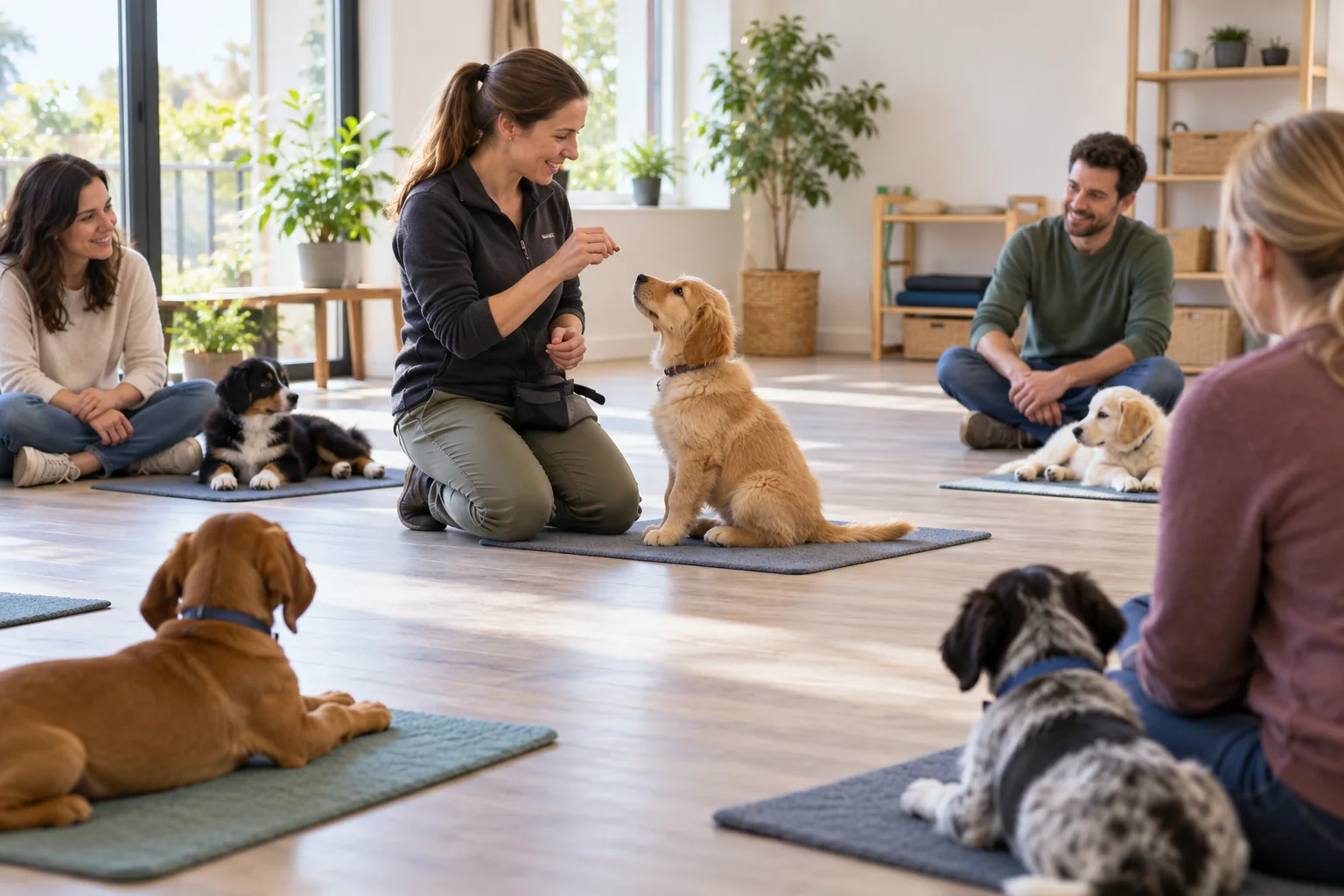
The instructor usually starts with introductions and a short explanation of how the course works. You'll probably settle your puppy on a mat with a chew while the instructor talks. Some first classes are mostly orientation for owners, with puppies just getting used to the space.
You'll then learn one or two simple skills. These might include:
- Name recognition, teaching your puppy to look at you when you say their name
- Luring a sit or a down with a treat
- A hand touch
- Settling on a mat
- Calm handling, such as touching paws and ears gently
The instructor typically demonstrates the skill, then you practice with your puppy while they move around the room to help.
Many classes also cover common puppy problems, such as biting, chewing, potty training and crate training, and give you a chance to ask questions.
At the end, you'll usually get some practice to do at home during the week.
Expect your puppy to need breaks. Some puppies focus only briefly before they need to sniff, chew or rest. That's normal, and a good instructor will build pauses into the session. It's fine to head outside for a moment if your puppy needs a potty break or some quiet away from the group.
How puppy play should look
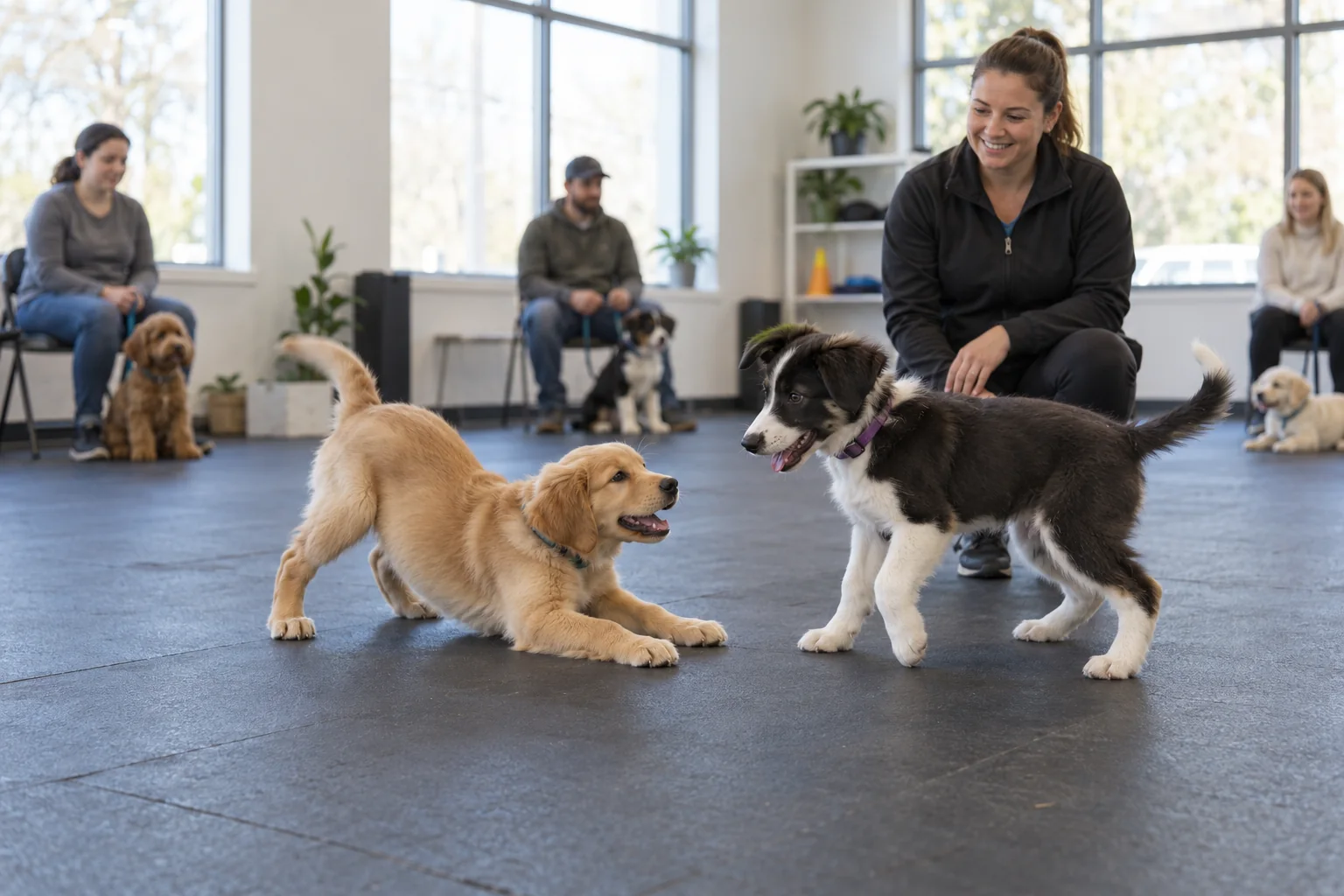
Some puppy classes include short, supervised play sessions. Done well, these help puppies learn to play politely and read other dogs.
The MSPCA explains that in its puppy play sessions, trainers aim to pair your puppy with other puppies with the same play style, and may move a puppy that keeps growling, biting or jumping on others without giving them a break (MSPCA: What to expect in puppy play).
Good puppy play usually looks like:
- Loose, wiggly bodies and play bows
- Puppies taking turns chasing and being chased
- Frequent pauses and breaks
- Both puppies choosing to come back for more
Signs that play needs a break:
- One puppy constantly on top or chasing, while the other tries to escape
- A puppy hiding, tucking their tail or trying to get behind their owner
- Play getting louder, faster and rougher without pauses
A good instructor will intervene early to give puppies a break, match them with suitable playmates or let a shy puppy watch from a distance. Play shouldn't be a free-for-all.
Help a shy or overexcited puppy settle
If your puppy is shy
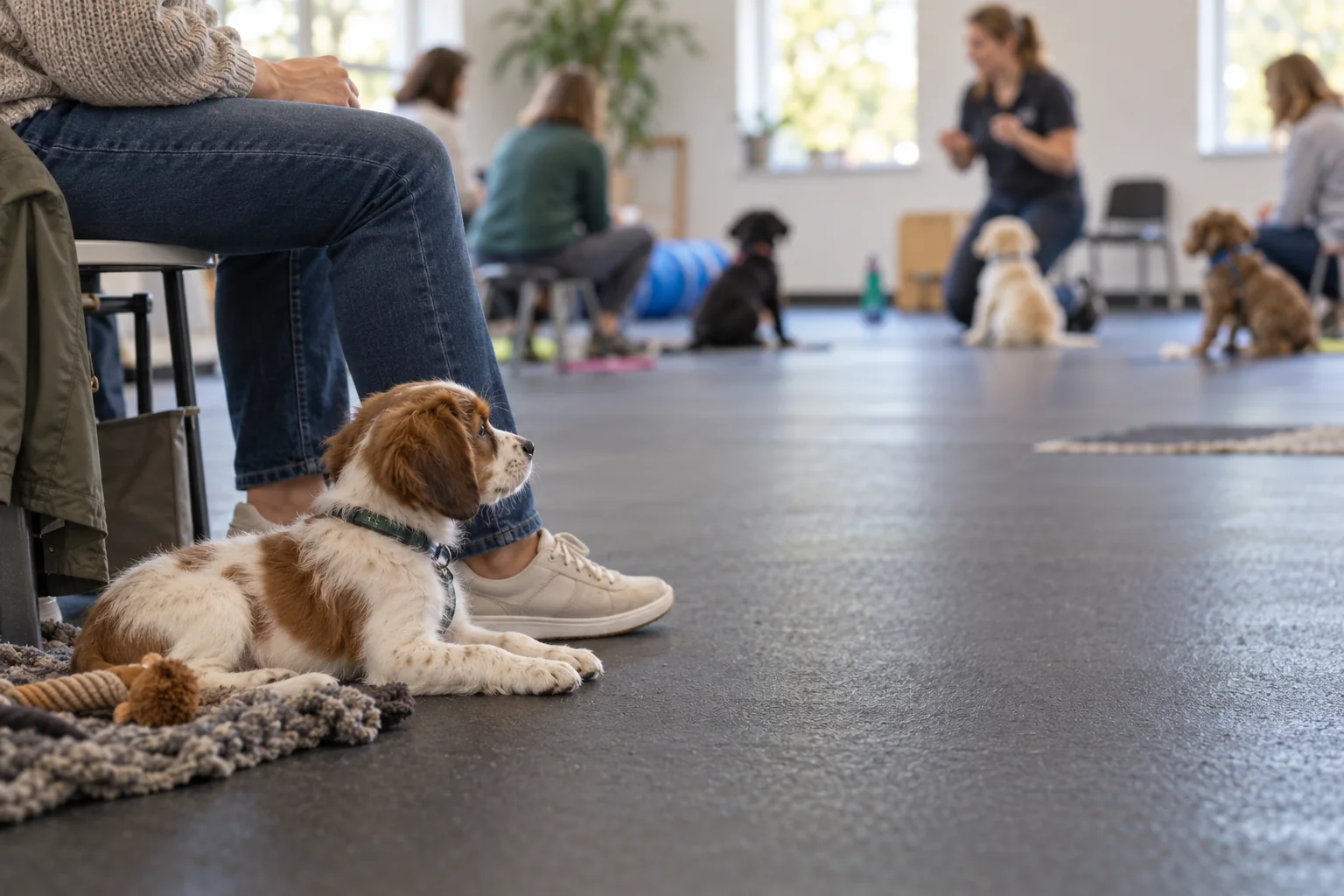
It's completely normal for some puppies to feel unsure in a new place. A shy puppy may hide under your chair, refuse treats or stay close to you.
- Let your puppy watch from a distance at first.
- Sit with them on their mat and offer treats if they'll take them.
- Don't push them to greet other puppies or people.
- Ask the instructor if you can sit near the edge of the room, away from the busiest areas.
- Keep the first class short if needed. It's fine to leave early.
Our guide on how to socialize a puppy without overwhelming them explains how to build confidence gradually.
If your puppy seems very frightened, or the class is too much for them, talk to the instructor. They may suggest a smaller class, a private session first or a different approach.
If your puppy is overexcited
Other puppies arrive bouncing off the walls, barking at everyone and pulling toward every puppy in the room.
- Keep your puppy on a short, loose leash close to you.
- Give them a chew or food toy on their mat during talks.
- Reward any calm moment, such as sitting, lying down or looking at you.
- Ask if you can sit further from other puppies.
- Take short breaks outside if your puppy gets too worked up.
Remember that barking, distraction and excitement are very common at the first class. Your puppy isn't being naughty. They're experiencing a lot of new things at once.
Some owners find it helps to arrive a little early and let their puppy explore the empty room before others arrive. Others prefer to arrive just on time, so there's less waiting around. Try one approach, notice how your puppy copes and adjust next week.
Signs of a well-run class
Watch how the class is run, especially in the first session.
Signs of a good class:
- The instructor uses rewards and explains how to use them well.
- Puppies are calm or curious most of the time, and stressed puppies get space.
- Owners get individual help and feedback.
- Play is closely supervised and paused often.
- The room is clean, safe and not overcrowded.
Signs to be cautious about:
- Use of prong, choke or shock collars, leash jerks or shouting
- Puppies being forced to interact or held down
- Uncontrolled, rough play
- An instructor who dismisses your questions or concerns
If something doesn't feel right, it's fine to leave and find another class.
Watch how your puppy copes during and after class. If they spend much of the session trembling or hiding, or seem unsettled afterward, tell the instructor and ask whether a quieter class or private session might suit them.
After class: practice at home
Use class to learn what to practise between sessions.
- Practise what you learned in short sessions, several times a day.
- Practise in different rooms, then in the garden, then on quiet walks.
- Keep a note of questions to ask at the next class.
- Let your puppy rest after class. New places and people can be tiring.
If your puppy seems tired after class, keep the rest of the day quiet and give them room to rest.
Our guide on how to turn a dog training lesson into something you can practice explains how to make homework manageable in a busy week.
A worked example: a puppy who hides at the first class
Here's an illustrative example. Adapt it to your own puppy.
The pattern: A ten-week-old puppy arrives at class, sees the other puppies and hides under the chair, refusing treats.
During the class:
- The owner sits near the edge of the room, with the puppy on a mat under the chair.
- They let the puppy watch, without asking them to come out.
- After a while, the puppy peeks out and takes a treat.
- The owner skips the play session, and the instructor suggests a short private session.
During the week:
- The owner practices name recognition and a hand touch at home.
- They visit a few quiet new places, offering treats.
At the second class:
- The puppy takes treats more readily and comes out from under the chair to practice a sit.
In this example, letting the puppy watch and go at their own pace helped them feel more comfortable.
Troubleshoot common problems
My puppy barks or can't settle: Move further from other puppies, offer a chew and reward calm moments. Ask the instructor for help.
My puppy won't take treats: They may be worried or overstimulated. Give them more distance or a short break, and don't push an interaction.
My puppy had an accident: This is common. Clean up and give them a chance to go potty before the next class.
My puppy pulls to play or forgets cues: Move further from the group and practise easy skills at home before trying them in a new place.
My puppy is much bigger or smaller than the others, or I missed a class: Ask the instructor about a suitable play group or a catch-up handout.
When a class isn't the right fit
A group class is not the right starting point for every puppy.
Consider talking to your vet or a qualified, reward-based professional, and possibly starting with private sessions, if:
- Your puppy is very frightened in new places or around other dogs
- They growl, snap or seem very stressed in class
- They have a health condition that makes group classes difficult
Use reward-based help only. The American Veterinary Society of Animal Behavior states that evidence supports reward-based methods for all canine training (AVSAB: Why you need to reward your dog in training).
You can find more help with your puppy in our puppy training guides.