
To teach your dog to take treats gently, start by changing how you hand the food over. Put a small treat in the middle of your flat, open palm, with your fingers held together and your thumb tucked against the side of your hand. Hold your hand still, at or a little below your dog's mouth, and let them lift the treat off your palm. Without fingertips held out, there is much less for your dog to catch. Practice when your dog is calm and not very hungry, using ordinary treats rather than their favorites.
If your dog still catches your skin, stop offering food from your hand for now. Toss treats onto the floor or put them in a bowl instead. You never need to put up with painful contact to train this. If grabbing food comes with stiffening, growling, snapping or a bite, stop hand-feeding and read the next section before you continue.
This guide covers one thing: taking food rewards without catching fingers. Mouthing hands and arms during play or for attention is a different problem and is not covered here.
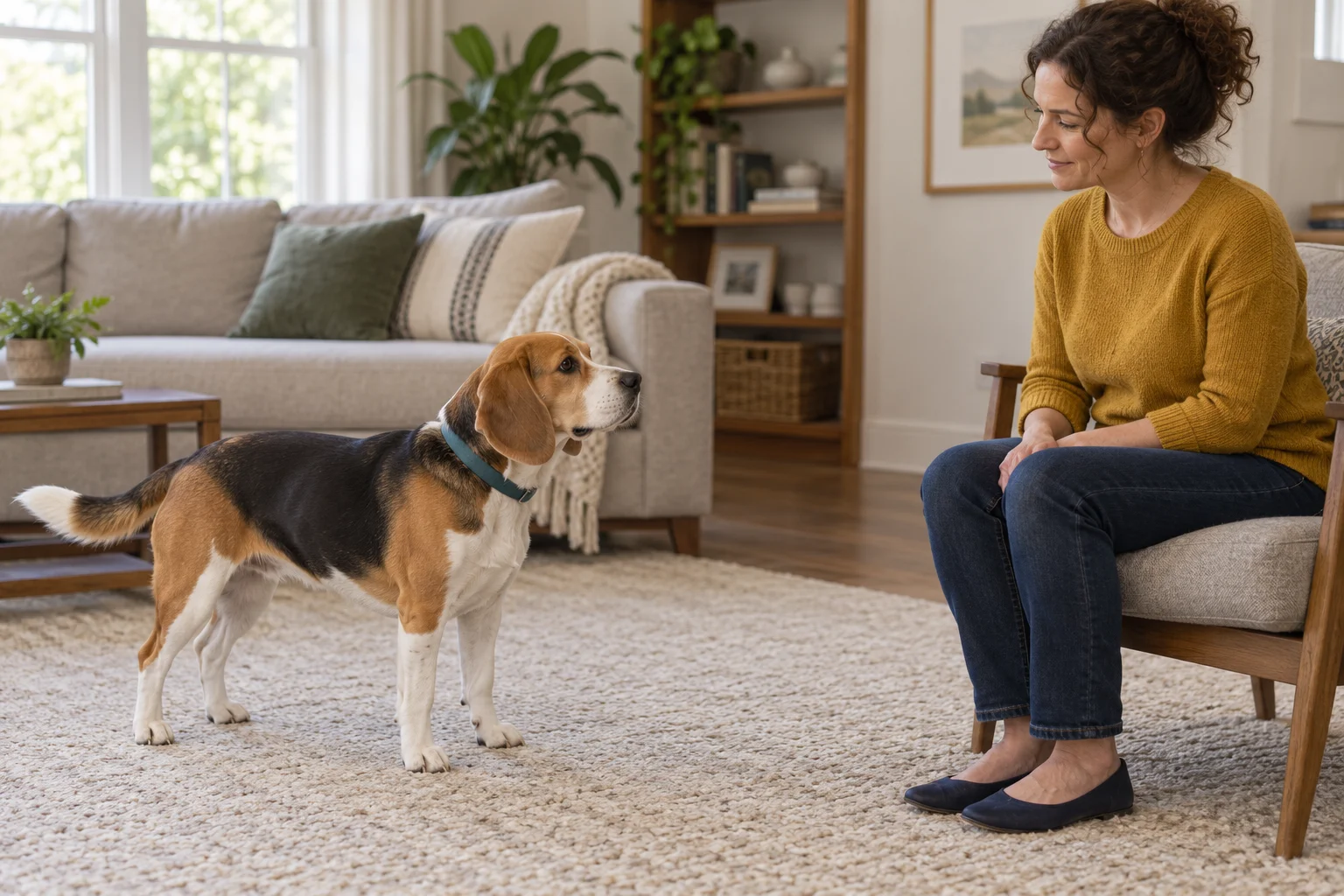
When treat snatching needs professional help
Ordinary treat snatching looks eager. Your dog lunges at the food, opens their mouth wide, and their teeth catch your fingers in the rush. Their body is loose and wiggly, and they are keen to get the next treat. Vetstreet's guide to taking treats gently describes this kind of grabbiness as typically not aggressive, though it can still be unpleasant and intimidating.
Some food-related behavior is different and needs a different plan. Stop hand-feeding and get help if your dog:
- Stiffens, freezes or stares hard when you reach toward food, a bowl, a chew or a toy.
- Growls, curls a lip or snaps when someone comes near while they have food.
- Has bitten someone over food or anything else.
These signs can point to guarding or fear. They are outside the scope of a treat-delivery exercise, and an online guide cannot tell you how to change them safely. Keep people, especially children, away from your dog while they have food or chews, and feed your dog somewhere quiet where nobody needs to approach them.
A sudden change also needs attention. Vetstreet advises that a dog who suddenly starts biting harder or less carefully may have a medical problem, fear, anxiety, frustration or aggression behind it, and recommends seeing a veterinarian first. If your dog's treat-taking changes suddenly, book a vet visit before you train.
For guarding, threats or a bite history, look for an appropriately qualified, reward-based behavior professional, starting with your vet. The guide to when to seek professional behavior help explains how to find the right person and what to bring.
Keep children out of treat practice
This is an adult-only exercise. Children should not feed treats from their hands to a dog who snatches, and they should not act as the person whose hand is "practiced on."
The RSPCA's advice on children and dogs says to stay with your children around dogs and never leave a child alone in the same room as a dog, even your own. It also advises teaching children not to approach a dog who is eating or has a treat. The RSPCA notes that young children are far more likely to be bitten.
While you are working on treat-taking, give children something else to do in another room, or practice when they are out. If children want to give the dog something, an adult can toss a treat onto the floor away from everyone, or put food in the dog's bowl.
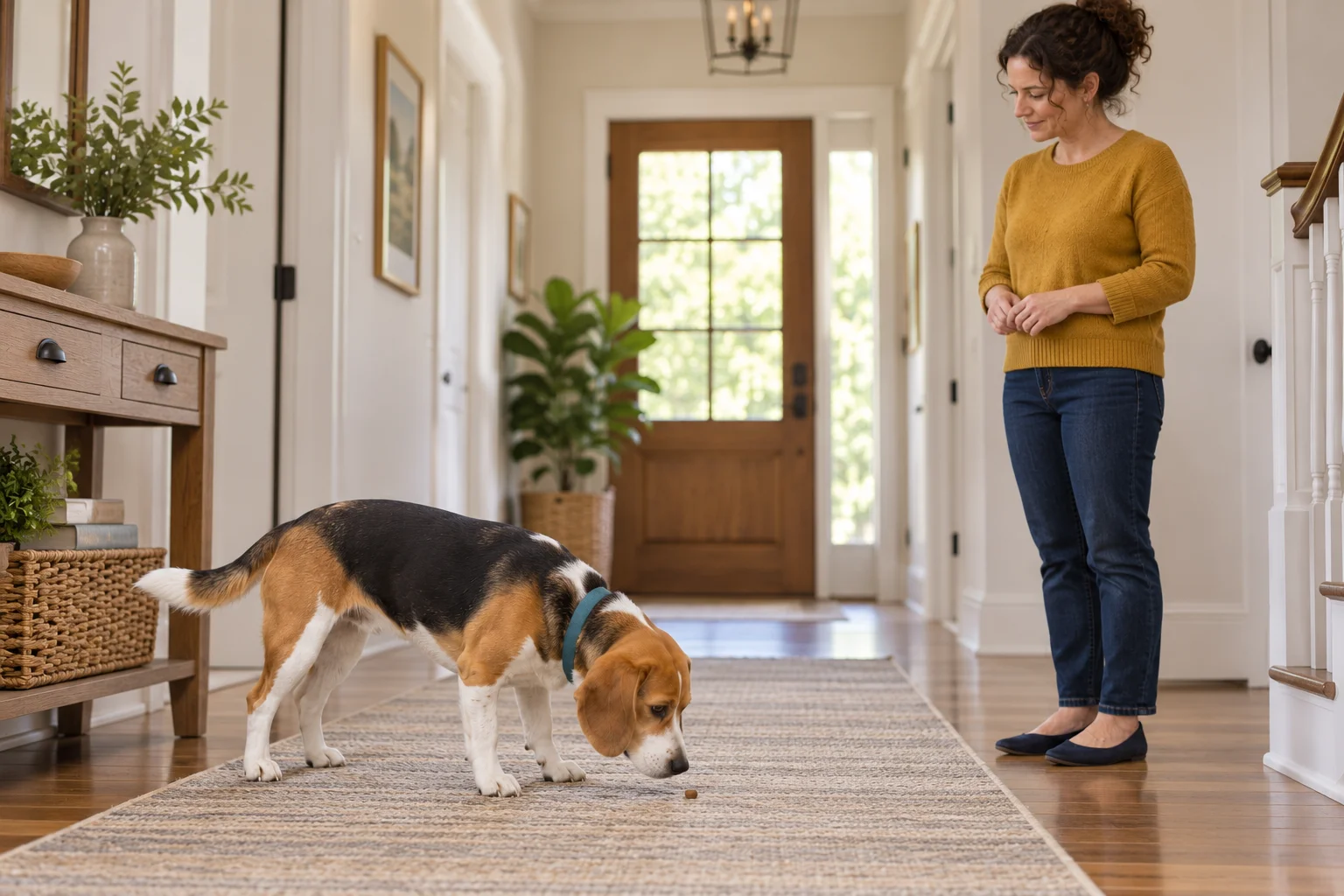
Protect your fingers while you train
You do not have to hand-feed to train your dog. If your dog's grabbing hurts, change the way you deliver food first, then work on gentleness separately.
Useful alternatives:
- Floor delivery. Toss or drop the treat on the floor. Whole Dog Journal's article on dogs who bite hands while taking treats, by trainer Pat Miller, suggests tossing treats for behaviors where your dog is moving anyway. For a down, food placed between the front paws may suit the position better than a toss. Floor delivery can still make a sitting or standing dog lower their head or move, so choose delivery that fits the exercise rather than assuming it preserves a position.
- A bowl or a flat surface. Put the treat in a small bowl or on a plate and set it down in front of your dog.
- A long-handled spoon. Whole Dog Journal mentions a metal spoon as a way to keep fingers clear. Put a little soft food on the spoon and let your dog lick it off.
- Something to lick. A squeezable tube of dog-safe soft food lets your dog lick instead of bite, as the same article describes. Check any human food with your vet first if you are unsure it is safe.
Pick whichever fits the exercise you are training. You can stick with these methods for as long as you like. Many dogs train perfectly well with food delivered on the floor or from a palm.
Set up a calm, easy practice session
Gentleness is easier when your dog is relaxed. Whole Dog Journal suggests using lower-value treats and training after a meal rather than before, so your dog is less frantic for food.
Before each session:
- Choose a quiet room with doors closed and other pets elsewhere, so nobody competes for food.
- Use small, dry, ordinary treats, such as pieces of your dog's own kibble. The AKC GoodDog! Helpline's guide to dogs who chomp treats and fingers recommends small pieces that are not moist, because sticky food clings to your hand. Keep the special treats for later.
- Keep the treats in a pouch or bowl out of your dog's reach, so you take one at a time.
- Sit on a chair or on the floor, so your hand can rest at or below your dog's mouth without you bending over them. Vetstreet advises keeping hands level with or below the muzzle, so your dog does not need to jump or stand on their hind legs.
If your dog is bouncing, barking or pawing at you, end the session and try again when they are calmer. The AKC advises ending the session if your dog is overexcited.
If choosing lower-value treats is new to you, the guide to choosing training rewards explains how to sort your dog's treats from everyday to special.
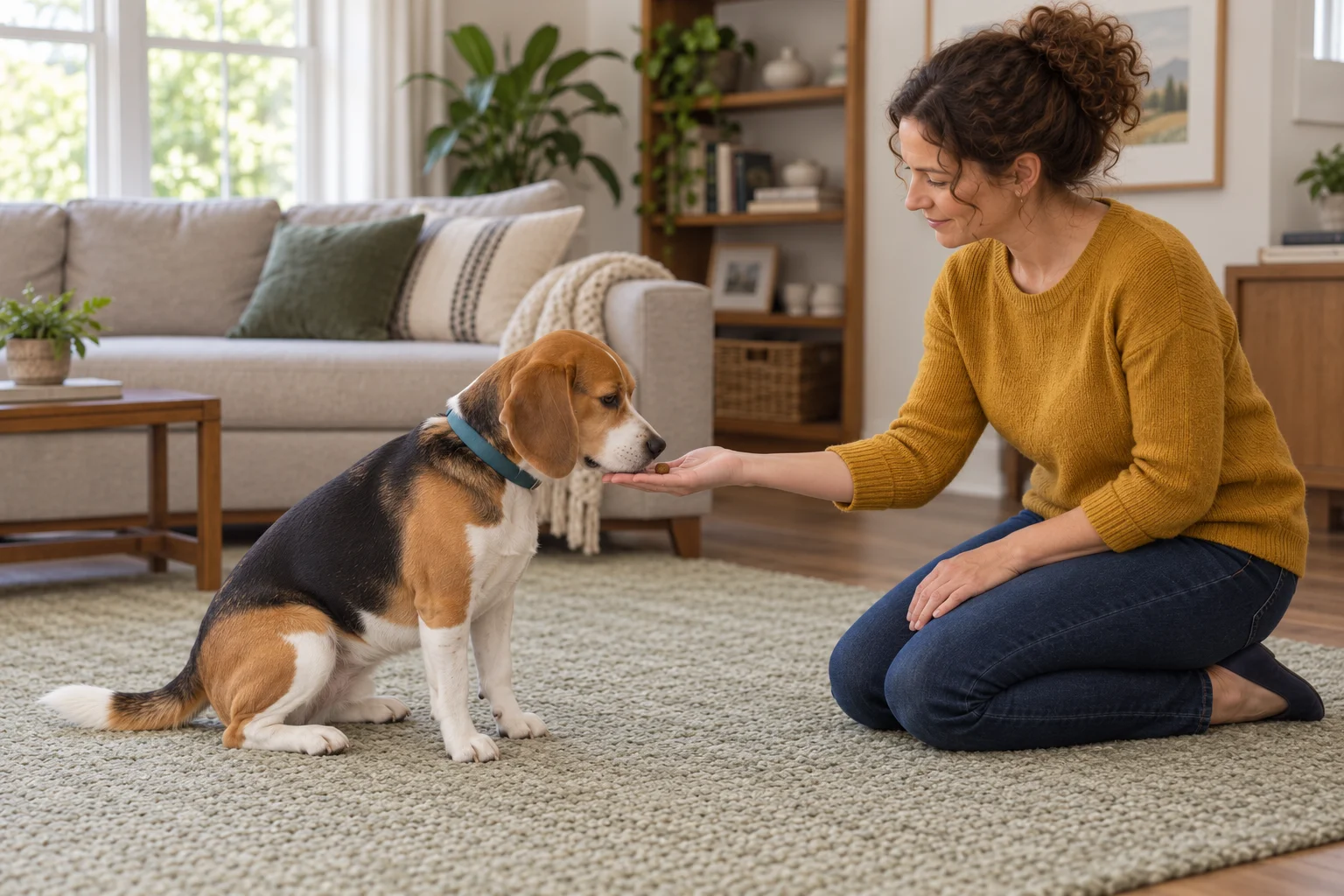
Offer treats on a flat, still palm
This is the main method. It removes the fingertips your dog has been catching, and each treat rewards a calm approach.
Put one treat in the middle of your palm. Hold your hand flat and open, fingers straight and together, thumb tucked against the side of your hand. Whole Dog Journal describes this as feeding your dog "like a horse," from the flat of the hand rather than the fingertips.
Rest your hand on your knee or hold it low, at or just below your dog's mouth. Keep it still. Let your dog come to your hand and lift the treat off your palm. Many dogs lift food off a flat palm with their lips and tongue.
When your dog takes the treat softly, praise them quietly and offer the next treat the same way. The treat itself is the reward for a calm take.
Watch what your dog does as your hand appears:
- If they come forward calmly and lick the treat up, keep going.
- If they lunge but take the treat without catching your skin, slow down. Wait a few seconds between treats, and bring your hand out more slowly.
- If their teeth catch your palm, read the next section before you offer another treat.
A handful of calm takes, then a break, is a complete session.
Switch to floor rewards after painful contact
You do not need to hold your hand in place if your dog hurts you. Stop hand-feeding for the rest of the session.
Do not shout, tap your dog's nose or do anything else meant to startle or hurt them. The American Veterinary Society of Animal Behavior recommends reward-based methods for all dog training.
If it hurt, stop offering food from your hand for the rest of the session. Deliver the remaining treats on the floor instead. That way your dog still gets their reward, and your hand is not put at risk again.
Then make the next session easier in one specific way:
- Use a lower-value treat.
- Practice after a meal or a walk, when your dog is calmer.
- Offer the treat more slowly, with longer pauses between treats.
If your dog's teeth still catch your palm when they are calm and the treat is ordinary, stay with floor, bowl or spoon delivery. You do not need to keep testing your hand.
Practice a pause at your hand, if contact is already soft
Some dogs take softly from an open palm but crowd the hand before it opens. This optional exercise rewards a brief pause away from a stationary hand.
Only use it if your dog's contact with your hand is already soft. If they bite or paw hard at a closed hand, skip this section and keep using floor delivery and the flat palm.
The AKC describes a version of this exercise. Sit on the floor or a chair. Hold one treat in a closed fist, resting still on your knee. Keep the rest in your pouch. Your dog will probably sniff or nudge your hand. Wait without moving. The moment your dog moves their nose back from your hand, open your fist into a flat palm so they can take the treat. If your dog lunges as your hand opens, close it again gently and wait for them to move back.
Keep it short and easy to win. If your dog gets frustrated, starts pawing hard or mouthing your fist, or barks, stop the exercise straight away. End with a few treats on the floor and go back to the flat-palm method in your next session.
Add a word for taking food gently
A word such as "gentle" can remind your dog how to take food. It is optional.
The AKC suggests adding it once your dog is taking treats calmly, saying "gentle" each time a treat is given. With the flat-palm method, say "gentle" softly as you offer your hand. Use it only when you expect a calm take, so the word stays linked to the gentle behavior.
If your dog is very excited, saying "gentle" will not slow them down on its own. Use floor delivery when your dog is too excited to take food softly.
Move to holding treats in your fingers, if you need to
You never have to feed treats from your fingertips. Floor, bowl and flat-palm delivery work for almost every exercise. Some owners want fingertip delivery for precise timing, so this section explains how to build up to it.
Only move on when your dog takes food softly from a flat palm in several different rooms and sessions, without lunging.
Vetstreet describes a gradual approach. Start with the treat hidden in your closed hand. When your dog touches your hand softly with their nose or tongue, open your hand flat so they can take it. Next, hold the treat with all five fingertips closed around it, and later between just two fingers. At each stage, Vetstreet advises releasing the treat into your dog's mouth only when their teeth are off your skin.
Change one thing at a time. If your dog grabs at the new way of holding the treat, go straight back to the flat palm. If any contact hurts, go back to floor delivery for that session.
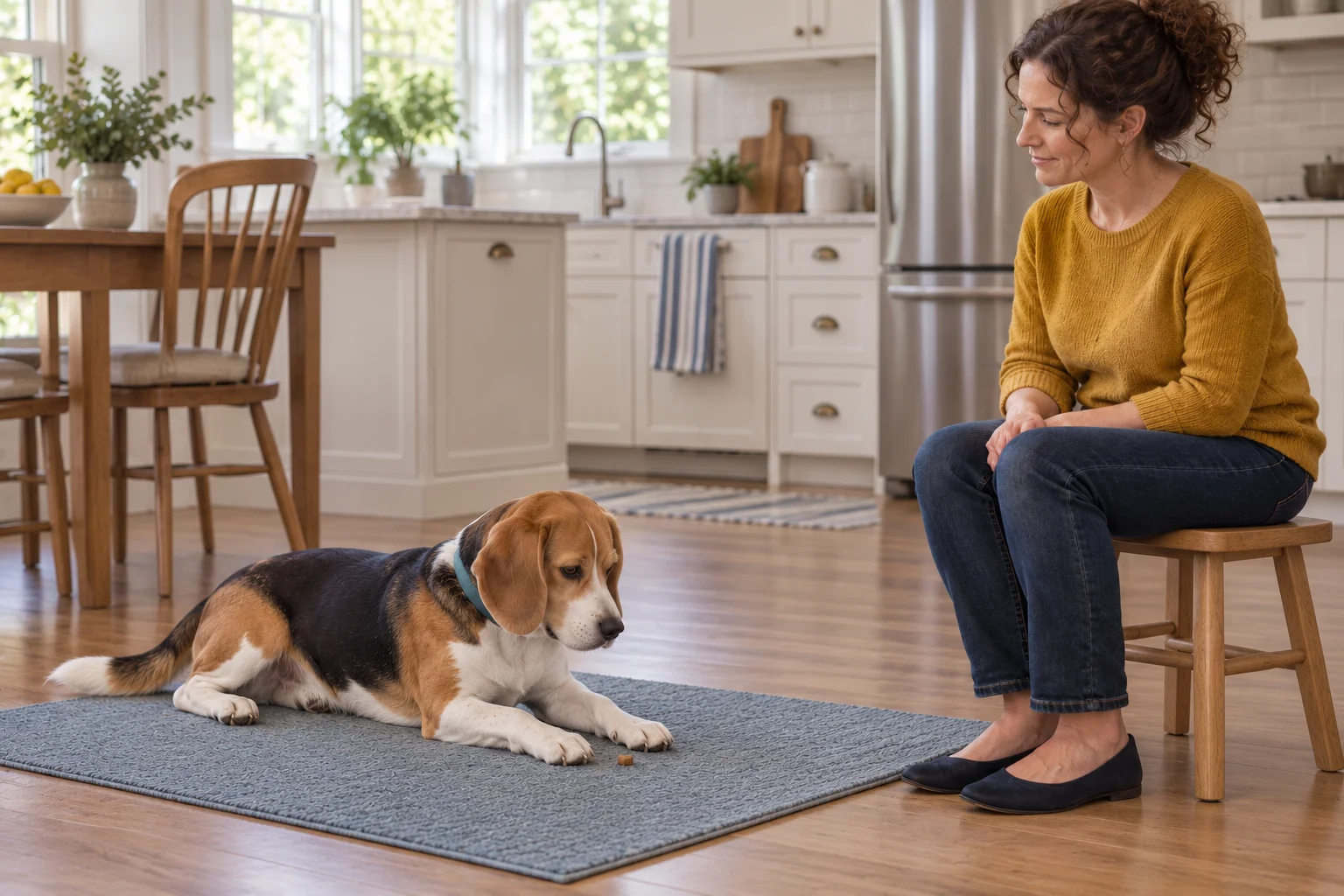
Use calm delivery in your other training
Many training guides ask you to give the treat right at your dog's nose, while they hold a position. You can do that with a flat palm instead of fingertips. Hold the treat in the middle of your palm and bring your hand to your dog's mouth at nose height, keeping it still once it arrives.
If your dog still grabs, use floor, bowl or spoon delivery to keep your fingers clear. For a down, you can place food between their front paws. Food on the floor may draw a sitting or standing dog out of position, so it will not suit every sit, stand or stay exercise. Use a delivery method that lets you reward the behavior you asked for without painful contact.
If you use a marker word such as "yes," keep its promise. Every "yes" is still followed by a treat; only the way the treat arrives has changed. The guide to reward marker timing explains how a marker works.
Puppies often take food roughly too, especially while their teeth are sharp. The same flat-palm and floor delivery works for them. Mouthing during play is a separate problem, covered in the guide to stopping puppy biting during play.
Fix common treat-taking problems
Your dog is gentle with kibble but grabs special treats
This is common. Higher-value food makes many dogs more excited. Use ordinary treats when you hand-feed, and save the special ones for floor or bowl delivery until your dog takes ordinary treats calmly from your palm.
For example, a young adult dog takes kibble softly from his owner's palm in the kitchen. When she switches to cheese for a harder exercise, he snaps it off her palm and catches her skin. She delivers cheese on the floor for the rest of that session and goes back to kibble on her palm the next day. A few days later, she tries a single piece of cheese on her palm after a meal, when he is calmer. He takes it softly, so she continues with one or two pieces at a time.
Your dog is rough outdoors or in a class
New places are exciting. Expect your dog to be grabbier there, even if they are gentle at home. Use floor or bowl delivery outdoors at first, and practice the flat palm somewhere quieter. The guide to why your dog listens at home but not outside explains why skills need practice in each new place.
Your dog is gentle with you but not with others
Make sure everyone who feeds your dog uses the same flat-palm delivery. Vetstreet notes that everyone in the household should deliver rewards the same way. Remember that children should not be part of this exercise.
Your dog paws at your hand or lap
Pawing often happens when your dog is very keen and the food is close or exciting. Rest your hand on your knee rather than holding it out, use a less exciting treat, and pause before offering the next one. If pawing continues, deliver on the floor for the rest of the session. Some dogs paw because they have learned it makes food appear, so avoid handing over a treat while their paw is on you.
Your dog won't take food from your palm
Some dogs are unsure about taking food from a flat hand, or nudge the treat off. Lower your hand so it rests flat on your knee or the floor, and let your dog sniff it. If they still hesitate, put the treat on the floor next to your hand. There is no need to insist on hand delivery.
You have more than one dog
Train each dog on their own, with the other dogs in another room. Feeding several dogs from your hands at once can cause competition. Keep the dogs separate for the whole session, including any floor rewards.
Choose your next practice session
For your next session, pick the safest delivery that works for your dog today.
If your dog's teeth still catch your skin when they are calm, deliver treats on the floor, in a bowl or from a spoon, and try the flat palm again on another day. If your dog takes ordinary treats softly from your flat palm, keep practicing that in a quiet room and then in a second room. If the flat palm is easy everywhere, try the optional waiting exercise or a slightly more exciting treat, changing only one thing at a time.