
Before you plan a bath, check two things. Does your dog have inflamed skin or open sores, or seem uncomfortable when touched? If so, skip the bath and call your vet. Has your dog ever growled, snapped or bitten during bathing or handling? If so, get help from your vet and a qualified behavior professional rather than practicing at home.
If your dog's skin is healthy and they have no history of snapping, practice bath time separately from real baths, in a place your dog can walk into and out of on their own, such as a walk-in shower on a non-slip mat. This article never involves lifting your dog into a tub, or pushing, pulling or carrying them in. Build up in small stages: treats in the bathroom, walking onto the dry mat, the sound of running water, a little warm water on the feet, and then gradually more of the body. Each wet moment ends with the water turned away and a treat.
If your dog tries to leave, freezes or starts trembling, turn the water off or away, step back and pause. Leave the way out open. Try an easier stage only if your dog comes back on their own and looks relaxed. Otherwise, end the session.
Check your dog's skin and comfort before any bath
Signs that mean a vet visit first
Virginia Tech Veterinary Teaching Hospital's bathing guidance advises skipping the bath and calling your vet if your pet has inflamed skin, open sores or seems uncomfortable when touched.
Call your vet before bathing or bath practice if your dog:
- Has inflamed skin or open sores.
- Has redness, bumps, excessive scratching or an unusual odor after a bath.
- Flinches, yelps or pulls away when touched, or seems stiff, sore or slow to get up.
- Has started disliking baths or handling much more than before.
If your dog's coat is matted, remove the mats before wetting it. Virginia Tech recommends doing extensive detangling a day or two before the bath. Our guide to a dog who hates being brushed covers mats and brushing.
If your dog has growled, snapped or bitten
If your dog has growled, snapped or bitten during bathing, drying or handling, don't use this article as a home plan. See your vet first, then a qualified reward-based behavior professional. Our guide on when to seek professional behavior help explains what to look for. Never punish a growl; it is your dog's warning.
Keep children out of bath practice. Bathing involves close handling of a wet, possibly worried dog, so an adult should do it.
Leave skin care and medicated baths to your vet
If your vet prescribes a medicated shampoo, follow the directions exactly. Virginia Tech Veterinary Teaching Hospital's bathing guidance notes that many medicated shampoos need to stay on the skin for 10 to 15 minutes. Use the contact time your vet gives you.
Follow your vet's instructions exactly. Don't swap in a different shampoo, change how often you bathe, or shorten or lengthen the contact time on your own.
For routine baths, Virginia Tech recommends shampoo made for pets rather than human shampoo. Ask your vet or groomer which product suits your dog's coat and skin.
Many dogs don't need frequent baths. Virginia Tech's bathing tips say many healthy dogs do well with baths every 4 to 12 weeks, depending on coat type and lifestyle. Ask your vet or groomer what suits your dog.
If your dog needs a bath before they are ready
Sometimes a dog needs washing before bath practice has worked, for example after rolling in something, or when a medicated bath has been prescribed. Keep those occasions separate from training.
- For a small dirty patch, wiping just that area with a damp cloth may be enough, if your dog accepts it calmly.
- For a full bath your dog isn't ready for, ask a groomer or your vet's team to do it. Tell them your dog finds baths difficult and ask whether they can work in short breaks.
- For a prescribed medicated bath your dog can't yet manage at home, ask your vet whether the clinic can do it or whether there is another option. Don't skip prescribed treatment while you train.
- Don't lift, carry or force your dog into a bath or shower to get it done.
If a necessary bath goes badly, let your dog rest, then return to the easy stages below.
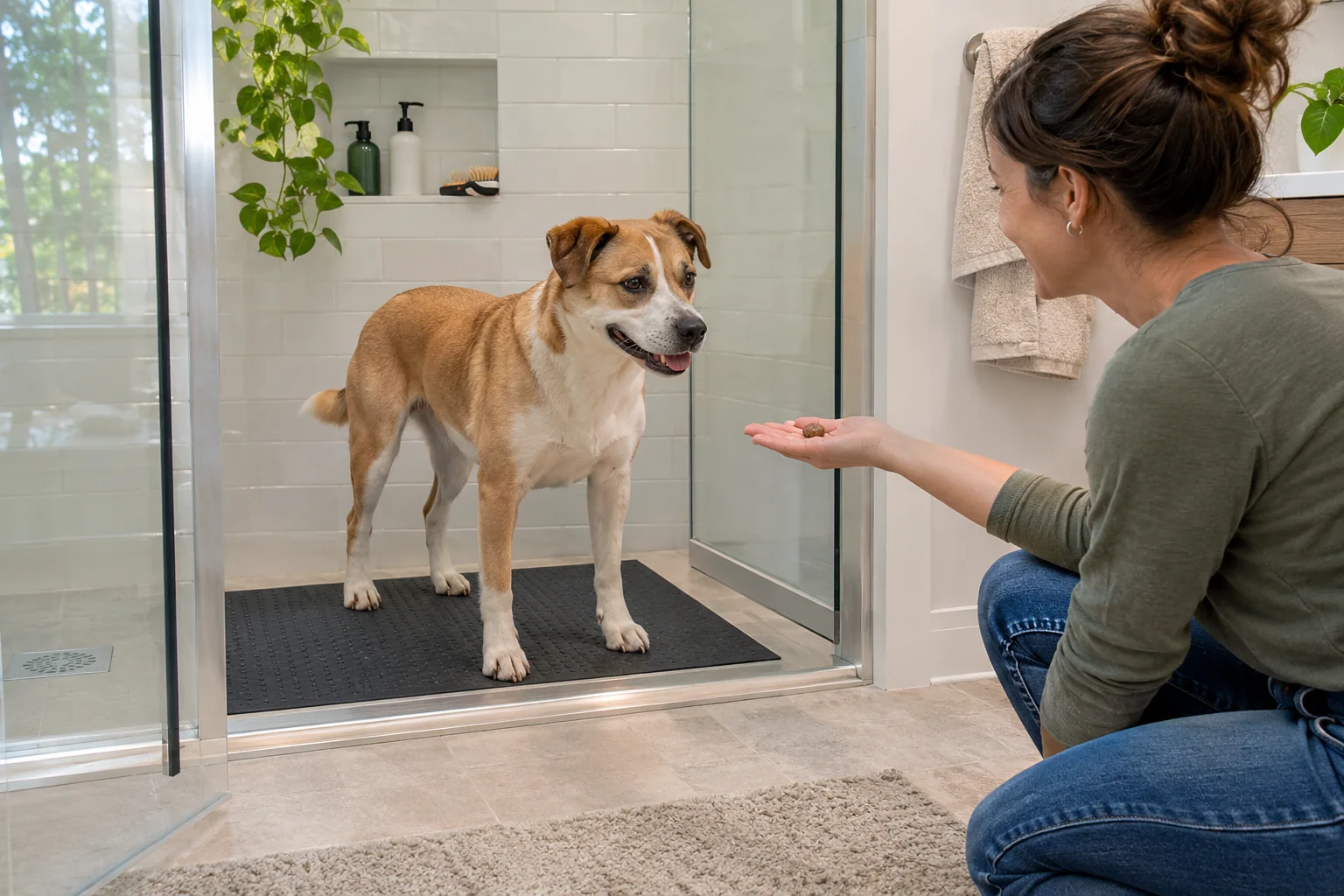
Choose a place your dog can walk into
Bath practice in this article happens somewhere your dog can walk in and out of under their own power. That might be:
- A walk-in shower with a low or no step.
- A large, low-sided basin or dog bath set on the floor, which your dog can step into easily.
- A ramp or step that your dog already uses confidently, if it is stable and non-slip.
A high-sided bathtub that needs lifting is not part of this plan. Don't lift, push, pull or carry your dog into a tub. If your dog can only be bathed by lifting, use a groomer or your vet's team instead.
Make the surface non-slip. Fear Free Happy Homes' bath time tips, reviewed or edited by Fear Free's veterinary behavior team, suggest a rubber mat in the bath or shower, or a towel as a quick fix.
Keep the bathroom door open during practice so your dog can leave. Close outside doors and secure the area if a wet dog might run outdoors.
Prepare the shower, water and treats
You will need:
- Small, soft, tasty treats in a pouch at your waist or a bowl on a shelf out of your dog's reach. Our guide to choosing training rewards can help.
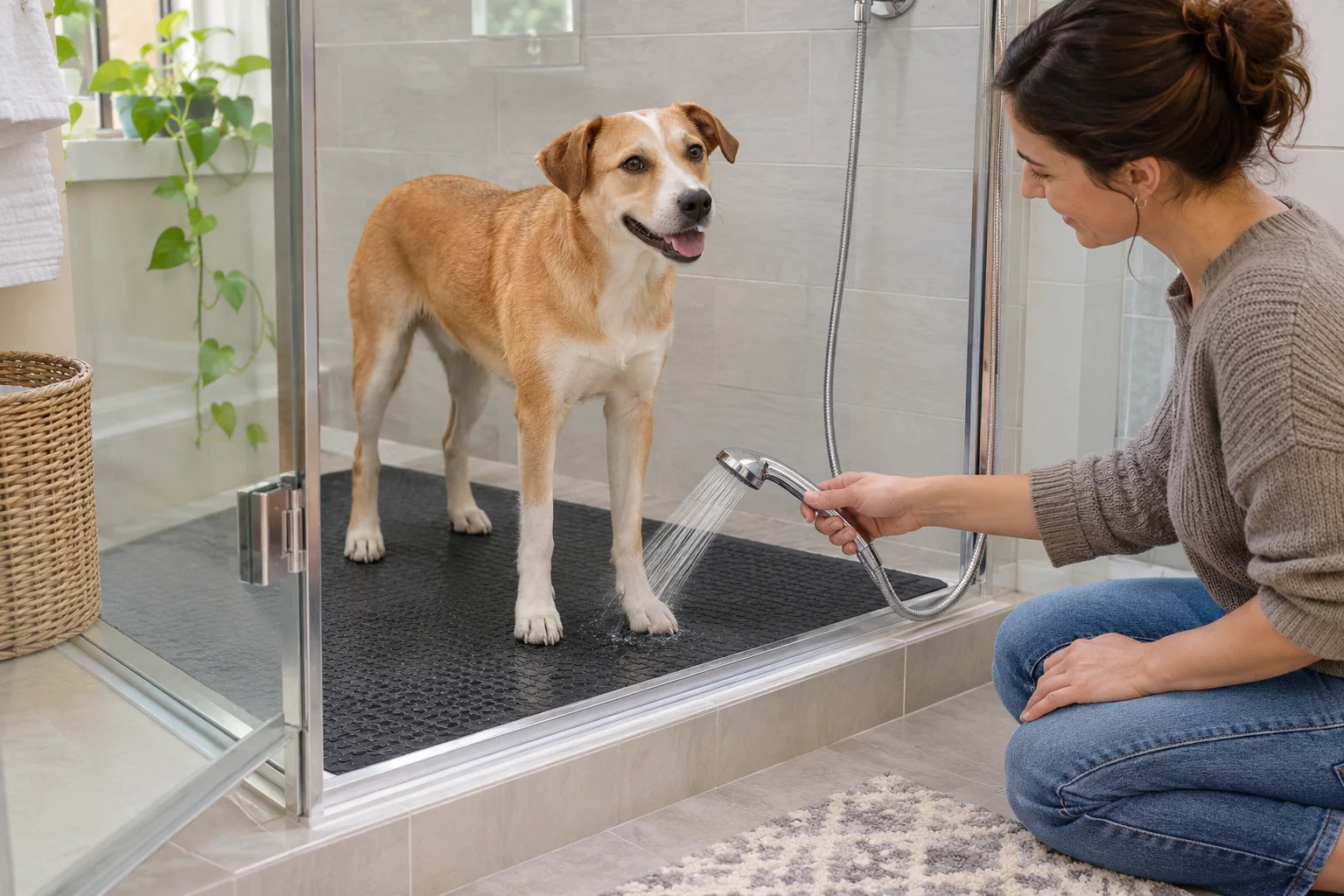
- A handheld shower head or a cup, so you control where the water goes. Fear Free notes that a handheld option lets you control the water flow.
- Towels within reach.
- Dog shampoo chosen with your vet or groomer, for real baths only.
Set the water to a gently warm temperature before your dog comes in, as Fear Free suggests, and test it on your wrist. Virginia Tech recommends lukewarm water.
If you use a basin, keep the water shallow, no deeper than your dog's paws, so your dog is never standing in deep water. Make sure the bathroom is warm and the floor outside the shower is dry or covered with a towel, so your dog doesn't slip when stepping out.
Kneel or sit beside the shower entrance, slightly side-on, without blocking the way out. Hold the shower head or cup in one hand, and use your other hand to take treats from the pouch. You only use one hand at a time: the water stops or turns away first, then your other hand gives the treat.
Practice bath time in small stages
Keep sessions to a few minutes and stop while your dog is still relaxed. Our guide to short dog training sessions explains how to fit practice into your day.
Each stage below follows the same pattern. Do one short, easy moment, turn the water off or away, then give a treat. That is one repetition. Pause for a few seconds. If your dog stays and looks relaxed, start the next repetition. If they leave, don't call them back. Continue with an easier stage only if they come back on their own and look relaxed; otherwise end the session.
Give treats after each wet moment, not as a way to keep your dog standing still while you keep washing. Don't use a lick mat or a steady stream of treats to hold your dog in place.
Make the bathroom a good place
Give your dog a few treats in the bathroom with the water off, then leave. Repeat at different times of day, so the room isn't only linked with baths.
Walk onto the dry mat
Toss a treat onto the non-slip mat in the dry shower or basin. Let your dog walk in, eat it and walk out again. Don't block the exit. When your dog walks in easily, give a second treat while they stand on the mat, then let them leave.
Get used to the sound of running water
With your dog outside the shower area, turn the water on at a low flow, pointed away from them, for a second or two. Turn it off, then give a treat. Gradually leave it running a little longer, and then try it with your dog standing on the mat.
Wet the feet
When your dog stands relaxed on the mat with the water running nearby, hold the shower head low and close to their feet, and let a little warm water run over one paw for a second. Turn it away, then give a treat. Repeat with each paw.
Wet the legs and body
When your dog stays relaxed with wet feet, gradually move up the legs, then the shoulders and back, working from neck to tail as Virginia Tech suggests. Keep the shower head close to your dog's body so the spray is gentle. Keep water away from the face; Fear Free suggests using a face towel instead of spraying water in your dog's face.
Watch for signs your dog needs a break
Watch your dog's whole body, not just whether they eat. Stop immediately if your dog tries to step out, leans away, freezes, trembles, tucks their tail, licks their lips, pants hard, shows the whites of their eyes or mouths at the water or your hand.
When that happens, turn the water off or point it away, step back from the exit and pause. Let your dog leave if they want to. Continue with an easier stage only if they come back on their own and look relaxed. If they don't, end the session and help them get warm and dry.
Eating a treat doesn't mean your dog is comfortable. A dog can eat while stiff or shaking. Move on to the next stage only when your dog is relaxed at the current one: a loose body, a soft face, walking in willingly and staying without being held. There is no target number of sessions or days.
For example, a dog walks onto the mat happily and stands calmly as the water runs, but walks back out as soon as it touches her paw. Her owner turns the water away and waits by the open door. The dog comes back and walks onto the mat with a loose body, so the owner runs water near her feet without touching them and gives a treat. Over the next sessions, the dog starts walking straight onto the mat when the water comes on, so the owner tries one paw again for a second. If she had started trembling or trying to leave each time, her owner would have gone back to the water-sound stage and asked a groomer to handle any baths she needed in the meantime.
Give a real bath when your dog is ready
Give a full bath at home only when your dog is relaxed being wetted all over during practice. Until then, use the options in "Plan for baths your dog needs now".
When you do:
- Wet your dog thoroughly with warm water, avoiding the face, and don't pour water into the ears.
- Apply shampoo gently with your fingertips. Virginia Tech advises keeping shampoo away from the eyes, ears and nose. Clean the face with a damp cloth instead.
- Rinse thoroughly. Virginia Tech advises rinsing until you no longer feel slickness or see foam.
- For a medicated bath, follow your vet's instructions for the shampoo and contact time.
Keep the same stop rule during a real bath. If your dog tries to leave, turn the water off and pause. Don't hold them in place to finish. If shampoo is still on the coat, rinse it off only if your dog comes back relaxed. If they don't, ask a groomer or your vet's team to help, rather than holding your dog to rinse.
Dry your dog gently
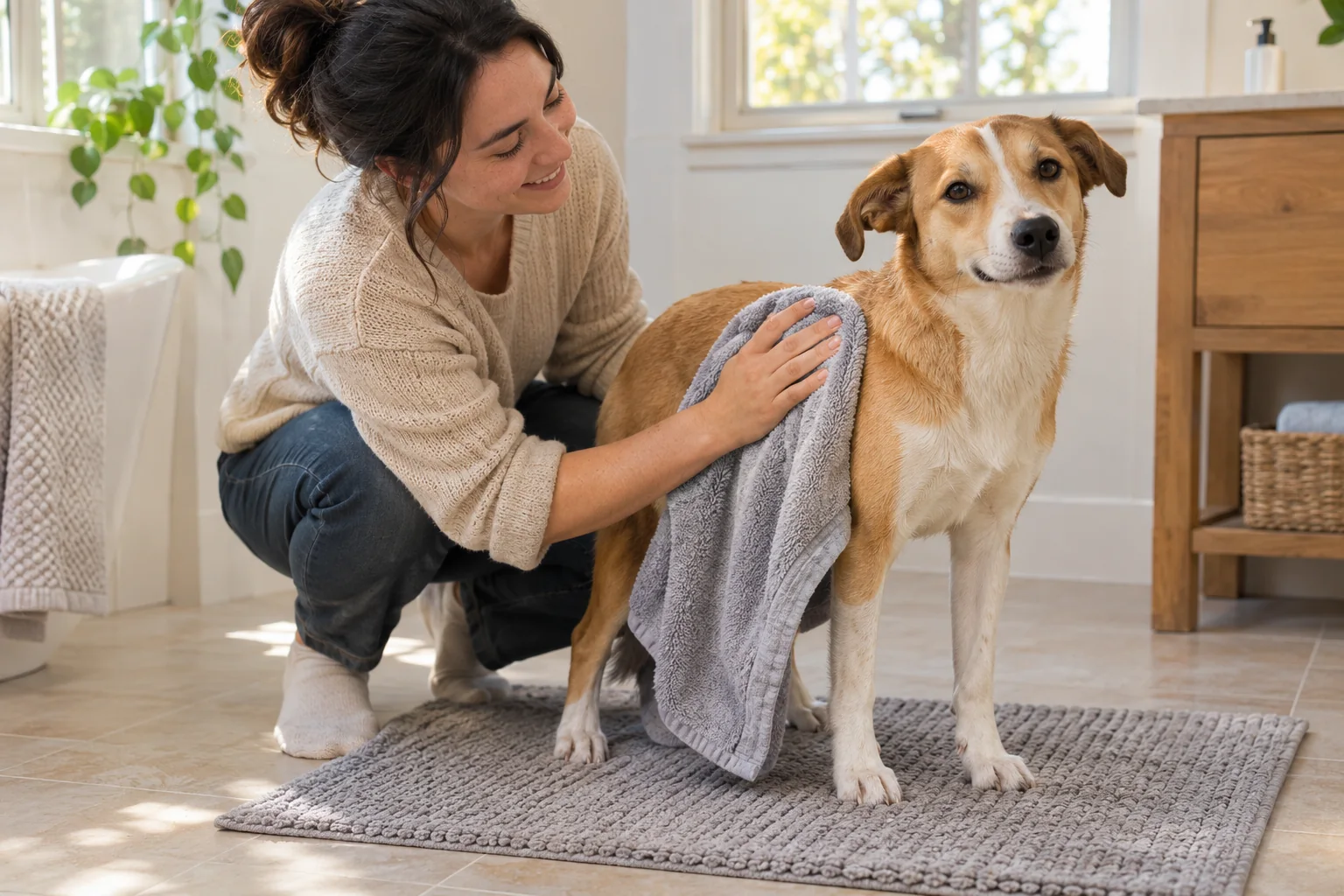
Have a towel ready before your dog shakes. Fear Free suggests having the towel at hand to wrap your dog before they shake off. Virginia Tech advises pressing towels against the coat rather than rubbing.
Fear Free notes that human hair dryers are too hot and too noisy for dogs. If your dog needs more than towel drying, ask your groomer what they would suggest. Keep your dog in a warm room until they are dry.
If your dog pulls away from the towel, stop and pause. Let them shake off and dry in a warm room rather than holding them still.
Keep practicing between baths
Baths may be weeks apart, so short practice sessions in between help your dog stay comfortable. Now and then, toss a treat onto the dry shower mat, run the water briefly while your dog is nearby, or wet just their feet and give a treat. Keep these sessions easy and end them while your dog is relaxed. If your dog starts avoiding the bathroom again, go back to an earlier stage before the next real bath, and keep your groomer or vet in mind for any bath that can't wait.
Fix common bath time problems
Your dog won't walk into the shower
Go back to tossing treats near the entrance rather than inside. Make the dry shower a place for treats on ordinary days, with no water at all. Never push or carry your dog in.
Your dog shakes or tries to leave when the water starts
Turn the water off and pause. If your dog returns relaxed, go back to running the water at a low flow, farther away, for a shorter time.
Your dog accepts the feet but not the body
Turn the water away and pause. If your dog returns relaxed, stay with the feet and lower legs for now, and move up more gradually. If your dog pulls away from one particular area, or seems sore there, see your vet before more practice rather than working around it.
Your dog is fine with water but not the towel
Stop and pause. Practice the towel separately when your dog is dry: a towel lying on the floor with treats, then a brief touch on the shoulder, then a gentle press. Let a wet dog dry in a warm room in the meantime.
Your dog slips or scrambles on the shower floor
Turn the water off and let your dog step out if they want to. Check the mat: it should lie flat, cover the area your dog stands on and stay put when wet. Practice again on the dry mat before adding water.
Your dog bites at the spray or tries to drink it
Some dogs find the water exciting rather than frightening. Turn the water off and pause. Use a gentler flow held close to the body, or a cup instead of the shower head. If your dog's mouth comes near your hands, end the session and keep the next one calmer and shorter.
Your dog is worried by the hair dryer
Towel drying in a warm room is enough for many dogs. If your dog's coat needs a dryer, ask your groomer about it, and don't use a human hair dryer, which Fear Free notes is too hot and too noisy. Getting a dog used to noisy equipment is a separate skill from bath practice.
Your dog's skin seems worse after baths
Stop bathing and call your vet if you notice redness, bumps, excessive scratching or an unusual odor after a bath. Virginia Tech recommends contacting your veterinarian if those signs appear. Don't change shampoo or bathing frequency without their advice.
If the only bath option requires lifting your dog
Don't lift your dog in as a shortcut. Use a groomer or your vet's team for full baths, and use a walk-in shower or a low basin for practice if one is available. Getting a dog comfortable with being picked up is a separate skill not covered here.
Your dog is stiff, older or slow to get up
Ask your vet before bath practice. Pain can make standing on a wet surface or stepping over an edge difficult. Your vet or groomer can suggest the safest way to keep your dog clean.
Your dog copes at home but struggles at the groomer
Tell your groomer which stages your dog is comfortable with at home, and ask whether they can work in short breaks or at a quieter time of day. If your dog can't be bathed without a struggle, talk to your vet.