
Before you pick up a brush, check three things. Does your dog show any sign of pain or a skin problem? Does their coat have mats? Have they ever growled, snapped or bitten while being brushed or handled? If the answer to any of these is yes, the first job is a vet visit, a groomer or a qualified behavior professional, not brushing practice. The details are in "Check for pain, skin problems, mats and snapping first".
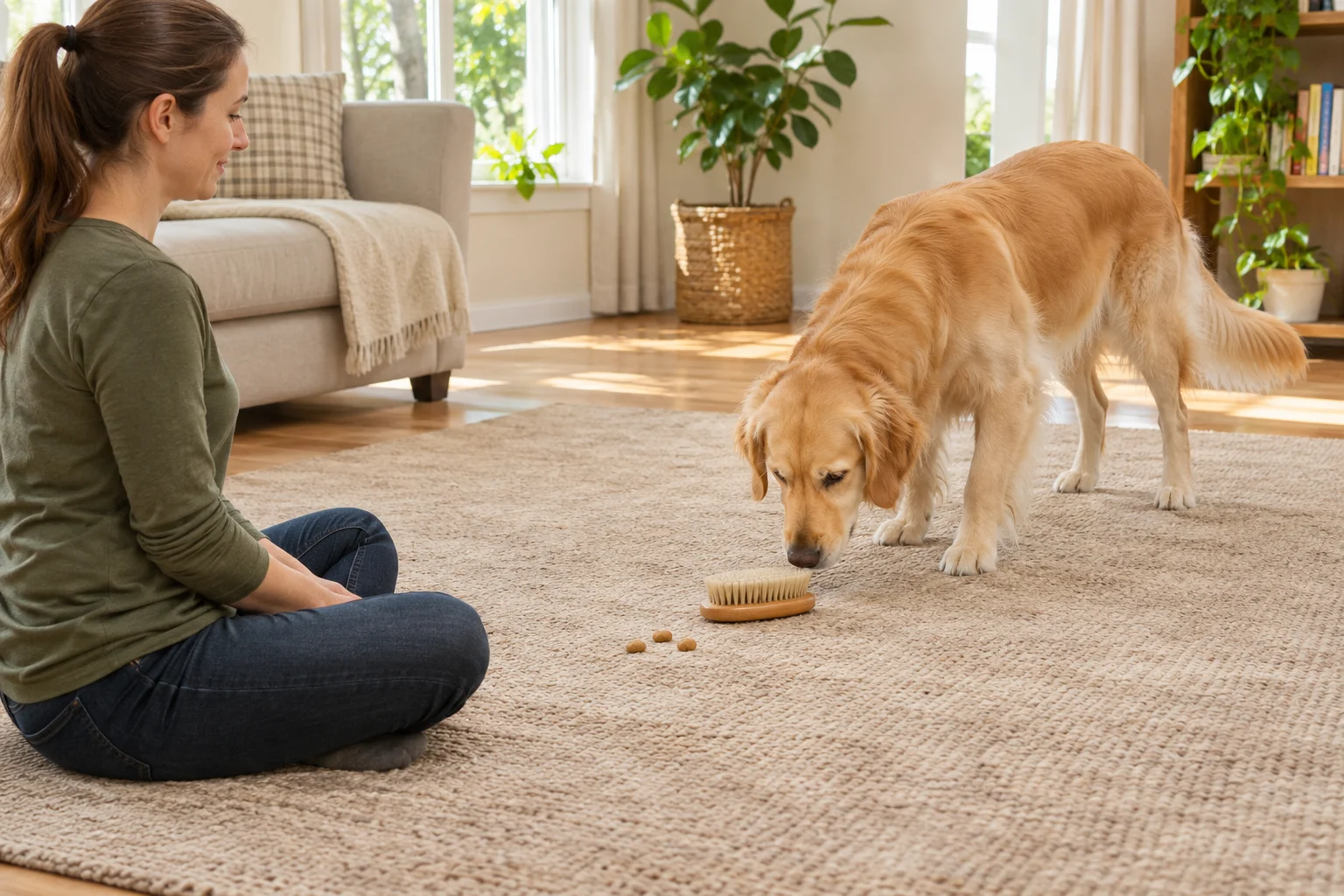
If your dog is comfortable being touched and their coat is free of mats, start small. Let them investigate the brush on the floor, then approach it held still at your side. Move on only when they approach easily with a loose body and a soft face, and return willingly between treats; sniffing alone is not enough. First touch the back of the brush to a spot they enjoy being stroked, such as the shoulder, lift it away and give a treat. Only when your dog stays relaxed through those touches should you try one slow, gentle stroke with the bristles. Lift the brush away, put it down and give a treat. That single stroke is a complete repetition.
If your dog moves away, stiffens or turns toward the brush, stop and put the brush down. Pause. Try an easier version only if your dog comes back on their own and looks relaxed. Otherwise, end the session. Keep your dog free to leave at every stage, and give treats after brushing, never as a way to keep them still while you carry on.
Check for pain, skin problems, mats and snapping first
Look for signs of pain or skin trouble
A dog who dislikes brushing may be uncomfortable. VCA's guide to signs of pain in dogs, written by two veterinarians, lists avoiding or resenting being brushed or combed among possible signs of pain, along with lashing out if handled and licking or chewing at painful areas. None of these proves pain, but each is a reason to see your veterinarian before training.
Book a vet visit first if your dog:
- Has recently started disliking brushing, or reacts more strongly than before.
- Flinches, yelps or turns to look at one particular area when touched.
- Has red, sore, scabby, moist or smelly skin, hair loss or discharge.
- Licks, chews or scratches one spot.
- Is limping, stiff or slow to lie down or get up.
Mikkel Becker, writing for Vetstreet, also recommends a vet check before training a dog who resists brushing, because problems such as ear infections or sore joints can make handling uncomfortable.
Check for mats
Mats are tight clumps of tangled fur, often behind the ears, under the legs, around the collar or harness, between the toes and around the tail. PetMD's guidance on matting, written by a veterinarian, explains that mats can pull on the skin, trap moisture and hide skin problems, and they can be painful.
Don't cut mats out with household scissors. PetMD warns that mats often sit close to the skin, and a sudden movement can cause a cut. Don't try to brush a tight mat out either. Pulling on it can hurt your dog and teach them that the brush means pain. "Arrange coat care your dog needs now" explains who should handle mats.
Get help if your dog has growled, snapped or bitten
If your dog has growled, snapped, air-snapped or bitten while being brushed, groomed or handled, don't use this article as a home plan. See your vet first, then a qualified reward-based behavior professional. Our guide on when to seek professional behavior help explains what to look for. Never punish a growl; it is your dog's warning.
Keep children out of brushing practice. Brushing means close contact around your dog's body, so an adult should do it.
Arrange coat care your dog needs now
Training takes time, and some coats can't wait. Separate the care your dog needs now from the slow practice that makes brushing easier later.
Ask a groomer to deal with mats now. PetMD advises seeing a groomer when a mat is tight or large, won't loosen with gentle brushing, or is near a sensitive area. It advises a vet when matting is extensive or the skin underneath may be damaged, and notes that a vet may use sedation for severe matting. PetMD treats painful matting, or red, raw, moist or broken skin, as urgent.
When you book, tell the groomer that your dog finds brushing hard. Ask whether they can work in short sessions and stop when your dog needs a break, and whether a shorter trim would make the coat easier to care for while you train. If a groomer can't handle your dog without a struggle, ask your vet about the options, including sedation where the vet thinks it is appropriate.
Ask how often your dog's coat needs care. PetMD says that brushing frequency depends on your dog's hair type and length, and suggests asking your vet or groomer. Some coats tangle within days, so check with a professional rather than assuming brushing can simply wait.
Keep the professional appointments and the training separate: professional assessment and any coat care needed now come before training. Start the short, easy sessions below once the mats have been dealt with and your dog is comfortable being touched. Suspected pain or skin problems need your vet's advice first; practicing on another area is not a workaround.
Choose a gentle brush that suits your dog's coat
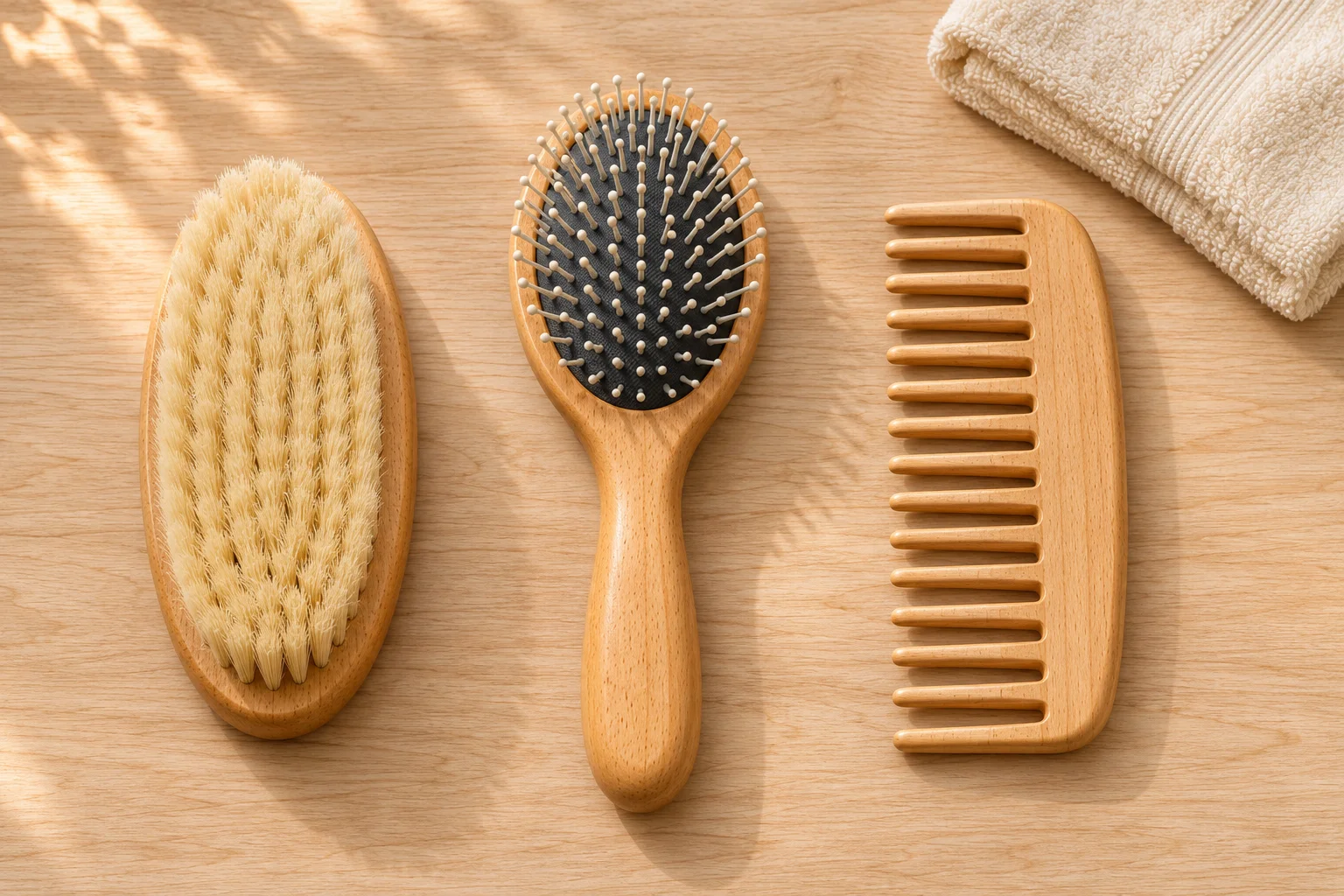
There is no single right brush. A smooth, short coat, a double coat, a long silky coat and a curly coat each need different tools. Companion Animal Veterinary Hospital's guide to dog brushes suits each brush to a coat type. It warns that firm slicker brushes with thin bristles can stab the skin, and notes that brushes skim the top of the coat, so a comb is often needed to find knots underneath.
For training, choose the gentlest suitable option:
- Ask your groomer or vet which brush suits your dog's coat, and which they would use for training a sensitive dog.
- Choose a softer or more flexible version where your dog's coat allows it.
- Check the bristles. Vetstreet points out that hard metal bristles, and bristles with the protective tips worn off, can scrape or pull.
- Run the brush lightly over the back of your own hand. If it scratches you, it will probably feel scratchy to your dog.
If your dog already reacts to the sight of one brush, a different-looking brush may be easier to start with. If your dog enjoys being stroked by hand, gentle hand strokes on the same areas can also come before the brush.
Set up your room, treats and position
Pick a quiet room with a non-slip floor, such as a rug. Leave space all around your dog so they can walk away in any direction. Don't hold their collar, tether them, sit them between your knees or corner them against furniture.
Use small, soft treats your dog really likes. Keep them in a pouch at your waist or in a bowl on a table beside you, out of your dog's reach. Our guide to choosing training rewards can help if ordinary kibble isn't interesting enough.
Sit or kneel on the floor beside your dog, slightly side-on, rather than leaning over them from the front. Your dog can stand, sit or lie down, whichever they choose; you don't need a cue for this exercise.
Hold the brush in the hand nearer your dog's tail. Keep your other hand free to take treats from the pouch. You will only use one hand at a time: the brush hand brushes, then the brush rests in your lap or on the floor, and then your other hand gives the treat.
Keep sessions to a few minutes and stop while your dog is still relaxed. To end a session, put the brush out of sight and scatter a few treats on the floor. Our guide to short dog training sessions explains how to fit practice into your day.
Practice with one dog at a time, with other pets in another room if they are comfortable there, so nobody competes for treats or crowds the dog you're brushing. For a young puppy who hasn't yet learned to dislike brushing, our guide to gentle puppy handling covers a broader introduction to being touched and groomed.
Let your dog investigate the brush
Put the brush on the floor and drop a few treats around it. Let your dog sniff it, step on it and eat the treats. Vetstreet suggests this kind of introduction.
Next, sit on the floor and hold the brush still at your side, low down. When your dog comes over to sniff it, take a treat from the pouch with your other hand and give it. Vetstreet's advice here is to avoid moving the brush toward your dog. Your dog moves toward the brush; the brush stays where it is. Put it away, then repeat a few times.
Eating a treat doesn't mean your dog is comfortable. A dog can eat while stiff, leaning away or watching the brush closely. Look at the whole body. A dog who is ready to move on walks up to the brush easily, sniffs it with a loose body and a soft face, and comes back to you between treats. If your dog hesitates, keeps their distance or leaves, put the brush away and pause. Next time, start with the brush lying on the floor again.
Brush one gentle stroke and stop
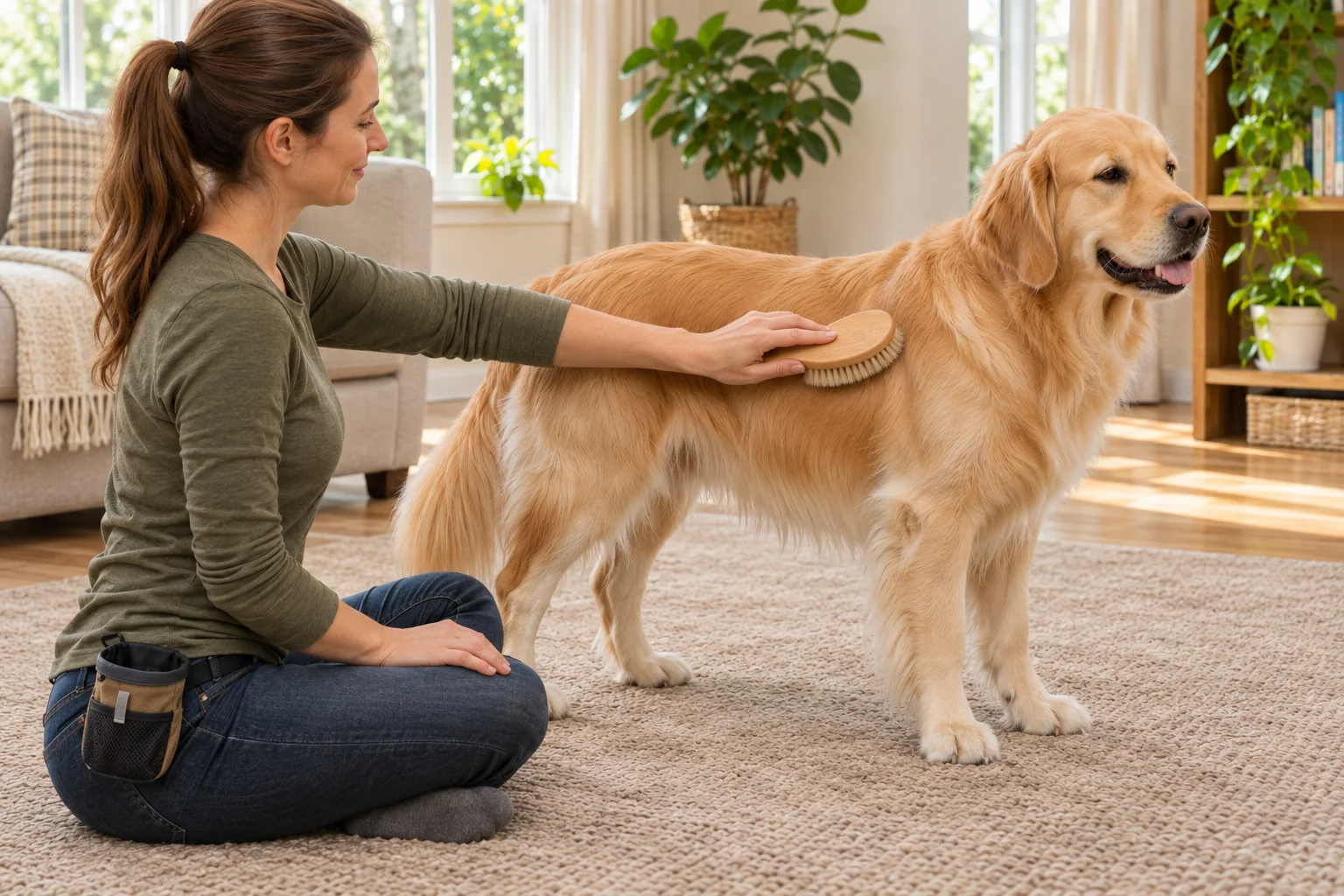
Start on a spot your dog already enjoys being stroked. For many dogs, the side of the shoulder or chest works well, and Vetstreet suggests the chest or shoulder as a starting area. Choose somewhere else if your dog prefers it.
- Sit beside your dog with the brush in the hand nearer their tail.
- Move the brush slowly from your side and rest its back, not the bristles, on your dog's shoulder for a second. Lift it away, put it in your lap, and give a treat from the pouch with your other hand.
- When your dog stays relaxed through several of those touches, with a loose body and staying beside you, turn the brush over. Give one slow, light stroke with the bristles, in the direction the hair grows, over a few inches of the shoulder.
- Lift the brush away and put it down. Then give the treat.
- Pause for a few seconds. Your dog is free to stay or to leave. If they stay beside you looking relaxed, start the next repetition. If they leave, don't call them back. Continue with an easier version, such as the back of the brush, only if they return on their own and look relaxed; otherwise end the session.
That is one complete repetition. Give the treat after the stroke, not during it. Don't use a lick mat, a steady stream of treats or a helper feeding your dog to keep them standing still while you keep brushing. Food that holds a dog in place can hide the moment they would have walked away.
Watch for the signs that end the repetition straight away: your dog moving off, stiffening, freezing, licking their lips, turning their head toward the brush or your hand, or tucking their tail. Stop, put the brush down and pause. Resume with an easier version, such as the back of the brush, only if your dog comes back on their own and looks relaxed. If they don't, end the session.
Build up strokes and areas as your dog relaxes
Add more only when your dog shows you they are comfortable. Look for a loose body, a soft face, a dog who leans into the brush or stays beside you between repetitions, and a dog who comes over when the brush appears. There is no target number of strokes or days.
Make one change at a time:
- More strokes. Give two or three slow strokes on the same spot, then lift the brush away and give a treat.
- A nearby area. Move to the side of the chest or along the back, returning to a single stroke on each new area.
- More sensitive areas last. Legs, belly, tail, feet, ears and the back end are harder for many dogs. Work toward them gradually, and accept that some areas may stay a job for your groomer.
The AKC's guide to cooperative grooming, by Sassafras Patterdale, CPDT-KA, recommends focusing on one area at a time and notes that you don't need to cover the whole body in one session. It also advises against chasing or coaxing a dog who walks away.
Longer brushing is a duration change, so the same rule applies. On the first sign that your dog wants to stop, stop. If a whole session ends with your dog leaving, make the next session shorter and stay on an easier area.
For example, a dog might accept a single stroke on her shoulder but walk off after the second stroke in a row. Her owner puts the brush down and waits. The dog comes back, sniffs the brush with a loose body and lies down beside her owner, so the owner gives one stroke on the shoulder, lifts the brush away and gives a treat. Over the next sessions, the dog starts leaning into the brush after each single stroke, so the owner tries two strokes before the treat. When the brush catches on a small tangle behind the dog's ear, the owner stops, leaves it and books a groomer appointment instead of working on it.
For feet, our guides to paw wiping and nail trimming cover paw handling separately. A chin rest is optional; some owners find it a useful way for their dog to say they are ready, but it is not required for brushing.
Our guide to ear handling and vet-directed cleaning covers ear care separately. Not every dog needs ear cleaning.
Fix common brushing problems
Your dog walks away when the brush appears
Put the brush away and pause rather than restarting the exercise straight away. Try an easier introduction only if your dog comes back on their own and looks relaxed; otherwise end the session. When they are ready, return to the brush lying on the floor, as described in "Let your dog investigate the brush". Wait for easy, voluntary approach with a loose body and soft face, not sniffing alone. A different-looking brush may help at a later session.
Your dog mouths or grabs the brush
Stop brushing, put the brush down and pause. Resume only if your dog comes back relaxed, and go back to the back of the brush on the shoulder. If your dog's teeth press on your skin, or they growl or snap, end the session and follow "Get help if your dog has growled, snapped or bitten".
Your dog is fine on the shoulder but pulls away from the legs or back end
Stop contact, put the brush down and end the session. Pulling away from one particular area may indicate pain or new sensitivity: ask your vet for advice before trying more contact, including another shoulder stroke. If that area needs care now, discuss it with your vet and groomer rather than trying to train through it. Once your vet has addressed any concern, resume routine practice only with relaxed, voluntary participation; difficult coat care may still need professional help.
Your dog eats the treats but stays stiff
Taking food doesn't mean your dog is comfortable. Stop contact, put the brush down and pause. Try an easier stage only after your dog comes back on their own with a loose body and looks relaxed; otherwise end the session. If they freely re-engage, you can offer the brush held still at your side, or the back of the brush if they are already comfortable with that step. Stop again at any tension rather than continuing until they loosen up. Ongoing tension needs advice from your vet and a qualified behavior professional.
Your dog wriggles, rolls or tries to play with the brush
Some dogs find brushing exciting rather than worrying. Wriggling away still counts as moving away, so stop, put the brush down and pause. Continue with an easier version only if your dog comes back and settles; otherwise end the session. Next time, try practicing after a walk or a play session, when your dog is calmer.
Your dog follows you for treats but leaves when the brush lifts
Coming over for food is not the same as being comfortable with the brush. When your dog leaves, put the brush down and pause. If they come back relaxed, go back to holding the brush still at your side and reward your dog for sniffing it. Move on to the back of the brush on the shoulder only when your dog stays relaxed as your hand lifts.
Your dog copes at home but struggles at the groomer
A grooming salon has new people, sounds and smells. Tell your groomer what your dog is comfortable with at home and which areas are still hard. Ask about short visits, a quieter time of day or breaks during the appointment. If your dog can't be groomed without a struggle, talk to your vet before the coat becomes a problem.
The brush catches on a tangle
Stop and lift the brush away; don't pull through the knot. Give a treat once the brush is off. Leave the tangle and ask your groomer to deal with it, or to show you how to manage small knots safely for your dog's coat. If you find a tight mat, see "Arrange coat care your dog needs now".
Keep brushing calm as part of everyday life
Once your dog is relaxed with several strokes on a few areas, short, regular brushing sessions are often easier for both of you than a long session now and then. Brush when your dog is calm, end before they want to stop and give a treat once the brush is down.
If your dog's comfort changes, such as a dog who used to enjoy brushing starting to walk away or flinch, treat it as new information. Stop, check their skin and coat for problems, and see your vet before you continue.
Keep your groomer in the picture. Tell them what your dog is comfortable with at home, which areas are still hard and what helps your dog relax.