
When your puppy chews furniture, shoes, cables and anything else within reach, it can feel as though the whole house has become a test you keep failing. You remove one object and another appears in your puppy's mouth. You say no, the puppy pauses, and the chewing starts again when you look away.
Chewing is a normal part of puppy life. Destructive chewing happens when that need meets an interesting object, easy access or a period when nobody is able to guide the choice. Treating every incident as the same bad habit makes the problem harder to solve.
Your job is to protect unsafe and valuable objects, make suitable chewing easy to choose, and have a calm response ready for the occasional miss. That plan is quieter than a battle over every slipper, and it remains useful when you cannot watch every movement.
This article is about teeth on objects. If your main problem is teeth on hands, clothes or ankles during play, use the separate guide to puppy biting during play. It covers that interaction without turning this guide into a second mouthing article.
Your puppy is not trying to destroy your home
Puppies investigate with their mouths. Chewing can also be satisfying in its own right, and it may help a puppy cope with the discomfort of changing teeth. That does not make a chewed table leg acceptable. It does change the job in front of you: guide a normal need towards safer objects instead of treating the puppy as though it has a character flaw.
PDSA's guidance on training dogs not to chew describes chewing as normal, especially for puppies, and recommends suitable things to chew alongside removing access to tempting belongings. Both parts matter. An alternative does little while the shoe remains available, and prevention leaves the puppy without an appropriate activity.
Avoid explanations such as spite, revenge or stubbornness. A puppy who chews the remote after you leave the room has found a reachable, interesting object. The timing may show that access changed when you left or that the puppy was given more freedom than it could handle. It does not show a plan to punish you.
Once you see the event this way, you can ask more useful questions. What made the object easy to reach? What was the puppy doing before the chewing began? What would you like to be available next time?
Separate the stolen item from what keeps the pattern going
The object in your puppy's mouth is the casualty. It is not always the reason the behaviour keeps happening.
Look at the whole event. Was the slipper beside the puppy while the suitable chew was in a cupboard? Had the puppy just woken up and started exploring? Was the household busy, leaving a long period without interaction? Did somebody chase the puppy, turning possession into a brilliant game? Was the puppy tired and roaming instead of resting? Several answers may fit the same incident.
Keep two questions separate:
- What needs to be protected or made inaccessible?
- What need, opportunity or consequence made chewing that object worth repeating?
If you answer only the first question, the puppy may move from the slipper to the rug. If you answer only the second, a dangerous item can remain within reach while learning takes time. A useful plan covers both.
For a few days, record only details that will help you change the setup: the room, the object, what happened immediately beforehand, where an appropriate chew was, and how people responded. You are looking for repeatable conditions, not building a case against the puppy. Incidents in the kitchen while you prepare food call for a kitchen plan. Chewing before a rest may mean the chewing outlet needs to become part of the wind-down routine.
Puppy-proof by removing opportunities, not by testing restraint
A puppy cannot learn a household rule from an object that is available all day and interrupted only occasionally. Each unsupervised success gives the puppy more practice at selecting, carrying and chewing it. Prevention protects the learning period.
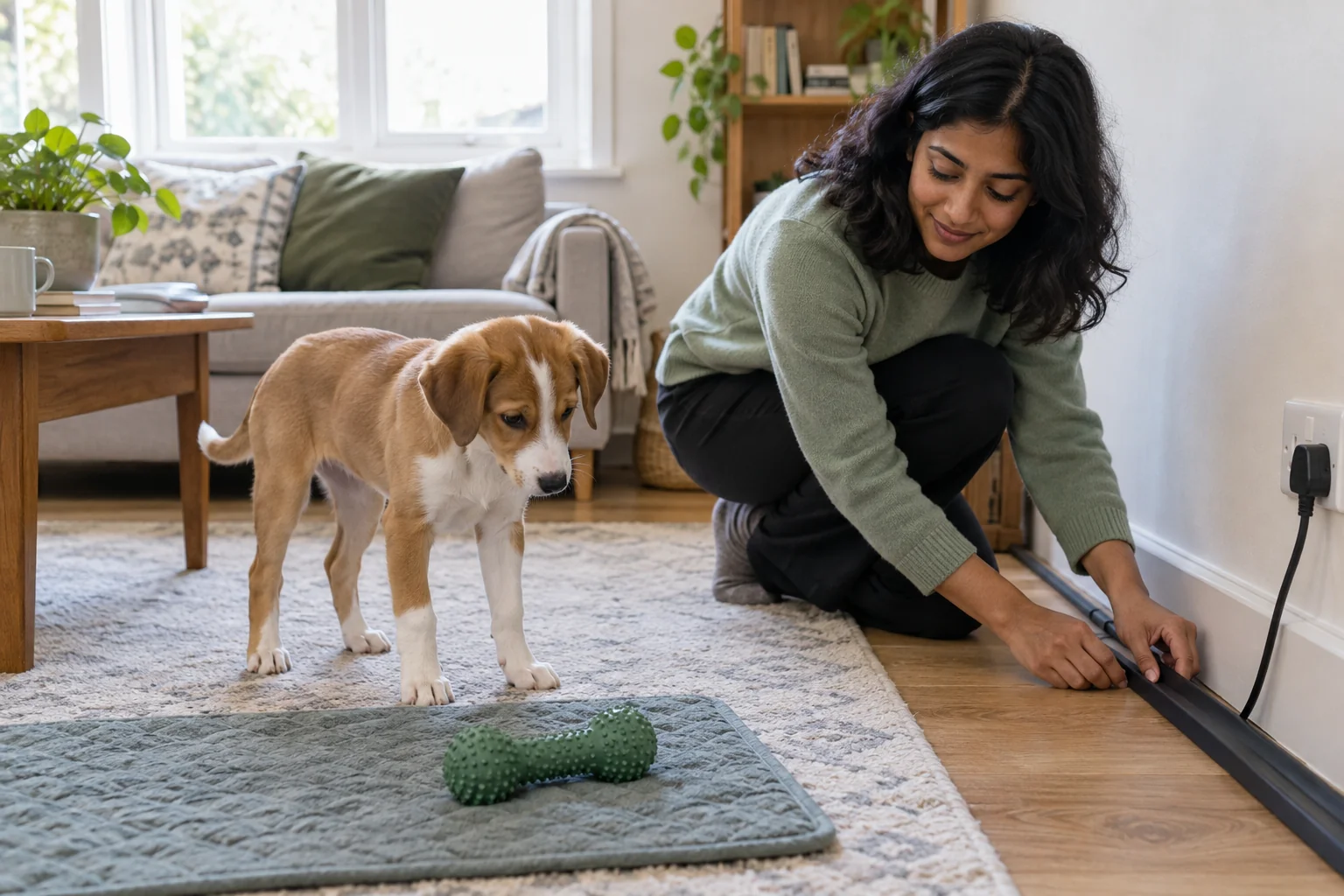
Start at puppy height. Get down and scan the routes your puppy uses. Look for electrical cables, chargers, medicines, cleaning products, bins, food, children's belongings, laundry, shoes, remote controls and small items that could be swallowed. Include low shelves, trailing tablecloths and bags hung where a puppy can pull them down. Secure, move or shut away anything dangerous or precious instead of hoping a verbal cue will beat access.
Closed doors, lidded storage, cable protection, gates and a prepared pen can do more than repeated correction. They are everyday safety equipment. The guide to management and dog training explains how prevention protects the learning period instead of asking a weak new skill to compete with constant rehearsal.
Do not stop after making a room look clear from standing height. Walk the perimeter and check chewable edges, exposed fixings and reachable hazards. Then watch what your puppy notices during a calm supervised visit. Puppies are very good at finding the loose corner you missed.
Puppy-proofing needs regular resets. A chair moves, someone leaves a bag on the floor, or your puppy becomes tall enough to reach a new surface. Make a quick scan part of leaving a room. The relevant question is whether the current environment is safe for the amount of freedom you are giving.
Build a room-level plan for the moments you cannot watch
"Supervise your puppy" is incomplete advice if it means staring every second. Nobody can cook, work, use the bathroom or help a child while tracking every movement. Your arrangement needs to change when your attention changes.
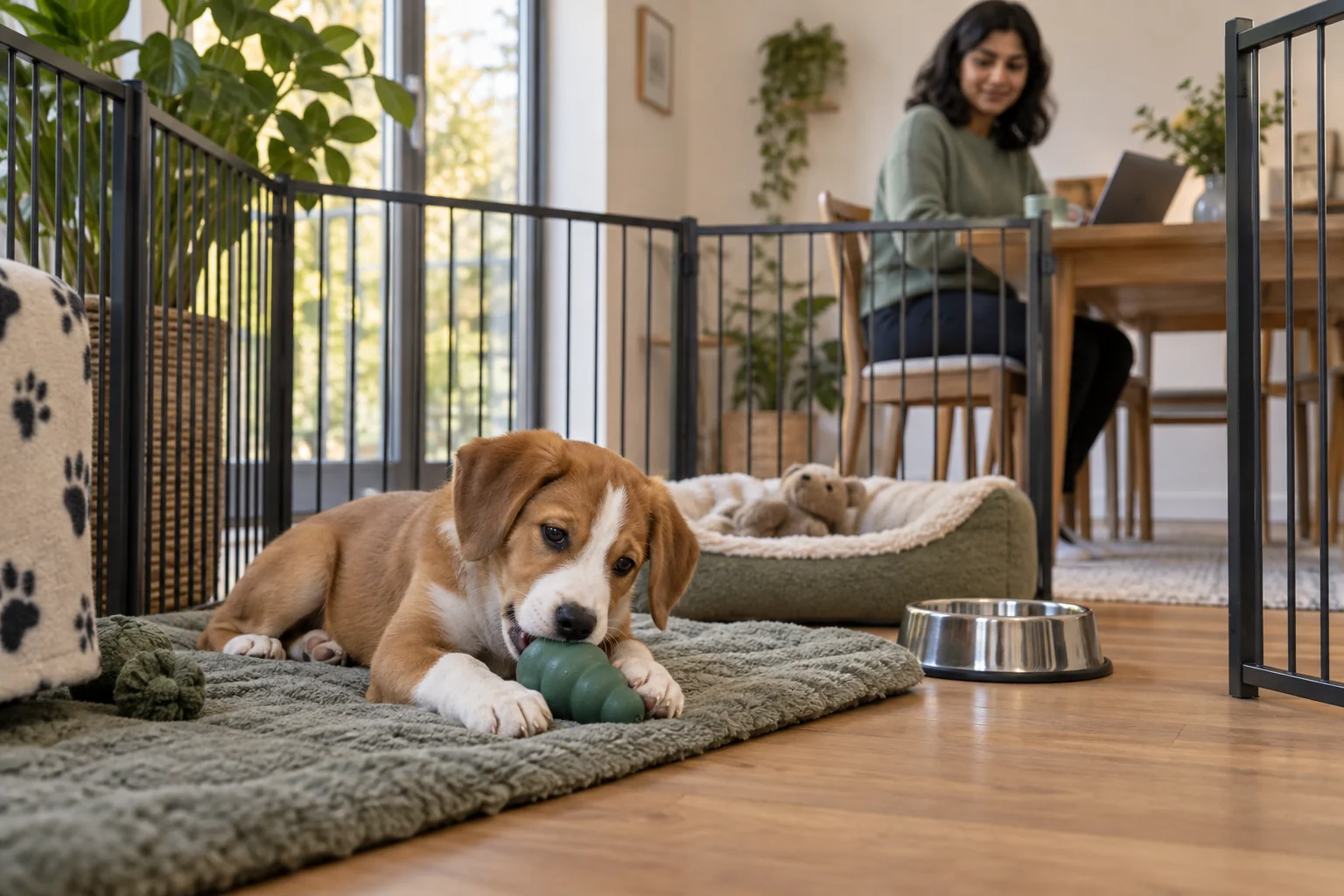
During direct supervision, the puppy can share your space and you can notice interest before teeth settle on an object. When your attention is divided, use a prepared safe area with water, a comfortable resting option and an appropriate chewing outlet you have already assessed. When neither arrangement is possible, close access to that room.
For each main room, decide three things:
- Which objects must the puppy never reach, and how will you secure them?
- Where will an appropriate outlet be placed when chewing usually begins?
- Which boundary will you use when your attention moves elsewhere?
In the sitting room, cables might be enclosed, shoes stored behind a door, a suitable chew placed near the resting area, and a gate kept ready before a video call. In the kitchen, bins might be secured, food and cloths moved off low surfaces, and the puppy settled behind a gate with an activity before meal preparation starts. The exact arrangement will depend on your home. It must be easy enough to use without improvising.
Design for ordinary lapses in attention. A plan that relies on perfect vigilance is not a safety plan. A room that remains manageable while you answer the door is much more useful.
Choose chewing outlets for the puppy in front of you
There is no object that is universally safe for every puppy. Suitability depends on the puppy's size, chewing style, health, how the item wears and whether you are present. A gentle chewer may use an item very differently from a puppy who tears pieces off quickly. An item that was suitable last week may become unsafe after damage.
Choose items intended for dogs and appropriate to your puppy's size and current use. They should not be easy to swallow whole, break into hazardous pieces or injure the mouth. Check the maker's guidance, inspect the item before and after use, and remove anything that has become cracked, sharp, loose or small enough to present a risk. If you are uncertain about hardness, materials, teeth or diet, ask your vet instead of relying on a universal online list.
A small selection can help because puppies do not always seek the same sensation. Offer different shapes or textures only after each has passed your safety check, then observe which type your puppy chooses in a particular context. One texture is not automatically best. The alternative has to compete with the chair, rug or cardboard your puppy currently finds satisfying.
Food-filled or edible options need individual judgement too. Consider your puppy's normal diet, total food intake, chewing style and any veterinary advice. Do not assume that a product described as natural, hard or long-lasting is harmless. Do not leave a new item with an unsupervised puppy just because its packaging calls it durable.
Supervision matters at the beginning. Watch how your puppy holds, bites and dismantles the item. You are learning about this puppy and this product. You are not granting a permanent safety certificate.
Make the allowed choice easier and keep it interesting
A suitable chew cannot help from the top of a cupboard. Put options near the places and times when chewing tends to start. If your puppy wakes and heads for a rug edge, keep an assessed alternative near the resting area. If chewing begins while you prepare dinner, set up the safe zone before you pick up the saucepan.
Rotation can renew interest without filling the floor with every item at once. Keep a small number available, put some away while they are still usable, and bring them back later. Rotation does not make an unsuitable item safe or guarantee enthusiasm. It lets you see whether a change in location or novelty affects the puppy's choice.
Notice appropriate chewing and reinforce it quietly. You might place a small food reward nearby, offer calm praise if your puppy enjoys it, or simply allow uninterrupted access to the satisfying activity. Avoid repeatedly touching the puppy or taking the item away to check it when there is no safety concern. Your attention should not make the allowed choice less comfortable than chewing alone behind the sofa.
Offer the outlet before predictable trouble. The puppy routine guide shows how waking, meals, activity and rest can act as anchors rather than forcing every puppy onto one timetable. Add chewing opportunities around your puppy's pattern. Waiting for damage and then producing the same item as a consolation prize gives you less to work with.
If your puppy repeatedly ignores what you provide, review the situation instead of adding pressure. The outlet may be in the wrong place, unavailable at the important time, too familiar, unsuitable for that chewing style or less rewarding than the accessible household object. Change one variable and observe. The choice gives you information about the setup.

Trade for household objects instead of starting a chase
When your puppy picks up an ordinary household object, your response can make release easy or make possession exciting. Running after the puppy adds movement, attention and a game. Grabbing at the mouth can frighten the puppy, damage trust and encourage swallowing or guarding.
If the item is not an immediate emergency, stay calm. Approach without looming, or invite the puppy towards you. Offer something your puppy values enough to release the object, such as an appropriate food reward or another safe activity. When the puppy lets go, move the household item out of reach and provide a suitable chewing outlet. The exchange ends the incident without teaching that people rush in to seize things.
Practise when the stakes are low. With a safe, low-value object your puppy is allowed to hold, offer the exchange, reward release and sometimes return the safe object. The aim is to build a history in which your approach predicts something good rather than automatic loss. Keep the practice easy and voluntary.
Do not turn every exchange into a formal performance. Management should prevent most thefts. Trading is the recovery plan for an occasional miss, not a reason to leave hazards around as training opportunities.
If your puppy stiffens, freezes, growls, snaps or guards objects, stop rehearsing exchanges on your own. Prevent access to contested items and read the guide to when professional behaviour help is needed. Guarding needs an individual safety assessment rather than a tougher attempt to take things away.
Skip punishment and unsafe taste experiments
Shouting, hitting, frightening, spraying or physically forcing the mouth open does not teach which object is appropriate. It can make your approach threatening and may teach the puppy to chew out of sight, run away with finds or swallow quickly. The visible chewing may become harder to interrupt safely while the need remains.
A sharp reaction can also turn a dull object into a reliable way to start interaction. If taking a sock makes everyone leap up, the sock has gained extra value. Calm prevention and exchange remove that entertainment.
Avoid homemade taste deterrents. Household mixtures can irritate the mouth, skin or digestive system, damage surfaces, or be unsafe if swallowed. They can also spread onto appropriate items and water bowls. A bitter taste does not remove a cable hazard or provide a suitable chewing outlet, so it cannot replace physical prevention.
If you use a commercial household or pet product, read its label, follow the maker's safety directions and keep it away from the puppy unless its intended use clearly permits contact. Ask your vet when uncertain. Never spray anything at the puppy or apply substances to the puppy's mouth.
Make the environment clearer rather than the consequence scarier. Remove access, provide a suitable alternative and reinforce the choice you can live with.
Review the plan when chewing keeps breaking through
Frequent incidents usually mean that something in the arrangement needs attention. Audit the conditions before deciding that redirection has failed.
Check availability first. Was an appropriate outlet actually in the room before the puppy found the household object? Then check access. Could the tempting item have been placed behind a door or barrier? Check timing next. Does chewing rise after waking, during busy household periods, before rest or when the puppy has had little suitable activity? Finally, check the human response. Has theft repeatedly produced chasing, bargaining or a burst of attention?
Change the earliest part of the chain you control. Put shoes away before the puppy enters. Prepare the safe area before the call begins. Offer the chewing activity before the predictable restless period. Close access when supervision drops. Early changes ask less of the puppy than a cue delivered after chewing is already rewarding.
Do not answer every increase with more physical exercise. A puppy can become more frantic when overtired, and constant activity does not teach settling. Balance appropriate movement, sniffing, food, social contact, chewing and protected rest according to your puppy and veterinary guidance. Ask what is missing or badly timed before asking how to exhaust the puppy.
Review progress by counting preventable incidents and successful setups. Chewing itself does not need to vanish. Fewer stolen objects, quicker calm trades and more voluntary use of suitable outlets show that the household arrangement is improving.
Treat ingestion, choking and sudden change as veterinary issues
Some chewing events are emergencies rather than training moments. If you think your puppy swallowed part of an object, contact your vet promptly even if the puppy currently looks well. PDSA explains that swallowed foreign objects can cause a gut blockage, with possible signs including vomiting, reduced appetite, abdominal pain, low energy or difficulty passing faeces. Do not wait for several signs to appear before asking for advice.
If the object could be poisonous, contact a vet immediately. The RSPCA's dog poisoning guidance advises acting quickly rather than waiting for symptoms and warns against trying to make a dog vomit unless a veterinary professional tells you to. Take the packaging, plant sample or remaining material with you if your vet says it is safe to do so. Do not offer food, drink or a home remedy unless directed.
Choking needs urgent veterinary help. Signs can include distress, difficulty breathing, repeated attempts to swallow, pawing at the mouth, unusual breathing sounds, collapse or blue-tinged gums. Call the vet and start travelling for emergency care. PDSA's first aid for choking guidance makes clear that first aid does not replace veterinary treatment. Follow real-time professional instructions rather than reaching blindly into the mouth, where you could push an object farther in or be bitten by a panicking puppy.
Bleeding, a broken tooth, something embedded in the mouth, persistent drooling, repeated pawing at the face, swelling or pain when eating also warrants veterinary advice. Do not force the mouth open to investigate.
Arrange a vet check for chewing that becomes sudden, intense, repetitive or difficult to interrupt, particularly if it comes with changes in appetite, digestion, energy, sleep or behaviour. Medical discomfort and nutritional or gastrointestinal problems cannot be solved by adding more toys. If health causes are excluded and the behaviour remains compulsive or connected to distress, ask for referral to an appropriately qualified behaviour professional.
Put your prevention system into use this week
Choose the room where most damage happens. Remove hazards and valuable objects from puppy height, decide where an appropriate chewing outlet will live, and choose the boundary you will use when your attention shifts. Test the arrangement during a calm period while you are present. Watch what your puppy still finds, and adjust the room before a costly mistake occurs.
Prepare two responses in advance. For an ordinary stolen object, trade calmly, put the item away and make a suitable outlet available. For possible ingestion, choking, poisoning or injury, stop treating it as training and contact a vet immediately.
Then look at timing. For several days, note when chewing starts and what was happening just before it. If the pattern repeats, place the outlet and boundary before that moment arrives. This reduces the need to rely on "no" after the fact.
Your puppy will continue to have a need to chew. A workable home gives that need safer places to go, keeps dangerous opportunities rare, and makes an occasional management failure less likely to become a chase or a fight. Protecting the home and respecting the puppy can be part of the same setup.