
An emergency U-turn is a cheerful cue that means "turn around with me and walk the other way." You teach it as a game long before you need it, so that when something appears ahead on a walk you can say your cue, turn, and walk away together on a loose leash.
Before you start, check that walking and turning are comfortable for your dog. If your dog seems stiff, slow or sore on walks, or if they already lunge, panic or bark hard at things they see, read "Check for pain, panic or lunging before you start" first.
If those don't apply, start indoors with your dog on a leash. Walk forward a few paces, say "this way" once in a happy voice, then turn and walk the other way, guiding your dog round with a treat at their nose. After you have both walked a couple of paces in the new direction, give the treat. Never pull or jerk the leash to turn your dog.
This is a rehearsed walking skill. It helps you leave a situation early and calmly. It is not a treatment for reactivity, and it does not guarantee your dog will turn in every situation.
Check for pain, panic or lunging before you start
A U-turn asks your dog to change direction quickly and keep walking. A dog who finds that uncomfortable may lag, stop or refuse, and training will not fix the cause.
VCA Animal Hospitals' guide to signs of pain in dogs lists less energy or decreased endurance for activities they used to enjoy, such as walks, among the possible signs of pain. VCA advises bringing changes like these to your veterinarian's attention.
Talk to your vet before you train if your dog:
- Has started slowing down, stopping or lagging on walks.
- Seems stiff, limps or is reluctant to turn sharply.
- Is older or has a known joint or back problem.
Ask your vet whether quick turns are suitable, and wait for their advice before you practice.
Some dogs need more help than a walking cue can give. If your dog lunges, barks hard, freezes or panics when they see other dogs, people or traffic, or if you struggle to keep them safely under control on walks, get help from a qualified, reward-based behavior professional, starting with your vet. The Halifax Humane Society's U-turn handout describes the U-turn as a management tool, not a cure, and recommends a qualified professional for fear or aggression. The guide to when to seek professional behavior help explains how to find the right person.
You can still teach the U-turn to these dogs as part of a plan with a professional. Just don't rely on it as the whole answer.
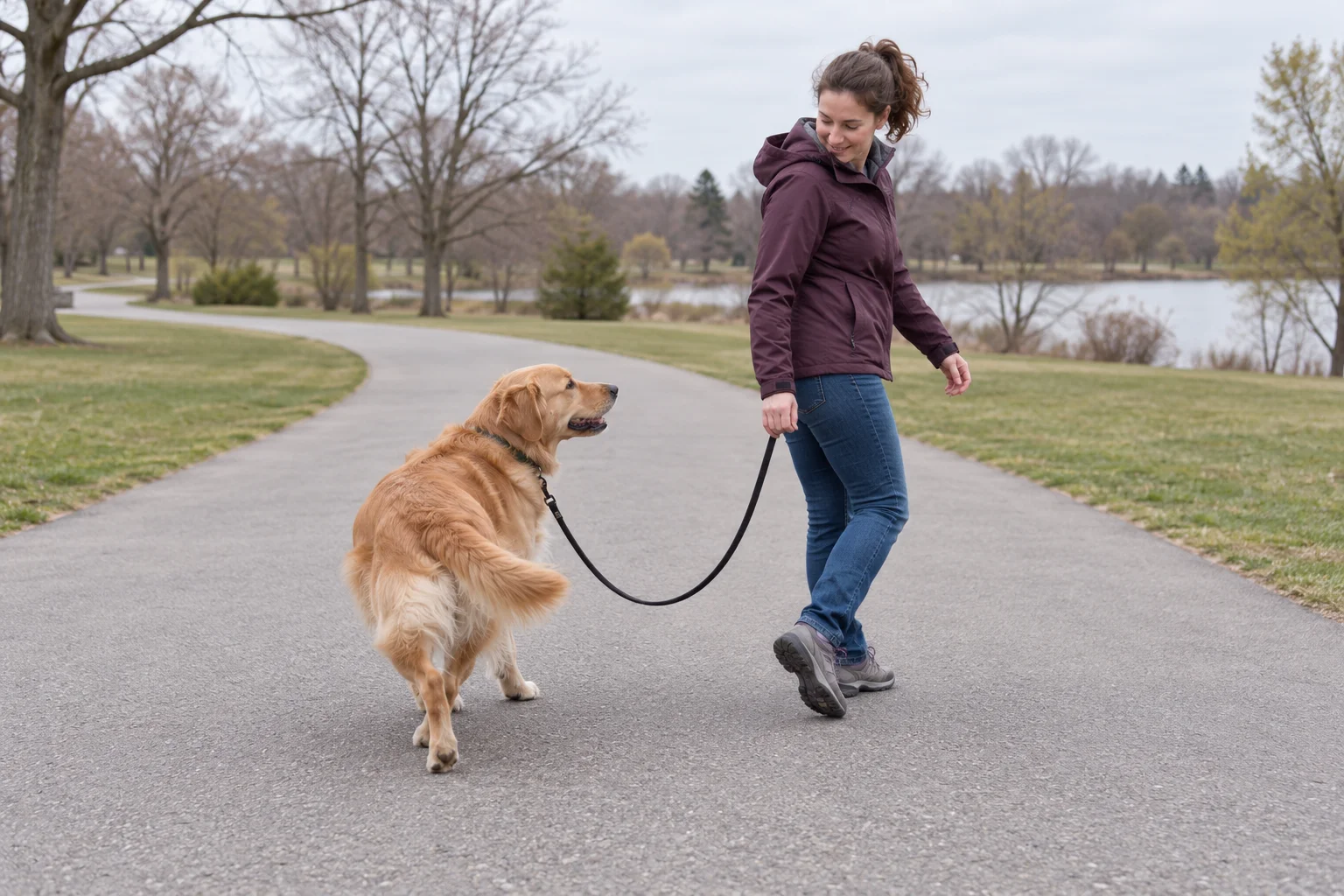
Teach your dog to turn and walk away with you
The finished skill is simple to describe. You are walking with your dog on a loose leash. You say your cue once. You turn around, and your dog turns with you, without the leash going tight. After a couple of paces in the new direction, give your dog a treat while continuing to walk safely away.
Whole Dog Journal's excerpt on using a U-turn, from Feisty Fido by Patricia McConnell, PhD, and Karen London, PhD, stresses that the dog should turn because they have learned the cue, not because they hit the end of the leash. Leash tension can add to the conflict you are trying to avoid.
Typical uses include:
- Seeing another dog coming toward you on a narrow sidewalk.
- Spotting something ahead you would rather not walk past, such as a loose dog or a noisy delivery.
- Leaving any situation early, before your dog becomes too interested or worried to listen.
Get your leash, treats and starting position ready
Use a well-fitted harness or flat collar and a standard fixed-length leash, about 6 feet (2 meters) long. Check the buckles and clip before each session. A retractable leash makes it hard to keep the leash slack and steady through a turn.
Get your hands ready. In this guide, your dog walks on your left. If your dog prefers your right, swap everything.
- Your left hand, the hand nearer your dog, holds a small, soft treat.
- Your right hand holds the leash, at about waist height, with enough slack that the leash hangs in a loose curve between you.
- Keep more treats in a pouch or pocket within reach of your left hand. Keep a secure grip on the leash in your right hand while your left hand fetches and gives each reward. Never let go of the leash to reach for food.
Choose your treats. Small, soft treats your dog really likes work best, because a turn on a walk competes with interesting smells and sights. If your dog ignores a treat, try something tastier. The guide to choosing training rewards has more ideas.
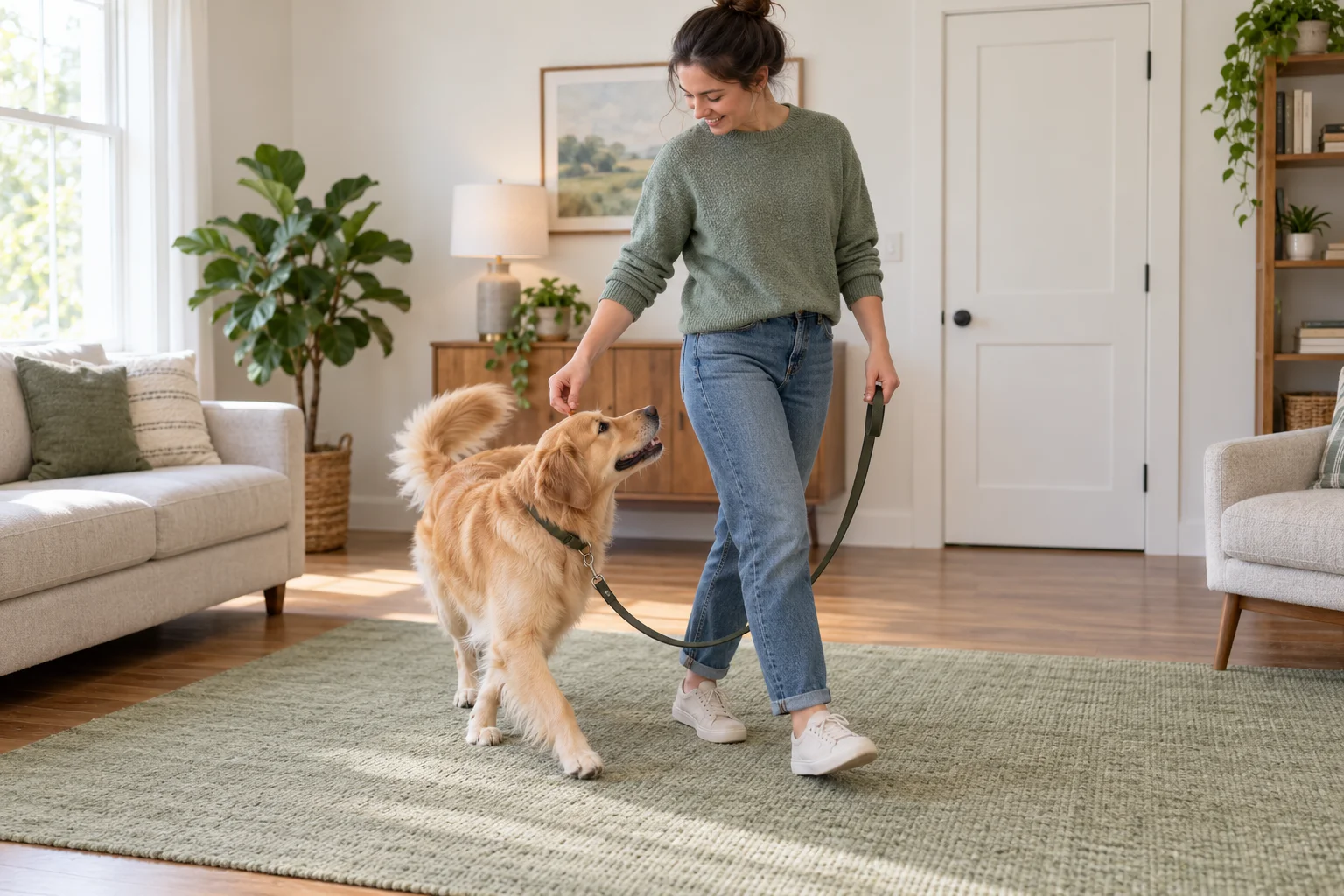
Teach the turn indoors with a treat to follow
Start in a quiet room or hallway with the outside door closed. Clear a space long enough to walk a few paces, then turn and walk back.
- Walk forward three or four paces with your dog on your left.
- Say "this way" once, in a cheerful voice.
- Then turn to your right, away from your dog. As you start the turn, bring your left hand, with the treat, to your dog's nose.
- Turn slowly, keeping the treat at their nose, so your dog walks round the outside of your turn and ends up beside you, facing the new direction.
- Walk two or three paces in the new direction, then give your dog the treat at your side.
- Keep walking a few more paces. That ends the repetition.
The order is always: cue, then turn, then a couple of paces together, then the treat, continuing to walk safely away. This follows the Halifax Humane Society handout's reward timing. The American Kennel Club's guide to cues for avoiding approaching dogs also describes guiding the turn with a treat at the nose and keeping the leash loose, without pulling your dog.
Why turn away from your dog? Turning toward your dog means stepping into their path, and you may bump or tread on them. Turning away gives them a clear, wide arc to walk round. Go slowly at first, because your dog has farther to walk than you do.
Keep the leash slack the whole time. If it starts to tighten, slow down your turn and let your dog catch up. Never pull your dog round with the leash.
Do a handful of repetitions, then stop. The guide to short dog training sessions explains how to fit practice into your day.
Turning on a slippery floor can make some dogs scramble. If your floor is slippery, practice on a rug or move to a quiet yard.
Turn on the cue without showing a treat
Over many repetitions, your dog learns that "this way" means a turn and a treat. You can tell your dog is ready to move on when they start to turn as soon as you say the cue, before your treat hand reaches their nose.
At that point, stop showing the treat first. Keep your left hand empty and relaxed at your side. Say "this way," turn, walk a couple of paces, then fetch and give a treat with your left hand while your right hand keeps its secure leash grip. Keep moving safely away as you reward.
You have faded the lure, not stopped rewarding: your dog still gets a treat after every turn. Both the Halifax Humane Society handout and the AKC describe this distinction.
If your dog doesn't turn when your hand is empty, don't repeat the cue. Go back to guiding with the treat. Try the empty hand again when your dog starts turning on the cue before the treat hand reaches their nose.
If you want, practice with your dog on your right side as well. The AKC suggests teaching the turn with your dog on both sides, so you can use it whichever side they happen to be walking on.
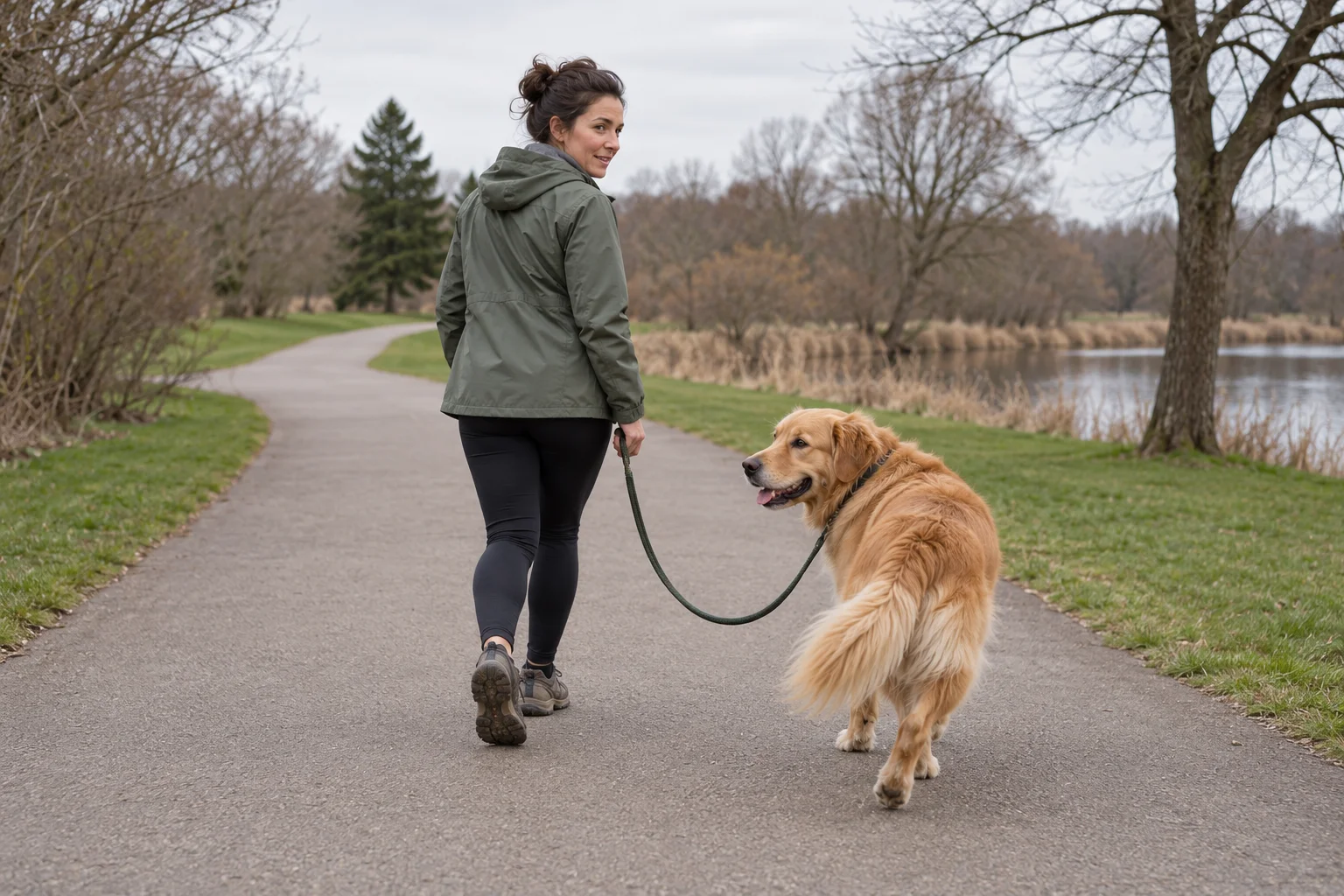
Practice outdoors where nothing is happening
Once your dog turns readily indoors without a treat to follow, move outside. Choose a quiet yard, a quiet street at a quiet time of day, or an empty parking lot.
New places are harder, so make the exercise easier again. Go back to guiding with a treat for the first few turns, then fade it again. The Halifax Humane Society handout recommends using the lure again at first when you move outdoors.
Before every turn, check the route behind and beside you. Look for cyclists, joggers, cars pulling out, the edge of the curb, and anything your dog could step into. Only turn where it is safe to walk the other way.
Your dog is ready to use the U-turn on real walks when they turn with you on the first cue, on a loose leash, in several quiet outdoor places, without the treat leading them. If they hesitate, lag or the leash tightens, stay with quiet places for longer.
The guide to why your dog listens at home but not outside explains why each new place needs a little extra practice.
Practice around mild distractions at a distance
Before you rely on the U-turn, rehearse it near the kinds of everyday sights you meet on walks, while your dog is still relaxed.
For example, practice on a street where a parked car, a trash can or a person walking on the far side are in view, but your dog is not focused on them. Say "this way," turn and walk away, and reward after a couple of paces. Success looks like your dog turning on the first cue with a loose leash and their attention on you, not on the sight.
The Halifax Humane Society handout also suggests practicing in the places where things usually appear, even when nothing is there. That builds the habit on your real routes.
Do not walk toward something your dog finds frightening, or set up a meeting with another dog, to test the cue. If your dog stops, stares or stiffens at something, give them more space rather than continuing the rehearsal there. Turn away early, while they can still move comfortably with you. The Halifax Humane Society handout flags prolonged staring as a reason to act early; there is no universal number of seconds before a dog reacts.
Use the U-turn on real walks
When you see something ahead you want to avoid, use the U-turn early, while your dog is still relaxed and can listen.
- Check the route behind and beside you.
- Say "this way" once, cheerfully.
- Turn away from your dog and walk briskly in the new direction.
- After a couple of paces, give a treat while continuing to move safely away.
- Keep walking until you have plenty of distance, then carry on with your walk.
Keep your voice happy, even if you feel worried. The AKC recommends a happy, excited tone so the change of direction feels positive. Keep the leash slack and let your dog turn because they want to come with you.
Keep rewarding the U-turn on real walks with treats. A real situation is harder than practice, so it is worth a good reward.
The guide to what to do when your dog barks at other dogs on walks covers route choices and other ways to give your dog more space. The guide to loose leash walking covers walking without pulling.
What to do if your dog won't turn with you
Say the cue once. If your dog doesn't turn, don't repeat it again and again, and don't pull harder on the leash. Repeating the cue teaches your dog to ignore it, and leash pressure can make a worried or excited dog more tense.
In practice, a missed turn may mean the setting is too distracting, the cue is not learned yet, or the movement is difficult. Check for discomfort rather than assuming it is a training problem. If your dog is comfortable, make the next attempt easier:
- Go back to a quieter place.
- Guide with a treat again for a few repetitions.
- Turn more slowly, so your dog can keep up.
On a real walk, keep a secure leash grip without jerking or dragging your dog. If they stop, look for a safe exit and encourage movement away when they can respond. Waiting at the edge of a path is an option only if the other dog or person can genuinely pass at a distance your dog finds comfortable. Do not stay there for a forced close pass. Ask the other person to give you space or move away where possible, and use a safe exit when one becomes available. If you cannot maintain control or keep others safe, seek immediate assistance. Then choose quieter routes and times and arrange individual help if needed.
If your dog regularly can't turn when something appears, keeps lunging, barking or panicking, or you find it hard to keep them safe, stop relying on the U-turn and get help from a qualified, reward-based professional and your vet. If your dog seems stiff or sore when turning, stop practicing and talk to your vet.
Use reward-based methods throughout. The American Veterinary Society of Animal Behavior recommends reward-based methods for all dog training. Never jerk the leash, scold or drag your dog to make them turn.
Fix common U-turn problems
Your dog walks straight on when you turn
You may be turning too fast, or the cue doesn't mean much yet. Slow the turn down, use a tastier treat at their nose, and go back indoors for a few sessions.
For example, a young adult dog turns well in the hallway but carries on forward when her owner turns on the sidewalk. Her owner goes back to guiding with a treat for the first few turns outside, and turns more slowly. The dog follows the treat round with a loose leash, so the owner rewards after a couple of paces. When the dog starts turning on the cue before the treat hand reaches her nose, the owner tries an empty hand again and rewards after a couple of paces.
The leash goes tight during the turn
Your dog has farther to walk on the outside of the turn. Slow down, take shorter strides as you turn, and keep a little more slack in the leash.
Your dog turns but then pulls back toward what they saw
You may have cued the turn too late, after your dog was already focused. Turn earlier next time. Give the treat after a couple of paces in the new direction while continuing to move safely away; do not delay the reward until you reach a farther point. If your dog cannot keep moving with you, use the safe-exit guidance above rather than pulling them away.
Your dog jumps at your treat hand during the turn
Your hand is probably too high. Keep the treat at your dog's nose height, close to their face, and move it smoothly round with the turn. Give the treat at the same low height. If your dog is very bouncy, practice after a walk, when they are calmer.
Your dog is busy sniffing when you say the cue
Sniffing is an important part of a walk, and a nose deep in a hedge may not hear you. In practice, wait until your dog has finished sniffing and is walking with you before you say "this way." On a real walk where you need to turn, use a slightly higher-value treat and turn more slowly. If your dog regularly can't leave a smell, give them more sniffing time earlier in the walk.
Your dog turns at home but not when they are excited
Excitement makes turning harder. Practice the U-turn on quiet stretches near the start of a walk and again near the end, when your dog has calmed down. Keep the first turns on any exciting walk easy and well rewarded.
Your dog only turns when they can see food
Go back to the empty-hand stage indoors, and keep rewarding after every turn so your dog learns that food still comes.
Your dog turns but seems stiff or slow
Stop practicing and talk to your vet. Don't use tastier treats to get your dog through a movement that may hurt.
Plan your next practice session
For your next session, start at the easiest stage your dog does comfortably.
If your dog still needs the treat at their nose, practice that indoors for a handful of turns. If they turn as soon as you say "this way," try a few turns with an empty hand and give the treat after a couple of paces. If empty-hand turns are easy indoors, move to a quiet yard or street, guiding with a treat for the first few turns. If quiet outdoor turns are easy, practice on your usual routes when nothing is around.