
Fetch looks simple. You throw a ball, your dog chases it, brings it back and drops it at your feet. In reality, many dogs only manage part of the game. Some watch the ball fly past with no interest. Some chase it, then lie down and chew it. Others grab it and run off, delighted that you're chasing them for once.
Fetch is really a chain of separate skills: wanting the toy, chasing it, picking it up, bringing it back and letting go. Most dogs who "don't fetch" are missing one or two links. When you teach each part on its own and then join them together, fetch becomes much easier.
This guide explains how to choose the right toy, how to build interest in a dog who doesn't seem bothered, how to teach the return and the release, and how to keep the game safe and fun. It also covers dogs who run off with the toy, dogs who get fixated on balls, and when fetch might not be the right game for your dog.
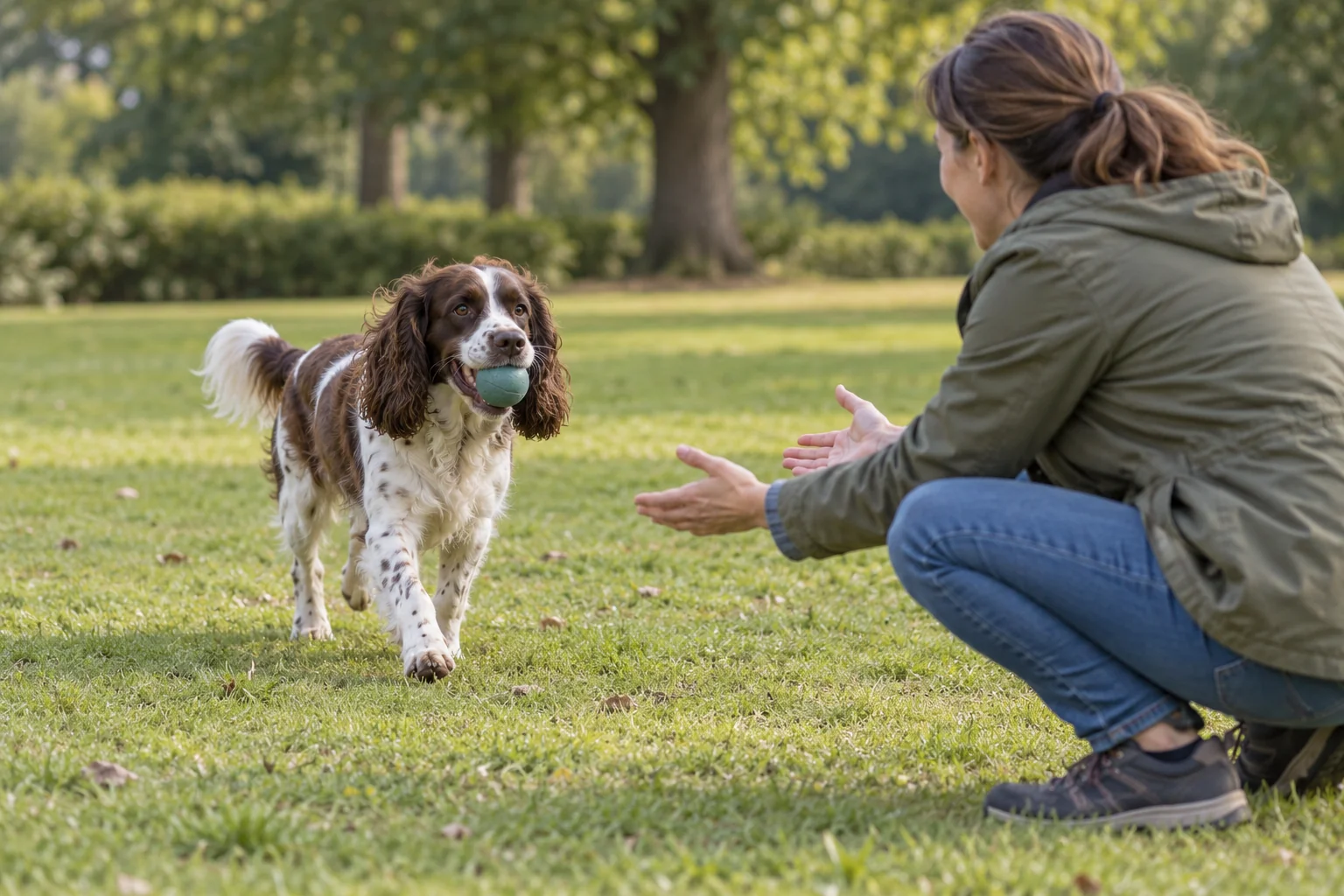
Why some dogs don't fetch naturally
Some dogs, especially those bred to retrieve, seem to fetch almost from the start. Plenty of others don't, and that's completely normal.
Common reasons a dog doesn't fetch:
- They don't care about the toy. If a ball isn't exciting, there's no reason to chase it.
- They don't see the point of bringing it back. For many dogs, keeping the toy is the best part.
- Letting go feels like losing. If giving up the toy means the fun ends, many dogs hang on.
- Running off gets them chased. Keep-away can be more fun than fetch.
- They're not built for it. Some dogs aren't keen on fast running, or find it uncomfortable.
The American Kennel Club's guide to fetch points out that, for dogs, the reward isn't the game itself (AKC: How to teach your dog to fetch). That's a useful reminder. Your dog needs a reason to take part, whether that's treats, play with you or another throw.
Choose a toy your dog actually wants
The best fetch toy is the one your dog loves. That might be a ball, but it could just as easily be a soft toy, a rope toy or a rubber ring.
When choosing a toy:
- Pick something your dog already likes to carry or play with.
- Choose the right size. A ball should be too big to swallow or get lodged in your dog's throat, but small enough to carry comfortably.
- Choose a dog toy, not a stick. PDSA warns that sticks can cause serious injuries and recommends safer alternatives such as a dog-safe ball or rubber safe-stick (PDSA: Dog cheats death after game of fetch ends in horror). For size, material and condition, see PDSA's guide to choosing a safe ball for your dog.
- Have two identical toys. This helps when teaching your dog to bring the toy back.
Check toys regularly for damage. A ball that's been chewed into pieces, or a soft toy with stuffing coming out, can be a choking or swallowing risk. Replace worn toys, and put fetch toys away when you're not supervising, especially if your dog likes to chew.
Keep your fetch toy special. If it's only used for this game, it often becomes more exciting.
Build interest in a dog who isn't bothered
If your dog ignores the toy, start by making it interesting before you throw anything.
- Make it move. Drag the toy along the ground in a zigzag, or wiggle it away from your dog. Most dogs are more interested in things that move away from them.
- Play tug. A short, gentle game of tug can make a toy much more appealing.
- Hide treats in it. Some toys can be stuffed with food, which makes them worth picking up.
- Reward any interest. Mark and reward a look, a sniff or a touch.
Keep these sessions short, and stop while your dog is still keen. Our guide on how long should dog training sessions be? has tips for keeping practice brief and frequent.
If your dog still isn't interested after several sessions, try a different toy. Some dogs prefer something soft, others something squeaky or chewy.
Timing helps too. Many dogs are more playful at certain times of day, for example after a nap or before a meal. Try short play sessions at different times and notice when your dog is most keen. If your dog has just come back from a long walk, they may simply be too tired to be interested, and that's fine.
Your own energy matters as well. A cheerful voice, a bit of movement and some genuine enthusiasm from you can make a toy far more interesting than a ball thrown silently across the room. Keep it light and fun, and stop before either of you gets bored.
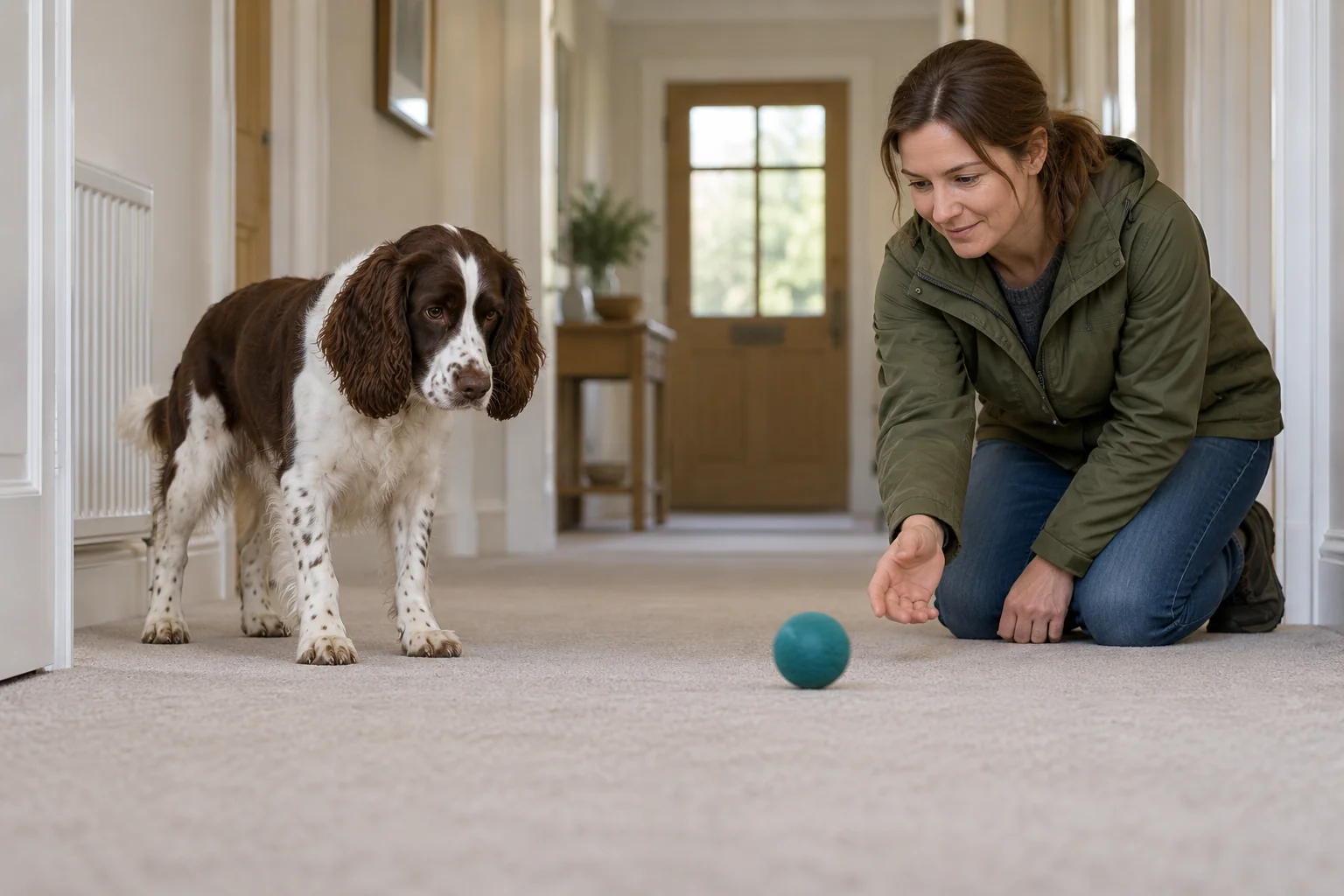
Teach the first short throws
Once your dog is interested in the toy, start with very short throws.
- Choose a quiet space with few distractions, such as a hallway or a quiet room.
- Toss the toy a short distance, just a metre or two.
- When your dog chases it and picks it up, praise them enthusiastically.
- Encourage them back by calling cheerfully, crouching down or moving backwards away from them.
The AKC guide recommends working at your dog's pace, building gradually from very easy versions. Don't rush to long throws. Short, successful repetitions build the habit.
If your dog picks up the toy but doesn't come back, don't chase them. Instead, move away from them, call them happily, or use the two-toy approach below.
Keep the first sessions to just a handful of throws. Five or six good repetitions, followed by a break, usually work better than a long session where your dog gets bored or tired. If your dog does well, end the game on a high note with a treat or a short game of tug. If they struggle, make the next throw easier rather than harder.
It also helps to practise somewhere your dog already feels relaxed. A familiar room or garden lets them focus on the toy rather than on new smells and sounds.
Teach your dog to bring the toy back
Bringing the toy back is often the hardest part. Here are some ways to make it more appealing.
Move away from your dog. Many dogs follow when you move away. Run a few paces backwards or turn and jog in the other direction as your dog picks up the toy.
Use a clear, non-slip hallway if your dog is comfortable there. A short, familiar space makes it easier to encourage the return without adding distractions.
Use a long line only as a safety backup. If the area is not securely fenced, attach one to a well-fitted harness and keep it slack. Don't use it to stop a sprint or jerk your dog back. Our guide on how to teach your dog to come when called safely explains safer long-line handling.
Make returning worth it. When your dog comes back, reward them with a treat, praise or another throw. If returning always ends the game, your dog may stop coming back.
Don't snatch the toy. Grabbing the toy the moment your dog arrives can teach them to keep their distance. Let them hold it for a moment while you praise them, then ask for a release.
Use the two-toy game
The two-toy game is a simple way to teach both the return and the release.
- Have two identical toys.
- Throw the first toy.
- When your dog picks it up and starts to come back, show them the second toy and make it exciting.
- When your dog drops the first toy to get the second one, immediately throw the second toy.
- While they chase the second toy, pick up the first.
Over time, your dog learns that bringing a toy back and letting it go leads to another throw. Once they're returning reliably, you can gradually stop showing the second toy so early.
This approach works especially well for dogs who love chasing more than they love keeping the toy.
If your dog loves the toy so much that they won't swap for anything, try making the second toy even more exciting, or swap the toy for a treat instead of another throw at first. The key is that letting go always leads to something good, so your dog never feels they've lost out.
Teach a calm release
A reliable "drop" makes fetch much smoother. It's best taught separately, away from the excitement of throwing.
A simple way to start:
- While your dog is holding a toy, offer a tasty treat right at their nose.
- When they let go to eat the treat, say "drop" just as they release, then pick up the toy.
- Give the toy back straight away, so letting go doesn't mean losing the game.
Repeat until your dog drops the toy easily when you say the word. Then practise during fetch.
Our guide on how to teach your dog to drop it calmly explains this in more detail, including how to avoid turning release into a tug-of-war.
Add a cue and build distance
Once your dog is chasing, returning and dropping reliably, you can add a cue such as "fetch" or "get it" before you throw.
Then, gradually build up:
- Distance. Throw a little further each time, as long as your dog keeps returning.
- Location. Move from a hallway to a room, then the garden, then a quiet park.
- Distractions. Practise with more going on around you, such as other people or dogs at a distance.
Each time you make one thing harder, make the others easier. For example, when you first practise in the park, go back to short throws.
Some owners like to add a short wait before each throw. Ask your dog to sit or stand still, pause for a second, then throw and say your cue. This can help excitable dogs stay a little calmer and stops them leaping at your hand as you throw. Keep the wait very short at first, and release your dog with the cue so the chase itself is the reward. If your dog finds waiting too hard when the ball is in your hand, practise the pause with the ball held behind your back or in a pocket first.
Keep fetch safe for your dog's body
Fetch is great fun, but repeated chasing, sprinting and sudden stops can stress a dog's joints and muscles, PDSA vets warn (PDSA: How to choose a safe ball for your dog). A few habits keep it safer.
- Warm up first. A short walk before throwing gives your dog's muscles time to warm up.
- Keep throws low and short where you can, rather than high throws that make your dog leap and twist.
- Choose good ground. Grass is kinder than concrete. Avoid slopes, holes and slippery or uneven surfaces.
- Avoid hot weather. Play in the cooler parts of the day, offer water and stop if your dog seems hot or tired.
- Stop before your dog is exhausted. End while your dog still wants more.
- Watch for stiffness or limping after play.
If your dog seems sore, stiff or reluctant to run after fetch, talk to your vet before continuing. Older dogs, young puppies and dogs with joint problems may need gentler versions of the game, such as rolling a ball along the floor or short throws on soft ground.
Gentler fetch ideas that still give your dog the fun of retrieving:
- Roll rather than throw, so the ball stays low and your dog doesn't need to leap.
- Hide the toy in an easy spot and send your dog to find it, then bring it back.
- Play indoor fetch along a carpeted hallway with very short rolls.
- Alternate fetch with sniffing, for example by scattering a few treats between throws.
These versions keep the game in your dog's routine without the repeated sprinting and sudden stops.
Watch for dogs who become fixated
Some dogs love fetch so much that it becomes the only thing they want to do. They may stare at the ball, push it at you constantly, or struggle to settle when a ball is nearby.
If your dog seems very fixated:
- Keep fetch sessions short and structured, with a clear start and end.
- Put the ball away when the game is over, out of sight.
- Mix in other activities, such as sniffing games, training or calm chews.
- Practise settling after play, so your dog learns that the game ends and rest follows.
- Use a clear end signal, such as saying "all done", showing your empty hands and offering a chew or a scatter of treats.
A predictable ending helps many dogs accept that the game is over, rather than pestering for more throws.
The AKC guide notes that working at your dog's pace helps them succeed, and the same idea applies here. A game that leaves your dog unable to relax isn't helping them.
If your dog becomes frantic, frustrated or snappy around toys, or guards balls from people or other dogs, talk to a qualified behaviour professional.
Choose rewards that keep your dog playing
For many dogs, another throw is the best reward. For others, especially those still learning, treats are useful too.
Reward ideas:
- Another throw
- A short game of tug
- A tasty treat when they return
- Enthusiastic praise
Our guide on how to choose training rewards your dog actually wants has more on matching rewards to what your dog finds motivating.
Mix it up. If your dog seems to lose interest, try switching rewards or ending the game sooner.
A worked example: a dog who runs off with the ball
Here's an illustrative example of how you might work with a common problem. Adjust it to your own dog.
The pattern: Your dog chases the ball eagerly, then runs off with it and won't come back. When you go after them, they run further.
Change the setup:
- Practise indoors in a hallway for a few days.
- Use two identical balls.
In the hallway:
- Toss the first ball a short distance.
- As your dog picks it up, show the second ball and move backwards.
- When they drop the first ball, throw the second.
- Pick up the first ball while they chase the second.
Move outside:
- If the garden is not securely fenced, use a long line attached to a well-fitted harness as a slack safety backup. Don't use it to stop a sprint.
- Keep throws short and keep using two balls.
After a week or two:
- Check whether your dog is coming back more quickly. If so, gradually increase distance.
Troubleshoot common problems
Your dog chases the toy but then ignores it. Make the toy more exciting with tug or treats inside, and keep throws very short.
Your dog won't let go of the toy. Practise the release away from fetch, and use the two-toy game. Avoid tugging the toy out of their mouth.
Your dog brings the toy back but drops it far away. Reward them for coming closer before dropping, and move backwards so they follow.
Your dog loses interest quickly. Keep sessions very short and stop while they still want more.
Your dog gets overexcited and starts nipping. Pause the game, wait for them to settle and start again more calmly. If nipping continues, get professional help.
Your dog won't fetch outside. There may be too many distractions. Go back to short throws in a quieter place.
When to get help
Most dogs can learn some version of fetch with patience and the right toy. Some need more support, and some may simply prefer other games.
Talk to your veterinarian if:
- Your dog seems stiff, sore or reluctant to run
- Your dog limps or seems uncomfortable after play
- Your dog's interest in play suddenly drops
Look for a qualified, reward-based trainer or behaviour professional if:
- Your dog guards toys, growls or snaps when you approach
- Your dog becomes frantic or fixated around balls
- You've tried consistently and aren't making progress
Use reward-based help only. The American Veterinary Society of Animal Behavior states that evidence supports reward-based methods for all canine training (AVSAB: Why you need to reward your dog in training).
You can also browse our other dog training guides for more everyday skills.