
Eye drops are a veterinary treatment, so start with your vet, not with training. If your dog's eye is red, cloudy, swollen or weepy, or your dog is squinting, pawing at it or rubbing it, see your veterinarian as soon as possible. If drops have already been prescribed and you can't give them, call your vet's team now and ask what to do. Don't skip doses, and don't stop the treatment early on your own. Your vet decides the diagnosis, the medicine, the dose, the schedule and how to put the drops in.
If your dog has growled, snapped or bitten when their face or head was handled, ask your vet and a qualified behavior professional for help rather than practicing at home.
Comfort practice, done separately from real doses, can make future treatment easier. With your dog free to walk away, you practice short, gentle moments: your hand near their face, a brief touch on the cheek, and a clean, empty practice bottle that comes a little closer over time. Each moment ends with your hand moving away and a treat. No liquid is ever used during practice, and nothing touches the eye. If your dog moves away, turns their head away or stiffens, stop and pause. Try an easier stage only if your dog comes back on their own and looks relaxed; otherwise, end the session.
See your vet first for any eye problem
Signs that need a vet
PetMD's guide to red eyes in dogs, written by a veterinarian, advises taking your dog to your vet as soon as possible if their eyes are red, and notes that this can be an emergency in some cases. It lists pawing or rubbing at the eye and squinting as signs of pain or discomfort, along with discharge, cloudiness on the surface of the eye and swelling in or around the eye.
Contact your vet promptly if your dog:
- Has a red, cloudy, swollen or weepy eye, or new discharge.
- Squints, holds an eye closed, or paws or rubs at their face.
- Has hurt their eye, or the eye looks different from the other one.
- Seems to bump into things or see less well.
Don't wait to see whether it settles, and don't try training first. An eye that may be sore needs a vet's assessment before anyone handles it.
Use only what your vet prescribes
Use only the drops your vet has prescribed for this dog and this problem. Don't use human eye drops, another pet's medicine or leftovers from an earlier treatment. If anything about the label or instructions is unclear, ask your vet's team before you give the medicine.
Get help if your dog has growled or snapped
If your dog has growled, snapped or bitten during face, head or eye handling, don't use this article as a home plan. Talk to your vet, then a qualified reward-based behavior professional. Our guide on when to seek professional behavior help explains what to look for. Never punish a growl; it is your dog's warning.
Keep children out of eye practice and eye treatment. Working close to a dog's face is a job for an adult.
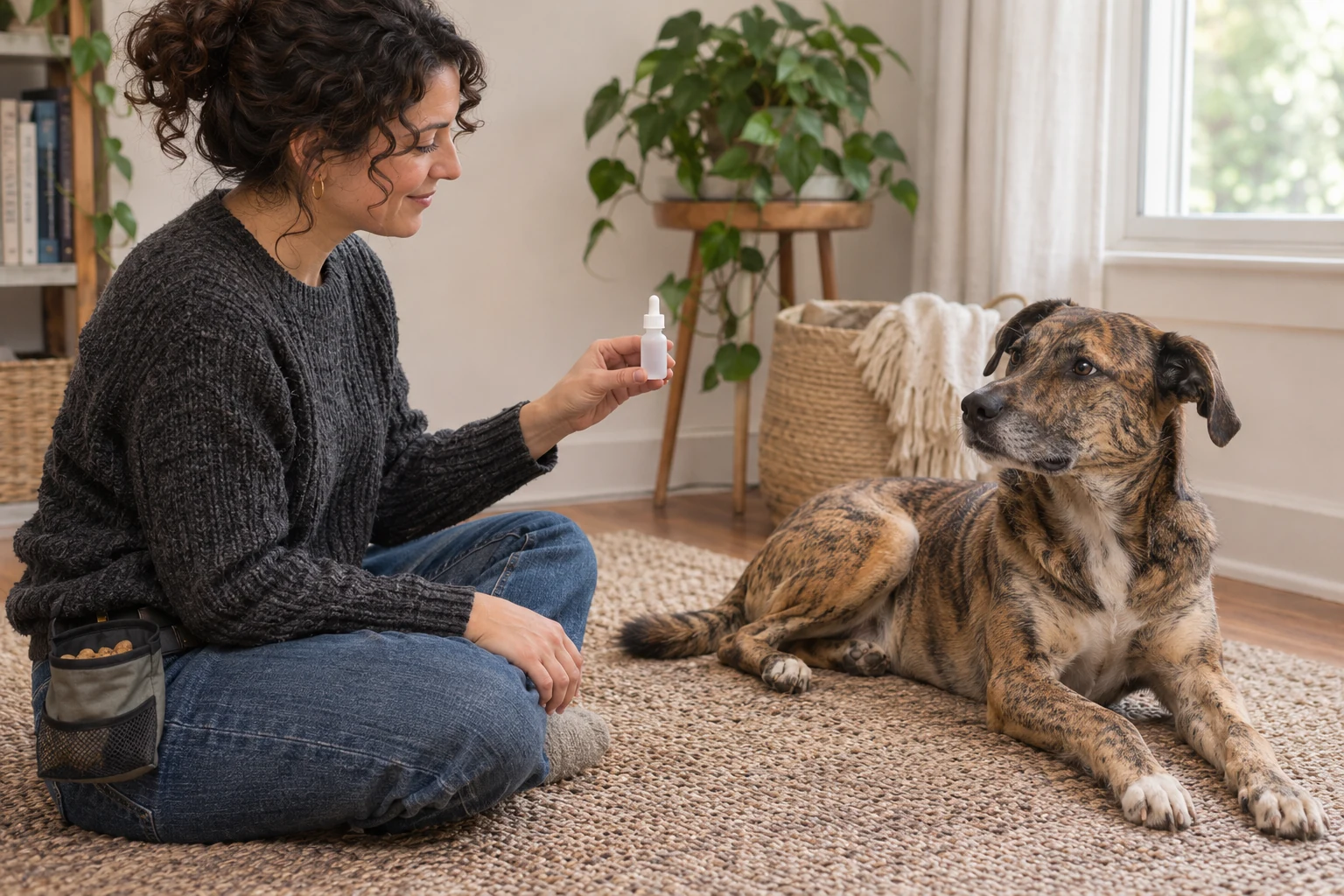
Keep treatment and practice separate
Real treatment can't wait for training to work. Keep the two apart:
- Treatment follows your vet's instructions exactly: which eye, how many drops, how often and for how long.
- Practice happens at other times, with a separate, empty practice bottle, and never with the real medicine.
If giving the drops at home is distressing for your dog, or unsafe for you, call your vet's team. PetMD's guide to giving eye drops, written by a veterinarian, advises talking with your vet if you're having trouble giving them. Ask whether:
- The clinic team can give some doses, or show you how.
- Another form of treatment or a different schedule might work for your dog.
- Anything about the eye has changed and needs a recheck.
If a dose is missed or only partly given, ask your vet what to do. Don't add extra drops or double up on your own.
Ask your vet to show you how to give the drops
The application technique is your vet's job to teach. The American Kennel Club's guide to giving your dog eye drops advises asking your veterinarian or a veterinary technician to show you the proper way to apply them.
When you are at the clinic, ask:
- Which eye, how many drops and how often.
- How to hold the bottle and where to aim.
- Whether to shake or refrigerate the medicine, and how long to continue.
- If there is more than one eye medicine, what order to give them in and how long to wait between them.
- How to keep the bottle tip clean. PetMD advises keeping the tip of the applicator clean and not touching your pet's eye.
- What changes mean you should call back.
The Royal Veterinary College's fact file on giving eye treatment warns against touching the eye with the bottle dispenser, because this could damage the cornea, and says to follow your vet's instructions on storing and shaking the medicine. The AKC guide also warns against touching the tip to the eye or skin.
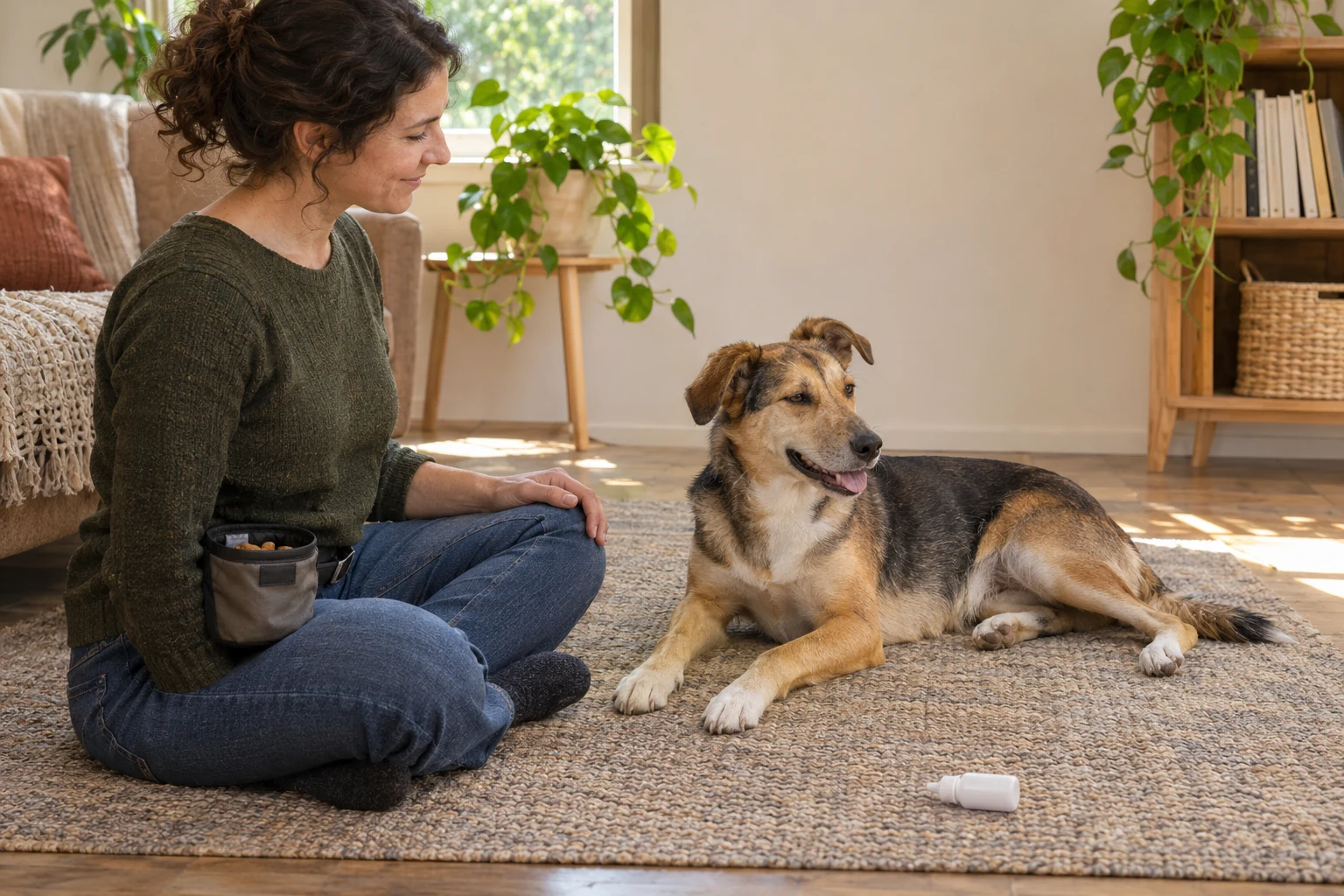
Set up a calm space for practice
Pick a quiet room with a non-slip floor. Leave space all around your dog so they can walk away in any direction. Don't hold their collar, tether them, wrap them in a towel, hold their head, sit them between your knees or corner them.
Use small, soft treats your dog really likes, kept in a pouch at your waist or in a bowl on a table beside you, out of your dog's reach. Our guide to choosing training rewards can help.
Get a clean, empty dropper bottle to use only for practice. Whole Dog Journal describes practicing with an empty bottle so a dog can learn that the bottle predicts good things before real medicine is involved. Never practice with the real medicine bottle, and keep the practice bottle closed so nothing can drip.
Sit on the floor beside your dog, slightly side-on, rather than facing them or leaning over their head. Your dog can stand, sit or lie down, whichever they choose. Use the hand nearer your dog's head for touching, or for holding the practice bottle. Keep your other hand free to take treats from the pouch. Use one hand at a time: the touching hand moves away first, then the other hand gives the treat.
Choose calm moments for practice, such as after a walk or a game when your dog is settled, and not straight after a real dose, when your dog may still be unsettled. If your dog is currently on treatment, make sure the eye is comfortable enough for practice by checking with your vet first; practice is for a dog whose eye isn't sore.
Keep sessions to a few minutes. Our guide to short dog training sessions explains how to fit practice into your day.
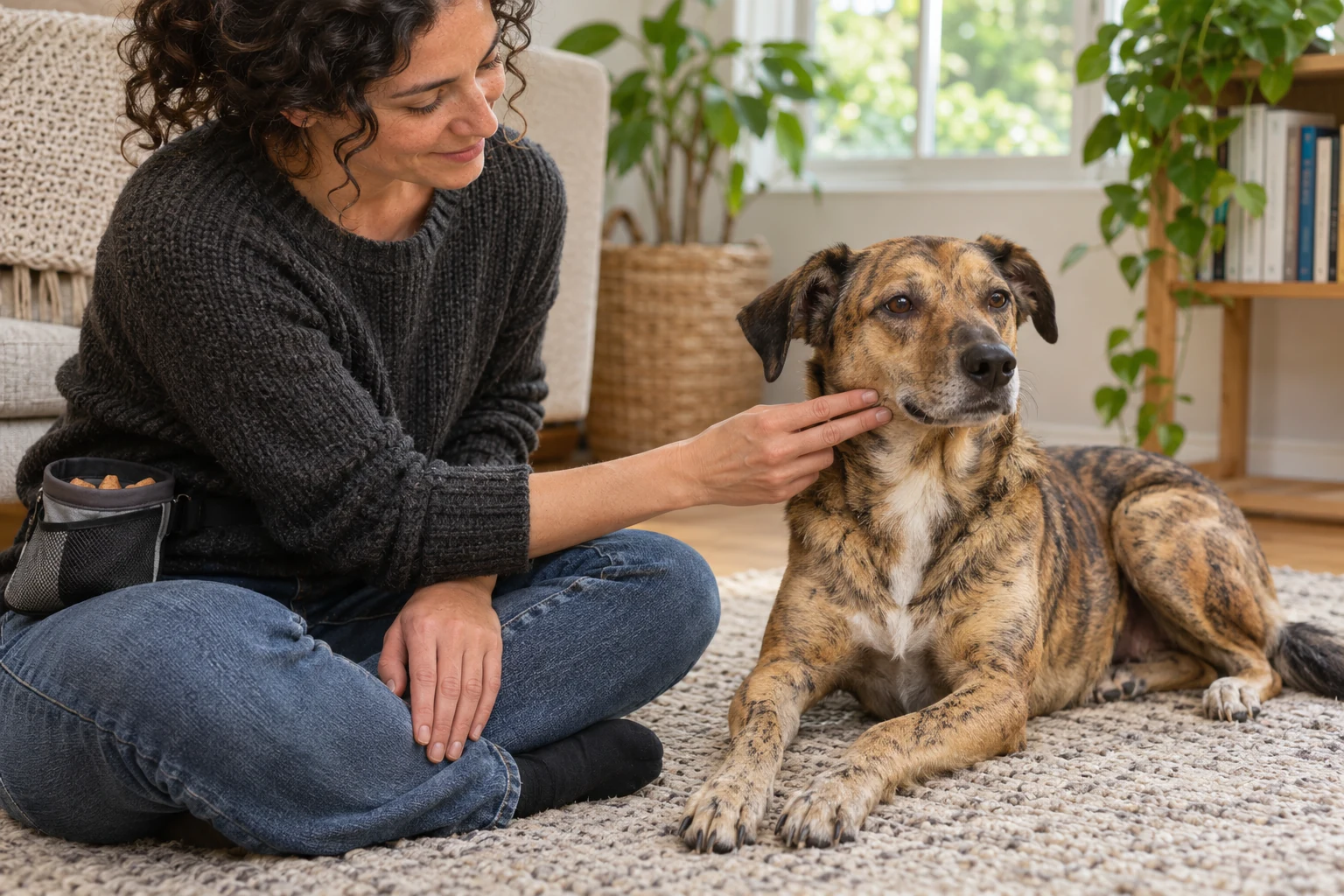
Practice face handling in small stages
The AKC guide notes that you can teach your dog to tolerate eye drops and even help by staying still. The stages below build that comfort gradually, one small change at a time.
Each stage follows the same pattern. Make one brief contact, move your hand away, then give a treat. That is one complete repetition. Pause for a few seconds. If your dog stays beside you and looks relaxed, start the next repetition. If they leave, don't call them back. Continue with an easier stage only if they return on their own and look relaxed; otherwise end the session.
Give the treat after the contact, not during it. Don't use a lick mat, a steady stream of treats or a helper feeding your dog to keep them still near their face. Whole Dog Journal's article on giving dogs eye medication quotes a veterinarian who notes that restraint usually means a dog will resist.
Start with a stroke your dog already enjoys
Stroke your dog once on the chest or the side of the neck. Move your hand away, then give a treat.
Move your hand toward the side of the face
Bring your hand slowly from the side of the neck toward the cheek, stopping a few inches away. Move it back, then give a treat. Over several repetitions, stop a little closer, as long as your dog stays relaxed.
Touch the cheek briefly
When your dog stays relaxed as your hand comes close, rest your fingertips on their cheek, below and to the side of the eye, for a second. Move your hand away, then give a treat. Keep your fingers well away from the eye itself and the eyelids.
Rest your hand alongside the head
When your dog stays relaxed with cheek touches, rest your palm lightly along the side of their head for a second, without gripping or holding. Move it away, then give a treat. This builds comfort with the kind of hand position your vet may show you, but it is not a hold.
Introduce the closed practice bottle
Put the closed practice bottle on the floor near your dog and give a treat. Then hold it still in your hand at your side and give a treat with your other hand. When your dog stays relaxed, bring the closed bottle slowly toward the side of their head, stopping several inches from the eye, then move it away and give a treat. Over many repetitions, you can bring it a little closer and a little higher, but keep it well clear of the eye. Never squeeze it.
Combine the hand and the bottle
When your dog is relaxed with each part, rest one hand on the cheek for a second while the other briefly holds the closed bottle a few inches away. Then move both hands away, put the bottle down and give a treat.
Notice what progress looks like
Progress usually shows up as small changes over several sessions: your dog staying beside you as your hand comes up, leaning into a cheek touch, staying relaxed when the practice bottle appears, and coming over willingly when you sit down to practice. Write down which stage your dog is comfortable with, so you and your vet's team know where things stand. If progress stalls, stay at the easiest stage your dog enjoys for a few sessions before trying the next one again.
Watch your dog's face and body and stop early
Watch your dog's whole body, not just whether they eat. Stop immediately if your dog turns their head away, backs off, leans away, stiffens, freezes, licks their lips, shows the whites of their eyes or paws at your hand. Move your hand and the bottle away and pause. Continue with an easier stage only if your dog comes back on their own and looks relaxed. If they don't, end the session.
Eating a treat doesn't mean your dog is comfortable. A dog can eat while stiff or leaning away. Move to the next stage only when your dog is relaxed at the current one: a loose body, a soft face and staying beside you, or coming back, between repetitions. There is no target number of repetitions or days.
Squinting, pawing at or rubbing the eye are different. They can be signs of eye pain, so stop practice and contact your vet, rather than treating them as a training setback.
For example, a dog accepts a hand on his cheek but backs away when the practice bottle rises toward his head. His owner lowers the bottle to her lap and pauses. The dog comes back and lies down beside her with a soft face, so she holds the bottle still at her side and gives a treat. Over the next sessions, he starts staying relaxed and looking at her as the bottle appears, so she brings it a little closer, still well away from his eye. If he had started squinting or rubbing his eye, she would have stopped practice and called the vet.
Give real doses the way your vet showed you
Give the medicine exactly as your vet prescribed and demonstrated. The RVC fact file and the AKC guide both suggest a treat afterward, and the RVC notes that giving the medicine before a walk or a meal may help your dog cooperate. Ask your vet whether that timing fits the schedule.
Keep the same calm approach. Sit beside your dog rather than looming over them, and keep sessions short. A predictable routine can help: the same quiet place, the same position and a treat straight afterward, so the dose is brief and followed by something good. Keep the real medicine out of sight between doses, so picking it up doesn't always mean something your dog dislikes is about to happen. If your dog pulls away during a real dose, stop rather than chasing or holding them. Don't try to put more drops in to make up for any you missed. Ask your vet's team what to do about a missed or partial dose.
If the eye looks worse during treatment, contact your vet. PetMD advises a recheck if your pet seems in more pain, or if the eye is becoming redder, cloudier or more watery.
A chin rest is optional. Some owners find it a useful way for their dog to say they are ready, but a dog resting their chin is not proof of comfort, and you should never use it to hold the head in place. If your vet thinks a muzzle would keep everyone safe, our guide to wearing a muzzle comfortably explains how to teach it ahead of time. A muzzle doesn't make it acceptable to continue past your dog's stop signs.
Fix common eye drop problems
Your dog backs away when the bottle appears
Put the bottle down and pause. If your dog returns relaxed, go back to the bottle lying on the floor, then held still at your side. Your dog doesn't need to sniff it; staying nearby with a loose body is enough.
Your dog accepts your hand but not the bottle
Keep the hand and the bottle as separate stages. Practice the bottle on its own, far from the face, and combine them only when both are easy.
Your dog squints, rubs or paws at the eye
Stop practice and contact your vet. These can be signs of eye pain. Don't switch to practicing on the other eye or another part of the face as a workaround.
Your dog eats the treats but stays stiff
Stop, move your hand away and pause. Continue with an easier stage only if your dog comes back on their own and looks relaxed. If your dog stays tense even at the easiest stages, talk to your vet and a qualified behavior professional.
Your dog mouths your hand or paws at it
Move your hand away and pause. Continue with an easier stage only if your dog returns relaxed. If their teeth press on your skin, or they growl or snap, end the session and get help from your vet and a qualified behavior professional.
Your dog accepted drops before but now refuses
A change like this can mean the eye is sore. Contact your vet before you try again.
Treatment is due and your dog isn't ready
Treatment comes first. Call your vet's team for help giving the doses, as described in "Keep treatment and practice separate", and keep practicing at other times.
Your dog hides as soon as you pick up the medicine
Your dog may have learned that the bottle predicts something unpleasant. Pick up the empty practice bottle at random times during the day, give a treat and put it down, without going near your dog's face. Keep the real medicine stored out of sight, and keep giving doses as your vet directs, with their team's help if needed.
Your dog is small and wriggles away on the floor
Stay on the floor beside your dog rather than lifting them onto your lap or a table; being picked up is a separate skill not covered here. If you can't give the doses safely on the floor, ask your vet's team how they would like you to handle it.
Your dog needs drops in both eyes
Ask your vet whether the order or timing matters. In practice sessions, work on one side of the face at a time, and sit on your dog's other side for the other eye rather than reaching across their head.
Your dog is calm at home but not at the clinic
Tell your vet's team which stages your dog is comfortable with at home, and ask whether they can work in short breaks. If your dog is too worried to be examined, ask your vet what might help.