
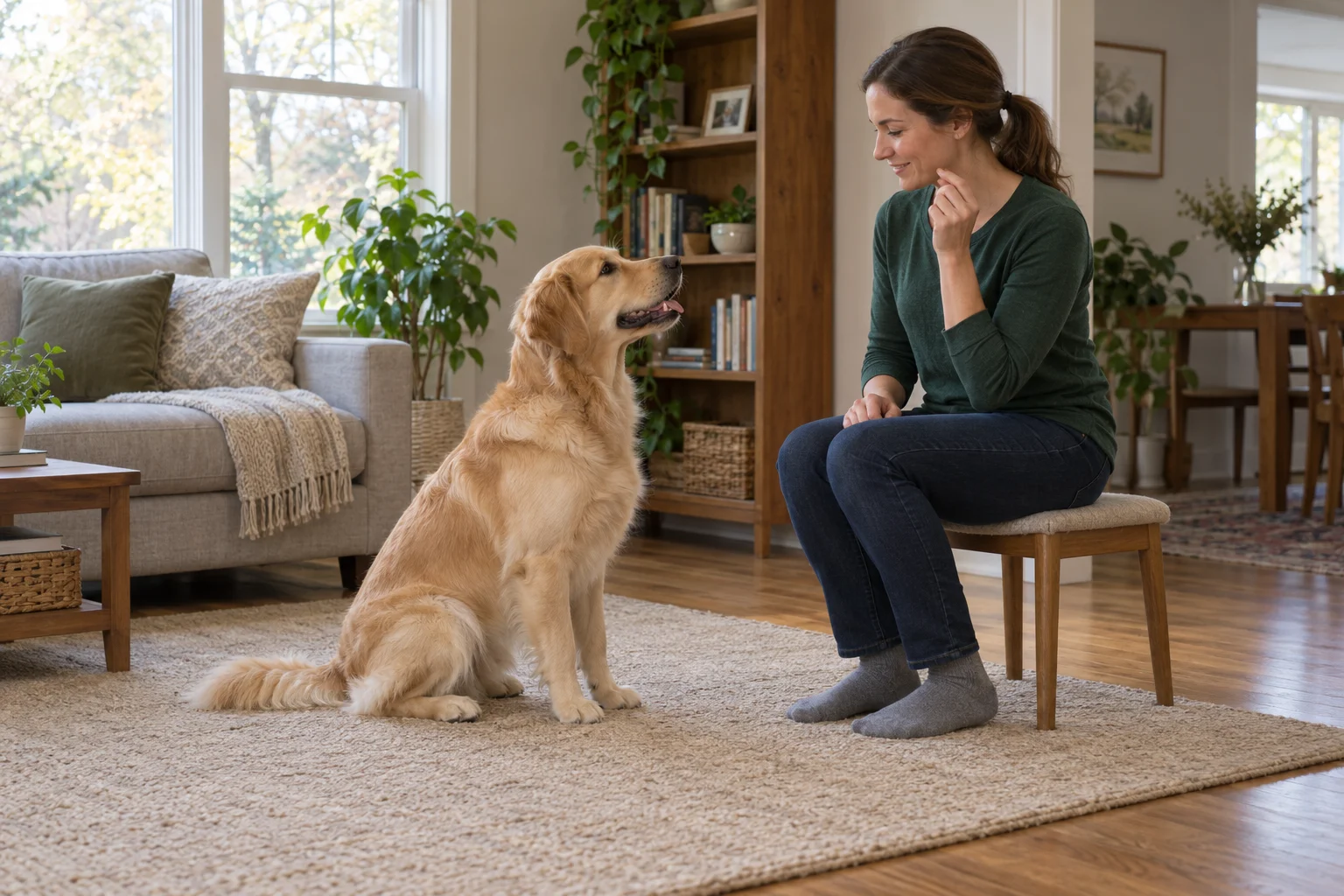
"Watch me" is a cue that asks your dog to look up at you and keep their attention on you for a few seconds. It's a simple skill, but a surprisingly useful one. A dog who looks at you is ready to listen, and a dog who can hold their focus on you for a moment can be easier to guide past distractions.
Quick start: In a quiet room, let your dog sniff a small treat, then slowly bring it beside your cheek. Mark a brief glance toward your face with “yes,” then lower your hand to give the treat at your dog's mouth height. Pause before repeating. Sit or kneel for a small dog, and never hold their head or insist on a stare. If looking toward your face seems uncomfortable, reward a glance toward your shoulder or hand instead. Add the words “watch me” only after your dog understands the hand movement.
The American Kennel Club puts it neatly: a dog that isn't looking simply won't see what you're doing (AKC: Grab and hold your dog's attention with the "watch me" command). "Watch me" gives you a clear way to ask for that attention, and to reward your dog for giving it.
This guide covers how "watch me" differs from your dog's name, how to teach it with a treat lure, how to build up duration and add distractions, and how to use it in everyday life. It also covers dogs who find eye contact uncomfortable, and why "watch me" isn't a fix for dogs who react strongly to other dogs or people.
How "watch me" differs from your dog's name
Your dog's name and "watch me" do different jobs.
Your dog's name is usually a quick "hey, listen" cue. It asks your dog to turn toward you, briefly. Our guide on how to teach your dog their name explains this skill, and notes that if you need your dog to stay engaged, a separate attention behavior is helpful.
"Watch me" asks for more. It asks your dog to look up at your face and keep their attention there until you release them or give another cue.
Teaching both gives you flexibility. You can use the name to get a quick glance, and "watch me" when you need a few seconds of focus, for example while a jogger passes or before you ask for something new.
Keeping the two separate also protects your dog's name. If you use the name all day long to mean "stare at me until I say otherwise", it can lose its quick, easy meaning. A dedicated "watch me" cue gives you a clear way to ask for more, while the name stays a light, friendly call.
Get ready to train
A little preparation makes "watch me" easier to teach.
- Choose small, soft, tasty treats your dog loves.
- Start somewhere quiet, such as your living room, with few distractions.
- Train when your dog is alert, but not overexcited or tired.
- Keep sessions short, just a few minutes at a time.
- Count your treats. If you're practicing several times a day, use some of your dog's daily food as rewards so they don't gain weight.
A marker word, such as "yes", or a click helps your dog understand exactly which moment earned the treat. Our guide on reward markers and timing explains how to introduce one.
It also helps to decide on a release word, such as "OK" or "free", which tells your dog the "watch me" is finished.
If your dog isn't very interested in food, a favorite toy can work as a reward. Hold the toy near your face instead of a treat, and reward eye contact with a quick game. Some dogs focus better for play than for food.
Lure your dog's eyes to your face
The simplest way to start is to use a treat to guide your dog's gaze.
- Hold a treat at your dog's nose, so they can smell it.
- Slowly bring the treat up toward your face, stopping between your eyes or beside your cheek.
- The moment your dog looks at your face, mark and reward.
- Repeat several times, then switch the treat to your other hand.
The AKC describes this approach of moving the treat from your dog's nose up between your eyes, then marking and rewarding the eye contact.
At first, reward even a brief glance. You're teaching your dog that looking at your face pays off.
Keep your hand moving slowly and smoothly. If you move too fast, your dog may lose track of the treat. If you hold the treat too high above your head, small dogs may need to tip their heads right back or jump, so kneel or sit for smaller dogs.
Fade the treat lure
Once your dog follows the treat to your face reliably, start doing the same movement without food in your hand.
- Make the same hand movement, from your dog's nose to your face, with an empty hand. Keep treats in a pouch or your other hand.
- When your dog looks at your face, mark and reward from your pouch or other hand.
- Repeat until the hand movement becomes a signal your dog understands.
If your dog stops following your empty hand, go back to a few repetitions with a treat, then try again. The AKC suggests rubbing your fingers with a treat to help your dog follow your empty hand at first.
Add the "watch me" cue
When your dog looks up reliably following your hand signal, add your verbal cue.
- Say "watch me" once, just before you make the hand signal.
- Mark and reward when your dog looks at your face.
- Repeat over several sessions.
Over time, you can make the hand signal smaller until your dog responds to the words alone. Test this now and then by saying "watch me" with your hands still at your sides. If your dog looks up, give a big reward. If not, keep pairing the words with the signal for a while longer. Many owners keep a small hand signal, such as touching their cheek, which can be useful when it's noisy.
Say the cue once. If your dog doesn't respond, wait a moment, then help with your hand signal. Avoid repeating "watch me, watch me".
Build up duration slowly
Once your dog looks at you on cue, you can teach them to keep looking for a little longer.
- Ask for "watch me" and begin with one second of comfortable attention.
- Mark the successful hold, then lower your hand to reward at your dog's mouth height. For this exercise, the marker ends that repetition; your dog does not need to keep looking while eating.
- Say your release word after the reward to signal a break before another request. Keep that order consistent rather than sometimes expecting more attention after the marker.
- Gradually increase the time, a second at a time, over several sessions.
- Mix short and longer holds, so it doesn't always get harder.
Battersea suggests building up gradually and notes that if your dog looks away before you've finished counting, you may have progressed too quickly (Battersea: How to teach your dog the watch me command). Go back to a shorter time for a few sessions.
A few seconds of attention is plenty for most everyday situations. You don't need a long stare.
The lure position and reward position are different. A treat beside your cheek can guide the initial glance, but bring it down to your dog's mouth to feed them. They should not need to jump or stretch up to eat. Once you've faded the lure, keep food out of sight until you mark the successful hold.
Add distractions gradually
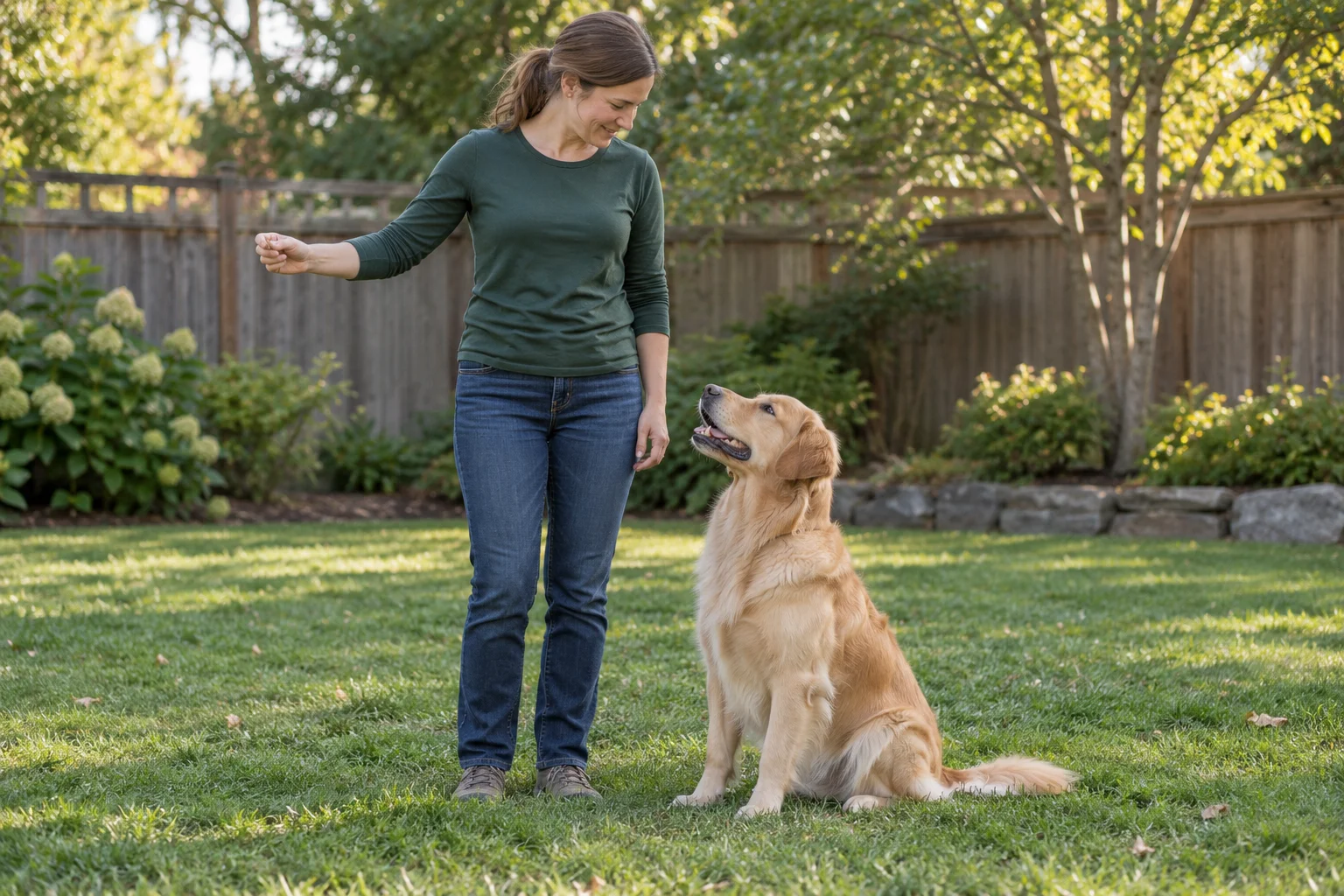
Your dog may find "watch me" easy in the living room but much harder when something interesting is happening. Add distractions slowly.
- Hold a treat out to the side. The AKC suggests holding a treat out to one side and rewarding your dog for looking at you instead. Start with your arm close to your body and gradually move it further out.
- Practice in different rooms, then the yard, then quiet places on walks.
- Add mild distractions, such as someone walking across the room or a toy on the floor.
- Make it easier each time you add something new. Shorter holds, better treats and more rewards.
If your dog can't look away from a distraction, it's too difficult for now. Move further away from it or make it less exciting, and try again.
A helpful way to think about distractions is distance, duration and difficulty. Change only one at a time. If you move somewhere busier, ask for shorter holds. If you ask for longer holds, stay somewhere quiet. Changing several things at once is the quickest way to lose your dog's focus.
Our guide on why your dog listens at home but not outside explains why skills that work indoors can fall apart outdoors, and how to build them up again.
When you first practice outside, choose a spot your dog already knows well, at a quiet time of day. Let your dog sniff and look around for a minute before you start, so they're not desperate to explore. Then ask for a few very short, easy "watch me" repetitions, reward generously and finish before your dog loses interest.
Help dogs who find eye contact uncomfortable
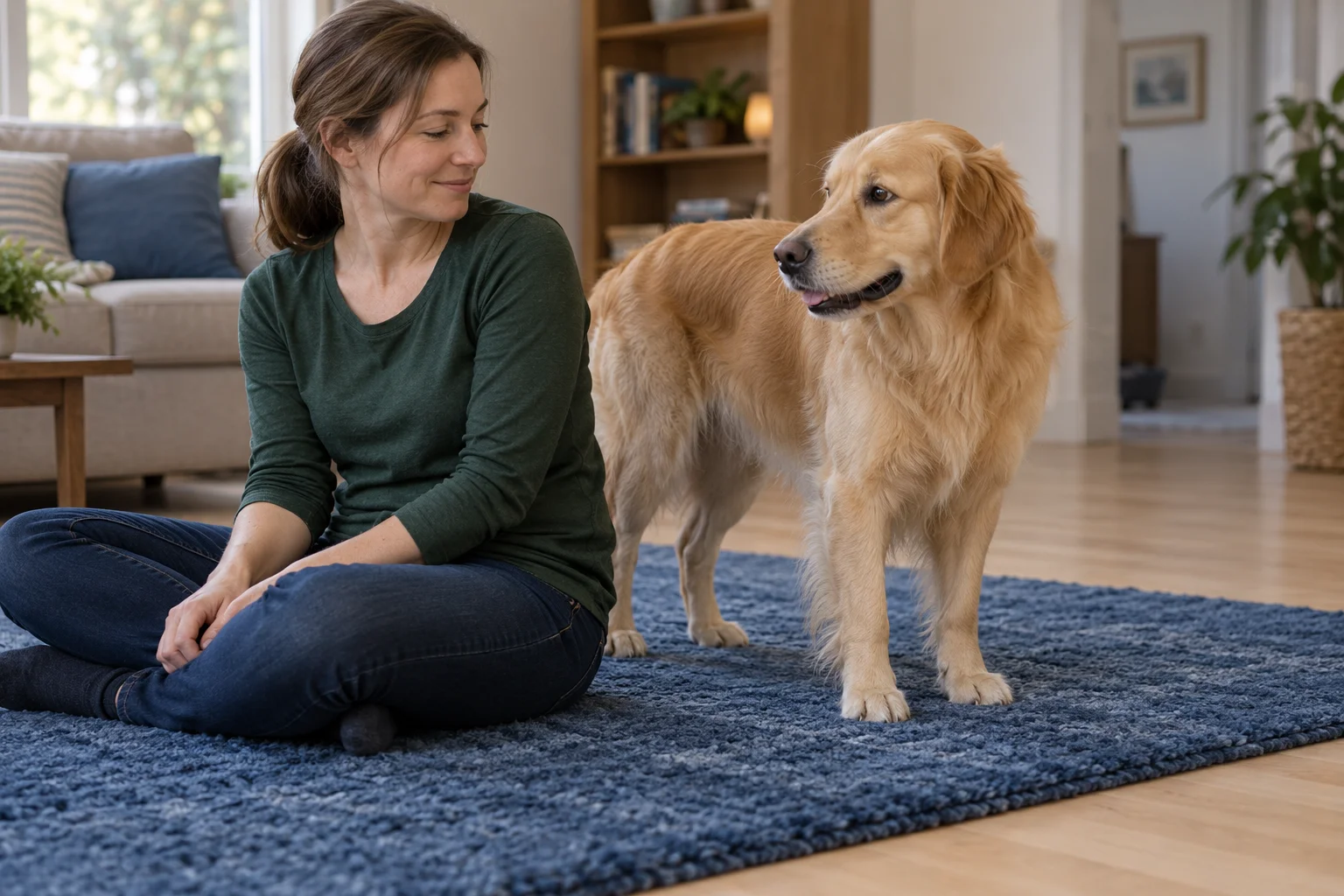
Not every dog is comfortable looking straight into a person's eyes. Battersea notes that a very nervous dog may be reluctant to hold eye contact.
If your dog seems uneasy, you can adapt the exercise:
- Reward a glance toward your face, rather than a direct stare.
- Reward your dog for looking at your chin, shoulder or hand. The goal is attention on you, not a staring contest.
- Keep your face soft and relaxed. Blink, smile and avoid leaning over your dog.
- Keep holds very short, and reward generously.
Never force your dog to look at you by holding their head or muzzle. That can make eye contact feel more uncomfortable, not less.
Some dogs are simply less comfortable with eye contact than others, and that's fine. What matters is that your dog can turn their attention to you when you ask, in a way that feels comfortable for them.
Use "watch me" in everyday life
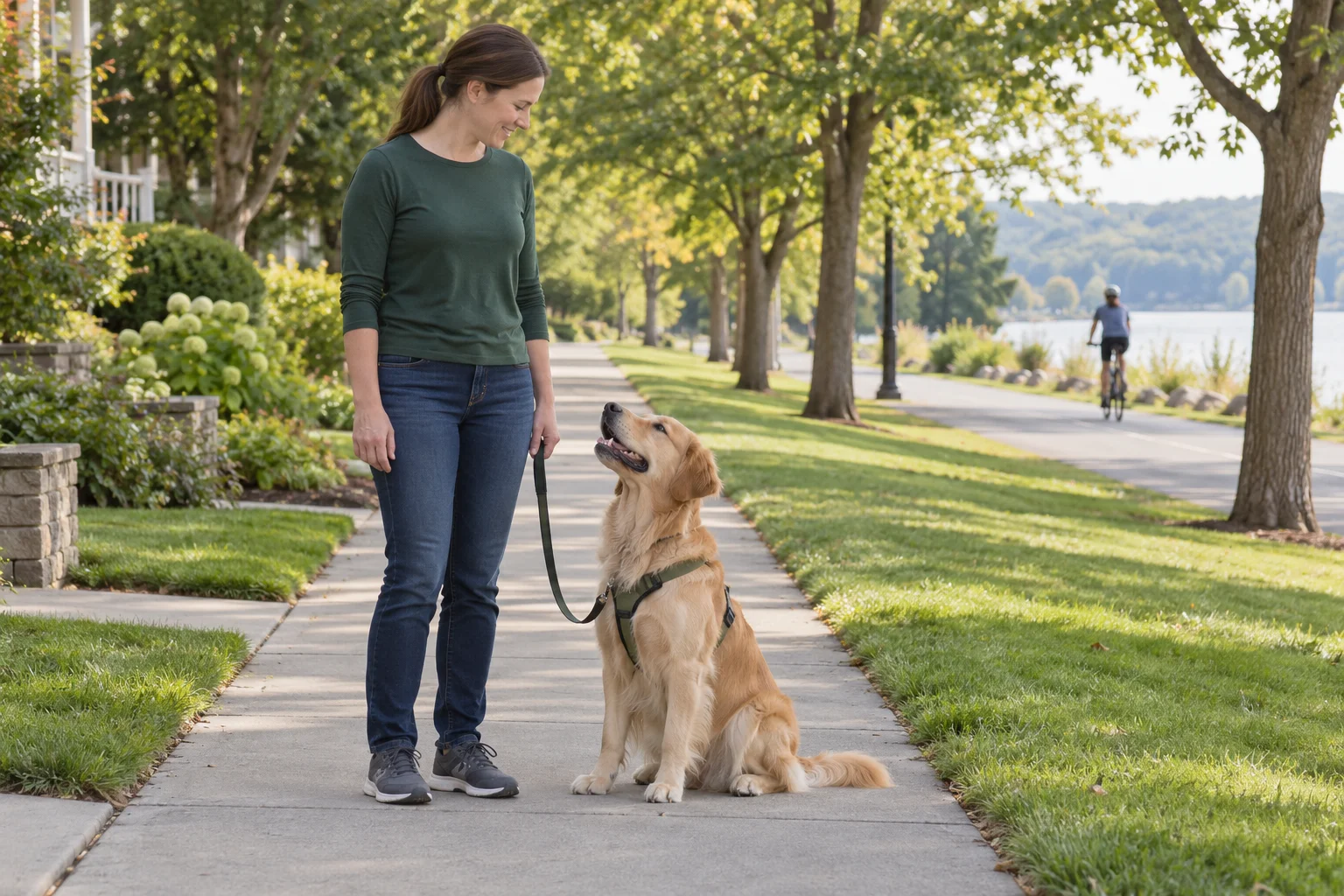
Once your dog knows "watch me" well, you can use it in many situations.
- Before giving another cue, so you know your dog is ready to listen.
- When something distracting passes, such as a jogger, cyclist or person carrying shopping bags.
- While waiting, for example at a crosswalk or outside a store.
- During training sessions, to get your dog's focus back between exercises.
- To reward check-ins. Even when you haven't asked, reward your dog for choosing to look at you on walks.
You can also reward with things other than food. After a good "watch me" on a walk, you might release your dog to sniff a patch of grass, greet a friendly person or carry on walking. These "life rewards" can be powerful, especially when your dog clearly wants to do something. Ask for a short "watch me" first, then use the release word to let them go and enjoy it.
"Watch me" isn't a fix for reactivity
"Watch me" can be one helpful tool for dogs who get excited or distracted by other dogs or people. But it isn't a complete plan for dogs who bark, lunge or seem frightened.
If your dog reacts strongly to other dogs, people or traffic:
- Keep a good distance from the things that upset them.
- Don't use "watch me" to make your dog face something they're scared of. A dog who is frightened needs more space, not more pressure.
- Get help from a qualified, reward-based professional, who can build a plan for your dog.
Our guide on what to do when your dog barks at other dogs on walks explains how to approach this more broadly.
A worked example: a dog who loses focus on walks
Here's an illustrative example. Adapt it to your own dog.
The pattern: A young adult dog knows sit and down at home but stops listening on walks, staring at squirrels and other dogs.
Begin indoors:
- Teach "watch me" indoors with a treat lure, a few minutes a day.
- Reward any glance at your face.
When the hand movement is familiar:
- Fade the lure, and add the verbal cue.
- Build up to two or three seconds of attention, using a release word.
When a brief hold is comfortable:
- Practice in the yard, then on a quiet street.
- Reward any check-ins your dog offers on walks.
When quiet outdoor practice is going well:
- Use "watch me" when a jogger or cyclist passes at a comfortable distance.
- Keep plenty of distance from squirrels and other dogs, and reward generously.
Move on when your dog responds readily and stays comfortable, not after a set number of days. If they stop responding, return to the last version they found easy. Progress may be uneven, especially around very exciting distractions.
A different dog, a different plan. Now imagine a shy rescue dog who turns their head away whenever their owner leans in to make eye contact. Here, the owner sits on the floor beside the dog rather than facing them, and rewards any glance toward their face, shoulder or hand. Holds stay very short, and the owner keeps their expression soft and relaxed. Over several weeks, the dog starts to look up more often on their own, especially when they know a treat might follow. The owner never pushes for a long stare.
What progress usually looks like
"Watch me" usually improves in layers. Your dog may master it in the living room within a few sessions, then seem to forget it completely in the park. That's normal.
Signs of progress include:
- Your dog looks up quickly when you say "watch me"
- They can hold their attention for a few seconds before your release word
- They respond in more places, not just at home
- They offer check-ins on walks without being asked
- They can look away from a mild distraction to look at you
It helps to keep a short note of where you practiced, how long your dog held their attention and what distractions were around. This shows you which situations your dog finds easy and which need more work, so you can plan the next session at the right level.
Troubleshoot common problems
My dog stares at the treat, not my face. Bring the treat to your face more slowly, and mark the moment their eyes shift to your face.
My dog looks away quickly. Shorten the hold, and reward sooner.
My dog won't look at me outdoors. Go back to quieter places and use better treats.
My dog seems uncomfortable with eye contact. Reward glances toward your chin, shoulder or hand instead.
My dog jumps up at my face. Keep the treat lower, perhaps at chest height, and reward calm looking.
My dog watches me but breaks off when I move. Your dog may be learning that you stand still during "watch me". Practice with small movements, such as shifting your weight or taking a single pace, and build up gradually.
My dog offers "watch me" constantly to get treats. That's a good problem to have. Reward check-ins sometimes, but only reward the full "watch me" when you've asked for it, and use your release word to end it.
Other people can't get my dog to watch them. Your dog has learned the skill with you. Teach other household members the same way, starting in a quiet room.
My dog looks at me but still pulls toward distractions. "Watch me" gives you a moment of focus, but it isn't a substitute for distance or leash skills. Keep more space from the distraction and reward generously.
When to get help
Many dogs learn "watch me" quickly with patient, reward-based practice. Some need extra support.
Look for a qualified, reward-based trainer or behavior professional if:
- Your dog barks, lunges or seems frightened around other dogs, people or traffic
- Your dog seems very anxious about eye contact or close attention
- You'd like help building focus in busy places
Talk to your vet if:
- Your dog suddenly seems less responsive, or seems not to see or hear you as well
Use reward-based help only. The American Veterinary Society of Animal Behavior states that evidence supports reward-based methods for all canine training (AVSAB: Why you need to reward your dog in training).
You can find more skills and games to try in our dog training guides.