
Before you start, rule out pain and warning signs. If your dog shows any sign of neck pain or new sensitivity, or growls, snaps or has bitten when handled, do not start this exercise. Read "Check for neck pain, new sensitivity or warning signs first" below and get the right help first.
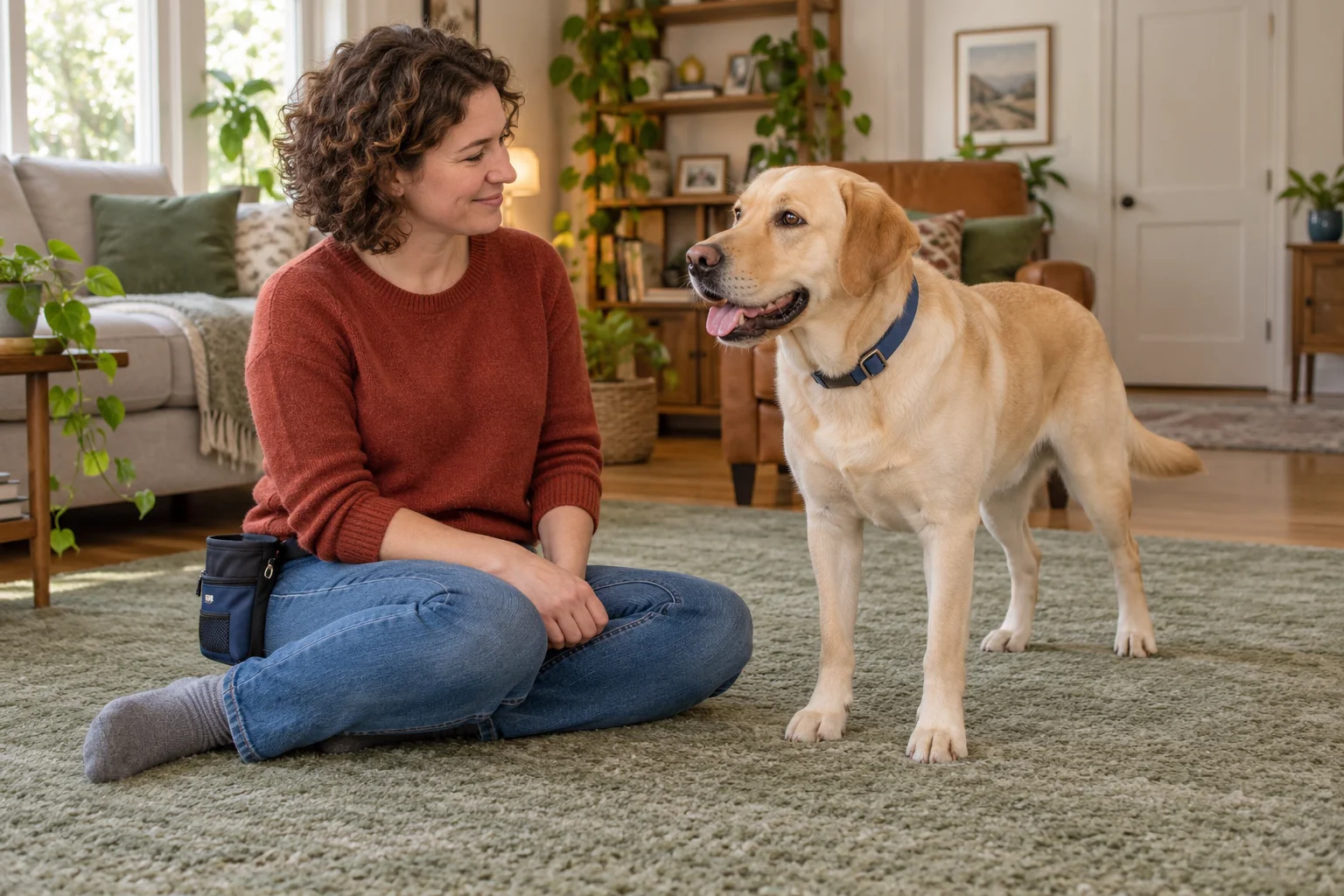
If none of those apply, start well before your hand touches the collar. In a quiet room with the doors closed, sit beside your dog with treats in a pouch. Move one hand a little way toward the side of their neck and keep it still. While that hand stays there, give a treat with your other hand, then take both hands away. Over many short sessions, bring the reaching hand closer, then touch the collar, then hold it gently for a second or two, giving treats while your hand is there.
Your dog must always be free to move away. If they pull back, let go at once and pause. This skill helps with everyday moments like clipping on a leash. It does not replace a leash, a gate, a recall or other safe management, and it never means pulling or dragging your dog by the collar.
Check for neck pain, new sensitivity or warning signs first
A dog whose neck hurts may duck, flinch or pull away when a hand reaches for their collar. Training will not fix that, and handling could make it worse.
Southeast Veterinary Neurology's guide to neck pain in dogs lists signs including:
- Carrying the head low when standing.
- A stiff neck, or reluctance to turn the head to the side.
- Yelping when touched, or whining for no obvious reason.
- Reluctance to jump on or off furniture, or to go up or down stairs.
- Reluctance to eat or drink from a bowl on the floor.
The practice advises seeing a veterinarian as soon as possible for neck pain. If you notice any of these, or your dog has recently started avoiding having their neck or collar touched, contact your vet before you practice. Wait for their advice before you start or resume.
Dogs Trust's guide to handling your dog notes that a dog in pain is more likely to show fear when handled, and advises speaking to your vet if your dog has an established fear of handling or shows aggression.
Some reactions call for professional help rather than a home exercise. If your dog growls, lifts a lip, snaps or has bitten when someone reaches for their collar or handles them, do not use this exercise. Avoid reaching for their collar for now, and use closed doors or gates to manage where your dog can go instead of taking hold of them. Talk to your vet, who can check for pain and refer you to a qualified, reward-based behavior professional. The guide to when to seek professional behavior help explains how to find the right person.
Keep this an adults-only exercise. Children should not practice reaching for or holding a dog's collar.
Use a gentle collar hold without pulling
Collar handling teaches your dog that a hand reaching toward their neck predicts something good. The finished skill is a dog who stays relaxed while you hold their collar gently for a moment.
That makes some daily tasks easier and calmer:
- Clipping a leash onto the collar.
- Checking that a collar fits, or reading a tag.
- Holding your dog briefly when they come to you.
It has limits, and they matter for safety:
- It does not replace a leash, a gate, a closed door or a recall. Keep using those wherever your dog could reach a road or another hazard.
- It is not a way to lead, pull or drag your dog. A brief hold means your hand rests in the collar with no pull on the neck.
- It does not mean your dog will accept a sudden grab when they are scared or excited. Do not test that on purpose.
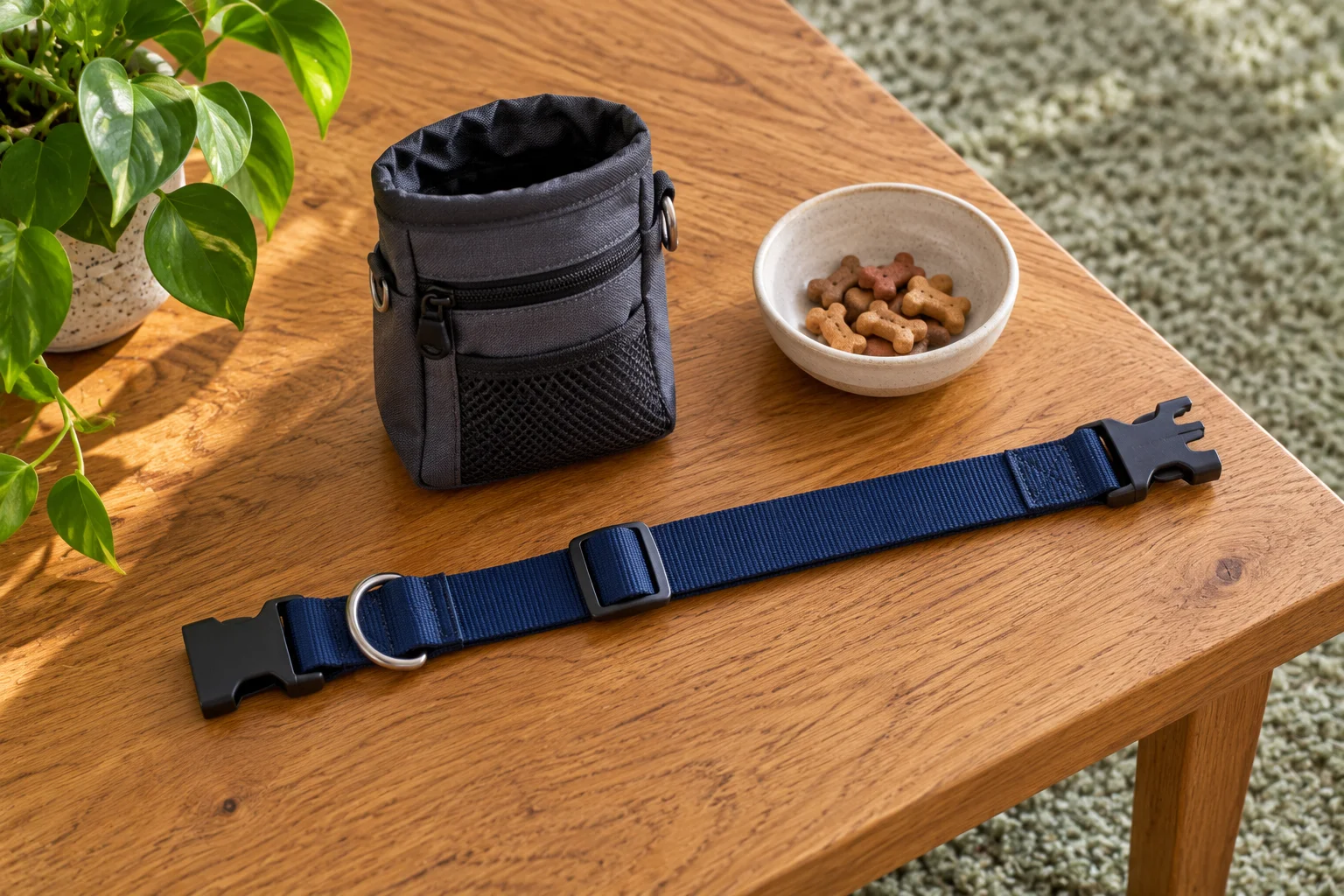
Use a comfortable, well-fitted flat collar. Do not practice with a slip, choke or prong collar.
If your dog already knows a chin rest, it can be a useful way for them to show they are ready, but you do not need one. The guide to teaching a chin rest explains that separate skill.
Stop when your dog moves away or stiffens
This method only works if your dog chooses to stay. Before you start, learn what "stop" looks like for your dog.
Watch for:
- Moving or leaning away from your hand.
- Ducking the head, turning the head toward your hand, or freezing.
- A quick lick of the nose or lips. Whole Dog Journal's guide to practicing collar grabs, by trainer Pat Miller, CBCC-KA, CPDT-KA, treats moving away or a nervous nose lick as a sign that your hand came too close or moved too fast.
- Stiffening, showing the whites of the eyes, or a tightly closed mouth.
If you see any of these, let go or take your hand away immediately. Take both hands back to your lap and pause. Do not follow your dog, block their way or keep holding until they stop pulling.
Then watch what your dog does. If they relax and come back to you on their own, try an easier version, with your hand farther from their neck than before. If they stay away or still look tense, end the session.
Food can make this harder to read. A dog may keep taking treats while feeling uneasy about your hand. Watch your dog's whole body, not just whether they eat. A relaxed dog has a loose body, soft face and eyes, and stays near you. A cooperative-care handout by veterinary technician Jessica Benoit, hosted on the American Veterinary Society of Animal Behavior website, advises against forcing interactions and says letting an animal opt in or out builds trust and reduces resistance.
Set up a quiet, secure practice spot
Choose a familiar room where your dog already relaxes, at a time when you are both calm. Dogs Trust recommends only practicing handling when you and your dog are both relaxed. Close the doors to the outside, and keep other pets in another room.
Do not practice at an open front door, near a road or anywhere your dog could get into trouble if they moved away. The point of these sessions is to make collar handling pleasant, not to test it in a risky moment.
Leave open space around your dog, so they can step away in any direction. Do not practice with your dog in a corner, against a wall or squeezed between you and furniture.
Set yourself up like this:
- Sit on the floor or on a low chair, side-on to your dog, about an arm's length away. The SPCA of Texas handout on teaching the collar grab suggests sitting or standing sideways, about two feet (60 centimeters) from your dog.
- Put small, soft treats in a pouch on the hip farther from your dog.
- Decide which hand does what. The hand nearer your dog's neck is your reaching hand. Your other hand takes treats from the pouch and gives them.
- Give each treat right at your dog's mouth, so they don't need to move away from your reaching hand to eat it. If your dog grabs food roughly, the guide to teaching your dog to take treats gently has safer ways to deliver it.
Keep sessions short. The SPCA of Texas handout suggests no more than about five minutes at a time.
Reach toward the collar, then give a treat
In this first stage, your hand does not touch your dog. You are teaching them that a hand moving toward their neck means a treat is coming.
Rest both hands in your lap. Then:
- Move your reaching hand a short way toward the side of your dog's neck, from below or the side, not over the top of their head. Stop and keep it still.
- While the reaching hand stays still, give a treat with your other hand.
- Take both hands back to your lap at the same time.
- Pause for a moment, then repeat.
Whole Dog Journal describes this same pattern: one hand reaches, the other hand treats, then both hands are removed. The order matters. Your hand moves first, then the treat arrives. When your reaching hand leaves, the treats stop.
Watch for one change. After a few repetitions, your dog may start looking at your treat hand as soon as the reaching hand moves. Pat Miller describes this as a sign that the reach now predicts food. That, together with a loose body and staying near you, tells you the reach is going well.
Bring your hand closer one stage at a time
Once your dog looks for the treat as soon as your reaching hand moves, and stays relaxed, reach a little closer to their neck on the next few tries.
Keep the same order every time: reach, hold your hand still, treat with your other hand, take both hands away.
Once your dog reliably looks for the treat at the current distance and stays loose, reach a little closer. If that response becomes patchy, return to the previous distance. Use your dog's response as your guide rather than a ruler.
If your dog leans away, licks their lips or stops looking for the treat, take your hand away and pause. If they relax and return voluntarily, try a shorter, slower reach, as Whole Dog Journal advises. If they stay away or still look tense, end the session.
Touch the collar with one finger
When your hand can rest a few inches from your dog's neck and they stay relaxed and look for the treat, you are ready for contact.
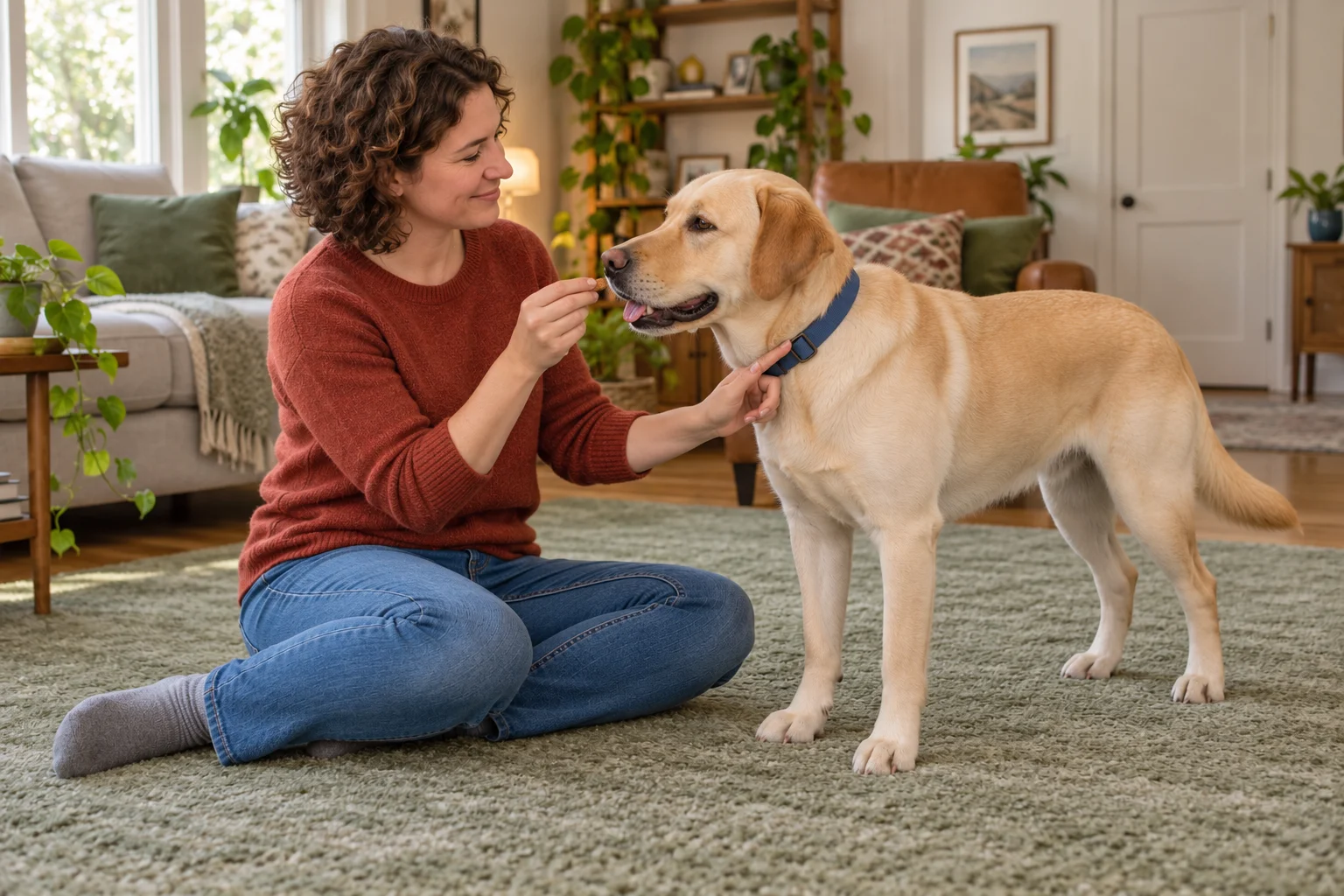
Reach toward the side of the neck as before. Lightly touch the outside of the collar with one finger. While your finger is there, give a treat with your other hand. Then take your finger away. The SPCA of Texas handout advises that the treats stop the moment your hand leaves the collar.
Build up slowly over several sessions:
- One finger touching the outside of the collar.
- Two fingers resting on the collar.
- One or two fingers slipped loosely under the collar, with no pulling at all.
Give treats while your fingers are on the collar, and stop as soon as you take your hand away. Keep each touch short at first, about a second.
The SPCA of Texas handout describes a dog who is ready to move on as having a relaxed face, an eager approach and taking the treat without bolting.
Build up to a brief, gentle hold
A brief hold means your fingers rest loosely under the collar and your hand curls gently around it, with no pull or pressure on your dog's neck.
Start with a hold of about one second. While your hand is there, give a treat. Then let go, and the treats stop. The SPCA of Texas handout builds up the hold from one second to about four, one second at a time, moving on only after a relaxed response at the current length. Treat those numbers as an example, not a target your dog has to hit.
During a longer hold, give a small treat about every second while your hand is there, then let go.
Keep these rules for every hold:
- Never pull or apply pressure on the collar. Your hand rests; it does not lead or drag.
- If your dog pulls back, let go at once, take both hands back and pause, as described in "Stop when your dog moves away or stiffens."
- Do not hold on until your dog stops struggling.
Your dog is ready for a slightly longer hold when they stay loose and keep looking for the treat through the current one. If they start to fidget or lean away, release the collar immediately and pause. Offer a shorter hold only if they relax and return voluntarily; otherwise, end the session.
Practice leash clipping with the outside door closed
A relaxed hold on the living-room rug is a good start, but the moments you need it, like clipping on a leash before a walk, are usually more exciting.
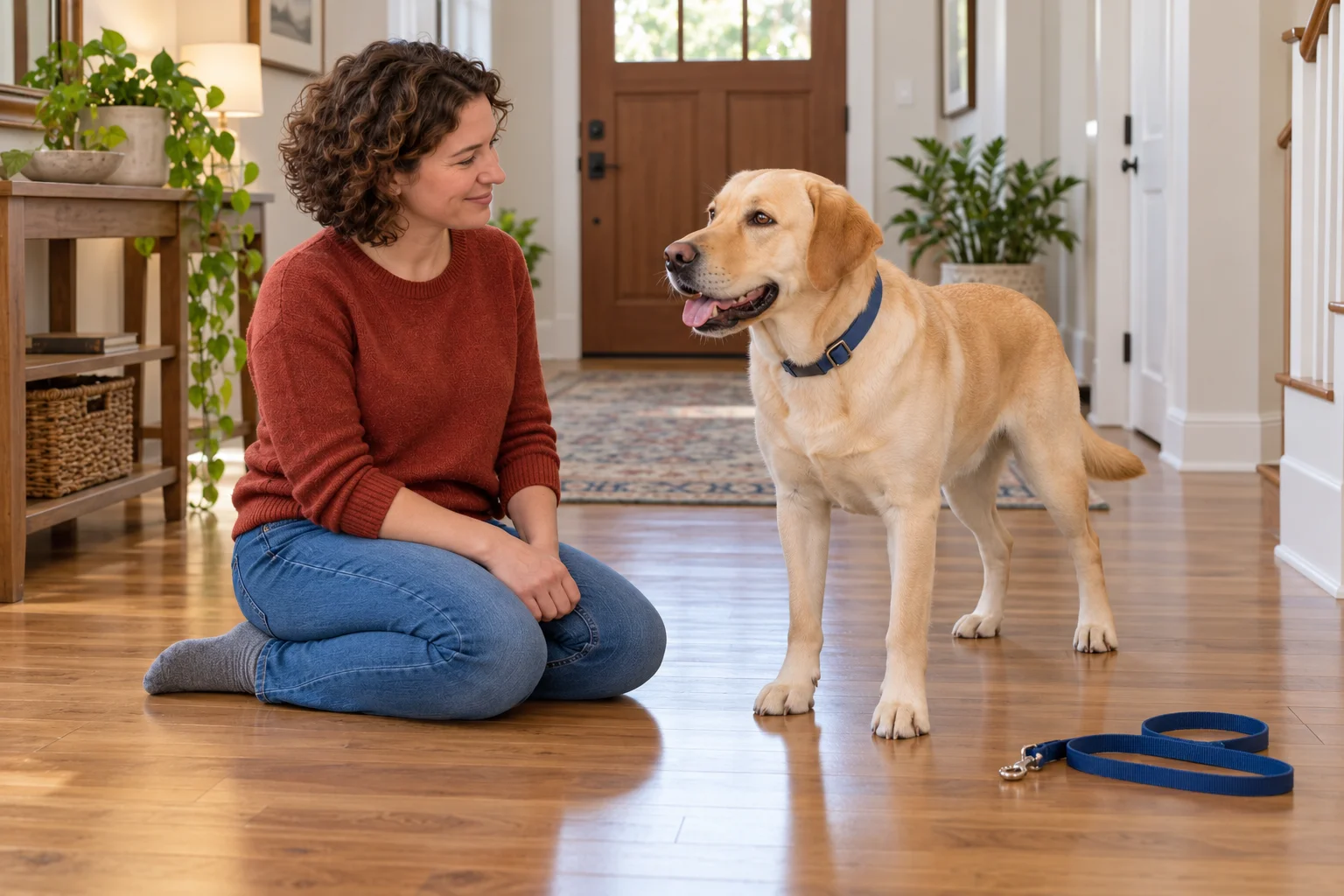
Rehearse those moments briefly, still with the outside door closed. For example, practice a one-second hold in the hallway while your leash rests on the floor nearby. Once that is easy, hold the collar, clip the leash on, give a treat and unclip it, with no walk afterward. Success looks like your dog staying loose and looking for the treat while you handle the leash. If your dog bounces, spins or ducks away, release the collar, take your hands back and pause. Resume easier practice in the familiar room only if they relax and choose to continue; otherwise, end the session.
When the leash is clipped on for a real walk, keep using treats for a while. Clipping the leash on calmly is part of this skill, not a separate program.
Other people in the household can learn the same exercise. Whole Dog Journal suggests that each new person start from the first stage with the hand moving toward the collar. Children should not take part.
If your dog comes to you when called, a brief, gentle hold can follow, but only once it is easy at home. The guide to teaching your dog to come when called covers recall itself.
Fix common collar-handling problems
Your dog ducks as your hand gets close
Your hand may be coming from above or moving too quickly. Take it away and pause. If your dog relaxes and returns voluntarily, reach from below or the side, more slowly, stopping at the last distance where they stayed relaxed. If they stay away or look tense, end the session.
For example, an adult dog stays loose while his owner's hand is a few inches from his neck, but ducks his head when her finger touches the collar. She takes her hand away and pauses. If he relaxes and comes back on his own, she offers the easier reach without touching him. If he stays away or looks tense, she finishes. She tries a brief fingertip touch only once he consistently stays loose and looks for the treat during the closer reach.
Your dog takes the treat and then moves away
Your dog may be eating while feeling uneasy. Take your hand away and pause as soon as they move away. Do not follow them or use food to bring them back. Only if they relax and return voluntarily should you offer a shorter touch or hold, delivering the treat right at their mouth while your hand is on the collar. If they stay away, look tense or move away again, end the session.
Your dog mouths or paws at your hand
Your dog may be excited or unsure. Use a calmer time of day, a lower-value treat and a slower reach. If mouthing comes with stiffening or growling, stop and follow the advice at the start of this guide.
Your dog pushes into your hand before you reach
Some dogs learn the game quickly and start leaning in or nudging your hand. That is a good sign, as long as their body is loose. Keep the order the same: your reaching hand moves first, and the treat follows. If your dog is so keen that they bump your hand hard or jump up, pause with both hands in your lap until they settle, then use a slower, shorter reach.
Your dog wears a harness for walks
If you clip the leash to a harness, this skill is still useful for checking the collar and tag, and for brief holds at home. Putting on a harness involves different handling around the head and legs, so treat it as a separate task and introduce it just as gradually.
Your dog is fine with you but not with another person
Each person should start from the hand approaching, not the hold. Make sure everyone reaches from below or the side and gives treats while their hand is near or on the collar.
Your dog is relaxed at home but not before walks
Excitement makes handling harder. Practice the hallway rehearsal with the leash nearby but no walk, and keep real leash clipping very short and well rewarded.
Plan your next session
For your next session, start at the easiest stage your dog accepts comfortably today.
If your dog leans away, take your hand away and pause. Only if they relax and return voluntarily should you try a more distant reach, with fewer repetitions. If they stay away or look tense, finish the session. If a reach close to the collar is easy, try a one-second touch with one finger. If a touch is easy, try two fingers loosely under the collar for one second. If a short hold is easy in the living room, rehearse it in the hallway with the outside door closed and the leash nearby. Stop at any sign of discomfort, and contact your vet if your dog's neck seems sore.