
Rain can change the shape of your dog's day. An indoor activity should match what they seem ready for and what you can safely supervise. It can offer a useful outlet when weather limits the usual routine, but it cannot promise calm or replace suitable outdoor movement, a health check or individual behaviour support.
A useful activity fits your dog, your room and the time you can genuinely supervise. A dog who becomes happily absorbed in finding scattered food may need something very different from a dog who becomes noisier and more frustrated around it.
Start with the dog you have in the room today
Before setting anything up, take a quick look at your dog rather than at a list of activities. Are they hovering around you, seeking food, carrying a toy, looking out of the window, pacing, or already half asleep? Have they had an opportunity to toilet, drink and rest? A restless dog may be asking for a simple need before they are ready for a game.
Then consider the household constraint. You may have ten quiet minutes beside your dog, a video call in the next room, muddy children arriving home, a sleeping baby, or another dog who will race in if food appears. The constraint is not an obstacle to ignore. It tells you which kind of enrichment is fair today.
Dogs Trust describes reward-based training as giving a dog something they want when they make a choice you like. It also notes that dogs value different things, including food, toys and attention. Its positive-reinforcement guidance is useful here because it keeps the question individual: what does this dog actually enjoy in this setting?
Dogs Trust's enrichment guidance also recommends considering the individual dog's preferences and watching for signs that an activity is confusing or frustrating.
A food search may suit a dog who is interested in sniffing and can work quietly. A chew may suit a dog who is already ready to lie down. A brief movement game may be better for a dog who has been staring at the door and needs a safe change of scene. Quiet observation may be enough when the household needs lower stimulation, or when your dog has already had plenty to process.
Do not make the activity carry a bigger job than it can do. If your dog is frightened, guarding, panicking, in pain or persistently unable to settle, a homemade game is not an assessment or treatment plan. PDSA advises contacting your vet if your dog's behaviour changes suddenly.
Choose the kind of outlet before you make it difficult
Indoor enrichment usually falls into a few useful groups. Sniffing and food-search let the dog use their nose. Chewing gives some dogs a quiet, sustained occupation. Problem-solving asks them to work out how to access something. Gentle movement gives the body a short, controlled outlet. Quiet observation lets the dog watch a low-key part of household life without being asked to perform.
These categories can overlap, but they do not do the same job for every dog. Start with the one that best matches the behaviour you are seeing, then keep the setup easy enough that your dog can understand it. If it goes well, you can offer it again another day. You do not need to build a more elaborate version immediately.
Useful engagement usually looks like a dog choosing to investigate, making progress, taking pauses and returning to the activity without becoming stuck. The dog may be alert, but their body is not escalating into frantic effort. They can disengage when the activity ends and eventually choose another ordinary behaviour, such as drinking, changing rooms or resting.
A harder puzzle can still be a poor fit. Hiding food where a dog cannot reach it, sealing it inside several layers of packaging, or making them repeat failed attempts can create a task with lots of effort and little useful information. If you have to keep showing the dog the answer, make the setup simpler.
A simple question helps: can your dog succeed without becoming more wound up? If the answer is no, make the next version easier or choose another category.
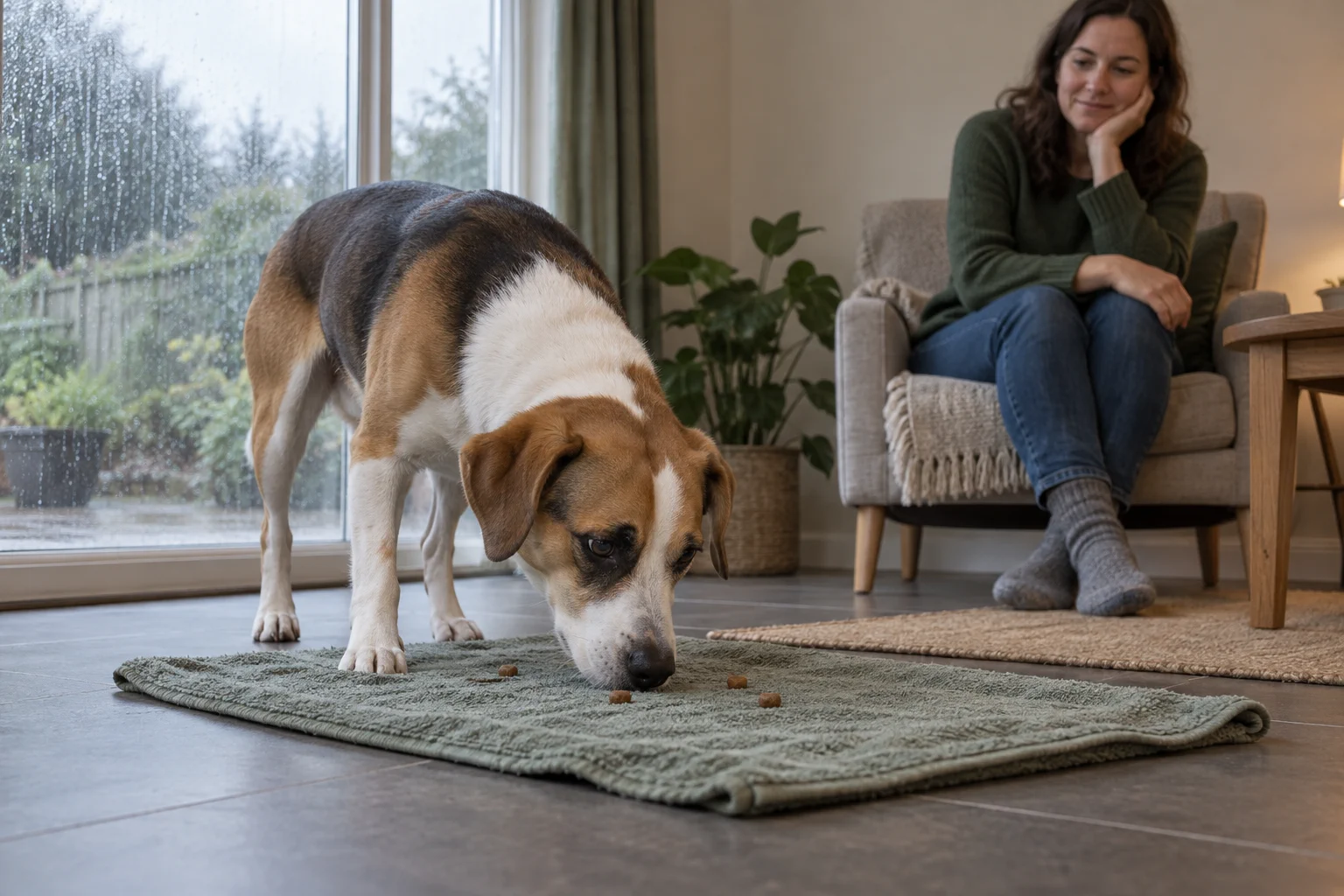
Use sniffing when your dog needs a quiet job
Sniffing is often a practical rainy-day option because it can happen in a small space and does not require you to turn the sitting room into an obstacle course. It is especially handy when you need something low-key while you make a drink, answer an email or sit nearby.
Begin with an obvious food search. Scatter part of your dog’s usual meal across a clean, dry towel laid flat on the floor, or place a few pieces in an open cardboard box with several pieces of loosely crumpled paper. Dogs Trust includes foraging for treats in a cardboard box among examples of things a dog may find rewarding. Keep the first version open enough that your dog can see and smell what is available.
You can also place a few pieces of familiar food around one clear area of a room while your dog waits behind a door or with another adult. Use open floor space away from cables, children’s toys and furniture gaps. A clear living-room corner with doors closed and the bin out of reach is often easiest to supervise.
Keep paper, cardboard and fabric only if your dog handles them safely. Some dogs shred without swallowing; others tear and ingest material quickly. If your dog eats non-food items, do not use a cardboard box, towel folds or paper. Choose an open scatter on a washable surface instead, or skip food searches until you have a safer option.
A food search can be brief. When the food is gone, pick up the materials, check the area and give your dog a quiet pause. What they choose next tells you more than a timer: do they move on to an ordinary activity, or demand another round with mounting intensity?
Offer chewing only when you can supervise the item
Chewing can suit a dog who is already capable of lying down near you and who benefits from an occupation that does not require a lot of movement. It can be useful during a family film, while you prepare food, or when you want to protect a quiet period after a walk.
The safety question comes first. Use only an item you know is appropriate for your own dog, and supervise while it is available. Check it regularly for pieces that are breaking off, becoming small enough to swallow, or causing the dog to gulp. Do not assume that a product sold for dogs is automatically safe for every chewer.
A low-cost option may be part of your dog’s usual meal offered in a safe, familiar format. If you use food, account for it within the day’s food rather than treating it as extra. Dogs Trust advises reducing meals when food is used for training to help prevent weight gain. Avoid unfamiliar human foods or anything you are not sure your dog tolerates.
The location should protect the dog from interruption. Give the item on a bed, behind a gate, or in a separate quiet room if people are likely to walk through. Do not hand a valued chew to a dog beside another dog and hope they will share the space politely. Food and chews can create pressure even between dogs who normally get along.
Chewing is not a way to keep a dog in a difficult situation. Do not use it to hold them near visitors, loud household activity or something that makes them uneasy. If your dog keeps lifting their head, freezing, carrying the item away, or watching another dog approach, the setup is not restful. Give them more distance and a protected place instead.
When the chew ends, remove any remaining small pieces if needed and watch the transition. A dog who stretches out, changes position and rests has told you that the activity fitted the moment. A dog who rushes around searching, vocalises or starts pestering another dog may need a shorter, simpler occupation next time, or a different outlet entirely.
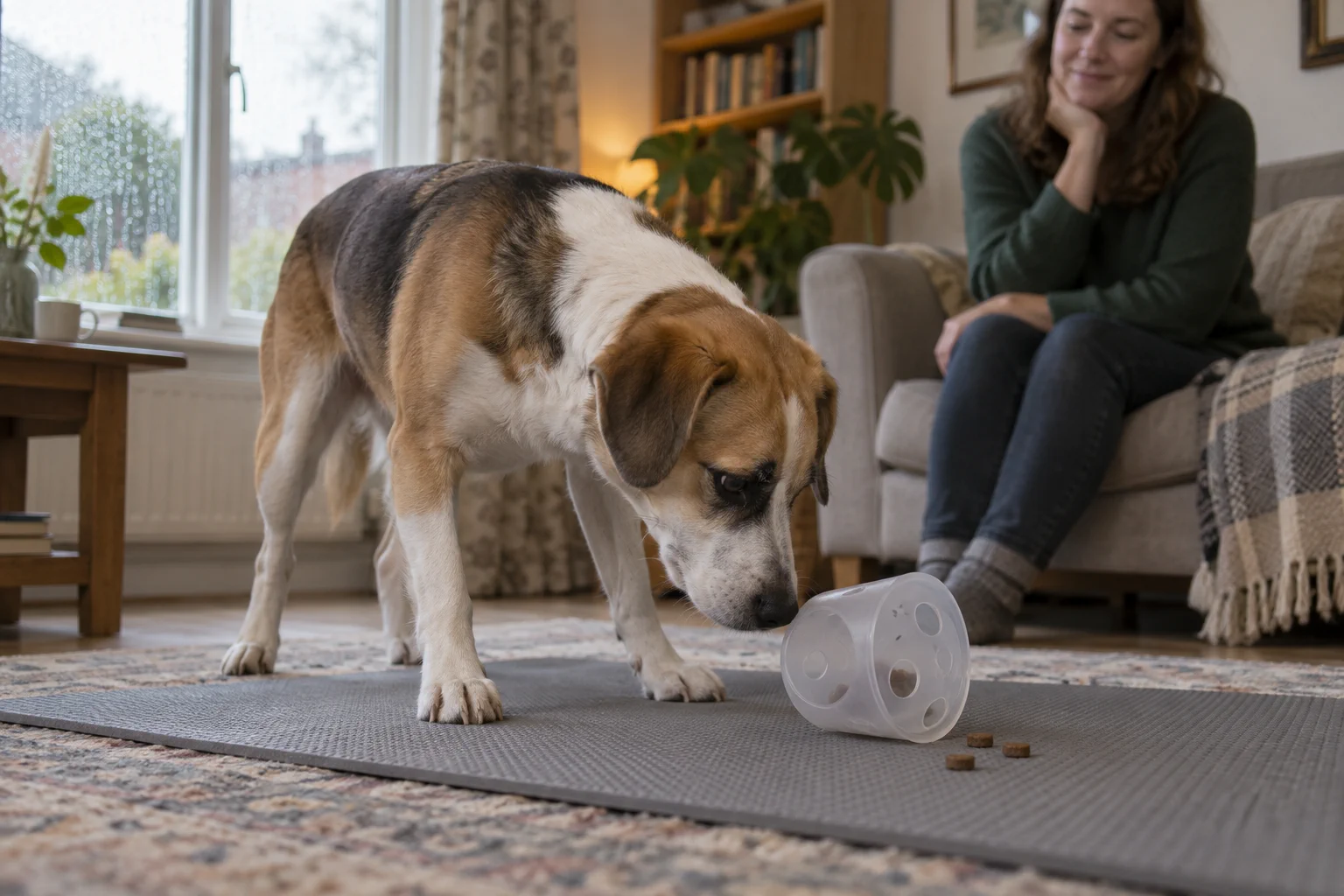
Let problem-solving stay solvable
Problem-solving can be enjoyable when the dog can work out the answer. It can also become frustrating when the task is beyond them, the item slides away, or the reward is inaccessible. Choose a clear puzzle with a reasonable chance of success.
Start with a simple choice. Put a few pieces of food in one or two open cups on the floor, then let your dog investigate. Or place food under one lightweight, upside-down plastic container that is easy for the dog to nudge. Stay nearby so you can prevent chewing or swallowing the container. An AVSAB-hosted guide to food puzzle toys recommends making a new puzzle easy at first and raising the difficulty gradually.
For a dog who understands that version, you might place an empty box over the food with a wide opening cut in the side, provided the cardboard is safe for that dog and cannot be eaten. The solution should be visible in the dog’s actions: sniff, nudge, paw, find food, pause.
Do not add layers merely because your dog solved the first version quickly. A dog may enjoy easy success and not need a more complicated puzzle. If you change anything, alter one part only, such as placing the cup a little farther apart or partly covering one opening. That lets you see whether the dog is still engaged rather than simply overwhelmed.
Signs of a poor fit include repeated hard pawing with no progress, biting the object rather than investigating it, sharp vocalising, throwing the item around, staring at you for rescue, or walking away and returning in an agitated loop. These signs tell you about the difficulty of this setup, not your dog's intelligence or character.
End before you see that pattern build. Make the next version easier, return to a food search, or offer a quiet break.
Keep movement gentle, clear and safe indoors
Rain does not mean your dog should be motionless, but indoor movement needs more care than outdoor walking. Slippery floors, furniture corners, stairs, children and low ceilings make high-speed games a poor trade. The goal is a brief, controlled change of activity, not indoor sprinting.
Use a clear strip of non-slip floor or a rug that does not slide. Scatter a few pieces of food from one end to the other, or invite your dog to follow you calmly from room to room for a short treasure hunt. Keep turns broad and avoid throwing toys down corridors, bouncing balls off walls or encouraging leaps onto furniture.
A dog who already knows easy, reward-based cues may enjoy moving between them in a quiet room. You might reward a hand touch, a turn towards you, or walking with you to a bed. Stop before excitement turns into skidding, jumping or frantic grabbing at your hands.
Movement can be the wrong choice if your dog is already overexcited. It can also be unsuitable for a dog with pain, stiffness, an injury, post-operative restrictions, or a change in how they move. When in doubt, choose a calmer activity and ask your vet what is appropriate for your dog.
If you want to build an indoor routine around voluntary resting after a brief activity, use the separate guide to teaching your dog to settle on a mat. That article explains the skill itself. Here, the point is to avoid treating movement as something that must always be followed by more stimulation.
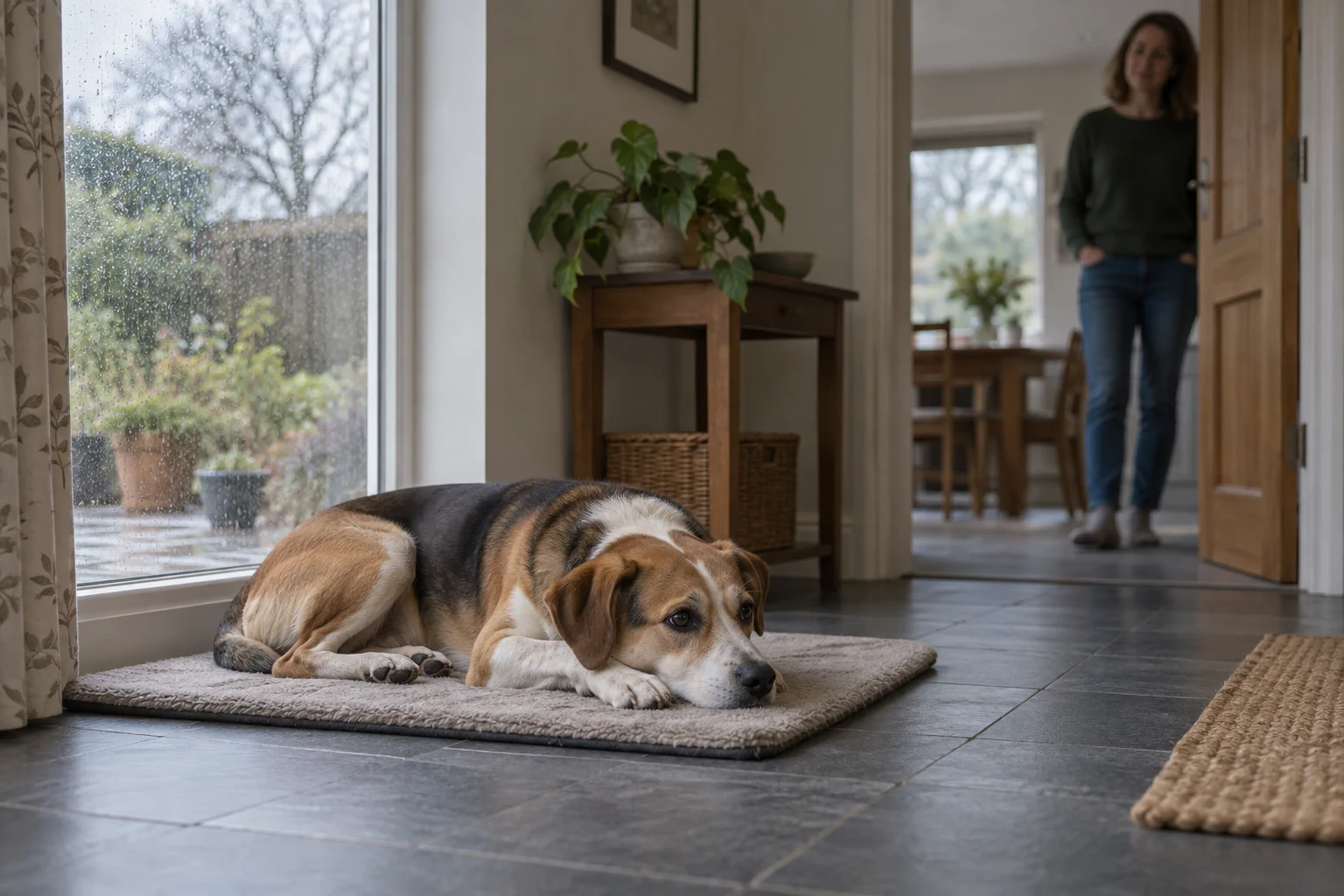
Make quiet observation a real option, not a failure
Not every rainy-day period needs an activity. Some dogs benefit from a calm place where they can watch ordinary life at a comfortable distance. A bed beside you while you read, a clear view of a quiet garden, or a spot behind a gate while you cook can be enough when the dog is already settled.
Observation works only if the view is manageable. A dog who watches the pavement and erupts at every person, dog or delivery is not having a peaceful pastime. Close the blind, move the bed away from the window, or choose a room with fewer triggers. These management choices reduce the dog's exposure to triggers while you decide whether individual help is needed.
You can quietly reward a dog for choosing a soft, calm posture without making a ceremony of it. Dogs Trust notes that calm speech, a gentle fuss or a stroke may reward quiet behaviour without making the dog more excited. Keep your own movements slow and see whether attention helps your dog remain comfortable. Some dogs will prefer to be left alone once they have settled.
A quiet observation period is not an excuse to leave a dog confined, ignored or unable to move away. They should have water, a comfortable place to lie down and the choice to change position. If your dog repeatedly gets up to follow you, try putting their resting place closer to where you are rather than insisting that they stay put.
This is also where the distinction between management and training is useful. Closing a blind or using a gate can prevent repeated rehearsals of barking or rushing. It does not solve every reason a dog reacts. Our guide to dog management and training explains how environmental support can create a safer, easier situation while you decide whether further help is needed.
Set up rooms so everyone can relax around the activity
A good enrichment setup begins before the food or toy appears. Remove the bin, laundry, children’s small toys and anything your dog is likely to steal. Clear cables from floor level and choose a surface you can clean. These choices let you supervise rather than spend the whole time saying no.
Give the dog an obvious work area. A washable mat, an open section of floor or a bed can show where the activity belongs without trapping them there. Leave a route away from the activity so the dog is not hemmed between furniture and a person. If the dog chooses to leave, let that choice give you information.
In a busy household, timing is often more valuable than a special product. Set up a food search while other dogs are behind a closed door. Offer a chew after children have finished running through the room. Put away a puzzle before a visitor arrives. You are not trying to teach a dog to tolerate every interruption. You are making a short period predictable enough to be useful.
For multiple dogs, separate them whenever food, chews, toys or close competition might matter. Use separate rooms, solid barriers or a routine where one dog has an activity while another rests elsewhere. Avoid relying on verbal reminders once each dog is already focused on a resource. Prevention is kinder and safer than trying to manage tension after it starts.
If one dog finishes first, do not allow them to hover over the other dog’s activity. Call them away with a familiar reward, guide them behind a barrier, or end both activities before that pressure develops. Give each dog enough space to engage without needing to share or negotiate over an item.
Learn from the signs that the activity is too much
Enrichment should not require your dog to be perfectly quiet. Sniffing, chewing and investigating naturally involve movement and concentration. What matters is the direction of change. Are they becoming more settled after the activity, or more frantic as it continues?
Watch for physical signs in context. Repeated barking at the item, sharp whining, frantic digging, hard staring, grabbing at your hands, racing between you and the activity, or being unable to move away can suggest that the activity is producing frustration or too much arousal. So can a dog who keeps returning but cannot make progress.
There is no need to correct those signs. End the activity calmly. Pick up loose materials, give the dog space and choose an easier option later. If food has been scattered, help them find any remaining pieces rather than leaving them to hunt endlessly around the room.
Also watch the social picture. Freezing over a chew, rushing to finish, blocking another dog, or carrying food away from you can mean the location is too exposed. The answer is usually more separation and less pressure, not asking the dog to share or proving that they can cope.
A dog who declines an activity has also given you useful information. They may not be hungry, may be tired, may prefer another reward, or may find the room too distracting. Do not keep presenting the same item until they take it. Offer ordinary rest and try a different category at another time.
AVSAB’s current position is that dog training and behaviour modification should use reward-based methods, and that aversives should not be used. Its position-statements page sets that boundary clearly. It applies here too: if an indoor game is not working, change the environment or make the task easier. Do not add pressure, intimidation or punishment.
Check what happens after the activity, not just during it
The most useful part of a rainy-day routine may happen after the food is gone or the game ends. Give your dog a short, ordinary pause in the same room. Put away the equipment, reduce your own movement and notice what they choose next.
You are not measuring whether the dog falls asleep on command. Look for patterns over several occasions. Perhaps after a food search your dog drinks, stretches and lies on their bed. Perhaps after a puzzle they pace, paw at the cupboard and demand another one.
Make a tiny note if it helps: activity, room, other dogs present, and what your dog did afterwards. Keep it descriptive rather than emotional. “Scattered part of lunch on a towel in the kitchen, door closed, lay down nearby afterwards” tells you more than “loved it”. Our guide to a useful dog behaviour diary can help if you want a simple way to notice patterns without counting perfect days.
Use the note to choose tomorrow’s version. If a food search led to a calmer transition, repeat that easy setup. If it made your dog frantic, reduce the amount, simplify the search, change the room or select chewing or quiet observation instead. A calmer home routine is built from these small adjustments, not from constantly raising the challenge.
Do not use the result as a diagnosis. A dog who does not settle after one activity has not proved that they have anxiety, stubbornness or excess energy. Look at the wider day: weather, sleep, visitors, health, outdoor opportunities and any change from their normal pattern all matter.
Build a rainy-day menu that fits real life
You do not need a cupboard full of gadgets. Keep one safe food-search option, one supervised chew or food activity your dog already handles well, one low-key movement idea, and one reliable resting place.
On a quiet working morning, an open food search in a clear room may be enough. On an afternoon when the dog is already settled, a protected chew near you may fit better. When the household has been inactive for a while, a gentle treasure hunt through two safe rooms may offer a change without indoor chaos. When everyone is tired, a bed away from the busy window may be the best enrichment available.
Rotate options because your dog’s response can change with the day. You do not have to make every option more difficult. Repeating an easy, successful activity is often more useful than inventing a challenge your dog cannot solve.
Keep outdoor needs in the picture when weather allows. Indoor enrichment can support a disrupted day, but it is not a substitute for suitable walks, toileting opportunities, fresh air, exploration and the individual movement your dog normally needs. If weather repeatedly prevents outings, adjust expectations, seek safe weather windows where possible and use indoor activities as support rather than a replacement.
Start with one small activity that fits your dog and the room. Watch what happens afterwards, then repeat it another day or leave it there.