
To teach your dog to stand on cue, start when they are already sitting or lying down comfortably on a non-slip rug, with you kneeling or standing in front of them. Hold a small treat at their nose. Move it slowly toward you, keeping it close to their nose. Stop moving your hand as they begin to rise, then keep it still while they finish getting up onto all four feet. The moment they are standing, say "yes" and give them the treat at their nose, before they take a step toward you.
Add the word "stand" only after your dog gets up easily when you make the same movement with an empty hand. Stop if getting up looks stiff, slow or painful, and talk to your vet before you practice again.
A stand on cue means your dog gets up onto four feet when asked. It does not mean they will hold still for long, and it does not teach them to accept brushing, toweling or a veterinary exam. Those are separate skills, covered later in this guide.
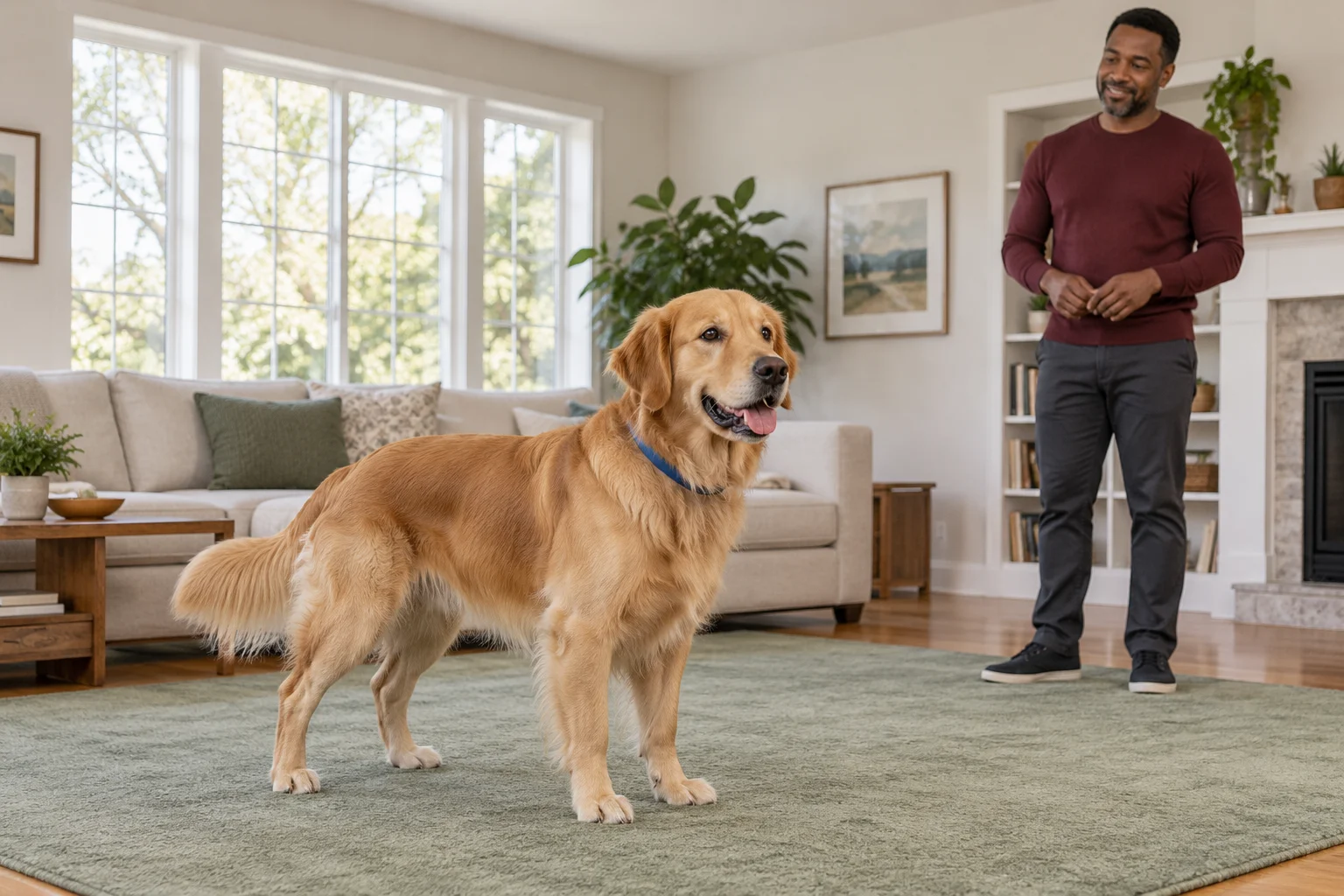
What counts as a stand
For this exercise, a stand means all four of your dog's feet are on the floor and their body is off the ground. Your dog does not need to stand square or perfectly still, and their usual relaxed stance is fine. Getting up from a sit or a down into that stance is the whole behavior. A stance that is new or unusual for your dog is different; the section on signs that getting up may hurt describes what to watch for.
A few words come up throughout:
- A lure is a treat held at your dog's nose to guide their movement. Their body follows their nose.
- A marker is a short word, such as "yes," that tells your dog the exact moment they got it right. In this guide, every time you say "yes," a treat follows. If you already use a clicker, the click can take the place of "yes."
- A cue is the signal that asks for the behavior. By the end, you will have a hand signal and the word "stand."
If marker words are new to you, the guide to reward marker timing explains how to pair one with food.
Keep the limits of this skill in mind. Holding a stand for longer, until you release your dog, is duration, and it belongs to the guide to teaching the stay command. Accepting touch is a different skill again. A dog who stands nicely on cue may still pull away, wriggle or worry the moment a brush or a hand reaches them. The guide to teaching a chin rest for cooperative care covers a way to let your dog opt in to gentle handling, and the guide to introducing gentle handling to your puppy covers short, rewarded handling practice for young dogs.
Start from a sit or down your dog finds comfortable
Battersea's guide to teaching a stand starts from a sit or a lie down. Either works. Use whichever position your dog chooses easily and holds comfortably.
You do not need to ask for a sit or down every time. Many dogs sit or lie down near you on their own during the day. Those moments are perfect starting points. If your dog already knows a sit or down cue and settles into it easily, you can use that too.
Do not push your dog into a sit or down to set up the exercise, and do not ask for a position your dog avoids. Some dogs find sitting awkward, and some find lying down on a hard floor unpleasant. If a starting position looks uncomfortable, leave it out.
Before you begin, watch how your dog gets up during the day. If they groan, seem slow or stiff, tremble, or pull themselves up with their front legs, getting up may hurt. Talk to your vet before you train a stand. Practicing a stand is not a gentler option for a dog who finds a sit or down uncomfortable, because every repetition asks your dog to get up. The section on signs that getting up may hurt explains what to look for.
Set up a quiet, non-slip practice spot
Choose a familiar room where your dog is relaxed. Close the doors so other pets and family members are not wandering through, and so your dog cannot slip out. You do not need a leash; your dog should be free to walk away.
Put down a rug or a non-slip mat for your dog to practice on. Getting up on a slippery floor is harder, and a mat also gives your dog a clear spot to stand on. Preventive Vet's guide to teaching stand suggests practicing on a mat to help prevent your dog stepping forward after they stand. Use a flat mat on the floor, not a raised surface.
Prepare small, soft treats your dog likes, about the size of a pea. Preventive Vet recommends keeping them in a treat pouch rather than a pocket, so you can reach one quickly. One hand holds the treat you lure with. Your other hand takes treats from the pouch.
Decide where to put yourself. Kneel or sit on a low stool in front of a small dog, so your hand is close to their nose height without bending over them. With a larger dog, you can stand or crouch. Leave enough room between you and your dog for their front feet to move a little as they get up, but not so much that they need to walk to reach you.
Lure your dog up into a stand without walking forward
With your dog sitting or lying down on the mat, facing you, hold a treat at their nose and let them sniff it.
Move the treat slowly straight toward you, keeping it close to your dog's nose, as described in the American Kennel Club's guide to the stand cue. If your dog starts from a down, let your hand rise a little as it moves, so their front end comes up too. Stop moving your hand as they begin to rise, and keep it still while they finish getting up.
Keep the movement short and slow. If you keep drawing the treat away after your dog is up, they may walk after it. Their feet can shift naturally as they rise; you are rewarding the standing position before they start following your hand.
Watch for the moment your dog is standing, then say "yes" before they start walking toward you. Preventive Vet advises marking the stand before the dog walks forward. If you wait until they have followed your hand, you are marking the walk.
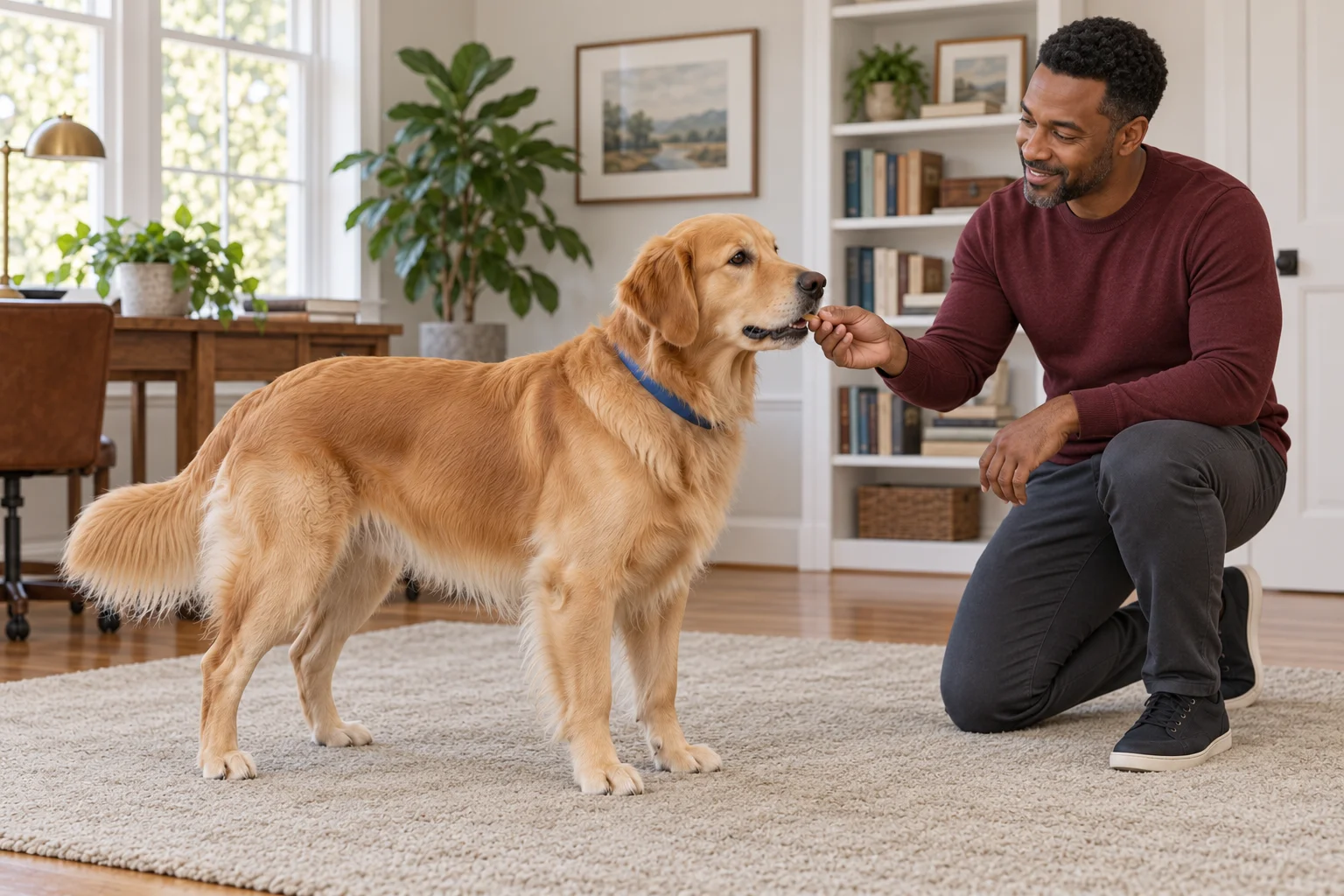
Give the treat while your dog is still standing
Right after "yes," give the treat from your lure hand, at your dog's nose, while they are still standing on the mat. Keep your hand where it stopped. If you push the treat farther toward you or lift it high, your dog will step forward or rear up to reach it.
The AKC points out that the treat needs to arrive while your dog is standing. If you only give it after they sit back down or wander off, you reward the wrong thing.
If your dog takes a step toward you just as you say "yes," give the treat anyway. "Yes" is a promise of food, and keeping that promise is what makes the word useful. On the next try, move your hand a shorter distance and say "yes" a little earlier.
Let your dog settle again before the next try
Once your dog has eaten the treat, that try is finished. There is no release word, because you are not asking your dog to stay standing. They can sit, lie down, sniff or walk off.
For the next try, your dog needs to be sitting or lying down again. If they settle back down on their own, wait for that. If they know a sit or down cue and do it comfortably, you can ask for it, say "yes" and give a treat for that too. Then run the next stand the same way.
Getting up and down repeatedly is physical work. A handful of tries is enough for one session. Stop while your dog is still keen, and stop straight away if they start to get up more slowly.
One complete try looks like this:
- Your dog is sitting or lying down comfortably on the mat, facing you.
- Your hand moves slowly from their nose toward you and stops as they begin to rise.
- They get up onto all four feet and you say "yes" before they step forward.
- They eat the treat at their nose while standing.
- They settle back into a sit or down, either on their own or with a cue they already find comfortable.
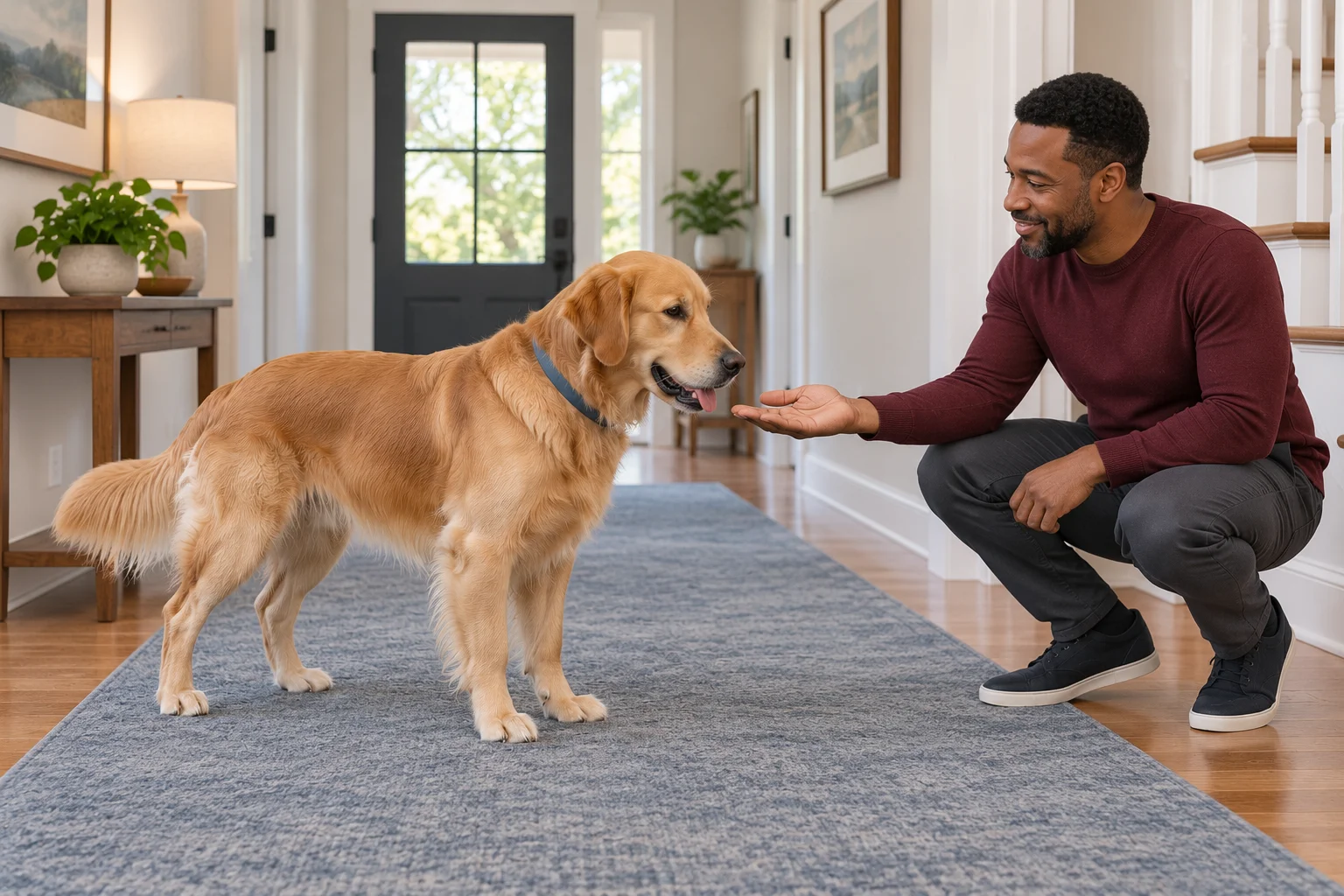
Ask for a stand with an empty hand
Once your dog gets up smoothly as your hand moves, without walking forward, on most tries in a session, you are ready to hide the food.
Hold a treat in your other hand, down by your hip. Make exactly the same movement with your luring hand, now empty: from your dog's nose, straight toward you, at nose height. When they are standing, say "yes" and bring the treat from your other hand to their nose while they are still standing. The AKC describes this change, with the treat already waiting in your other hand.
The food has not gone away. It still arrives after every "yes," but it comes from your other hand instead of leading your dog up. Your empty hand has become a hand signal.
If your dog only stares at your empty hand, Battersea suggests tucking a treat between your palm and thumb for a few tries, then going back to an empty hand. The smell helps, and your hand looks the same.
Add the word "stand"
Wait until your dog gets up readily for the empty-hand signal before you add the spoken cue. If you say "stand" while they are still working out what you want, the word gets attached to guessing.
When you are ready, say "stand" once in an ordinary voice. Pause for about a second, then give the hand signal. The order is always the word first, then your hand. When your dog is standing, say "yes" and give the treat at their nose.
Over many repetitions, your dog learns that the word comes just before the signal. Many dogs start to get up as soon as they hear "stand." When that happens, reward generously.
To check the word on its own, Battersea suggests saying "stand," waiting about three seconds, then giving the hand signal if your dog has not moved. Reward the stand either way. Over time, you can wait a little longer before helping. Avoid repeating the word, because your dog learns that the first few times do not matter.
Use fewer treats once your dog stands on the word
Two different changes happen to the food, and it helps to keep them apart.
The first is hiding the lure, which you have already done. Your dog stopped seeing a treat in your hand before they got up, but still got one every time you said "yes."
The second is handing out food less often. Leave this until your dog stands promptly when you say the word, in more than one room. Even then, change it gradually.
Give a treat every time you say "yes." Your dog has learned that "yes" means food is coming. Saying it without following through teaches them that the word means nothing.
To use fewer treats, change what you say rather than what "yes" means. On some stands, skip "yes" and give relaxed praise instead, such as "good dog." On others, say "yes" and give a treat as usual. Battersea suggests praising every stand but saving treats for the quicker ones, and giving treats more often again in distracting places. Preventive Vet suggests mixing in praise and everyday rewards.
Do not stop food suddenly as a test. Go back to "yes" and a treat for every stand whenever you practice somewhere new or harder.
Fix common stand problems
Your dog walks forward after your hand
Your hand is moving too far or too fast. Move it a shorter distance, more slowly, and keep it still once your dog starts to rise. Say "yes" the instant all four feet are under them.
For example, a young adult dog sitting on a kitchen floor follows the treat, gets up and trots three paces to her owner's knees every time. Her owner puts a non-slip mat down and sits on the floor at the edge of it, so the dog's nose is close to her hand. She moves the treat only a hand's width and stops. The dog rises onto all four feet and pauses, and the owner says "yes" and gives the treat right at her nose. The owner keeps this shorter movement for the rest of the session before trying the empty hand.
Your dog stays sitting or lying down
The treat may not be interesting enough, or your hand may be too high or too far away to pull their nose forward. Start with your hand right at their nose and move it straight out at nose height. The AKC suggests trying a tastier treat, or starting from a down if your dog is reluctant to leave a sit. Only start from a down if your dog lies down comfortably.
If your dog still does not get up, consider whether getting up is uncomfortable for them before you try anything else.
Your dog won't follow your hand
Some dogs seem worried by a hand moving toward their face. Once you are confident discomfort is not the reason, you can wait for a stand instead of guiding one. The AKC describes marking and rewarding stands a dog offers on their own. When your dog gets up from resting near you, say "yes" and give a treat at their nose while they are standing. Once they start getting up more often near you, say "stand" just before you expect them to rise, then mark and reward.
Your dog only stands when they can see food
Go back to the empty hand, with the treat in your other hand by your hip. Keep giving a treat after every "yes," so your dog learns that food still comes.
Stop practice if getting up may hurt
A dog who is slow to get up, or gets up in an unusual way, may be uncomfortable. VCA Animal Hospitals' guide to signs of pain in dogs lists several signs linked to standing and getting up:
- Groaning or grunting when standing up or lying down.
- Reluctance to get up once lying down.
- Trembling in the legs, particularly the back legs.
- Pulling up to a stand with the front legs rather than pushing up with the back legs.
- Standing with the front legs tucked back under the chest, which may take weight off sore hips or back legs.
VCA advises bringing changes like these to your veterinarian. Stop practicing the stand and contact your vet if you notice any of them, or if your dog starts getting up more slowly than before. Do not resume until your vet has advised you.
Standing is not automatically the safe choice for a dog who struggles with sitting or lying down. Getting up and holding a stand both use the legs, hips and back, and your vet is the right person to say which positions suit your dog. Do not use tastier treats to get your dog past a movement that may hurt. Taking food does not prove a dog is comfortable.
The same reward-based standard applies to every dog. The AVSAB position statement on humane dog training recommends reward-based methods for all dog training, says a dog should always be able to opt out of training, and lists forceful manipulation among the techniques to avoid. Never lift your dog up by the belly, pull on their collar or push them into a stand.
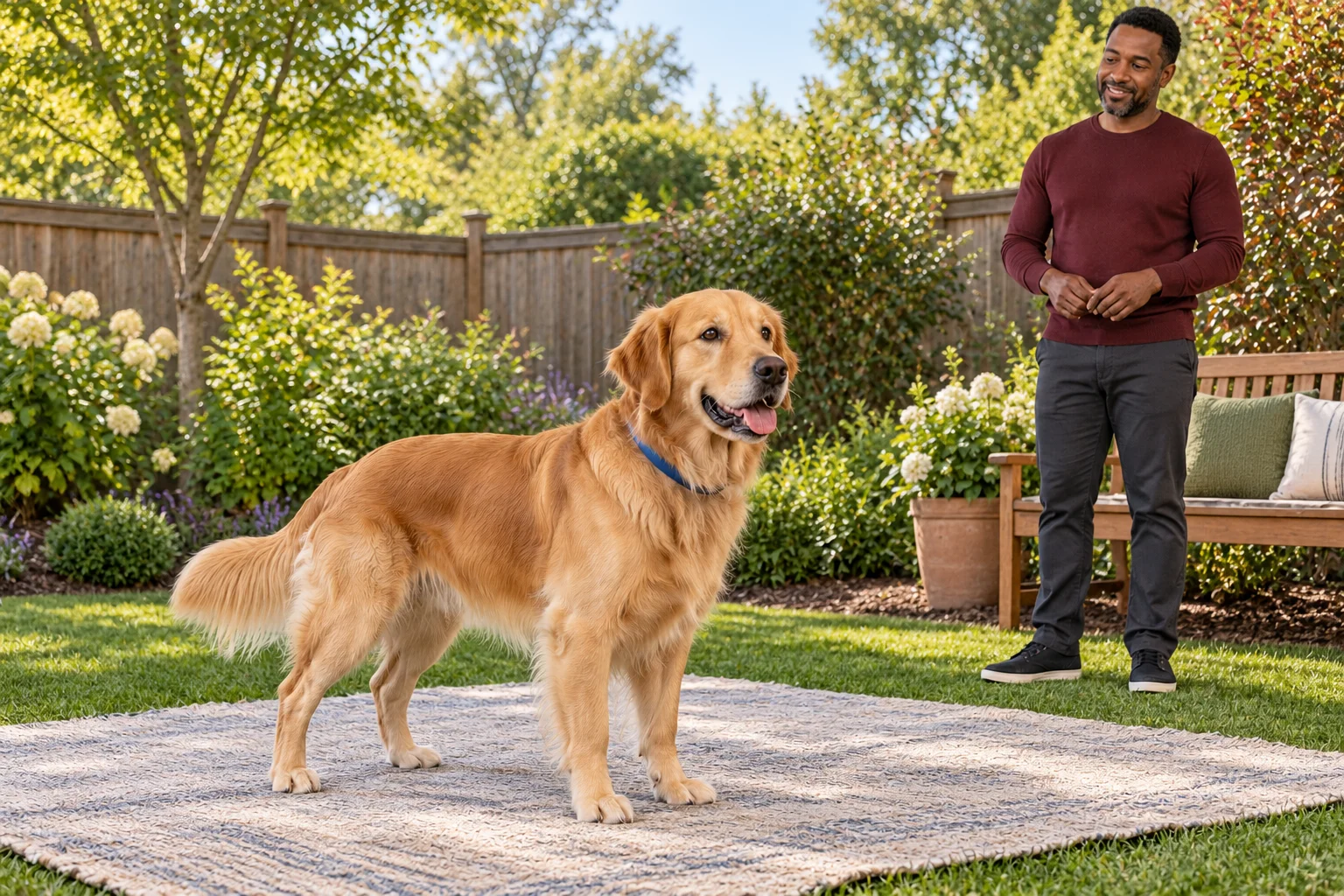
Practice stand in new places
Your dog may need help recognizing the cue in another room or outdoors, even when they respond readily on the living room rug.
When you change places, make the exercise easier again. Use the hand signal with the word, say "yes" and give a treat for every stand, and keep the session short. Try another quiet room first, then the yard, then a quiet spot outdoors with your dog on a leash if the area is not securely fenced. If your dog cannot get up on cue somewhere busy, move farther from the distraction or go back to a quieter spot. The guide to why your dog listens at home but not outside explains this in more detail.
You may want to use the stand where you brush or towel off your dog. That can help, but asking for a stand does not teach your dog to accept the brush or paw wiping with a towel. Keep those as separate, short practice sessions using the handling guides mentioned earlier, and let your dog move away if they want to.
For your next session, start with the easiest version your dog can do comfortably. If they still need the treat lure, practice that on the mat in a quiet room. If the lure is easy, try a few stands with an empty hand and the treat in your other hand. If the empty hand is easy, say "stand" once and pause before you move your hand.