
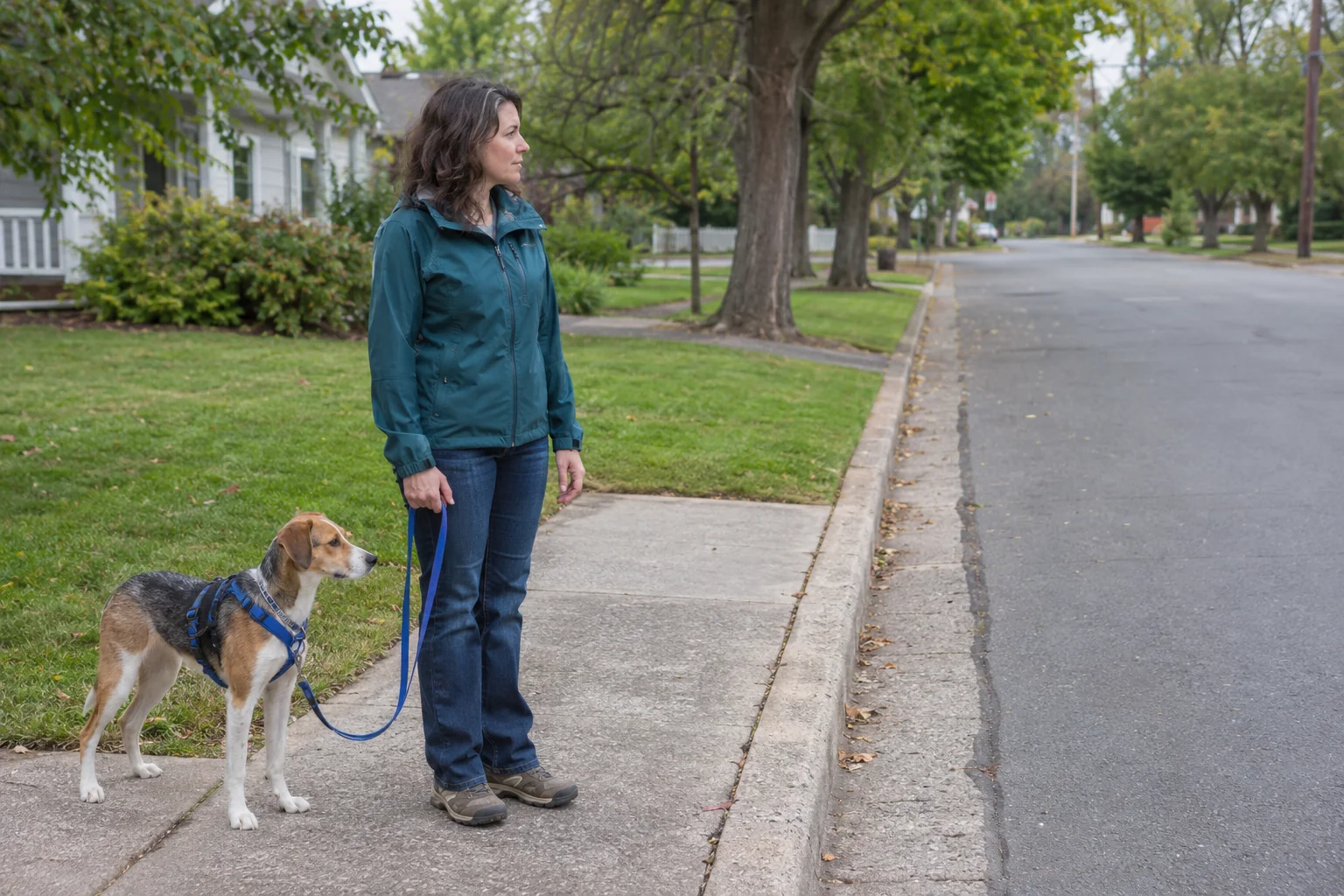
A curb wait is a calm stop on the sidewalk, one pace back from the edge, while you check the road. Your dog stays on a leash the whole time, and you decide when it is safe to cross. The wait doesn't teach your dog road safety, and it doesn't replace the leash or your own traffic check. It simply gives you a few calm seconds to look before you both step off together.
To start, you need a fixed-length leash, a harness or collar your dog already wears comfortably, small treats and a quiet sidewalk with no traffic nearby. Walk a few paces, then stop. The moment your dog stops beside you, give a treat at your side. Then say your release cue, such as "let's go", and walk on.
If your dog pulls hard, lunges or seems frightened near traffic, don't practice at the curb. Move to a quieter place well away from the road, and see "Check whether curb practice suits your dog right now" before you begin.
Check whether curb practice suits your dog right now
Curb practice needs a dog who can walk calmly on a leash near a road. Some dogs need other help first.
Practice somewhere quieter, away from the road, and get help if your dog:
- Pulls hard toward the road, other dogs, people or moving vehicles. Our guide to loose leash walking covers walking without pulling.
- Barks, lunges or stares at cars, bikes, other dogs or people. Our guide on what to do when your dog barks at other dogs on walks covers giving space on walks.
- Trembles, freezes, tucks their tail, tries to turn back or won't take treats near traffic. That suggests fear rather than a training gap. Our guide on when to seek professional behavior help explains when to involve a qualified professional.
If your dog seems stiff, sore or reluctant to sit or lie down, don't ask for a sit at curbs. A standing stop works just as well. Talk to your vet if your dog's movement has changed.
Keep children from holding the leash at curbs. An adult should handle the leash and make every crossing decision.
Keep your dog on leash and make every crossing decision yourself
The curb wait is a pause, not a safety system. Your dog can't judge traffic, and no amount of practice changes that. The American Kennel Club's guide to city life with your dog describes the "wait" cue as teaching a dog to stay in place until given permission to proceed. The permission always comes from you.
Make these rules part of every crossing:
- Your dog stays on a fixed-length leash near roads. Retractable leashes let a dog reach the road before you can react.
- You check for traffic yourself before every crossing, even when your dog waits perfectly.
- You cross together. Don't leave your dog waiting on the curb while you step into the road.
- You never use the wait off leash near traffic.
The AKC guide also notes that it's much harder to spot dangers when your dog is several feet away at the end of the leash. Keep your dog close beside you on a short, loose leash near curbs.
Set up your leash, treats and position
Choose equipment your dog already wears comfortably, such as a well-fitted harness or flat collar. Our guide to getting your dog used to a harness can help. Avoid choke, prong and shock collars.
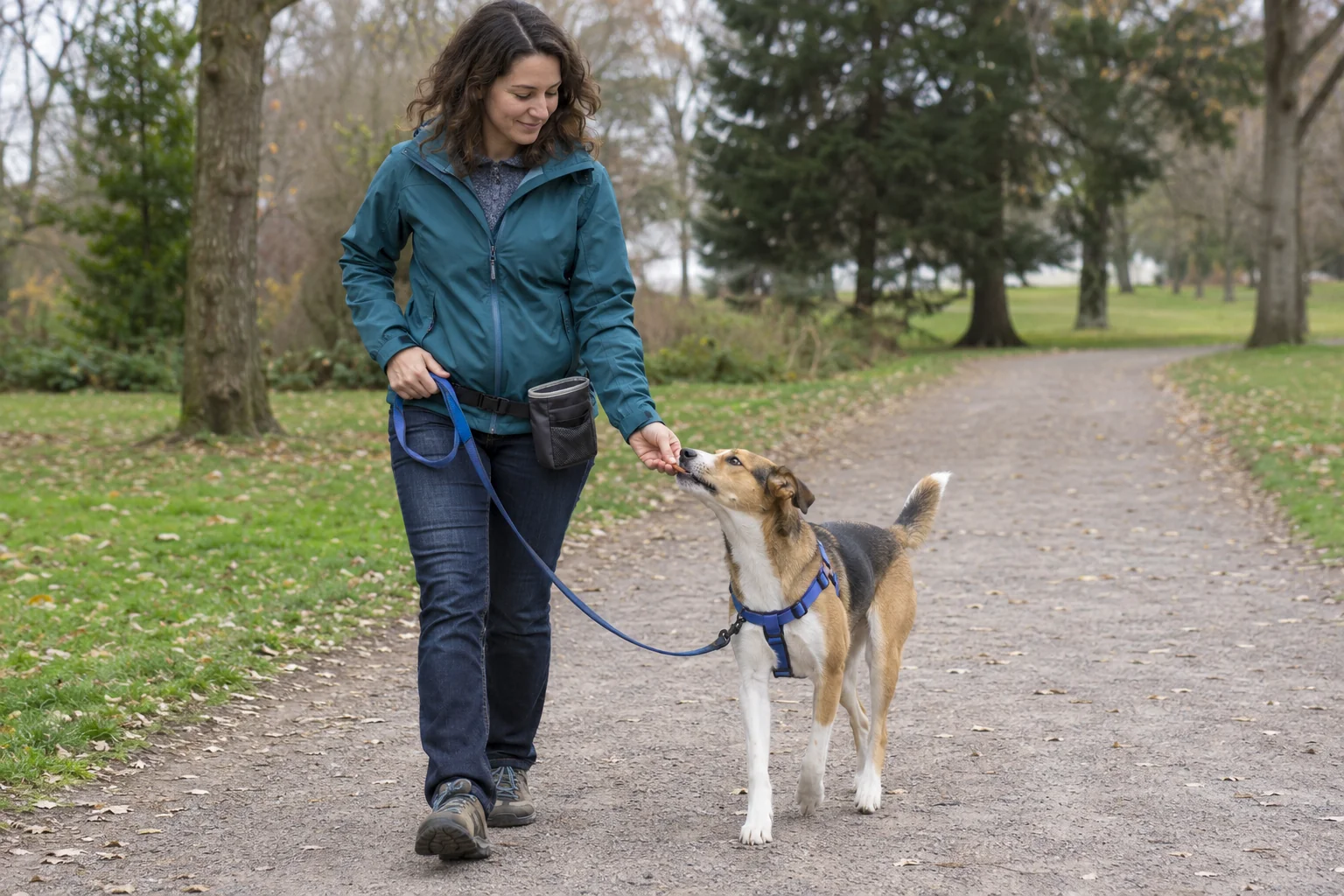
Use small, soft treats your dog really likes. Keep them in a pouch at your waist, on the same side as your dog. Our guide to choosing training rewards explains how to pick ones that work outdoors.
This article uses the dog on your left as the example. Reverse the sides if your dog walks on your right.
- Leash hand: the Calgary Humane Society's loose leash walking handout suggests holding the leash on the opposite side of your body from your dog and anchoring your leash hand at your hip. Here, that is your right hand at your right hip, with the leash crossing loosely in front of you.
- Treat hand: your left hand, nearest your dog, takes treats from the pouch.
- Treat delivery: bring the treat directly to your dog's mouth at your side. A guide-dog school, Pilot Dogs, explains in its handout on positive reinforcement that delivering food straight to the dog's mouth keeps the head facing forward, while missing it can make the dog curl in front of you. At a curb, that matters, because your dog stays beside you rather than drifting toward the road. Never toss treats toward the road.
Plan a practice route before you start
Pick a route you can walk without hurrying, with:
- A quiet path or sidewalk away from the road for the first stops.
- One or two residential corners with little traffic.
- A time of day when your street is quiet, such as midmorning on a weekday.
Keep practice short and part of an ordinary walk, so your dog still gets to sniff and explore. A few good stops on one walk are more useful than a long session.
Practice stopping on a quiet sidewalk first
Begin on a quiet sidewalk or path well away from the curb and from traffic, such as a park path or a quiet footpath.
- Walk a few paces with the leash loose.
- Slow down over a couple of paces, then stop. Keep your right hand still at your hip. Don't pull back on the leash.
- Wait. When your dog stops beside you with the leash still loose, bring a treat to their mouth with your left hand.
- Say "let's go" once, and walk on.
Your dog can stand or sit; either counts as a stop. The Calgary handout describes asking for a sit each time you stop, so that your dog starts to sit without being asked, and the AKC guide notes that an automatic sit can help a dog stop as soon as you do. If your dog sits on their own, reward it, but a calm standing stop is fine.
If your dog keeps walking, stay still with your leash hand at your hip, and wait for the leash to go slack. Then reward. Don't jerk the leash or keep stopping and starting.
Move on when your dog regularly slows and stops as you slow, without the leash tightening. Our guide to short dog training sessions has ideas for fitting practice into walks.
Practice at an edge away from traffic
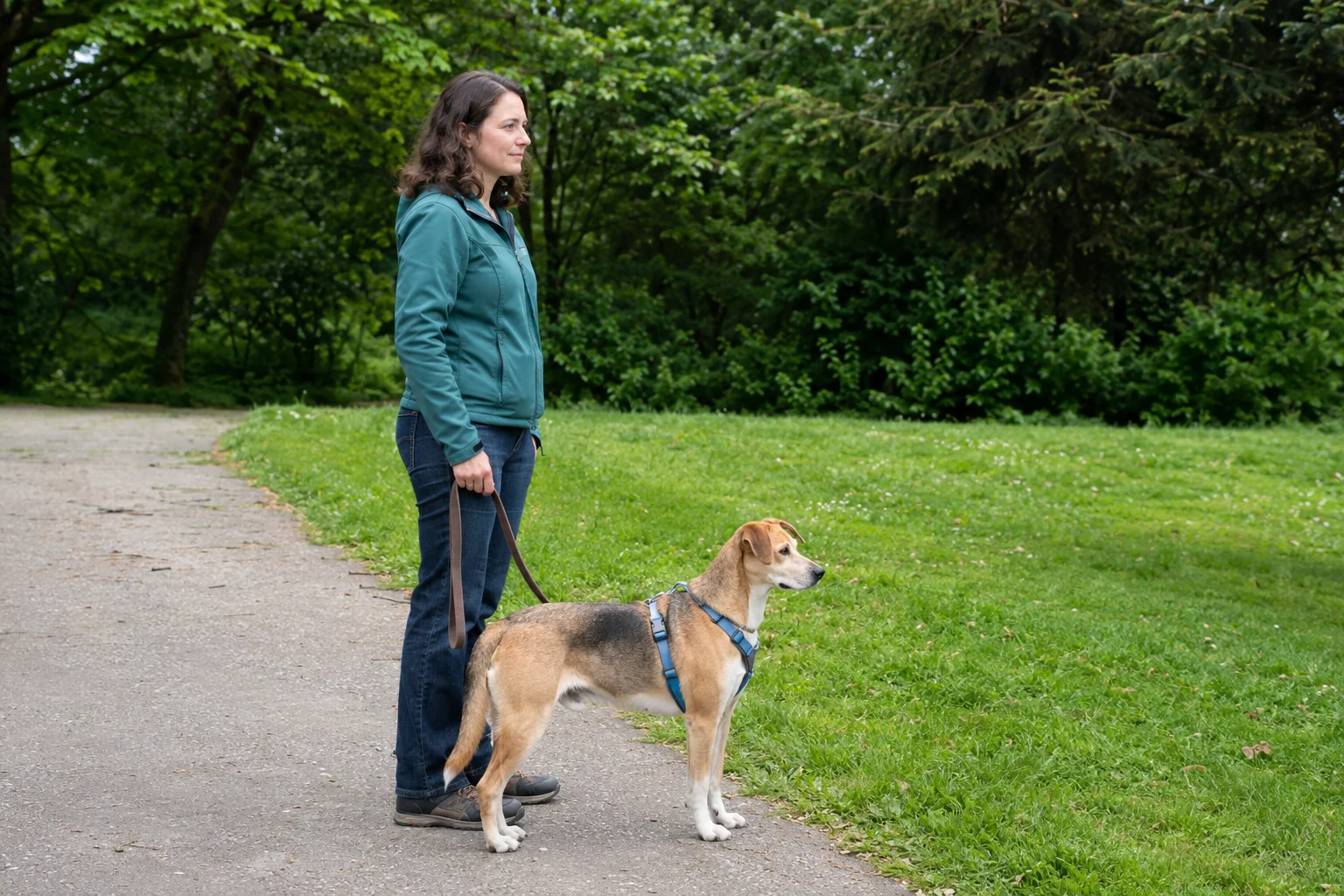
Before you go near a road, practice stopping where a path meets a different surface, such as where a park path meets grass, or at the top of a low step outside your home. These edges give your dog a clear place to stop without any traffic nearby.
Use the same pattern: slow down, stop a pace back from the edge, reward at your dog's mouth, then say "let's go" and walk on together. Move on when your dog starts slowing as you approach the edge, before you have fully stopped.
Choose where to cross
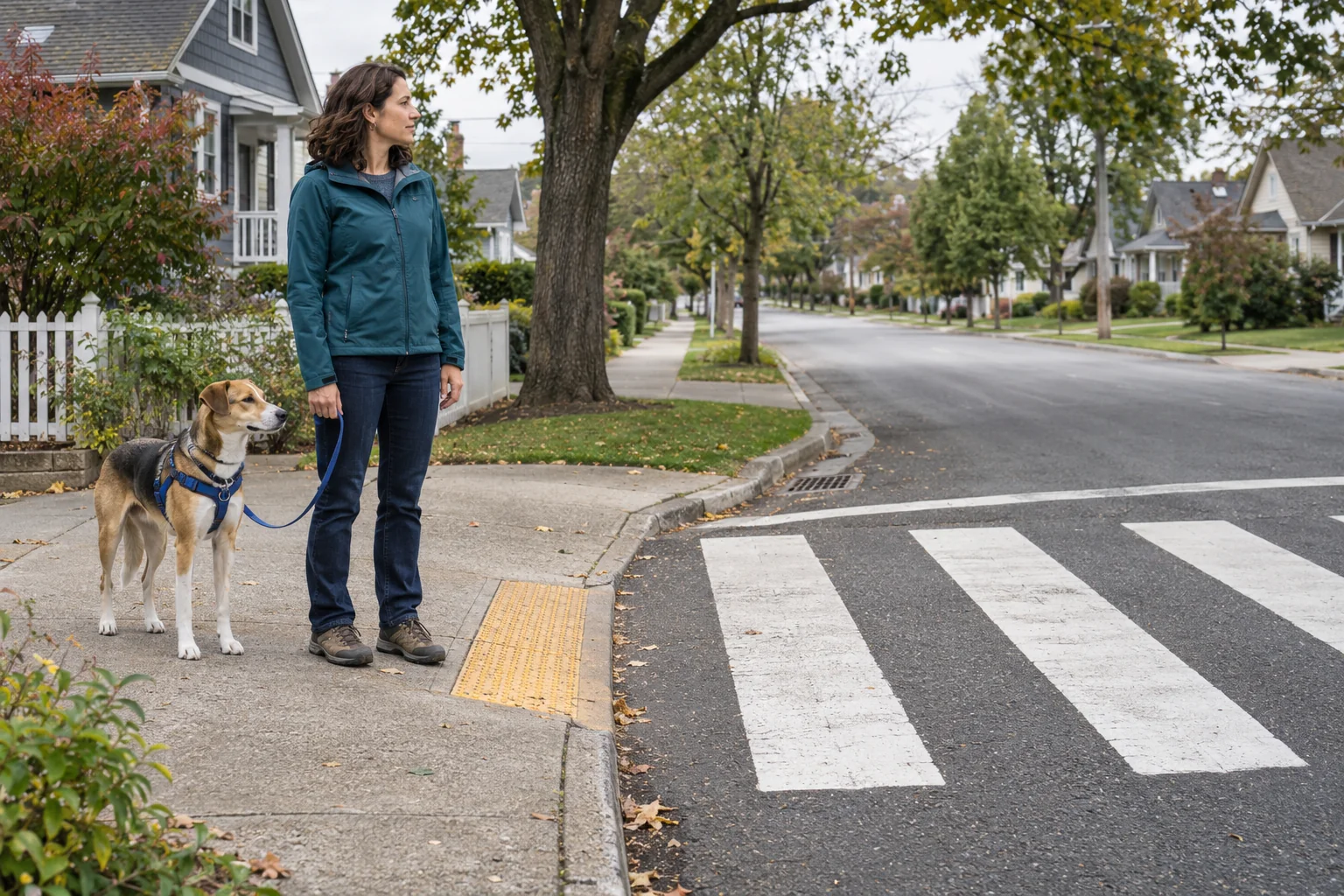
Where you cross matters as much as how your dog waits. NHTSA advises crossing at crosswalks or intersections. Where you can, choose crossings with:
- A clear view of traffic in both directions.
- Space on the sidewalk to stop a pace back from the edge without blocking other people.
- Pedestrian signals, if your area has them.
Avoid stepping out between parked cars, where drivers may not see you or your dog. When you walk along a street, keep your dog on the side away from the road where you can, so they are farther from passing traffic between crossings.
Check traffic the same way every time
Your traffic check is the most important part of every crossing. The National Highway Traffic Safety Administration's pedestrian safety page advises crossing at crosswalks or intersections and looking left-right-left for moving cars. It also advises waiting for a clear, complete stop before crossing, and watching for cars entering or exiting driveways or backing up in parking lots. NHTSA warns that some drivers may be distracted, and advises not stepping into the roadway until a driver has stopped.
While your dog waits:
- Look left, right and left again, and over your shoulder for turning vehicles.
- Watch for bikes, scooters and cars pulling out of driveways.
- Put your phone away.
- Make sure any driver who has stopped for you has actually stopped.
A walk signal doesn't replace your own check. NHTSA advises staying alert and checking signs, signals and the actions of drivers when you cross.
Only then say "let's go". If your dog is restless, it's tempting to rush. Wait anyway, and move a pace farther back from the curb if you need to.
Add a quiet curb with little traffic
Once your dog stops easily at edges on the path, practice at a quiet residential curb at a time with little or no traffic.
- Walk toward the curb with the leash loose.
- Begin slowing several paces before the edge, so you stop about one pace back from the curb. Your dog should stand on the sidewalk, not at the edge.
- When your dog stops beside you, give a treat at their mouth with your left hand. Pilot Dogs notes that its guide-dog handlers give a food reward at each curb stop at first.
- Check the road yourself, as described in "Check traffic the same way every time".
- When you have decided it is safe, say "let's go" once and step off together, walking rather than rushing.
Keep the leash short and loose as you cross, and keep looking for traffic. On the far side, walk on normally.
If your dog stops calmly at quiet curbs, you can add a word such as "wait" just as you begin to stop. Say it once. The stop itself is still what you reward.
Build up the wait and the setting gradually
Make one thing harder at a time.
- A longer wait: once your dog stops easily at quiet curbs, take an extra second or two to check traffic, and give a second treat at your dog's mouth during the wait if they stay calm.
- Busier streets: move to streets with occasional traffic, at quieter times of day. Stay a pace or two back from the edge.
- Different crossings: practice at corners, crosswalks and driveways, with different surfaces underfoot.
- New places: expect to make things easier again in a new neighborhood. Our guide on why your dog listens at home but not outside explains why.
Move on only when your dog stops beside you as you slow, keeps the leash loose and takes treats gently. If your dog stares at traffic, stops taking treats or starts pulling, go back to a quieter curb.
Once a dog stops consistently, Pilot Dogs describes moving from a food reward at every curb to occasional food rewards. Keep praising each calm stop, and keep using treats at busier or harder crossings.
For example, a young dog stops calmly at quiet corners but keeps stepping toward the edge when a bus goes past. His owner moves one pace farther back from the curb and gives a treat at his mouth as soon as he stops. She checks the road herself and crosses only when it is clear. Over the following walks, he starts stopping as she slows near that corner, and stays beside her with the leash loose as buses pass at that distance. If he had started trembling or pulling away from the road, she would have gone back to quieter streets and talked to a professional.
Use the curb wait on everyday walks
Stop the same way at every crossing, so your dog learns the pattern. Slow down early, stop a pace back from the edge, reward the stop, check traffic yourself and release with "let's go" when you have decided it's safe.
If you have already taught your dog to wait calmly at the door, the curb wait will feel familiar, but traffic makes it different. You stay with your dog, the leash stays on and you make every crossing decision.
Take extra care at night and in bad weather. NHTSA notes that pedestrians can be harder to see at night or in bad weather.
On days when your dog is especially excited, or the street is busier than usual, go back to easier crossings and stop farther from the edge. Some days are harder than others. If your dog can't manage the wait on a particular day, keep crossings safe by choosing quieter places to cross, holding the leash short and loose, and making every decision yourself.
Fix common curb wait problems
Your dog walks off the curb before you release them
Don't jerk your dog back. Keep your leash hand steady at your hip so your dog can't go any farther, and calmly walk back onto the sidewalk together. Next time, start slowing earlier and stop farther from the edge. Reward the stop sooner.
Your dog pulls toward the other side of the street
Something there may be more interesting than you. Stop farther from the curb, and only cross when your dog is beside you with a loose leash. If the pull is toward another dog, our guide on barking at other dogs on walks explains how to give space.
Your dog won't take treats near the road
Your dog may be worried or overexcited. Move to a quieter curb, or farther from the road, and practice there. If your dog seems frightened of traffic, talk to a qualified professional.
Your dog lunges at cars, bikes or scooters
Stop practicing at that curb. Move well away from the road, and keep walks on quieter routes for now. Our guide to the emergency U-turn explains how to turn away calmly. Lunging at vehicles needs individual help from a qualified professional.
Your dog stops but won't cross when you release them
Don't pull your dog into the road. Step back from the curb and pause. Your dog may be worried about traffic, the surface or something across the street, or may be sore. Try a quieter crossing, and if your dog often refuses or seems stiff, talk to your vet and a qualified professional.
Your dog rushes once you start crossing
Keep the leash short and loose, and walk at a steady pace. Practice the stop and release more on quiet curbs, rewarding your dog for walking beside you in the first few paces off the curb. Avoid crossing busy roads with a dog who rushes until this improves.
Cars come out of driveways on your route
NHTSA advises watching for cars entering or exiting driveways. Slow down and look before you pass a driveway, and use the same calm stop if a car is moving. Your dog doesn't need to wait at every driveway, but you should check each one.
Crossings are crowded and busy
Crowds can make it hard to stop a pace back from the edge. Practice at quieter crossings first, and choose quieter times on busy routes while your dog is learning. If you can't stop safely with space, wait farther back until the crowd thins.
Your dog can't hear your release cue
If your dog is deaf or hard of hearing, use a clear hand signal they already know as your release, given only when you have decided it is safe to cross.
Your dog sniffs or looks around during the wait
That's fine, as long as your dog stays beside you with the leash loose. Your dog doesn't need to stare at you; you are the one watching traffic.
Your dog barks or paws at you to get going
The wait may be too long for your dog right now. Make the waits shorter on quiet curbs, and give the treat sooner. Then build the time back up gradually.
Your dog won't sit on wet or cold ground
Let your dog stand. A calm standing stop is enough.
Your dog stops at every curb, even when you aren't crossing
That's fine. Reward the stop, then say "let's go" and walk on along the sidewalk.
You're walking with a stroller, children or another dog
Keep the crossing simple. Stop well back from the edge, and make sure every leash is in an adult's hand. Cross only when you can watch traffic and everyone you are with.