
When your dog grabs a slipper and dashes off, the most useful first move is usually to stop. Chasing tends to turn the theft into a game your dog wants to play again. Before you do anything else, though, check two things.
First, is the item dangerous? Batteries, medicine, string, socks, hair ties, chocolate or anything your dog might swallow or break apart need quick action and possibly your vet. If any of it may already have been eaten, call your vet now. The details are in "Check for danger and guarding before you do anything".
Second, does your dog look tense? If your dog stiffens, freezes, growls or starts gulping the item when you move, keep your distance and don't reach for the item or your dog.
If the item is safe and your dog is relaxed, stay where you are, turn side-on and toss a few treats on the floor past your dog, away from you. Wait until your dog has left the item and is comfortably away from it before calmly picking it up and putting it away. If your dog turns back, pause rather than hurry to grab it. For the long term, keep tempting things out of reach, give your dog plenty of their own things to carry and chew, and reward the choices you like before anything gets stolen, so a trade is an occasional way out rather than the main way to earn treats.
Check for danger and guarding before you do anything
If your dog may have swallowed something
Call your veterinarian for advice straight away if your dog has swallowed something or might have. That includes a piece torn off a larger item, and it includes a dog who seems completely fine. PetMD's guidance on swallowed objects, reviewed by a veterinarian, says to call your vet anyway, because some dangerous objects cause no immediate symptoms. It treats batteries as an emergency.
While you wait for advice:
- Don't make your dog vomit unless your vet tells you to. PetMD and Lort Smith Animal Hospital's foreign body guidance both warn that some items can cause more damage coming back up.
- If string, thread or cord is hanging from your dog's mouth, don't pull or cut it. PetMD warns that pulling can injure the digestive tract.
- Don't try to remove an object stuck in your dog's mouth. Lort Smith says this can cause internal injury.
- Pick up anything else your dog could swallow, so there is nothing more to grab.
Lort Smith lists vomiting, loss of appetite, abdominal pain, restlessness, drooling, weakness and straining to pass feces among the possible signs to report. If your dog is choking or struggling to breathe, go to an emergency vet now.
If your dog is holding something dangerous
If your dog is relaxed and still has the item in their mouth, get it back quickly without chasing. Stay where you are and toss your best treats on the floor past your dog, away from you, as the AKC suggests for dangerous items. Wait until your dog has left the item and is comfortably away from it before picking it up and putting it away. If your dog turns back, pause rather than hurry to grab it. Then call your vet if any of it could have been chewed off or eaten, or if it contained medicine, chocolate or another possible poison. If your dog guards it, follow "If your dog guards the item" instead.
If your dog guards the item
Some dogs run off with things because they want to keep them, and may defend them. The Dogs Trust guide to resource guarding lists early signs such as showing the whites of the eyes and lip licking, and more obvious ones such as a stiff or frozen posture, growling, snapping and biting. It also notes that some dogs guard by swallowing things quickly so they don't lose them.
If you see these signs:
- Move away and leave the item for now, if it is safe to do so.
- Don't reach toward your dog, corner them, scold a growl or test whether they will guard again.
- If the item is dangerous, keep your distance and toss treats away from you and your dog. As your dog moves toward them, toss more treats farther away. Dogs Trust says you may need your dog behind a closed door or baby gate before you can safely retrieve the item. Pick it up only after your dog has left it and is safely separated; if your dog turns back, pause rather than hurry. If you can't get it back safely, or any may have been eaten, call your vet now.
- If guarding is new, Dogs Trust advises a vet visit, since a sudden behavior change can have a medical cause.
The American Kennel Club's article on dogs who steal advises against practicing trades with a dog who already guards and suggests getting a professional's help instead. Our guide on when to seek professional behavior help explains what to look for.
Adults should handle every theft. Keep children from following the dog, trading or picking up dropped items.
Look for what happens before and after stealing
Watching what happens before and after a theft helps you choose what to change. These are possibilities, not diagnoses, and one dog can have more than one reason.
- An invitation to chase. Your dog grabs something, bows or bounces, looks back at you and waits for you to follow. The AKC article points out that chasing turns theft into a game dogs love.
- A way to get attention. Thefts cluster when you are on the phone, working or cooking. The AKC calls it an easy way to get your attention.
- Exploring and chewing. Items that smell of you, such as shoes and laundry, are especially interesting. Puppies may also chew whatever is within reach.
- Not enough to do. The AKC notes that bored dogs find their own entertainment, so a dog with little exercise or mental activity may go looking for something.
- Food smells. Tissues, wrappers and lunch bags attract scavengers.
- Guarding. Your dog wants to keep the item and shows the signs above when you come near.
- Worry. Some dogs run and hide with an item, then crouch, tuck their tail or turn away when someone approaches. This may follow past experiences of having things grabbed back or being told off. Treat it as fear rather than play: keep your distance, use the management below and get professional help if it continues.
The prevention below helps every dog. The incident handling in "Trade for a safe item without cornering your dog" is for relaxed dogs with safe items only.
Put tempting items out of reach
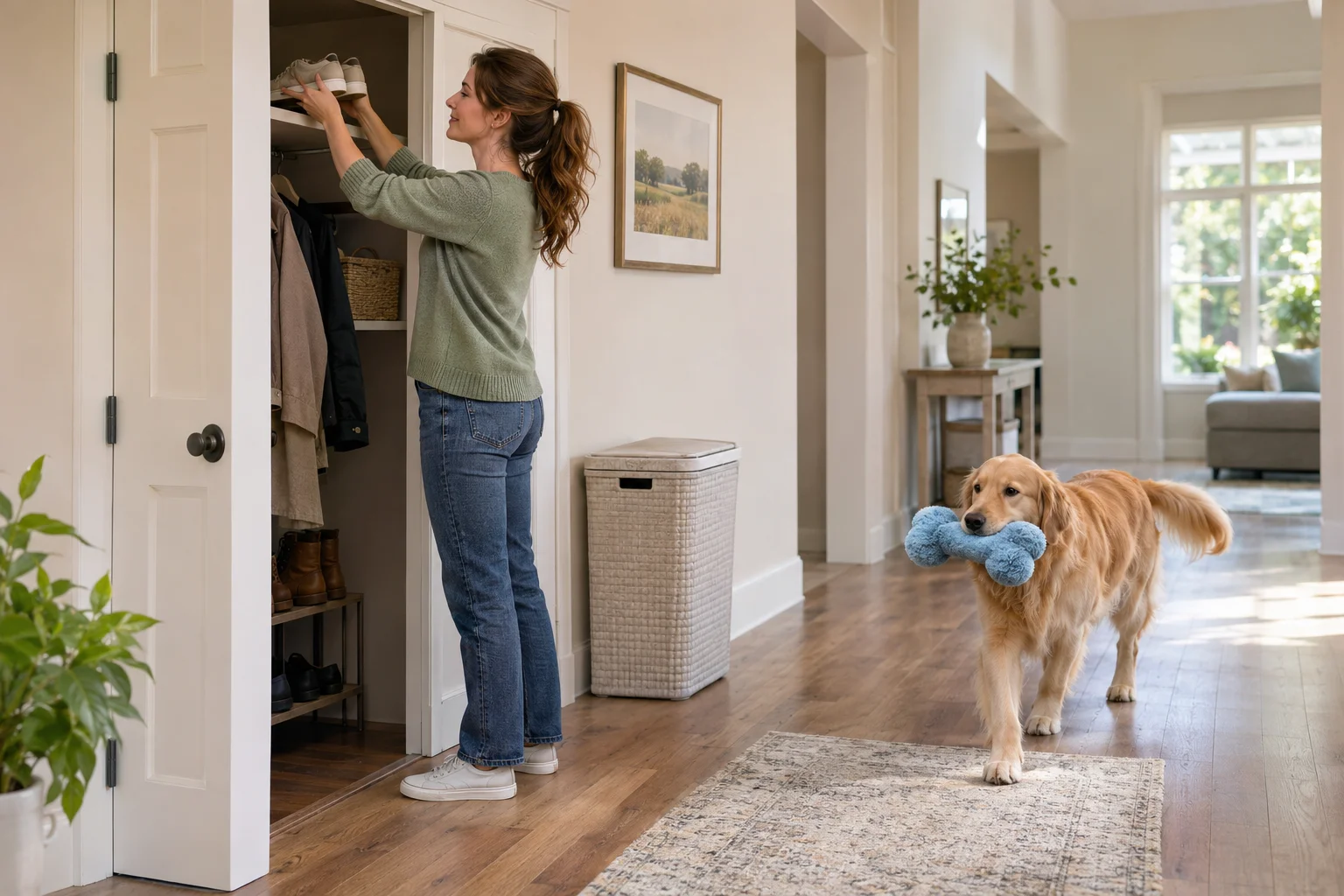
Every theft that doesn't happen is one less chance to practice the game. The AKC article suggests keeping shoes in the closet and putting lids on hampers and trash cans. Add anything your dog has taken before, plus small items that are easy to swallow: socks, hair ties, tissues, children's toys, chargers, remote controls and anything with batteries.
Check the places your dog can reach from a standing jump, such as low tables, the couch and the edge of the bed. If food is the target, our guide to counter surfing covers kitchen management.
When you can't watch your dog, keep them in a dog-proofed room, behind a baby gate or in a crate, as long as they are relaxed in that space. A barrier is not a good choice for a dog who becomes distressed behind it, so pick the arrangement that suits your dog. Our guide to management and training explains why prevention matters while you teach new habits.
As your dog learns to choose their own things, you can cautiously ease management around harmless objects while actively supervising. Keep batteries, medication, swallowable objects and other hazards permanently inaccessible; they are never tests of progress.
Give your dog things they're allowed to carry and chew
Many dogs like to carry, chew and show off objects. Offer suitable toys and chews so they have alternatives to your belongings.
- A variety of toys and edible chews. The AKC suggests rotating toys every week or two so they stay interesting. Choose chews sized for your dog, and supervise chewing until you know how your dog handles each one.
- A toy in every room. Pat Miller, writing for Whole Dog Journal, suggests keeping a favorite toy on a shelf in each room, ready for a toy trade.
- A carry toy by the door. Dogs who grab something whenever visitors arrive or you come home may settle for a soft toy left where they can reach it.
- Daily games. Short sessions of play, sniffing games and walks give your dog an outlet. Our find it game is an easy indoor option, and fetch gives retrieving dogs an appropriate way to carry things to you.
For puppies who mouth and chew everything, our guide to puppy chewing covers chew choices and teething.
Reward good choices before anything gets stolen
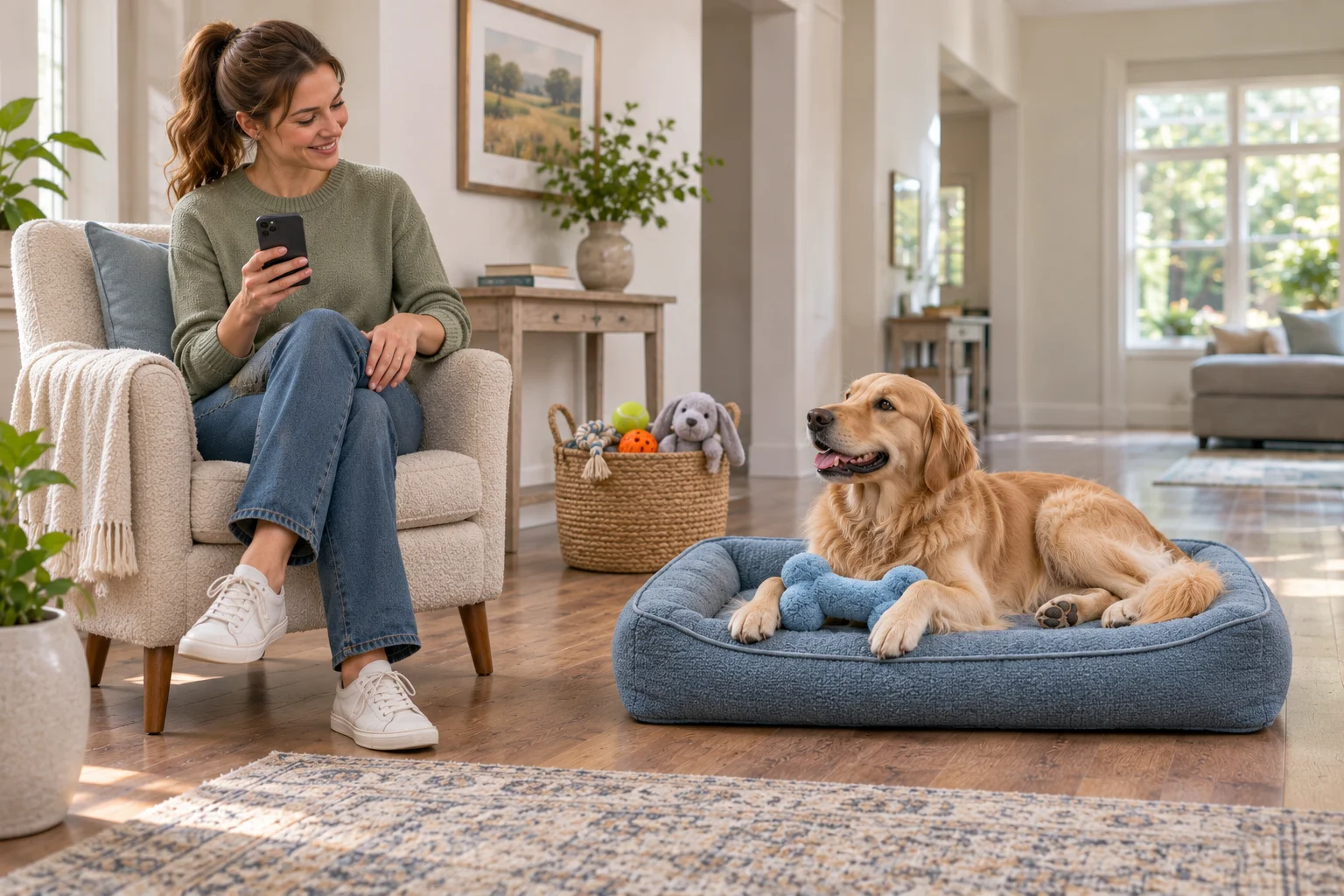
This part does the most to prevent a steal and trade habit. Your dog should earn far more from choosing their own things and leaving yours alone than from stealing.
Keep a small pot of treats somewhere you can reach easily, out of your dog's reach. Then watch for moments you can reward:
- Your dog picks up one of their own toys. Smile, praise them and join in with a short game, or toss a treat.
- Your dog sniffs your shoe and turns away. Toss a treat on the floor a short way from the shoe, so the reward arrives away from the item.
- Your dog lies down with a chew while you take a phone call. Walk over calmly and drop a treat beside them.
- Your dog brings you one of their own toys. Play with it, or swap it for a treat and then give it back, as the AKC suggests.
Time these rewards for when things are calm and nothing has been stolen. If your dog grabs things when you are busy, set up a chew or a toy before the call or the cooking starts, and reward your dog for staying with it.
A trained "leave it" cue helps your dog walk away from things before they pick them up. Our guide to the "leave it" command covers how to teach it. Practice it with ordinary items, not as a test of something your dog has guarded.
Stop chasing and keep your movements calm
When your dog has already grabbed something, stop where you are. Whole Dog Journal warns that chasing after your dog almost guarantees she will run away.
Stand still, turn your body side-on and keep your voice relaxed. Don't reach toward your dog, lean over them or step into their path. The AKC suggests acting as if the item doesn't matter, because for some dogs, the more you seem to want it, the more they want to keep it.
Then check the item and your dog:
- If the item is dangerous, or your dog shows guarding or worry, go back to "Check for danger and guarding before you do anything".
- If the item is safe and your dog is loose and wiggly or play-bowing, a calm trade is reasonable.
- If the item is safe and you don't need it right now, you can simply leave your dog with it and walk away. A slipper counts only if it meets all the safety conditions below and you can actively supervise; some dogs drop it once nobody reacts.
Count an item as safe only if it is too big to swallow, has no batteries, food or chemicals, and your dog isn't tearing pieces off it. If your dog starts chewing chunks off, it is no longer safe.
Trade for a safe item without cornering your dog
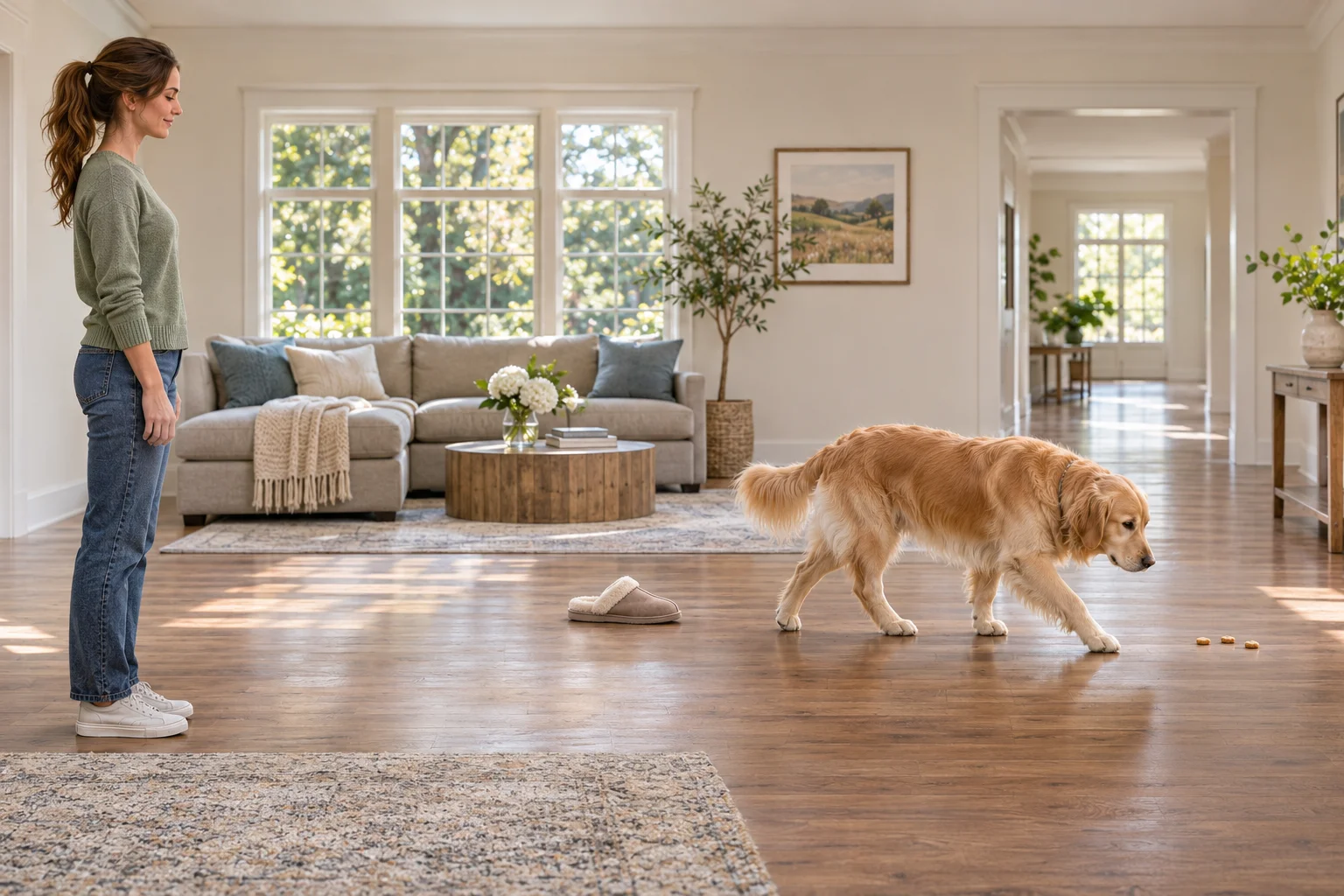
Keep your dog's escape route open throughout. Your dog should always have room to move away from you.
- Get your treats. Use small, tasty treats from your pocket, a pouch or the nearby pot. Something your dog values more than the item works best.
- Stay put. Remain a few feet away, side-on. If you need to move closer, take a slow step or two toward the side rather than straight at your dog, and stop if your dog stiffens or backs away.
- Toss treats past your dog. Throw a few treats on the floor beyond your dog, so they move away from you to eat them. Dogs Trust describes this, and Whole Dog Journal suggests dropping treats on the ground if your dog won't take one from your hand. Tossing treats keeps your hand away from your dog's mouth.
- Wait for the drop. Give your dog time to drop the item and go to the treats. Don't move toward the item while your dog is still standing over it.
- Retrieve only after your dog has left the item and is comfortably away from it. Walk to it calmly, pick it up and put it out of reach. If your dog turns back, pause rather than hurry to grab it. Wait for sufficient distance, or use a door or baby gate your dog is relaxed behind to separate them from the item before retrieving it; don't reach past your dog.
- Walk away without a lecture or a long fuss.
If your dog carries the item over to the treats and won't let go, don't reach for it. You can toss treats farther away, try a toy trade, or move toward the back door or the leash and cheerfully invite your dog outside. Whole Dog Journal suggests that kind of diversion but warns that you then need to follow through. If none of those works and the item is safe, leave it and try again in a few minutes.
If your dog takes the item under furniture or into their crate, don't reach in. Wait for your dog to come out on their own, as Whole Dog Journal advises, and then trade.
For a dog you don't need to trade with often, our guide to teaching drop it calmly builds a cue for releasing toys during ordinary play. It isn't a way to take things from a guarding dog.
Prevent repeated stealing for treats
Some dogs learn that stealing a sock is the fastest way to get chicken. Watch for a pattern: your dog grabs something, looks at you, waits for the treats and then grabs something else.
If that starts happening:
- Tighten management. Fewer chances to steal means fewer trades.
- Keep your response calm and low-fuss, but still use a reward your dog willingly trades for. Do not lower the reward to make stealing less worthwhile; prevent the next theft instead.
- Increase the rewards for good choices. Your dog should get many more treats and games for picking up their own toys and leaving yours than they ever get from a trade.
- Use non-food exits for safe items. Walking away, or leaving the room and closing the door behind you, if your dog is comfortable being left, can take the fun out of keep-away.
- Keep emergency trades. For a dangerous item, use your best treats every time, as described in "If your dog is holding something dangerous". Your dog's safety matters more than the pattern.
Fix common keep-away problems
Your dog grabs something every time you're busy
This often points to attention-seeking or boredom. Before you start a task, give your dog a chew or a stuffed toy and reward them for staying with it. Put tempting items away first. If thefts still cluster around busy times, add a short walk or game beforehand.
For example, a young dog keeps stealing slippers during work calls, play-bowing and looking back from the hallway. Her owner stops following her and tosses treats past her. She leaves the slipper and moves comfortably away to eat, so the owner calmly picks it up and puts it in the closet. If she turns back, the owner pauses instead of racing her to it. The owner then sets out a chew before every call and drops a treat beside the dog while she is lying with it. Over the following days, the dog takes the chew to her bed when the laptop opens, and slipper thefts become rare. If she had started grabbing things to get the treats, the owner would have kept the response low-fuss while retaining a reward she willingly trades for, moved the shoes out of reach and rewarded more choices made before a theft.
Your dog drops the item, eats the treats and grabs it again
Create enough distance before retrieving, rather than trying to beat your dog to the item. Toss treats farther past your dog and wait until they have left the item and are comfortably away. If they turn back, pause. If needed, use a closed door or baby gate your dog is relaxed behind for safe separation before picking it up; do not corner or restrain them. Then put the item out of reach so it can't be stolen again. Worry or guarding means stop and follow the safety boundaries above.
Your dog won't drop the item for food
Try a favorite toy, or start a game with a toy on the far side of the room. If the item is safe, walk away and leave your dog with it for a few minutes. Never pull the item, pry your dog's mouth open or turn it into a tug game. If the item may be dangerous and your dog still won't drop it, call your vet for advice.
Your dog stiffens or growls when you come near
Stop, step back and leave the item if it is safe. This is a guarding sign, not a training failure. Follow "If your dog guards the item", and get help from your vet and a qualified behavior professional before you practice any trades.
Your dog hides with the item and looks worried
Don't follow your dog into a hiding place. Leave them with a safe item and keep your distance, and use the management above to prevent more thefts. If your dog often looks worried or hides, talk to your vet and a qualified behavior professional.
Your dog grabs things when guests arrive
Excitement at the door can send some dogs looking for something to carry. Before visitors come, put shoes, bags and coats out of reach, and leave a soft carry toy near the door. Ask guests to put their belongings somewhere your dog can't get to. If your dog greets with their own toy, praise them and let them carry it. Ask guests not to chase or reach for stolen items. An adult can use the calm trade only if the item is safe and the dog remains relaxed, with room to move away. Wait until the dog has left the item and is comfortably away before retrieving; pause if they turn back. For danger, worry or guarding, follow "Check for danger and guarding before you do anything" instead.
Your dog chews or swallows part of the item
Follow "If your dog may have swallowed something" and call your vet, even if your dog seems fine.
Get help for guarding, fear or repeated swallowing
Contact your vet and a qualified reward-based behavior professional if your dog:
- Growls, snaps, stiffens or bites over stolen items, toys or food.
- Suddenly starts guarding or hiding things when they never did before.
- Seems frightened when approached with an item.
- Often swallows things, or keeps stealing despite consistent management.
- Lives with children or other people who can't reliably follow these precautions.
A professional can watch what happens in your home and build a plan that keeps everyone safe. Until then, keep tempting items out of reach, give your dog their own toys and chews, and reward the choices you want to see.