
If your dog snatches chicken bones, food wrappers and litter on walks, start with safety. If your dog may already have eaten something dangerous, such as a cooked bone, medicine or anything that could be poisonous, call your vet or an animal poison control line now, and don't make your dog vomit unless they tell you to. If your dog grabs things often or has started suddenly, a vet check comes before training.
For everyday walks, the most useful changes are management rather than willpower. Choose quieter routes and times, scan the ground ahead so you spot food before your dog does, and steer wide of it on a loose leash. Reward your dog for walking past at a distance they can manage, long before anything is in their mouth. Teach "leave it" at home first, and use a basket muzzle if your dog's scavenging is frequent or dangerous.
If your dog does pick something up, don't chase, yell, jerk the leash or pry their mouth open. Stop, toss a few treats onto clear ground a short way from your dog, away from you, and pick the item up once your dog has moved off to eat them. If your dog stiffens, growls or gulps the item when you come near, keep your distance and follow "If your dog guards what they find".
Check for danger and health problems first
If your dog may have swallowed something dangerous
Call your veterinarian for advice straight away if your dog has eaten, or may have eaten, a cooked bone, medicine, an unknown food or anything else that could be harmful. Call even if your dog seems fine.
If you think your dog has eaten something poisonous and can't reach your vet, the ASPCA Animal Poison Control Center is available 24 hours a day, 365 days a year at (888) 426-4435. The ASPCA notes that a consultation fee may apply. Keep the number in your phone before you need it.
Don't make your dog vomit unless your vet or poison control tells you to. The American Kennel Club's guide to dogs who eat chicken bones, which draws on an emergency veterinarian's advice, warns that making a dog vomit at home can cause a blocked or inflamed esophagus and aspiration pneumonia.
The AKC article lists these signs to watch for after a dog eats a bone: vomiting or regurgitation, drooling, hard swallowing, choking sounds, extending the neck, loss of appetite and diarrhea. Choking sounds can mean a blockage in the esophagus, which it describes as potentially life-threatening and needing immediate care, ideally at an emergency hospital. If your dog is choking or struggling to breathe, go to an emergency vet now.
If your dog guards what they find
Some dogs run off with a find, freeze over it, growl or swallow it faster when you come near. If you see this, keep the leash slack, stay as far back as the leash safely allows and don't reach toward your dog or their mouth. Toss treats well away from yourself, and only pick up the item once your dog has moved well away from it. If you can't get it back safely, or any of it may have been eaten, call your vet now.
Guarding needs a qualified reward-based professional, not trading practice on walks. Our guides to a dog who steals things and runs off and when to seek professional behavior help explain what to look for.
If you're not sure whether something was dangerous
You don't have to decide alone. If your dog ate something and you don't know what it was, or how harmful it might be, call your vet or poison control. Note what you think your dog ate, roughly how much and when, and keep any packaging or leftover pieces to show your vet, if you can pick them up safely. Don't wait for symptoms before you call.
If scavenging is frequent, sudden or includes non-food items
VCA's guide to pica in dogs, written by a veterinarian, describes pica as a dog persistently eating non-food items. It lists possible medical causes, including digestive conditions, intestinal parasites, anemia, poor nutrition, diabetes, Cushing's disease and some appetite-increasing medicines such as corticosteroids. It also warns that eating non-food items can cause blockages that may need surgery.
Book a vet check before training if your dog:
- Often eats non-food items such as stones, plastic, fabric or mulch.
- Has started scavenging much more than before, or seems constantly hungry.
- Has vomiting, diarrhea, weight loss, pale gums, weakness or a reduced appetite.
- Has started a new medicine around the time the scavenging increased.
VCA also notes that if medical causes are ruled out, your vet may refer you to a veterinary behaviorist. Don't change your dog's diet or meal sizes on your own to stop scavenging; ask your vet first.
Keep children from handling the leash in busy scavenging spots, and from trading with or reaching toward a dog who has something in their mouth. An adult should handle finds.
Get ready before you head out
A little preparation makes it easier to stay calm when your dog finds something.
- Fill a treat pouch with small, tasty treats your dog loves, so you have something better than the find.
- Use a fixed-length leash and the collar or harness your dog already wears comfortably.
- Carry a few poop bags, so you can pick up finds as well as waste.
- Save your vet's number, your nearest emergency vet and the poison control number in your phone.
- Bring your dog's basket muzzle if they already wear one comfortably.
- Plan a route with fewer hot spots, as described in "Choose routes and times with fewer temptations".
If other people walk your dog, such as family members, a dog walker or a pet sitter, share the plan with them. Ask them to keep the same leash and route habits, to trade rather than chase or pry, and to call you and your vet straight away if your dog eats something that could be harmful.
Choose routes and times with fewer temptations
Each find your dog reaches is a chance to practice scavenging, so fewer chances help.
Choose walks away from tempting areas where you can. Notice where your dog finds things, then plan around them. Common hot spots include sidewalks near restaurants and take-out places, bus stops, parks after picnics, schoolyards, and streets on trash collection day. Walking at quieter times of day can help too.
When you can't avoid a hot spot, walk through it with your full attention on the ground ahead and your dog on a fixed-length leash. A retractable leash gives your dog a long reach before you can react.
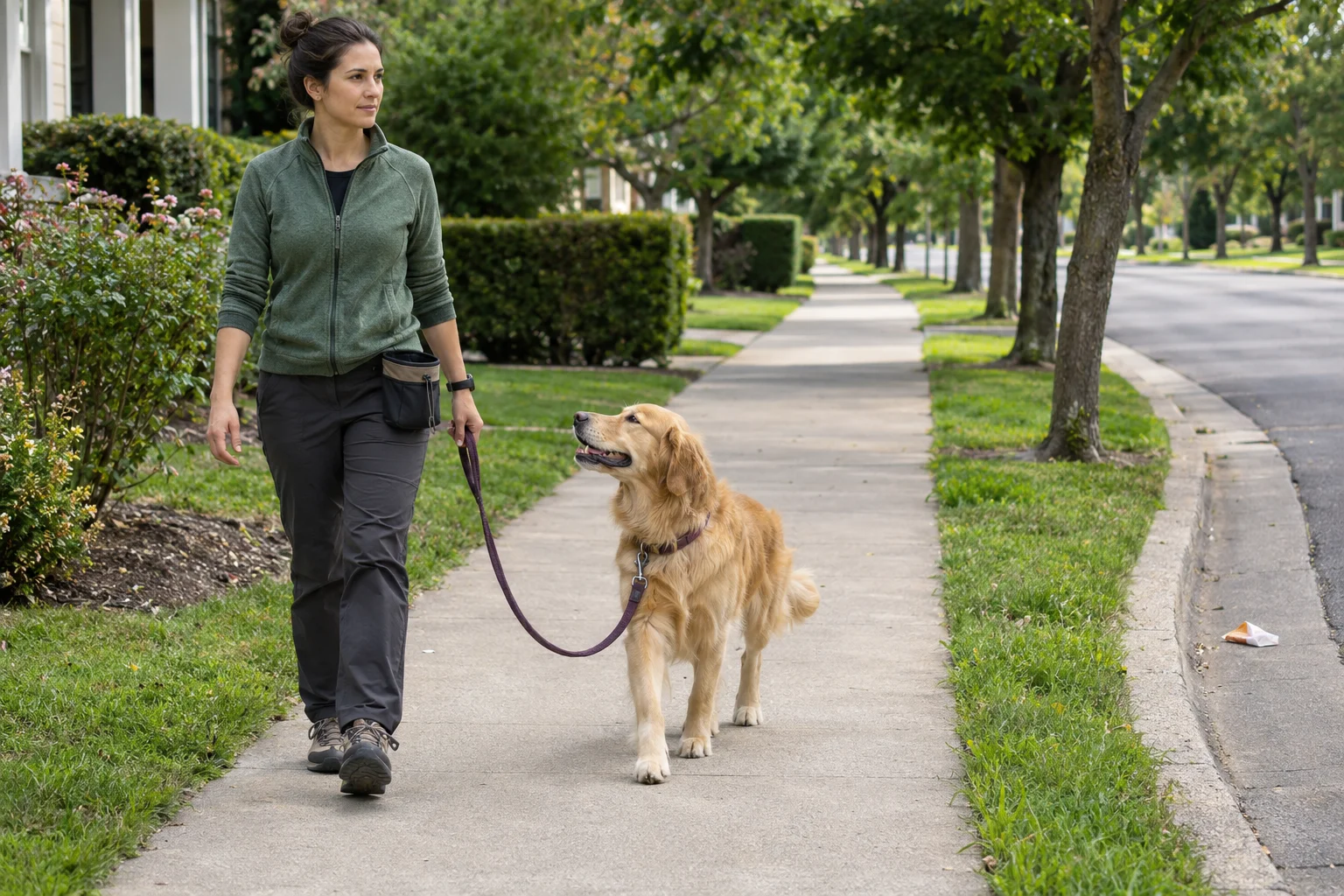
Hold the leash loosely and scan ahead
Hold the leash in one hand with a small, loose curve, at a length that keeps your dog on the path beside you. Keep your other hand free for treats from a pouch at your waist. Our guide to loose leash walking covers walking without pulling.
Look several yards ahead rather than at your dog. When you spot something tempting, act before your dog notices it:
- Shorten the leash smoothly by sliding your hand along it, so your dog can't reach the item. Do this calmly and early, so the leash stays loose rather than tightening suddenly.
- Steer wide of the item, crossing to the other side of the path or street only when it is safe.
- Turn and walk the other way if the item is too close to pass. Our guide to the emergency U-turn explains how to practice a smooth turn.
Avoid jerking or yanking the leash. Dr. Eileen Fatcheric, a veterinarian writing for Whole Dog Journal, notes that constant nagging or yanking a dog away won't stop them eating things, and yelling often makes a dog swallow their find as fast as possible.
Let your dog sniff in places where you can see the ground is clear. Sniffing is a normal part of a walk; the goal is to stop your dog eating things, not to stop them exploring.
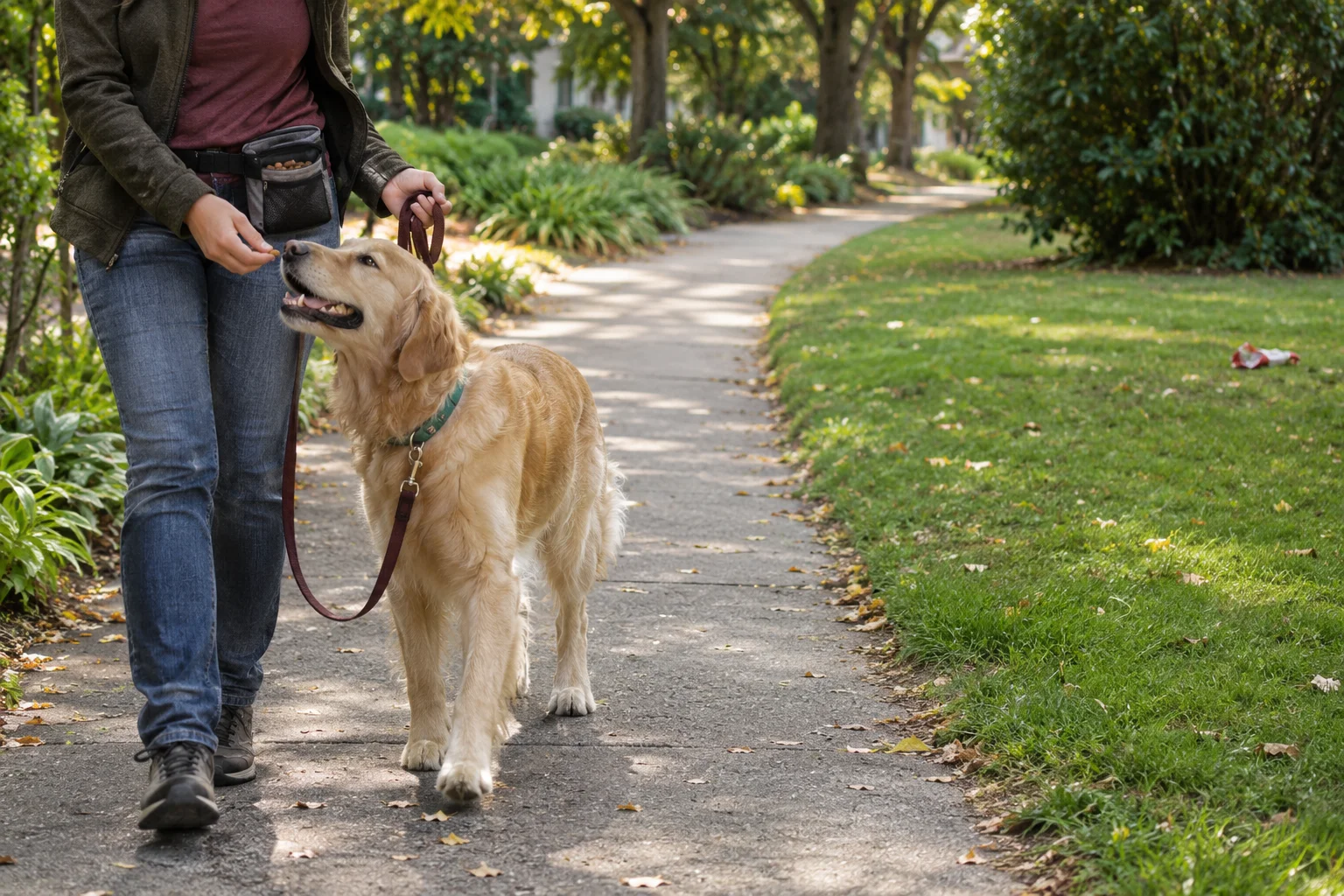
Reward your dog for walking past
This is the part that changes your dog's habits over time. Your dog should earn far more from walking past food with you than from finding it. Distance is what makes that possible: a dog who is close enough to smell a chicken bone may not be able to think about anything else, while the same dog a few yards farther away may happily take a treat and walk on.
- Spot the item first. Notice it while your dog hasn't seen it yet, or while they are still far enough away to look at you or take a treat.
- Keep your distance. Pass at a distance where your dog is still loose, listening and able to eat a treat. If your dog freezes, pulls hard toward the item or stops taking treats, you are too close; move farther away.
- Reward as you pass. Each time your dog glances at you or keeps walking with you, give a treat from your pouch beside your leg. You can also toss a treat a little way ahead of you, so your dog focuses on it instead of the ground. Only toss treats onto ground you can see is clear.
- Reward check-ins throughout the walk. Treat your dog for looking at you or walking beside you even when there is nothing tempting nearby, so checking in becomes a habit.
Use better treats outside than at home. Our guide to choosing training rewards can help. Make the distance smaller only when your dog stays relaxed and walks past easily at the current one. There is no set number of walks for this.
For example, a young dog keeps snatching chicken bones near a bus stop on his morning route. His owner switches to a quieter street for a few weeks and starts scanning the sidewalk ahead. When she sees a wrapper, she crosses the road early and gives him a treat each time he glances at her as they pass. One day he grabs a crust before she spots it. She stops, tosses three treats behind him and picks up the crust while he eats them. Over the following weeks he starts looking up at her as soon as he notices food on the ground, so she begins passing a little closer. Later, when he froze and stared hard at a bone on that street, she moved farther away and went back to the quieter route for a while.
Give your dog safe ways to search for food at home
Some dogs scavenge partly because searching for food is fun. Give that drive a safe outlet at home.
VCA's pica guide suggests feeding toys instead of bowls to encourage natural foraging. Slow feeders, snuffle mats and puzzle feeders all work this way. Our find it game gives your dog a safe way to search and sniff for treats. These work alongside walk management; they don't replace it.
Teach "leave it" at home before you use it outside
A "leave it" cue gives your dog a clear way to turn away from something before they pick it up. Whole Dog Journal advises starting leave-it practice in the house, because there are too many distractions outside, and rewarding with something tastier than the item your dog left. Our guide to the "leave it" command covers how to teach it.
Bring it outdoors gradually. Use it first with dull items at a comfortable distance, and only on items your dog hasn't already reached. Our guide on why your dog listens at home but not outside explains why outdoor practice starts easier.
Say the cue once. If your dog doesn't respond, don't repeat it louder or pull them away; move farther from the item and make the next attempt easier.
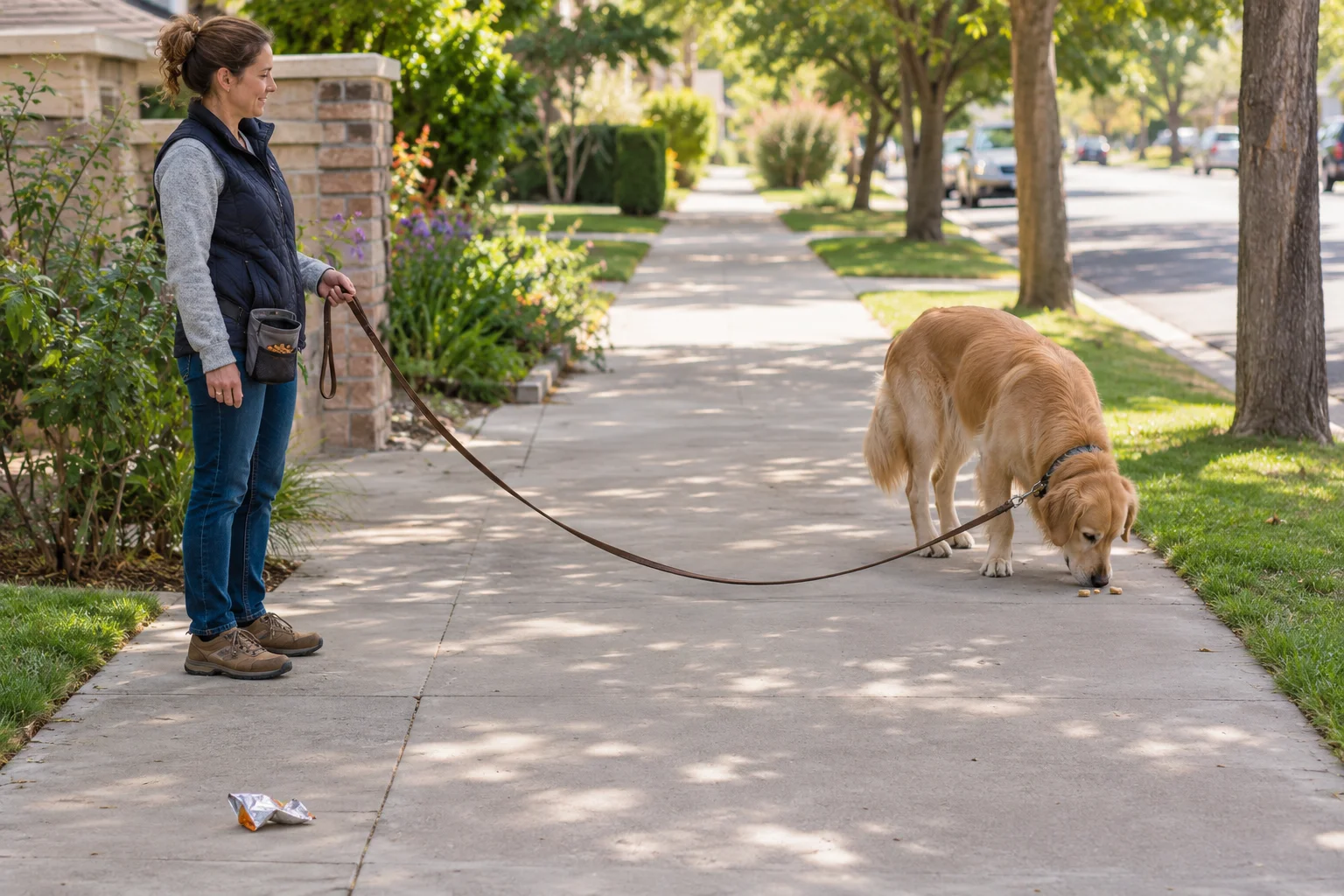
If your dog picks something up, trade safely
If your dog picks something up despite your best efforts:
- Stop and stay calm. Don't chase, yell or yank the leash. The AKC article warns that chasing or snatching can make a dog gulp the item down in one swallow.
- Keep the leash loose. Stay where you are and turn slightly side-on rather than leaning over your dog.
- Offer a trade. Toss a few tasty treats onto clear ground a short way from your dog, away from you. The AKC suggests offering something more tempting, then calmly removing the item once your dog swaps.
- Pick the item up once your dog has moved off to eat. Put it in a bag or a trash can out of reach.
- Walk on. Don't make a fuss.
Never pry your dog's mouth open or reach into it. If your dog won't drop the item and it could be harmful, call your vet. If it is harmless, such as a leaf, let it go and walk on.
If your dog gulps the item down before you can trade, follow "If your dog may have swallowed something dangerous". If they stiffen or growl, follow "If your dog guards what they find".
A drop it cue, practiced with toys at home, can make trades easier later. It isn't a way to take things from a guarding dog.
Use a basket muzzle for frequent or dangerous scavenging
For a dog who scavenges often, eats non-food items or has already needed vet treatment for something they ate, a muzzle can add safety while you train. VCA's pica guide notes that some dogs may need to be trained to wear basket muzzles.
Whole Dog Journal says basket muzzles are the only safe type for walks, because their loose fit and large openings let a dog pant, drink and take treats. Some basket muzzles have an optional guard that makes it harder to pick things up. Avoid snug fabric muzzles that hold the mouth closed.
Teach your dog to like wearing the muzzle before you need it on walks. Our guide to wearing a muzzle comfortably explains how. A muzzle doesn't replace watching your dog; some dogs may still nose or lick things through it, so keep scanning and rewarding as before. Take it off once you are home, and don't leave your dog alone in it.
If your dog vomits, retches or gags while wearing the muzzle, stop and take it off. The AVMA's pet first aid guide says not to muzzle a pet who is vomiting, and to keep your face away from your pet's mouth. Stand or kneel beside your dog and unclip the strap behind their head from the side, rather than leaning over their face. If your dog seems frightened, stiff or likely to snap, don't reach toward them. Keep the leash slack, stay beside them in a safe spot and call your vet straight away for advice. Call your vet about the vomiting too, especially if your dog may have eaten something. Practicing calm muzzle removal at home, as part of muzzle training, makes this easier if it ever happens.
Fix common scavenging problems
Your dog spots food before you do
Slow down in hot spots and look farther ahead. Choose a quieter route for a while, and keep your dog closer on the leash in places where finds are common.
Your dog won't take treats outside
Your dog is probably too close to the temptation or too excited. Move farther away, use a tastier treat and practice on quieter routes. If your dog won't eat even on quiet streets, they may be worried rather than distracted. Look for signs such as a tucked tail, a low body or trying to head home, and talk to a qualified professional if walks seem to worry your dog.
Your dog gulps things down as soon as you notice
Don't rush toward your dog or call out sharply. Watch for early clues that your dog has noticed something, such as a sudden change of pace or their nose going down, and steer away before your dog reaches the item. If your dog swallows dangerous things quickly, use a basket muzzle on walks and talk to your vet.
Your dog lunges toward food as you pass
You are too close for your dog right now. Keep the leash loose, avoid jerking it and move farther away, then reward your dog for walking on with you. Next time, steer wider earlier. If your dog also lunges or barks at people or other dogs, our guide on what to do when your dog barks at other dogs on walks covers that separately.
Your dog picks things up to get a trade
Some dogs learn that grabbing something earns a treat. Watch for a pattern of picking up an item, looking at you and waiting. If it starts, make trades low-key with a few ordinary treats, and give far more and better rewards for walking past things and checking in with you. Keep routes and leash length tight enough that grabbing is hard. For a dangerous item, still trade with your best treats; safety comes first.
Your dog grabs things off-leash at the park
Keep your dog on a leash, or on a long line attached to a harness, in places with litter or picnic leftovers. Our guide to using a long line safely explains how.
Your dog eats sticks or stones
Sticks and rocks are among the non-food items VCA's pica guide lists, and swallowed non-food items can cause blockages. Steer around them like any other find. If your dog eats stones, plastic or other non-food items often, see your vet, as described in "If scavenging is frequent, sudden or includes non-food items".
Your dog's scavenging suddenly gets worse
Treat a sudden change as a reason to see your vet before you change the training. Hunger, digestive problems and some medicines can all play a part, as described in "If scavenging is frequent, sudden or includes non-food items".